A shopper is waiting at your returns counter with an online receipt. Your associate can see the jacket, but not the payment, while your ecommerce team searches a different dashboard. If that sounds familiar, your next payments decision isn't just about adding another wallet. It's about making sure everyone can trace the money behind the same order.
Table of Contents
- What Omnichannel Payments Mean for Your Business
- Payment Features Every Channel Needs
- How One Order Record Ties Channels Together
- Measuring Authorization Performance by Channel
- Reconciling Splits, Refunds and Fees
- Balancing Checkout Speed With Fraud Controls
- Map Your Channels Before You Choose a Platform
What Omnichannel Payments Mean for Your Business
Omnichannel payment solutions provide a shared payment layer so web, mobile, point-of-sale (POS), B2B and subscription sales can use consistent customer identities, payment preferences, transaction records and refund rules. The important word is shared. Accepting payments in several places doesn't automatically connect what happens in those places.
Think of a bank account with several debit cards. Each card offers a different way to spend, but every transaction posts to the same ledger. Separate payment systems are more like separate passbooks, with employees transferring information between them whenever a customer crosses channels.
Follow the jacket, not the channel
Say a shopper buys a jacket online, collects it in store and later requests a refund at another location. If each channel keeps its own payment record, the associate might find the product without finding the original tender or knowing whether another refund is already pending.
A connected system lets the associate retrieve the purchase and initiate the permitted refund without recreating the sale. The customer doesn't need to understand your processor accounts or internal department boundaries.
The hub model illustrates how different buying environments connect to a common payment system.
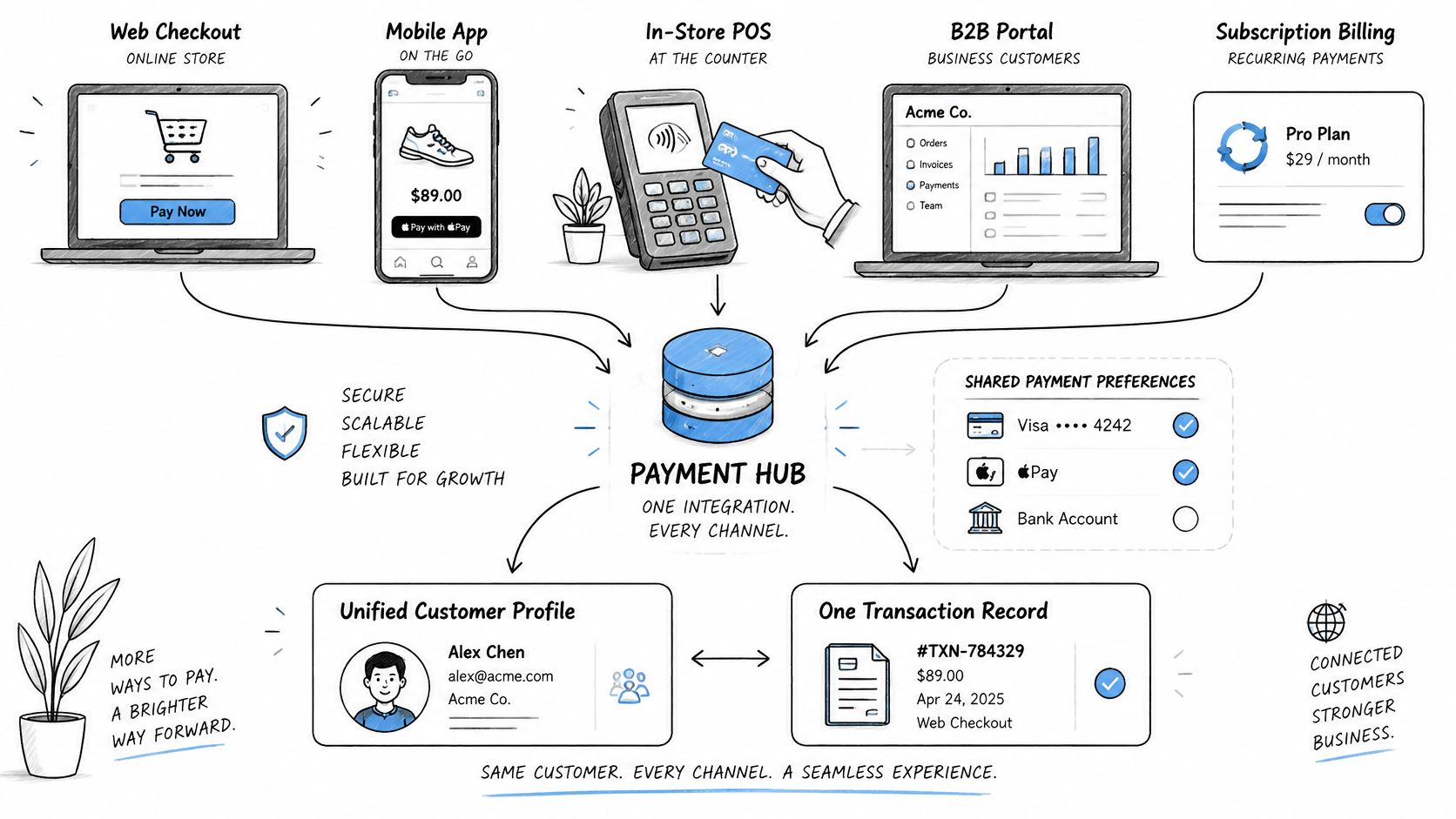
This matters beyond ecommerce: Worldpay's 2025 Global Payments Report found that digital payment methods accounted for 66% of global ecommerce transaction value and 38% of point-of-sale spending in 2024. Supporting digital payments therefore means planning for physical locations, not just website checkout.
A phone can also connect those environments. RecurX's guide to omnichannel checkout using QR codes is useful when evaluating how a physical interaction can lead into a digital payment flow. The operational requirement remains the same: the resulting transaction must stay attached to the purchase.
Quick test: Can a refund started in store reach the same order record that the online sale created?
If the answer involves copying a receipt into another system, you've found a gap worth investigating.
Payment Features Every Channel Needs
Judge an omnichannel solution by what works across channels, not by how many payment-method logos appear on its website. A long acceptance list won't help an associate who can't refund an online purchase.
Use this comparison as an operating specification, not an assumption that every provider supports every cell.
Required payment capabilities by channel
| Capability | Online | Store and POS | B2B and Subscriptions |
|---|---|---|---|
| Digital wallets | Apple Pay, Google Pay and PayPal at checkout and on product pages where supported | Tap-to-pay at the counter where the terminal supports it | Payment links on invoices; renewals require eligible saved credentials |
| Cards and stored credentials | Card entry in processor-hosted fields, without passing through the merchant server | Card-present EMV and contactless acceptance | Recurring charges against an authorized stored token |
| Split tender | Gift card plus card against one order | Cash plus card at the same register | Partial payment against one invoice |
| Partial capture and refunds | Capture shipped items and refund a single line | Refund to the original tender at the counter | Credit notes linked to the original invoice |
| Settlement and currency | Payouts to the brand's own account | Consistent settlement policies, with channel-specific timing and fees recorded | Multi-currency invoices where the processor supports them |
The wallet row needs careful interpretation. Apple Pay and Google Pay can support contactless in-person payment, but accepting PayPal online doesn't mean a standard card terminal accepts PayPal at the counter. Consistent service doesn't require identical interfaces. It requires clear acceptance rules and a connected purchase history.
Subscriptions introduce another distinction. A customer authorizing a wallet payment today hasn't necessarily authorized future off-session charges. Your checkout must collect the appropriate consent and use credentials supported for the renewal flow.
Turn capability gaps into requirements
- Unified customer identity: Recognize the shopper across supported touchpoints, while keeping account access and staff permissions controlled. An email match alone shouldn't grant unrestricted access to purchase history.
- A single order lifecycle: Carry partial shipments, returns and renewals through explicit states. Staff should distinguish an authorized payment from a captured payment without interpreting processor terminology.
- Order-level reconciliation: Attach each financial event to its purchase so finance can explain the remaining balance, not just confirm that money arrived.
Your POS integration design should specify how those requirements work when the register exchanges information with ecommerce and fulfillment systems. Include what happens when a connection fails: whether staff can continue selling, which actions must wait and how queued events are checked afterward.
For a self-audit, walk through every table row separately for web, mobile, store and business or recurring sales. Mark unsupported actions, manual workarounds and rules that change between channels. Then distinguish intentional policy differences from technical limitations, because buying software won't resolve a policy nobody has agreed on.
How One Order Record Ties Channels Together
An omnichannel payment architecture has distinct responsibilities. The channel front ends collect purchase intent, the customer and order layer preserves commercial context, and payment services handle authorization, capture, refunds and financial events.
The shared record sits between the buying experience and the movement of money.
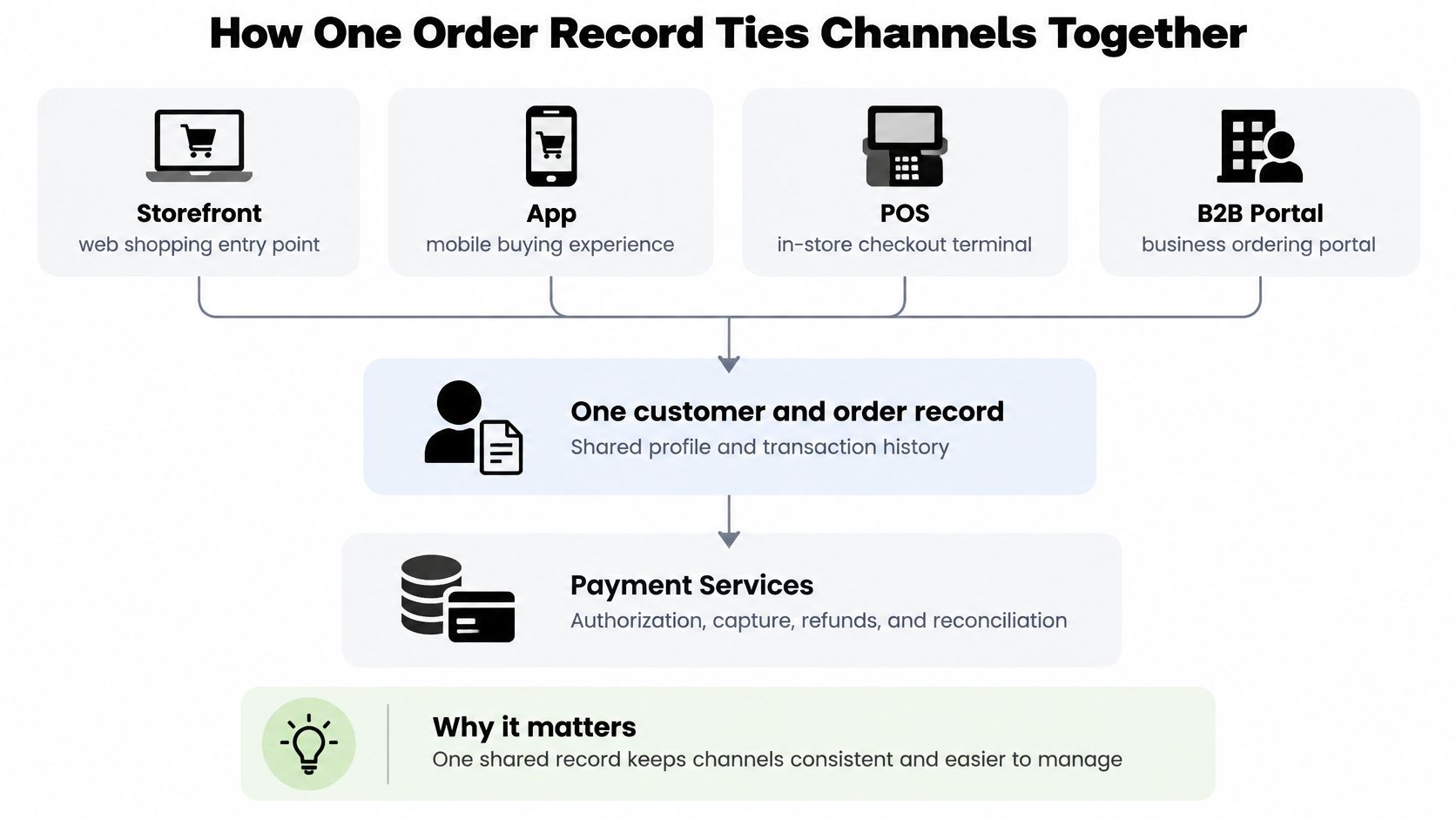
A storefront, app, POS terminal and B2B portal don't need identical screens. They need reliable access to the relevant order state. A clerk handling a return should be able to retrieve the purchased item, original payment reference, available refundable balance and any subscription relationship in the same lookup.
Separate the record from the credential
The shared record shouldn't become a shared repository of raw card numbers. Network tokenization replaces the primary account number, often called the PAN, with a payment token protected by cryptographic or domain controls.
A hotel key card is a useful analogy: it grants controlled access without handing over the master key. The analogy has limits, though. A payment token isn't automatically usable everywhere; its permitted use depends on the token domain, processor support and integration.
The PCI Security Standards Council's token guidance states that an EMVCo-compliant payment token outside the token service provider's token-data environment isn't itself account data for PCI DSS purposes, while systems that store, process or transmit PAN data remain in scope. Tokenization therefore changes how you design card handling, but doesn't remove every compliance responsibility.
Use these placement rules:
- Tokenize at capture: Replace the card number as early as the payment integration permits.
- Isolate card entry: Use the processor's hosted fields or another appropriately isolated collection environment.
- Store references, not PANs: Keep payment identifiers and token references in the order layer, with access restricted to the actions each role needs.
Preserve relationships across systems
An order identifier isn't a substitute for payment identifiers. Keep the links between the order, payment attempt, authorization, capture and refund, including the processor's references. Otherwise, an employee can find the sale but still can't investigate its financial history.
The same principle applies to a multi-store ecommerce architecture: preserve each store's context without creating disconnected customer histories. Keep legal-entity and access boundaries explicit rather than treating a shared interface as permission to combine everything.
For a visual companion to the channel-and-record model, use the following video.
During vendor evaluation, request a demonstration of those relationships, including what remains visible after a refund or failed renewal. A diagram is useful; a traceable transaction is stronger evidence.
Measuring Authorization Performance by Channel
A healthy overall approval rate can conceal a broken payment path. Say domestic store transactions perform well while mobile purchases from a particular issuer fail. Combining them into a headline average makes it harder to see which customers need attention.
Authorization performance is an observability and routing problem, not merely a checkout-design problem. CyberSource's payment KPI guide identifies detailed segmentation as necessary for advanced monitoring and emphasizes representative transaction samples when benchmarking across industries and countries.
Record enough context to explain failures
Segment attempts by country, payment service provider, issuer, acquirer, device and payment method. Also preserve the retry path and whether the customer changed methods after a decline.
For each attempt, capture:
- Issuer response: Store the raw decline code alongside your normalized category.
- Authentication outcome: Record whether a 3-D Secure or strong customer authentication (SCA) flow succeeded, failed or wasn't completed.
- Technical context: Include latency, token status, routing decision and payment-attempt identifier.
Keep an attempt view and an order view. A recovered purchase should count as a completed order, but its earlier failure still belongs in the routing analysis. Without that distinction, teams can mistake retries for fresh customer demand.
Retry rules by decline category
| Decline category | Retry action | Main risk |
|---|---|---|
| Soft decline, such as issuer unavailable or temporary system error | Allow a bounded alternative-acquirer retry, idempotently, when processor and network rules permit | Duplicate authorization if retry handling is unsafe |
| Authentication required | Complete step-up authentication, then resubmit the same order | Abandoned checkout if the challenge is poorly designed |
| Hard decline, such as stolen, closed or restricted card | Don't retry; offer another tender | Repeated attempts add friction and fraud exposure |
| Unknown or unmapped issuer code | Log the raw code and hold for review | Misclassification triggers unsafe retries or loses recoverable sales |
Idempotency means a repeated request doesn't create another financial action. Use processor-supported keys and deduplication controls, and check ambiguous timeouts before sending another authorization.
A payments orchestration platform can coordinate routing, but the team still needs evidence that a fallback improves outcomes. Compare routes using controlled traffic or shadow-mode decision tests, which evaluate routing logic without submitting duplicate live charges.
Optimize approval rate, net revenue after fees, chargebacks and latency together. A higher approval rate isn't a win if the additional sales cost more than they contribute.
Reconciling Splits, Refunds and Fees
The cheapest advertised processing rate isn't necessarily the cheapest operating model. A finance team can spend substantial effort explaining payouts when the processor's settlement report, store refund log and order export use different identifiers.
Optimus's payment reconciliation guide reports that U.S. merchants paid $172.05 billion in card-processing fees in 2023. For an individual brand, the useful question is what processing, exceptions and investigation cost together, rather than which provider advertises the smallest headline rate.
Reconciliation events and what must match
| Event | What Must Match | Common Gap |
|---|---|---|
| Split tender | Each tender amount against one order total | Tender totals drift from the order total |
| Partial capture | Captured amount per line item | Uncaptured balance stays open |
| Store refund | Refund to the original tender and order | Counter refunds aren't linked to the online order |
| Chargeback | Dispute tied to the original order and channel | Disputes booked without an order link |
| Subscription renewal | Each renewal charge against its subscription | Failed retries counted as separate sales |
| Cross-currency payout | Settled amount against the applicable exchange rate and fees | Fee differences hidden inside net settlement |
Consider a purchase paid partly with a gift card and partly with a bank card. The warehouse ships items separately, an associate later refunds an item, and the customer disputes a remaining charge. Finance needs an event history, not a single paid-or-unpaid flag.
The order can be commercially complete while a dispute remains financially unresolved. Keep those states separate so operations doesn't accidentally treat a settlement issue as an unfulfilled shipment.
Assign ownership before automating
Who maintains the authoritative reconciliation record: the commerce platform, payment processor, acquirer or merchant ERP? And who resolves differences when those systems disagree?
Assign a named team to maintain the matching rules and an owner for each exception category. Support might investigate an unexplained refund, while finance verifies a fee discrepancy and engineering repairs a missing event.
Useful reconciliation capabilities include:
- Order-level lineage: Follow each financial event back to its source purchase and tender.
- Automated fee verification: Compare charged fees with the applicable pricing rules.
- Currency-aware matching: Preserve transaction currency, settlement currency, exchange adjustments and fees separately.
- Exception queues: Route unmatched events with a reason, supporting evidence and accountable owner.
Cross-border transactions also require explicit treatment of currency conversion and settlement timing. Don't classify an expected timing difference as missing money, or hide a conversion adjustment inside an unexplained net payout.
Before go-live: Map every payment event type to an order ID, preserve its processor reference and test how an unmatched event reaches the person responsible.
Balancing Checkout Speed With Fraud Controls
A recognized customer buys online and returns an item in store without repeating their details. That's convenient, but a fraudster who takes over the same account may try to exploit that continuity, changing contact information before requesting a refund elsewhere.
Shared identity isn't proof of legitimate intent. It gives your risk team more context, provided they examine account changes and post-purchase activity alongside checkout behavior.
Protect the return as well as the sale
In a 2025 global merchant survey discussed in Sift's disputes report, 47% of merchants identified refund abuse as their leading fraud attack, while merchants reported losing 3.2% of annual ecommerce revenue to payment fraud. That makes returns and account servicing part of payment security, not merely customer support tasks.
The difference between a legitimate shopper and an attacker depends on connected signals, not just whether both can sign in.
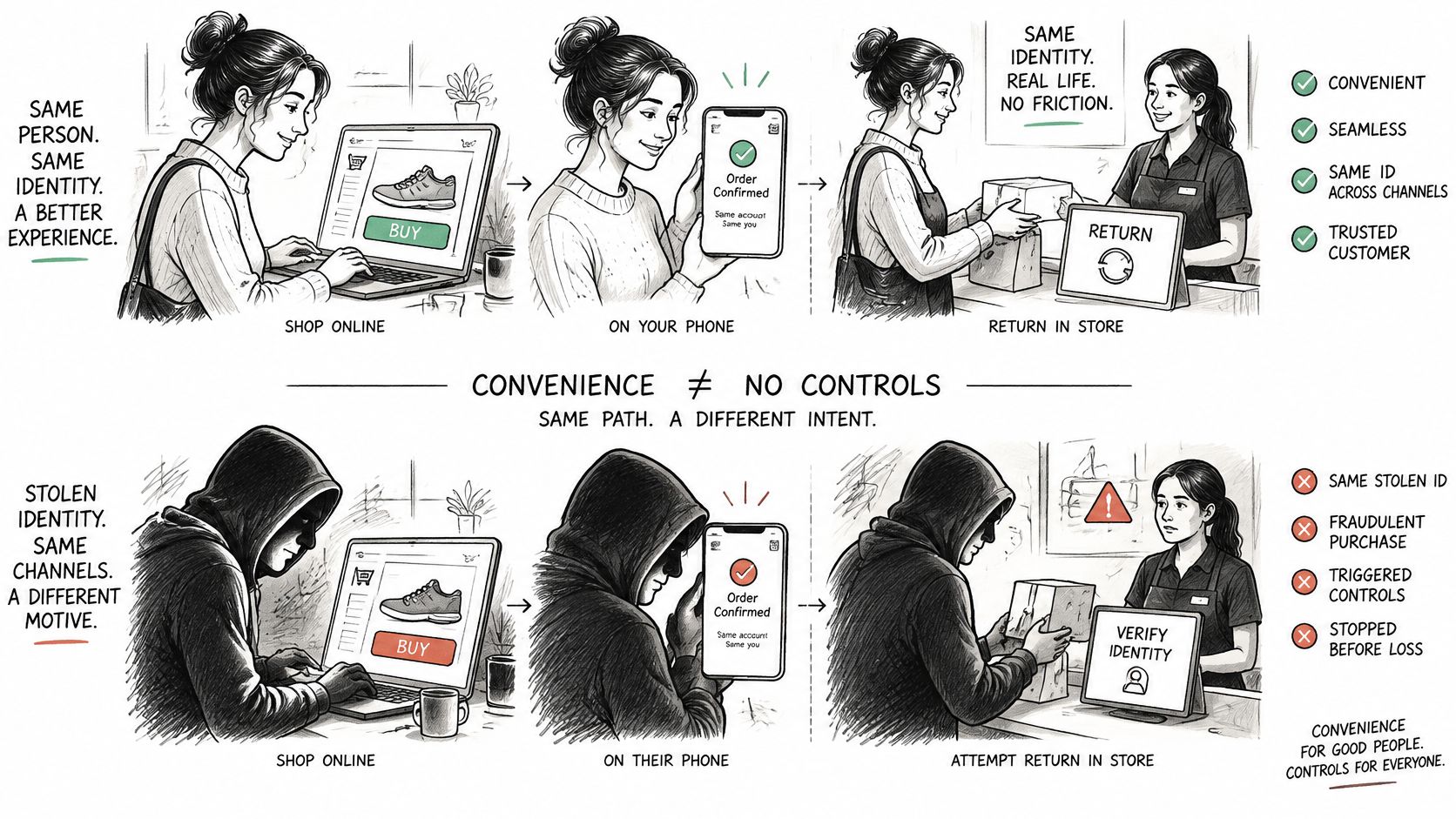
Requiring maximum authentication everywhere is the wrong response. A routine reorder and a refund requested after an account-email change don't deserve identical treatment. Excessive challenges can interrupt genuine purchases without addressing the behavior that makes the refund risky.
Apply checks where the behavior changes
Combine device, customer, tender, fulfillment and return signals. A familiar device and established purchase history provide different context from a new device, recent credential reset and request to redirect funds.
Use selective controls:
- High-risk refunds: Check refundable balance, previous refunds and tender eligibility before releasing funds. Require additional approval for unusual requests.
- Instant-payment flows: Verify recipient details and apply risk checks before funds move, rather than relying on later recovery.
- Cross-channel account changes: Step up verification when sensitive profile changes coincide with payment or return requests.
Distinguish first-party misuse, including a genuine customer disputing a valid charge, from fraud involving stolen credentials or payment information. The investigation and evidence differ: fulfillment confirmation may answer a delivery dispute, while account-access history can help investigate takeover.
Give associates a clear escalation path rather than asking them to make complex fraud judgments at the counter. Log policy overrides and the reason for each decision so the risk team can review outcomes.
Measure false declines alongside fraud losses. Blocking legitimate customers can make a fraud dashboard look better while damaging the business you're trying to protect.
Map Your Channels Before You Choose a Platform
Bring a completed channel map to the demo, not just a list of preferred payment methods. The example below is a working template: replace its acceptance rules and owners with your actual operating decisions.
Channel map to complete before any demo
| Channel | Tenders accepted | Refund and return path | Subscription rule | Reconciliation owner |
|---|---|---|---|---|
| Online storefront | Enabled cards and wallets | Original tender after return approval | Explicit consent before recurring billing | Ecommerce finance lead |
| Store and POS | Cash and supported cards | Order lookup and original-tender refund | Enrollment only through an approved recurring flow | Retail finance lead |
| B2B portal | Invoice payment methods enabled by processor | Credit note linked to invoice | Agreed billing schedule and authorization | Accounts receivable |
| Subscriptions | Eligible stored credentials | Refund against the relevant renewal | Authorized renewals with controlled retries | Subscription finance lead |
Treat these owners as roles to assign, not default responsibilities that software will choose for you.
- Complete the map. Include mobile buying experiences and any selling channel with a different return policy or legal entity.
- Ask where responsibility sits. Where does the order record live? Who holds the token? How many systems touch the card number? Request a live transaction trace rather than accepting a verbal assurance.
- Test the operating requirements. Verify reconciliation by order ID, segmented authorization reporting and selective fraud controls using your own purchase and refund scenarios.
Check fit through a controlled pilot
Our PlatformDTC model places storefront, checkout, subscriptions, payments, POS and fulfillment within a shared record model. Checkout accepts cards, wallets and pay-later options in one flow, with fraud checks and dispute answers built in.
To accept payments, businesses create a PlatformDTC account and complete Stripe Connected Account onboarding. Card details are entered into Stripe-hosted fields and never reach our servers.
Start with a limited channel pilot and reconcile its orders through capture, refund and payout. Measure the unmatched-event backlog and authorization outcomes by segment, then expand only when the financial totals match and someone owns every remaining exception.
PlatformDTC connects online, in-person and recurring commerce around a shared order lifecycle, helping teams keep checkout and payment operations together. Visit PlatformDTC with your completed channel map to evaluate how your purchases, renewals and returns would work in a unified system.