Global business-to-business ecommerce reached an estimated US$25 trillion in 2021 across 43 developed and developing economies, roughly three-quarters of worldwide gross domestic product and about 15% above the comparable 2019 level, according to the United Nations Conference on Trade and Development. That body estimated a further 10% rise in 2022, approaching US$27 trillion, before growth cooled in 2023 as restrictions and supply-chain shocks eased.
At that scale, a second storefront is a control problem, not a branding exercise. A multi store ecommerce platform pays off when one canonical order, one inventory reservation, one discount, and one return stay true across the web, the counter, and wholesale. How many themes a brand can launch is the wrong score. The right score is which object owns stock, price, and refunds, and which person or agent may change them.
I would refuse a second database the moment two stores sell the same SKU. The site can look different. The ledger cannot.
Table of Contents
- Four Architectures and the One Record They Must Keep
- Score Each Platform on Seven Criteria
- Checkout Localization and Channel Rules
- Which Architecture Fits Each Selling Motion
- How to Migrate Without Duplicate Orders
- How Agent Actions Stay Inside One Store
- Pick the Architecture Before You Add a Store
Four Architectures and the One Record They Must Keep
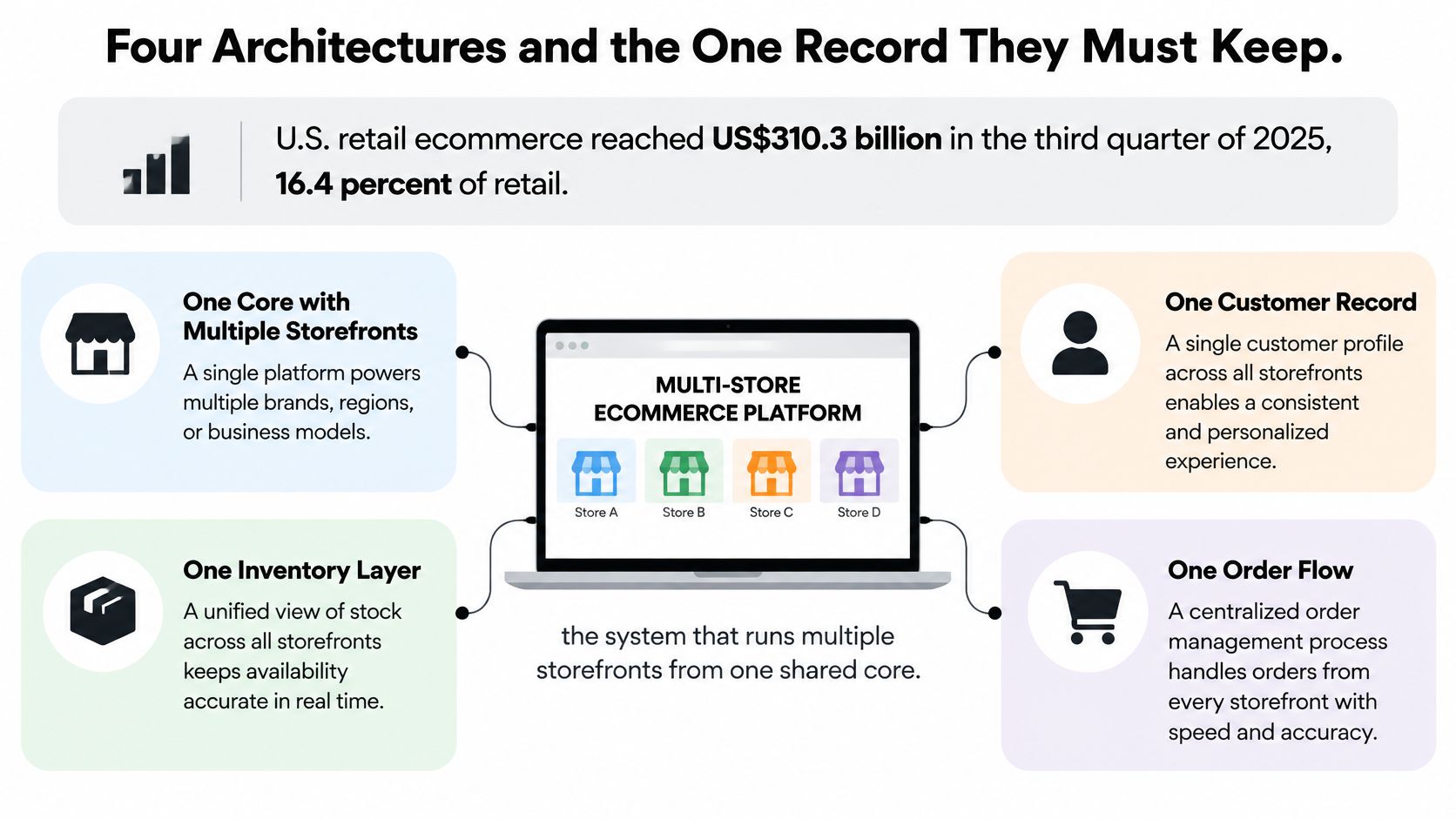
The U.S. Census Bureau estimated seasonally adjusted retail ecommerce sales at US$310.3 billion in the third quarter of 2025, 16.4% of total U.S. retail, up 1.9% from the prior quarter and 5.3% from a year earlier. First-quarter sales were about US$300.2 billion (16.2% of retail) and second-quarter sales US$304.2 billion (16.3%). That climb is sustained volume, not a spike, and it is about one-sixth of U.S. retail.
A multi store ecommerce platform is the system that runs more than one storefront, region, or selling motion while one set of rules owns products, prices, stock, customers, and orders. A branded site is not a second database. Before you add a store, name an owner for eight objects: product, price book, promotion, inventory reservation, customer, order, return, and subscription. If nobody owns the reservation, two channels will sell the same unit.
Pick the row before you pick a vendor
| Architecture | Catalog | Order model | Fits when | Main failure |
|---|---|---|---|---|
| Single catalog, many storefronts | One product master with store price books and content | One order and inventory record | Same SKUs across regions or channels | A local price edit leaks globally if price books are missing |
| Multi-catalog, shared services | Separate masters linked by a common ID | Shared order, customer, and stock ledger | Distinct brands or legal assortments | Bad mappings create ghost SKUs and double counts |
| Separate tenants plus integrations | Independent catalog per store | Orders synced after the sale | A brand must launch before systems merge | Inventory, price, and refunds drift apart |
| Composable storefronts, one order service | One catalog service with channel views | Canonical order written once | Web, wholesale, and POS on one brand | A front end promises a state the order model cannot store |
Single catalog, many storefronts keeps one product master and lets each store hold its own price book and content. It fits the same SKUs sold in several countries or channels. It fails when a merchandiser edits the master price because no store price book exists, and every region inherits the change.
Multi-catalog, shared services keeps a separate master per brand or legal entity, joined by a common ID, with one order, customer, and stock ledger. It fits house-of-brands assortments that must not share a cost file. Weak mappings invent ghost SKUs and double-count the same physical unit.
Separate tenants plus integrations give each store its own database and sync after the sale. They launch fastest and reconcile worst. Price, stock, and refunds drift because the sale already happened in a system the other stores cannot see.
Composable storefronts with one order service let the front ends differ. A headless commerce platform can render a channel view, but the order model still has to store every promise that screen makes, including partial ship, draft wholesale, and a subscription retry. Teams weighing ecommerce performance and security considerations should treat the write path, uptime, and payment coverage as architecture, not a later checklist.
If two stores sell the same SKU, start with one catalog unless a regulator or brand contract forbids it.
Mark the row that matches the stack you run, including the quiet clone an agency still hosts on its own account.
Score Each Platform on Seven Criteria
The row you marked becomes a scorecard. Score every candidate pass, conditional, or fail before anyone drafts a migration. A long feature list is not a pass, and a polished admin is not evidence that the objects underneath are shared.
- Catalog shape. Can one master serve several price books, and does the common ID survive an import from a spreadsheet or a PIM? A pass keeps the ID stable across stores. A conditional needs a manual map. A fail creates a new SKU on every import.
- One order record. Does a single canonical order hold web, POS, wholesale, and subscription lifecycles, with every write idempotent so a retried request never opens a second order? Conditional is acceptable only if subscriptions join the same record within one release. "On the roadmap" is a fail.
- Inventory reservation. Does one ledger hold reservations so two stores cannot promise the same unit? Ask the vendor, in writing, which object owns reservation, discount, and refund. A candidate that cannot name the owner fails, no matter how polished the admin looks.
- Checkout. Is the flow one component, with guest checkout, express wallets, and a landed cost shown before payment? Change field count and wallet coverage once, in one place, or assume every store will drift apart.
- Localization. Are currency, copy, and tax registration overlays on one catalog, rather than a cloned site per language?
- POS and B2B. Do cash sales, draft orders, and invoices write to the same customer and stock record the website uses?
- Permissions and reversibility. Can each user or agent be scoped by brand, market, channel, and action, with an audit trail and a rollback on every write? That scope decides which objects an assistant may touch later, so pair it with a way to measure ROI across AI assistants: a price change an agent shipped should be visible in revenue, and a blocked one in the log. If a platform cannot tell the two apart, keep agent permissions read-only.
How to record the score
Two columns do the work: pass, conditional, or fail in the first, the named owner of reservation, discount, and refund in the second. A conditional on catalog shape can wait. A fail on reservation cannot. I would not draft a migration plan, or sign a storefront license, until that sheet exists. Fill it in yourself during the demo, with the vendor's answers verbatim. A scorecard the vendor completes for you is a sales document, not evidence.
Checkout Localization and Channel Rules
Treat checkout as a conversion control, not a theme setting. Baymard's checkout benchmark reports that 17% of U.S. online shoppers abandoned an order in the previous quarter because checkout was too long or complicated, while the average U.S. checkout displayed 23.48 form elements by default. Usability testing there shows an optimized flow can drop to about 12 to 14 elements, a potential 20 to 60% cut in visible inputs.
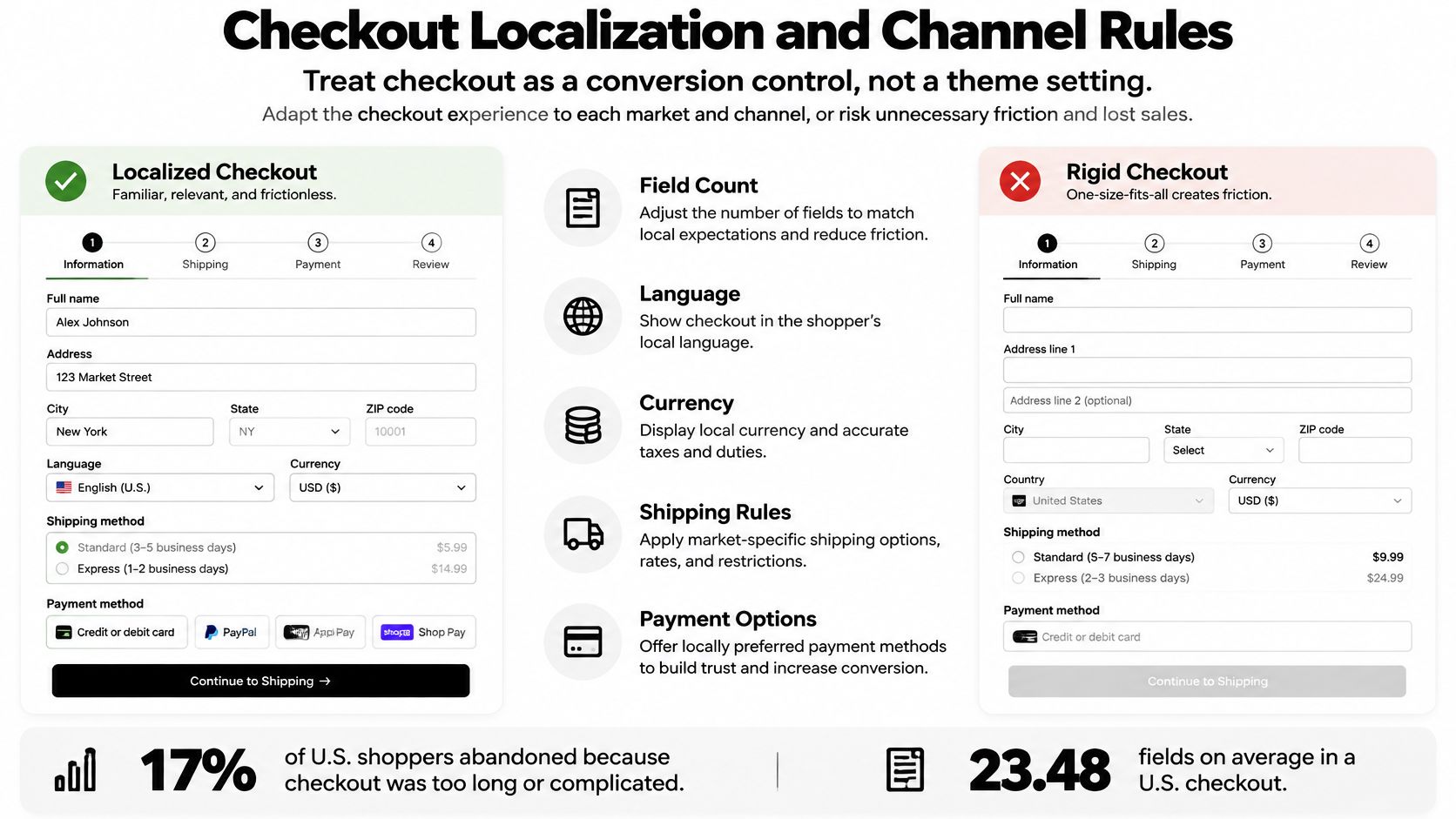
Build one checkout component for every storefront. Guest checkout, inline validation, express wallets, and a full landed cost belong in that component. Payment methods, tax, shipping, and address formats stay local. Copying the whole flow per theme is how length and wallets diverge until you can no longer compare conversion.
Shared object, local exception, split failure
| Rule | Keep shared | Keep local | If you split it |
|---|---|---|---|
| Checkout | One flow near 12 to 14 fields, guest checkout, wallets | Payment methods and address formats | Length and wallets diverge and conversion is not comparable |
| Landed cost | Price, tax, duty, and shipping shown before pay | Rates and tax IDs by market | Shoppers see a surprise total at the last step |
| Inventory reservation | One ledger and one reservation | Safety stock and ship-from location | Oversell or stranded stock across stores |
| Promotions | One discount engine with store scope | Thresholds and creative | Codes stack across sites or a global sale hits wholesale |
| Customer identity | One profile and order history | Consent, language, and store of acquisition | Duplicate people and broken subscriptions |
| POS and B2B | Same order lifecycle as web | Cash, cards, draft orders, invoices | Retail or wholesale stock is invisible online |
| Localization | One catalog with locale overlays | Currency, copy, and tax registration | Translated clones drift on price and attributes |
| Subscriptions | Renewals on the same order record | Which plans a store may sell | A retry creates a second subscription |
Checkout length stays on the shared component. A market may swap address formats and local tenders. If each theme owns the form, you cannot tell whether France converts worse because of the offer or because the form grew back to twenty-plus fields.
Landed cost is calculated once from price, tax, duty, and shipping, then shown before pay. Rates and tax IDs differ by market. Split the calculator and the shopper meets a new total after they have already committed.
Inventory reservation is one ledger. Safety stock and ship-from location can differ. Two stores reserving the same unit is an oversell. A store that reserves into a private bucket strands stock the other channel needed.
Promotions run in one engine with a store scope. Thresholds and creative can differ. Without scope, a code stacks across sites, or a sitewide DTC sale overwrites the wholesale price book.
Customer identity is one profile and one order history. Consent, language, and store of acquisition stay local. A copied customer file duplicates people and breaks renewals that look up the wrong profile.
POS and B2B should write the same lifecycle a unified commerce platform uses for web. Cash, cards, drafts, and invoices are the local exceptions. A separate B2B inventory makes the counter invisible online.
Localization is an overlay of currency, copy, and tax registration on one catalog. A translated clone whose price no longer matches the master is not a locale. It is a second catalog you forgot you owned.
Subscriptions renew on the same order record. A store may choose which plans it sells. A retry that opens a second subscription double-bills the buyer and double-commits stock.
Instrument once, then read the numbers per store: checkout-step abandonment, validation errors, payment failures, time to completion, and the share of sessions shown a complete landed cost. The shared checkout is real only when a change to field count or wallet coverage ships to every store without a per-theme rebuild.
Which Architecture Fits Each Selling Motion
A 2025 Priority survey found that 73% of retailers experienced data inconsistency from fragmented integrations across finance, inventory, and POS, while only 27% had one solution integrating those functions. A separate 2025 commerce-operations report found that only 36% of retailers believed they had clear and accurate inventory visibility. Adding a store on top of that split does not create a channel. It creates another writer of the same stock.
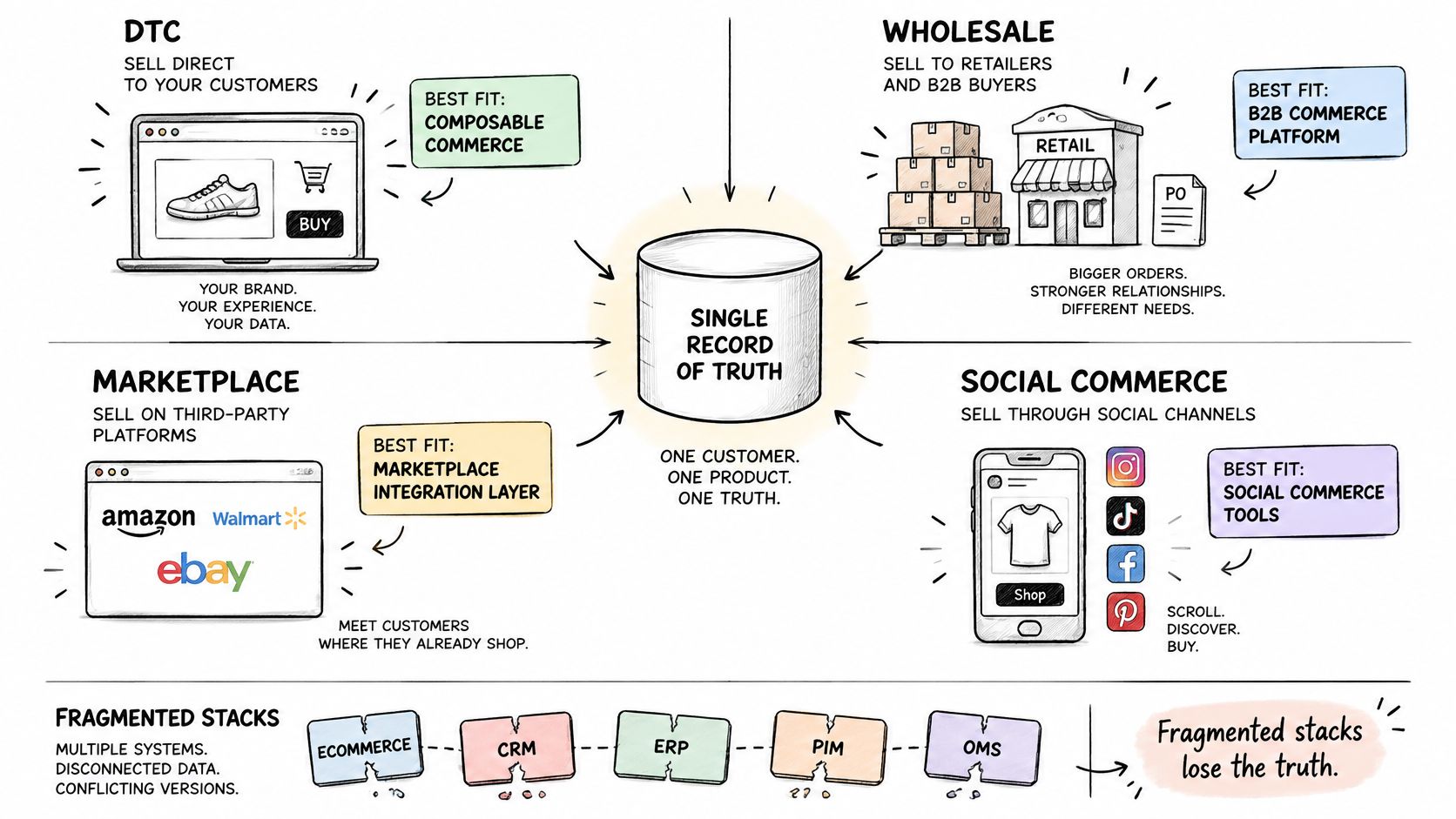
Four motions, four refusals
Multi-country DTC for one brand. Use a single catalog, locale overlays, one checkout, and local tax and currency. The same hoodie in three countries is not three products. Refuse a full store clone per country. The exception queue to staff is price mismatches between the overlay and the master.
A house of brands. Use multi-catalog with a shared order service, and share a stock pool only where SKUs overlap. A private-label soap and a licensed fragrance should not share a cost file just because they share a warehouse aisle. Refuse one mashed catalog that hides brand-level cost. Staff the queue for ghost SKUs and double counts.
DTC plus wholesale. Keep one product master, a wholesale price book, and draft orders and invoices on the same order lifecycle. The buyer sees a net-terms invoice. The warehouse sees the same reservation the website decremented. Refuse a separate B2B site with its own inventory. Staff the queue for a wholesale price that overwrote DTC, and for duplicate refunds when both desks issue credit.
Owned retail counters. POS cash and card must write the same customer and the same reservation the web uses. A Saturday sale that lands in a nightly file is already a lie by Sunday morning. Refuse end-of-day file drops as the stock system. Staff the queue for negative available-to-sell and for unapplied returns that never put the unit back.
Say a bakery group sells the same granola online, at two counters, and to a grocery wholesaler. One reservation should cover the jar. Three catalogs will sell the last jar three times, then argue about which refund is real.
Adding a store reduces control unless every shared object has an owner and a reconciliation latency target.
Set that latency in hours, not in "eventual." If the target is missed, the new store stops taking orders for shared SKUs until the queue is clear.
How to Migrate Without Duplicate Orders
Cut over in six steps. Each step has a pass condition. Skip one and you import the mess you were trying to leave.
- Name the system of record for catalog, price, stock, customer, order, and return, and list every store that currently writes those objects, including agency clones and the POS. Pass when each object has one writer and every other system is marked read-only or queued for retirement.
- Import the catalog and run the new stack in parallel. Each night, compare a sample of SKUs, prices, and on-hand units and log mismatches. Pass when the sample's mismatch rate is stable and explained, not when the import "looks done."
- Freeze new promotion types and map old codes onto one engine so a code cannot apply twice. Pass when a test cart in each store applies the code once and a cross-store cart refuses the stack.
- Send a slice of checkout traffic to the new flow. Watch error-free session rate, authorization success by tender, p95 latency, wallet adoption, and duplicate order count. Do not widen the slice because a dashboard looks green for an hour.
- Prove idempotency. A retried payment must not create a second order, and a retried refund must not pay twice. Pass only after you have forced the retry, not after you have read the vendor's promise.
- Cut order writes only after reservation and refund tests pass. Leave the old stack read-only for lookups for a fixed window, then shut the write credentials.
Baymard's abandonment research is the alarm set for that slice. Website errors or crashes are a reason for abandonment for 17% of U.S. shoppers, insufficient payment methods for 9%, lack of trust in card handling for 19%, and extra costs, the leading cited issue, for 40%. If error-free sessions drop, or shoppers stop seeing a full landed cost, you are recreating those reasons on the new stack. The same caution applies when counters move, and practical POS migration guidance for Singapore retailers is a useful reminder that cash drawers and card tenders have to land on the new record the day the lane switches, not in a later file.
Edge cases that fail a quiet cutover
- In-flight subscription renewals: pause new retries until the renewal writes the canonical order, or you will bill twice.
- Open B2B invoices: keep them on the shared lifecycle so a payment does not create a second wholesale order.
- Offline POS sales: queue them against the same reservation, with a conflict review before the next online promise.
- Gift-card balances: move the balance ledger with the customer, not as a store-level note.
- Partial shipments: the remaining units stay on the original order, not on a cloned one.
A practical ecommerce platform migration sequence is this list, not a big-bang DNS flip. If reconciliation latency or the duplicate-order rate on the sample is worse than the old stack, do not expand traffic.
How Agent Actions Stay Inside One Store
Reporting on the 2025 Akto State of Agentic AI Security survey, covered by Digital Commerce 360, found that only 21% of organizations had complete visibility into agent behavior, permissions, tool usage, and data access. Fewer than half monitored agent activity end to end, and one in five reported no meaningful monitoring or enforcement. That gap is the problem. A bulk editor with a model behind it is not a control.
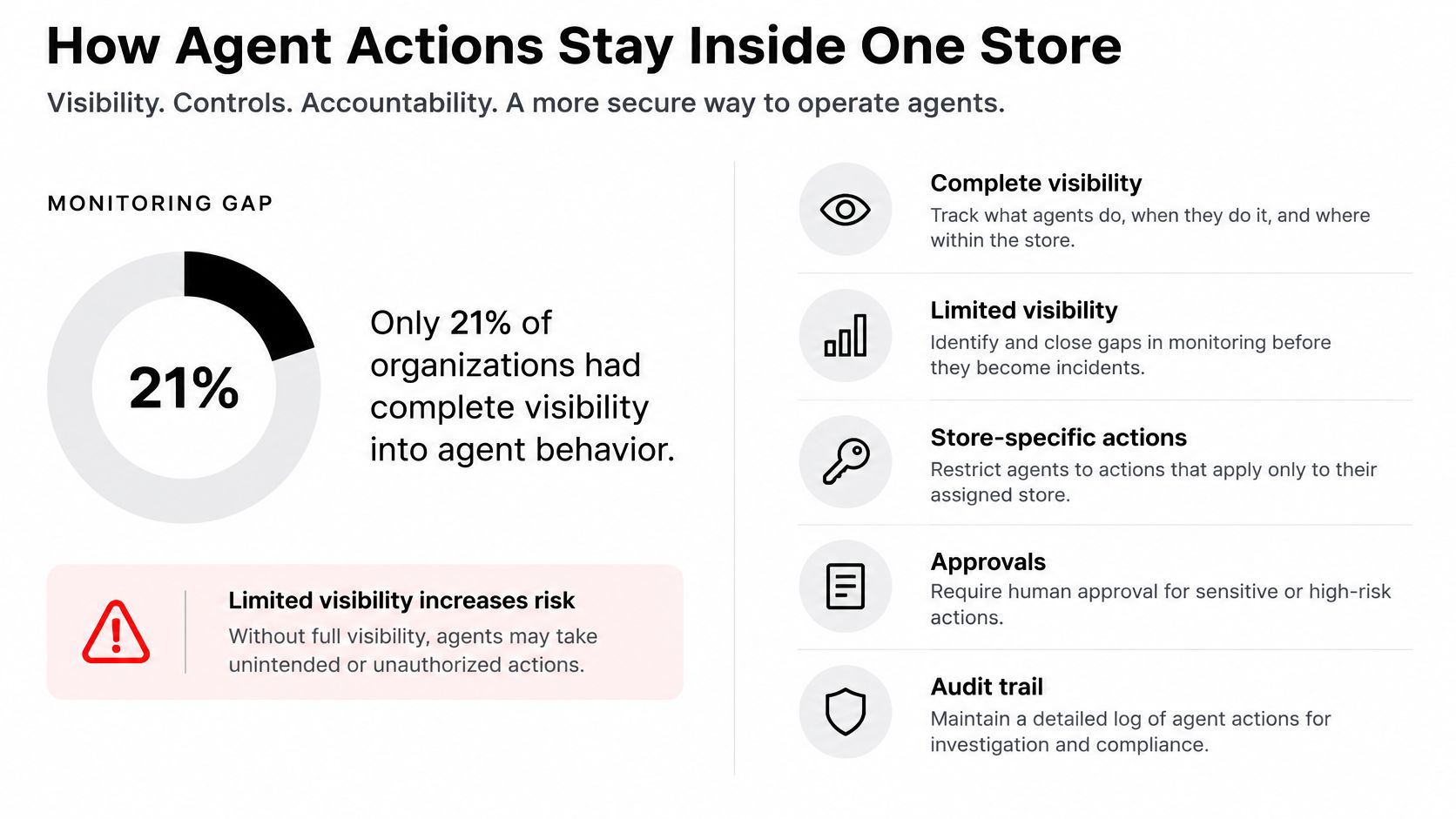
An agent action is a write to price, inventory, copy, campaign spend, customer messages, or fulfillment. A chatbot that only answers shoppers is out of scope. The failure mode is local optimization with a global blast radius: one region's agent marks a price down, and every brand on the shared master inherits it.
Scope, gate, trace, undo
Scope keys by brand, market, channel, and action. A merchandiser's agent for one region cannot edit another brand's price book, even if both brands sit in the same admin.
Require a human approval gate for spend and for any price or discount change above a threshold you set in currency, not in vibes. Read-only recommendations can run all day. Autonomous execution cannot.
Writes that change price or send a campaign must be idempotent, so a retry does not double the change or the send. Keep an audit trail and a compensating rollback that restores the prior price book, reservation, or message state.
Track four numbers: unauthorized changes blocked, median approval time, rollback rate, and revenue touched by rolled-back actions. If you cannot name those four, you do not have agent governance. You have a feature flag.
AI-ready multi-store commerce is transactional governance, not another bulk editor.
Pick the Architecture Before You Add a Store
If the same SKUs sell online, in owned stores, and to wholesale buyers, choose a single catalog with one order lifecycle. If brands or legal entities must keep separate assortments, choose multi-catalog with a shared order and stock service. Choose separate tenants only as a time-boxed launch, with a dated plan to fold writes into the shared record.
Do not buy a storefront license that cannot name the owner of reservation, discount, and refund.
Where you want that single record on a domain you already own, PlatformDTC is one option to run through the scorecard. You point DNS at the platform so the storefront and checkout both serve on that domain. Confirm the payment-account country before setup, because it cannot be changed once set. Building the store is free, with no monthly fee and a charge of 2.9% + $0.30 per card sale, and usage credits are included every month. Planned 2026 to 2027 work covers several markets and currencies from one catalogue, plus protocol discovery, a machine checkout surface, and agent payment handlers on every published storefront.
Map every live store to one row of the architecture table. Then run the first two migration steps, the named system of record and the parallel catalog sample, before any new storefront goes live.
PlatformDTC keeps storefront, checkout, subscriptions, POS, and wholesale on one order and inventory record, with agent actions scoped, approved, and reversible. That is the multi-store problem this architecture is meant to solve, not another pile of themes. Visit PlatformDTC and score it against the seven criteria before you add another store.