The global payment orchestration platform market was valued at USD 2.6 billion in 2025, according to Grand View Research. That's a substantial category for something shoppers never see. But a DTC operator shouldn't buy orchestration because the category is growing. The business case is incremental approved gross profit, with customer consent and payment credentials that won't become stranded when a provider changes.
More processor connections aren't automatically better. They can recover legitimate purchases, but they can also create more fraud exposure, confusing retries, and reconciliation work. The useful question is whether you can accept the right payment, explain every decision, and preserve the customer relationship afterward.
Table of Contents
- Why One Gateway No Longer Covers Checkout
- Architecture of a Production Control Layer
- Routing Retries Payouts and Tokens
- False Declines and Who Owns the No
- Integration Patterns That Survive a Provider Switch
- Channels Choosing the Layer and Next Steps
Why One Gateway No Longer Covers Checkout
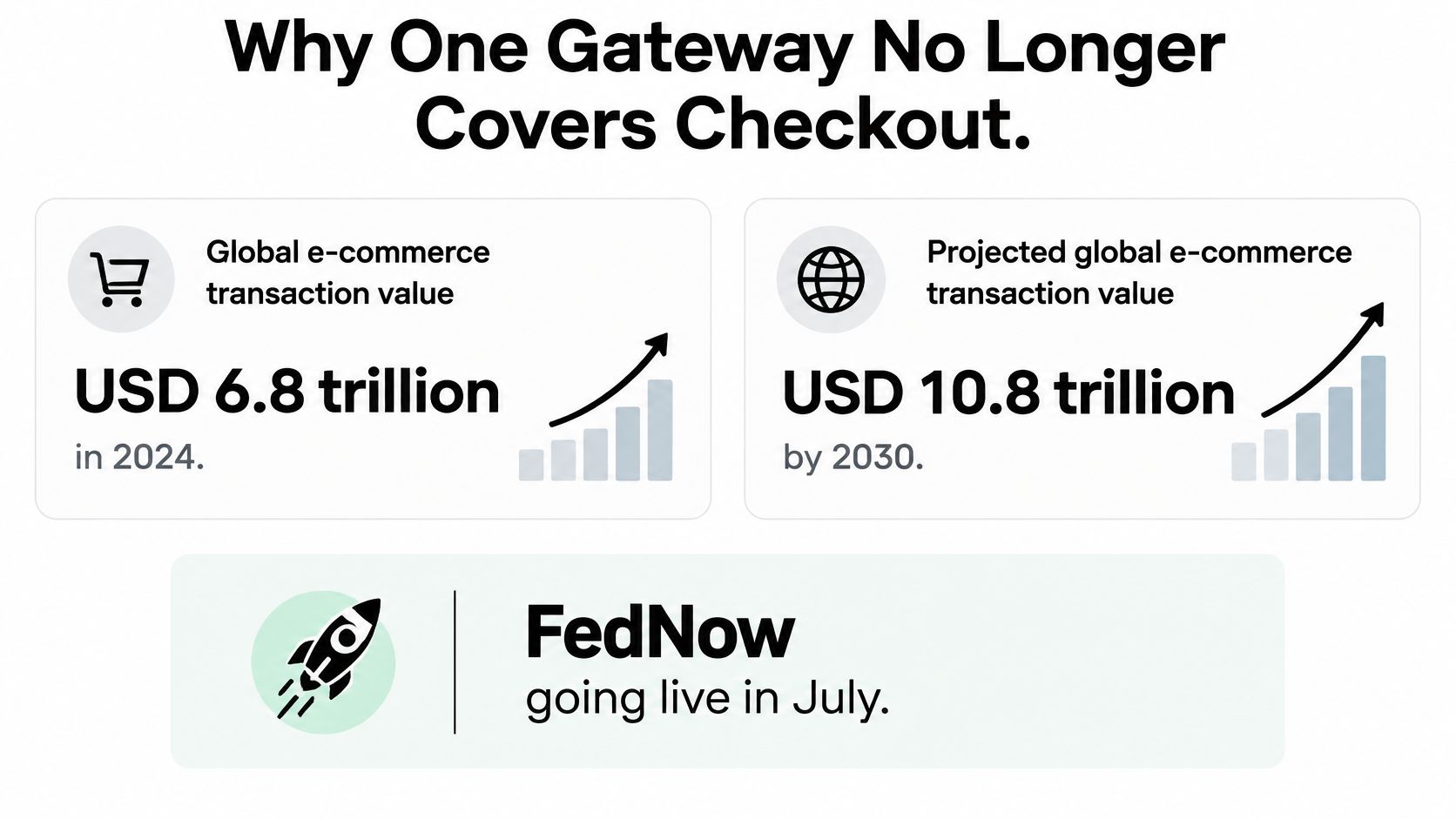
Global e-commerce transaction value reached approximately USD 6.8 trillion in 2024, with a projection of USD 10.8 trillion by 2030, according to the Digital Payments Review, which also records the FedNow Service going live in July 2023. Cards now sit alongside wallets, local methods, and instant account-to-account infrastructure. A brand's checkout has to accommodate that mix without making its operations team manage a separate order history for each rail.
A payments orchestration platform is the control layer that chooses how a payment is attempted, determines whether recovery is appropriate, and keeps payment outcomes connected to order and settlement records.
The scale of that checkout environment is illustrated below.
A runway isn't air-traffic control
Say a skincare brand starts with domestic card sales, then adds international shoppers, subscriptions, and wholesale invoices. Its original integration may still accept cards perfectly well. The problem is coordinating different payment methods, authentication requirements, provider responses, and settlement reports.
A gateway securely passes payment information to processing infrastructure. A processor carries transaction messages through the authorization and settlement chain, while the card issuer generally makes the authorization decision. Some providers bundle these roles, and gateways can support multiple acquiring relationships, so the distinction isn't just how many connections a vendor advertises.
Orchestration sits above those connections. Think of air-traffic control versus a runway: the runway supports a landing, while the controller coordinates where traffic should go and what happens when a route becomes unavailable. Our overview of payment gateways helps separate those responsibilities.
Method coverage must connect to operations
For a useful adjacent-channel comparison, OrderOut's restaurant payment integration guide for 2026 is a resource for operators considering how payment integration fits an ordering workflow. A DTC brand faces the same architectural question when online orders, retail purchases, and invoices must agree.
- Acceptance: Offer methods relevant to the customer rather than forcing every purchase onto cards.
- Control: Apply consistent routing and recovery policies across providers.
- Operations: Connect fraud decisions, refunds, and settlement to the order being paid.
The outcome should be fewer lost sales from payment-method gaps, not a promise that routing alone creates profit.
Architecture of a Production Control Layer
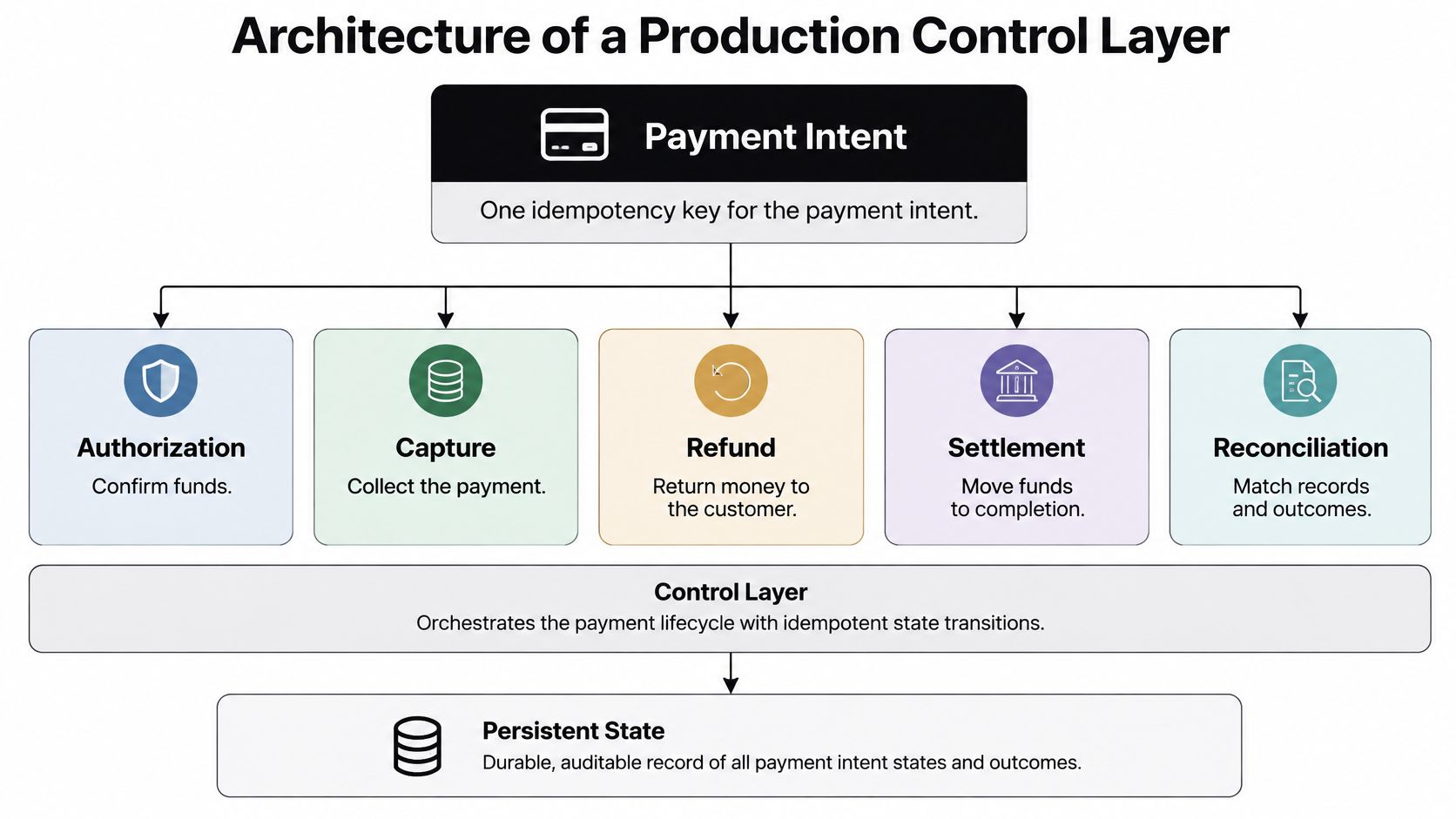
Start with one logical payment, not a collection of unrelated API calls. Model it as a state machine that records authorization, capture, refund, settlement, and reconciliation without confusing one stage with another.
The Engineering Handbook payment-system design describes the core pattern: an idempotent payment lifecycle, explicit failure handling, a transactional outbox, and a double-entry ledger. Idempotency means a repeated request doesn't create an additional payment effect.
The diagram shows the lifecycle the control layer must track.
Give every payment a stable identity
The merchant creates an idempotency key for the payment intent and preserves that identity across retries. The orchestrator records completed outcomes and returns the existing result when the same operation arrives again.
That matters when a processor accepts an authorization but the response never reaches your checkout. A timeout means the outcome is unknown, not that the payment failed. Don't send the transaction elsewhere until you've resolved whether the first provider authorized it.
A shared key isn't magic across independent PSPs. The orchestrator must enforce deduplication centrally, map provider-specific identifiers, and use distinct operation identifiers for capture and refund.
Components of a payments orchestration platform
| Component | Job | Failure if missing |
|---|---|---|
| Idempotency key and state machine | Preserve one result per payment intent across retries | Duplicate authorizations after timeouts |
| Provider adapters | Normalize PSP, wallet, and local-method APIs | Every new rail needs a custom integration |
| Router | Score and select the next eligible attempt | Static gateway with no failover |
| Error classifier | Separate soft declines, hard declines, fraud, 3DS, and timeouts | Blind retries that anger issuers |
| Retry policy with backoff and circuit breaker | Recover transient faults without retry storms | Latency spikes or fee leakage |
| Token vault | Protect credentials and manage token references | Expanded PCI exposure and broken renewals |
| Transactional outbox | Keep state writes and emitted events aligned | Orders that don't match webhooks |
| Double-entry ledger | Reconcile captures, refunds, fees, chargebacks, and settlement | Manual finance breaks |
Recover without pretending everything is atomic
Exponential backoff with jitter spaces retries and adds randomness so workers don't all retry together. A circuit breaker stops sending requests to an unhealthy provider. The outbox records an event alongside the state change, then allows reliable delivery afterward.
Use saga-style compensating actions, not an assumed shared transaction across PSPs and internal services. If an order can't proceed after authorization, the compensating action might be a void. If capture has already happened, it may require a refund.
Architecture rule: Build a switchboard with a receipt book, not a second cash register.
For cross-border planning, Zaro's payment solutions for scaling exports offers a complementary resource when evaluating enterprise payment needs alongside this architecture.
Use the following video as a companion to the lifecycle diagram.
The same controls protect subscription workers and agent-submitted checkout requests. A job can be delivered again without becoming permission to charge again, and every compensating action remains auditable.
Routing Retries Payouts and Tokens
A second route can recover a sale, but it can also add cost, fraud exposure, or subscription churn. The goal is incremental approved gross profit, not the largest possible processor list. Provider, issuer, and route all affect authorization, so measure approval on your own traffic instead of relying on broad industry benchmarks.
Score eligibility before price
A router should first decide whether another attempt is appropriate. It can then compare eligible routes using payment method, card BIN, issuer country, currency, merchant category, authentication outcome, historical performance, and current provider health. The BIN identifies the card's issuing range, helping teams compare issuer-specific results rather than treating every card alike.
Signals a router should score before failover
| Signal | Use in the decision | If ignored |
|---|---|---|
| Payment method and wallet | Match the rail the shopper chose | Forced card fallback and drop-off |
| BIN and issuer country | Prefer routes with stronger relevant issuer performance | Local declines on a global acquirer |
| Currency | Avoid unnecessary conversion | Extra FX cost and lower approval |
| 3-D Secure outcome | Distinguish failed authentication from a timeout | SCA loops and liability mistakes |
| Historical approval rate | Weight healthy payment corridors | Static routing that ignores issuer behavior |
| Cost and latency | Break ties after approval odds | Cheap routes that fail or slow checkout |
| Live provider health | Open the circuit during an outage | Traffic sent into a down PSP |
A soft decline may allow another attempt or require customer authentication. A timeout needs outcome investigation before failover. Hard declines, fraud blocks, and failed authentication should not trigger an automatic cascade through other PSPs.
Each additional processor connection creates another place to manage credentials, rules, and customer consent. More routes can raise fraud risk or disrupt recurring payments if a stored token cannot travel with the customer's permission. Keep the decision record tied to the route, authorization outcome, and applicable consent. For the broader role of the control layer, see our DTC payment system guide.
Tokens and payouts solve different problems
Tokenization replaces sensitive card credentials with references. A merchant token usually belongs to a particular vault or provider environment; a network token is issued within card-network infrastructure. Neither label alone means another processor can use it. Treat portability as a consent and credential-lifecycle question: establish which provider can use the token and whether the customer's permission covers the proposed route.
Use hosted collection so the primary account number does not pass through the commerce application. Track which credential supports the wallet or renewal, which provider can use it, and how its lifecycle is maintained.
Payouts are a separate operational concern. Authorization is not cash in the bank, and capture does not prove that the expected net funds arrived. Record the settling provider, destination account, payout reference, deductions, and associated orders.
Measure authorization by PSP, issuer country, BIN range, card brand, currency, method, and decline code. Add p95 and p99 latency, retry recovery, false-positive fraud declines, and net cost per successful transaction. Comparing these measures helps show whether a route adds profitable approvals or merely shifts cost and risk elsewhere.
False Declines and Who Owns the No
Losses associated with fraud, false declines, and refund abuse were estimated at as much as $448 billion annually, while nearly half of surveyed merchants estimated that up to 5% of legitimate orders were falsely declined, according to the Riskified study reported by FF News. That combined loss estimate isn't a false-decline-only total. It captures the tension operators must manage: blocking bad orders without rejecting good customers.
Adding PSPs doesn't resolve that tension automatically. A routing change can raise authorization while increasing fraud losses, manual reviews, chargebacks, or subscription churn.
Assign the decision before choosing recovery
A decline record should name who said no and preserve the original reason. A normalized code is useful, but it shouldn't erase the provider's detailed response.
- Issuer: Follow the issuer response and any authentication requirement. Another processor isn't permission to disregard it.
- PSP: Investigate provider restrictions, account configuration, or technical failures.
- Fraud vendor: Apply the approved review or appeal policy rather than bypassing the block.
- Orchestration policy: Identify the rule version that stopped the attempt and the evidence it used.
- Merchant rule: Make the commercial restriction visible to support, such as an excluded destination or order condition.
Say a long-standing subscriber's renewal fails after their card details change. The appropriate response might be an account-updater result followed by a permitted retry. A first-time order with suspicious delivery details may instead require review before fulfillment.
Both transactions failed, but they don't belong in the same recovery sequence.
Smart routing isn't the same as a profitable yes.
Measure incremental approved gross profit
Define incremental approved gross profit as the additional gross profit from legitimate recovered orders, less the incremental processing, fraud, dispute, review, and recovery costs. Compare a proposed policy with a meaningful baseline rather than crediting it for orders that would have succeeded anyway.
Segment the result by geography, method, issuer, customer tenure, and recurring versus one-time purchases. Keep the observation window long enough to capture refunds and disputes. Otherwise, a policy can look successful before its downstream costs arrive.
Connect each outcome to the order, subscription, customer, and fulfillment record. That lets an operator choose an alternative wallet offer, a 3DS step-up, account updating, capped retry, or human review without releasing an unpaid order.
Set explicit attempt limits and stop conditions. Report net revenue after fraud and operational costs alongside the recovery rate, and track cancellations or support complaints after dunning. Customers shouldn't have to decipher repeated holds or conflicting payment messages because separate teams optimized separate dashboards.
Integration Patterns That Survive a Provider Switch
Previously future-dated PCI DSS v4.0 requirements became enforceable on March 31, 2025, as discussed in the MPE sponsor case studies. Tokenization and hosted collection can reduce exposure, but merchants still need to understand their compliance scope.
The harder global question is whether you can change providers without interrupting renewals or losing the evidence behind an authorized payment. Portable consent means preserving usable records of what the customer agreed to. Consent alone does not determine whether authentication or provider requirements have been met.
Test the exit before signing the entry
Ask whether tokens are portable between PSPs and what contractual and technical conditions govern transfer. Establish whether network tokens and merchant tokens coexist, who controls the vault after termination, and whether a failed switch could interrupt renewals.
The answers should describe an executable migration process. A contractual right to export credentials is not enough if the receiving provider cannot ingest them or associate them with existing subscription records.
Migration test: Demonstrate a renewal, a refund, and a dispute-evidence lookup after the proposed provider change.
For European transactions, handle strong customer authentication and any applicable exemptions deliberately. A recurring-payment exemption or transaction-risk-analysis exemption is not a blanket guarantee. A new processor route doesn't by itself repeat the cardholder's authentication, so the original risk decision, exemption, and evidence must be checked rather than assumed.
Choose where continuity lives
Different integration patterns place the portability burden in different places:
- Thin router over merchant-owned PSP accounts: Keep direct provider relationships and centralized routing, while establishing how credentials and authentication context move between accounts.
- Orchestration vault with network tokens: Separate credential management from individual adapters, while checking token-requestor rights, lifecycle support, and processor eligibility.
- Commerce-owned lifecycle: Maintain consent, tax, refunds, settlement references, and audit history alongside the order and subscription, while processors perform payment execution.
The last pattern still requires sound payment integrations. A unified database does not make every token portable or every exemption applicable. The e-commerce API integration guide explains how to define boundaries between commerce records and external services.
Avoid creating separate mandate histories for subscriptions, POS, and B2B invoices. Store the customer agreement, payment reference, authentication evidence, and changes so authorized staff can retrieve them without reconstructing the purchase from vendor dashboards.
For PlatformDTC migrations, payment tokens and URLs are diligence work before data import. Catalog transfer can succeed while renewals or customer-facing paths remain broken, so validate those dependencies explicitly.
A strong control layer makes provider changes and payment records easier to manage. Connector count alone says little about portability or incremental approved gross profit.
Channels Choosing the Layer and Next Steps
A checkout can move from a phone to a laptop, a subscription renewal, a wholesale invoice, or a retail counter. The orchestration layer's job is to keep the purchase, payment status, and customer consent connected across those channels, while making clear who can authorize, retry, refund, or decline a payment.
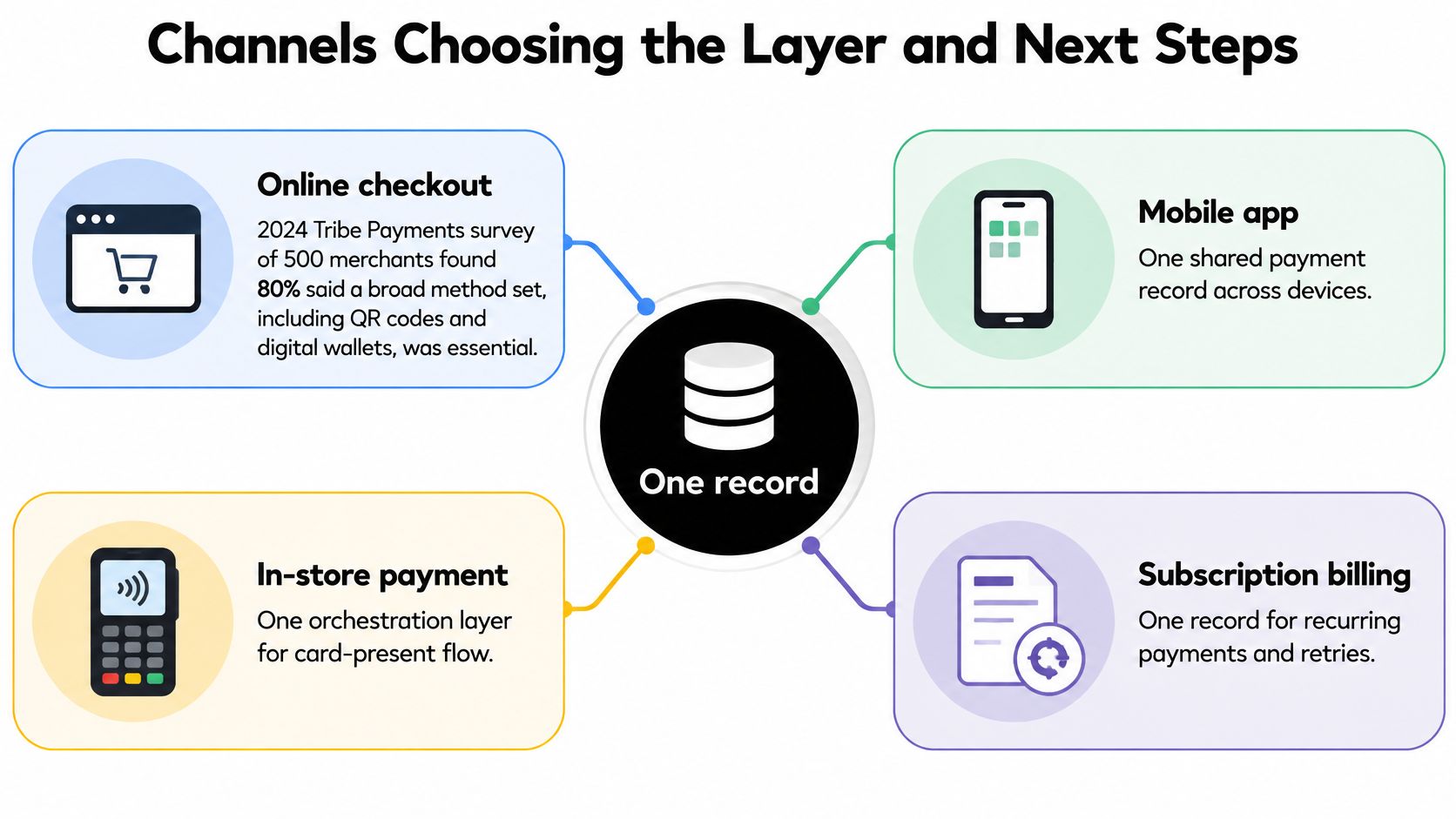
Follow the customer across channels
Online checkout. A customer browses on a phone and completes the purchase on a laptop. Keep the cart and payment status connected, and present eligible payment methods without asking the customer to enter card details again unnecessarily. The saved payment credential and the customer's consent need clear ownership.
Subscriptions. Each billing period is a separate payment attempt. Give each renewal its own idempotency identity, then reuse it for retries of that renewal. The next period needs a new identity. Apply the established token and authentication approach, and configure account updating where supported before starting customer-facing dunning.
B2B. A wholesale buyer approves a draft order, pays an invoice, and later receives a partial refund. Record those events with the commercial order so inventory, tax, and receivables reflect the same outcome. If a payment provider marks an invoice paid but the commerce record does not update, fulfillment can stall.
In-person. A shopper returns an online purchase at a counter. Staff need the original payment reference, item history, and refund eligibility, not just a matching customer email. Card-present payments need a supported integration of their own, while returns and loyalty should remain connected to the customer's purchase history.
Buy the layer or embed the control
A specialist orchestration layer can suit a business that already operates several acquirers, has finance staff to reconcile settlements, and wants to keep its existing commerce architecture. It adds payment control without requiring a full commerce-platform replacement.
Embedding orchestration in the commerce platform can work better when declines, subscriptions, refunds, and inventory need to share one operational record. The decision is about who will own payment correctness, security, maintenance, and incident response over time.
When to buy orchestration and when to build it in
| Criterion | Buy a specialist layer | Build it into the commerce platform |
|---|---|---|
| Token portability | Agree on vault exit and network-token rights before signing | Keep tokens with brand-owned PSP accounts where supported |
| SCA and mandates | Check exemptions and evidence after a route change | Associate consent and authentication evidence with the subscription |
| Idempotent renewals | Require one payment-intent identity across PSP attempts | Use the renewal's identity throughout checkout and dunning |
| Settlement ownership | Avoid pooled balances that are difficult to exit | Send payouts through the brand's own processor account |
| Fraud versus policy | Specify who can decline and who can retry | Record policy outcomes with the order |
| Channels | Add POS and B2B only with reconciliation support | Keep online, wholesale, and counter sales on one lifecycle |
Compare total cost of ownership, including connector upkeep, reconciliation staffing, incident handling, and migration time. More processor connections can add fraud variation and customer churn if routing changes break authentication context, token use, or payment consent. The goal is incremental approved gross profit, not a longer integration list, with customer consent remaining usable and portable where provider arrangements permit.
For commercial discovery, merchant outreach insights from Lead Printer can inform conversations with merchant-facing staff. Keep those conversations separate from technical acceptance: reported pain points can shape requirements, but they do not demonstrate correct timeout recovery or token portability.
Make onboarding the last step of discovery
For PlatformDTC, Stripe provides payment processing and payouts and carries out KYC/AML checks. Stripe is described as a PCI DSS Level 1 service provider. Card details go into Stripe-hosted fields and never reach PlatformDTC servers. PlatformDTC is not a regulated financial institution, and it does not hold a balance between a sale and its payout; a brand that leaves keeps its processing relationship.
Before onboarding, inventory current processors, token owners, payment-account countries, renewal authentication treatment, settlement destinations, and customer-facing payment URLs. Assign an owner to each unresolved dependency. Then test representative purchases, renewals, refunds, and provider failures before cutover.
A business must create a PlatformDTC account and complete Stripe Connected Account onboarding to accept payments. Start that process once you know which credentials can move, which customer agreements remain usable, and how finance will verify settlement. That is a more useful selection criterion than counting processor logos.
PlatformDTC brings checkout, subscriptions, payments, inventory, and fulfillment onto a shared order lifecycle, with governed APIs for agent actions. Visit PlatformDTC to assess how that approach fits your payment inventory, token-migration requirements, and settlement model.