Stop treating matching row counts as proof that a migration worked. That's the most popular advice in this space, and it's the reason brands cut over with clean tables and broken subscriptions, orphaned payments, and consent records nobody can legally use. Identical record counts can hide broken commerce lifecycles.
Good migration testing tools don't just compare tables. They follow an order through payment, fulfillment, refund, and renewal across the old and new stacks, and they force a measurable pass or fail before anyone touches DNS. If a check can't produce a discrepancy log with a threshold, it's an opinion, not a test.
Table of Contents
- Migration Testing Tools by Check Type
- How to Build a Migration Test Plan Step by Step
- Environments and Parallel Runs to Set Up
- Applying PlatformDTC Migration Utilities
- Record and Business Checks That Prove Migration Is Correct
- Using AI-Assisted Testing Without Missing Revenue Errors
- Confirm Your Cutover Go or No-Go Decision
Migration Testing Tools by Check Type
No single tool covers a migration, so pick one tool per check type. A reconciliation engine won't run your checkout, and a browser test won't find a missing foreign key in two million line items.
| Check type | Example tools | What it proves |
|---|---|---|
| Source profiling | Great Expectations, Talend Data Quality | Null rates, distributions and duplicate baselines before migration |
| Row and key reconciliation | Datafold data-diff, QuerySurge | Matching row counts, missing keys and column-level value differences |
| Transformation logic | dbt tests, custom SQL assertions | Mapping rules and derived fields produce the specified output |
| Load and cutover window | Apache JMeter, k6 | Throughput, retries and concurrency hold under production-like traffic |
| End-to-end journeys | Playwright, Selenium | Checkout, login, subscription renewal and refund flows work on the new stack |
What Each Row Actually Catches
Source profiling comes first, before any data moves. Tools like Great Expectations or Talend Data Quality set your baselines for null rates, value distributions, duplicate keys, and edge cases like zero-value orders or legacy IDs. Without those baselines, you can't tell whether a null in the target is a migration bug or a faithful copy of bad source data.
Row and key reconciliation is where Datafold data-diff or QuerySurge earns its place. They compare row sets, run key anti-joins, and surface column-level differences at volume. Transformation tests, usually dbt tests or plain SQL assertions, do a different job. They prove a derived field, say a recalculated tax-inclusive price, matches the specification rather than whatever the loader happened to produce.
Load tools such as Apache JMeter or k6 show whether the new stack holds throughput, retries, and concurrent checkouts inside your cutover window. That's also where your integration surface matters, so test the endpoints described in our guide to e-commerce API integration under load, not just in isolation. Playwright or Selenium then run the human journeys, login, checkout, subscription renewal, and refund, that data tools can't see.
How to Choose Without Wasting a Month
Onboarding speed isn't a soft preference. In 2024, 73% of more than 500 IT and business leaders surveyed by Opkey said that ease and speed of onboarding was a top priority when evaluating or purchasing a new testing tool, according to Opkey's State of ERP Testing report summary.
Practical rule: Favour migration testing tools your team can run within a week over tools that need a specialist you don't have.
Shortlist two tools per check type and run each candidate on a 1,000-record sample before committing. Drop any tool that can't export row-level failures your team can rerun.
How to Build a Migration Test Plan Step by Step
A plan that starts with the import is already late. The sequence below starts with evidence about the source and ends with monitoring, because defects found after cutover cost you rollback time you no longer have.
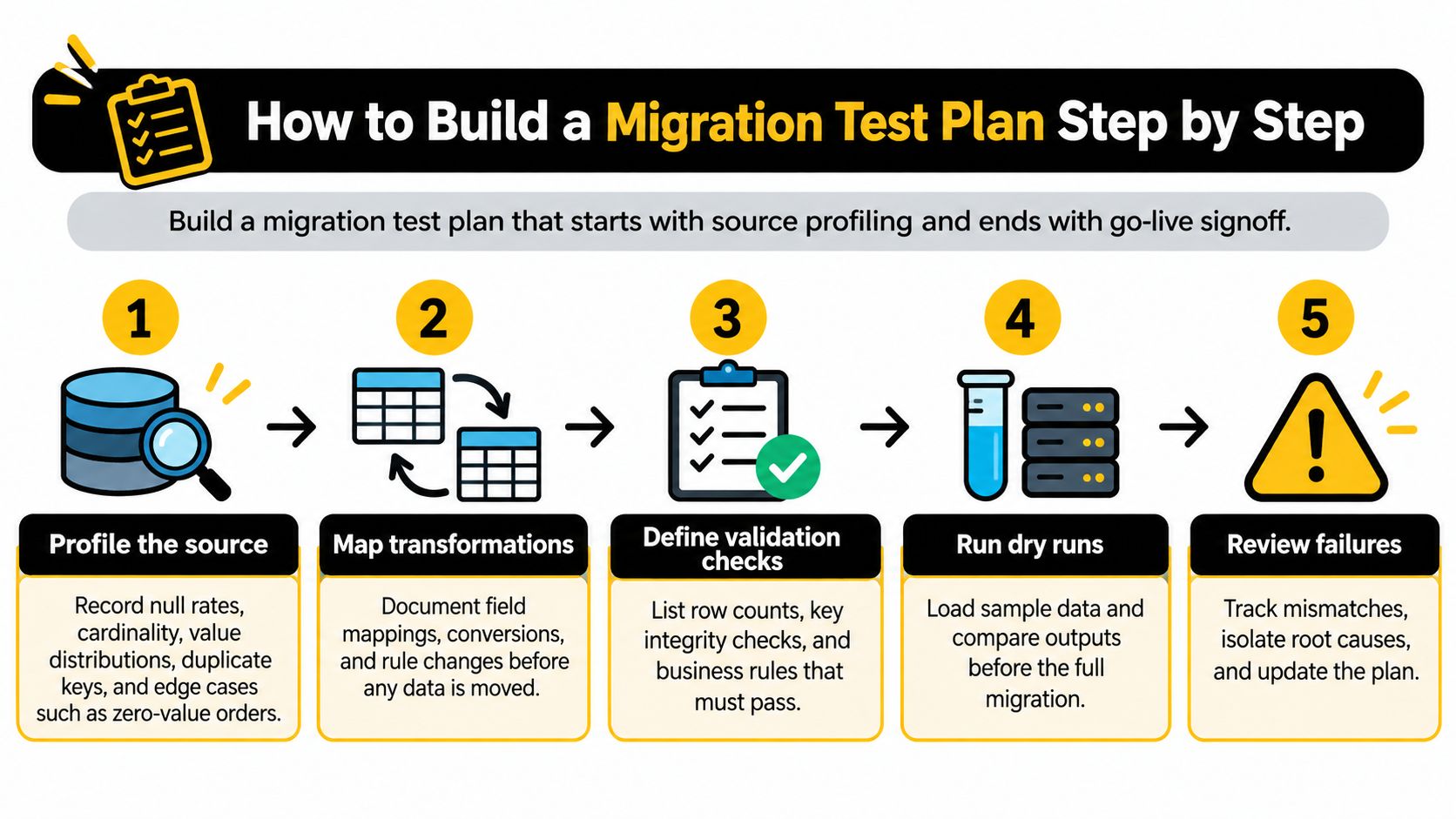
The Eight Steps in Order
- Profile the source. Record null rates, cardinality, value distributions, duplicate keys, and edge cases such as zero-value orders and legacy IDs. Teams skip this when the source looks clean, then waste days arguing about whether target anomalies are new.
- Document mappings in one sheet. List field mappings, filters, generated fields, and intentional transformations, and make every test cite that sheet. If a transformation isn't written down, nobody can test it.
- Run a pilot on representative data. Include your messiest catalog branches, partial refunds, and cancelled subscriptions, not only the cleanest tables. A pilot built from easy records proves almost nothing.
- Run at least two production-like mock migrations. The first finds volume and timing problems. The second proves your fixes and rehearses the window.
- Automate the core comparisons. Script row counts, key anti-joins, aggregate totals, and cryptographic hashes so every run repeats identically. Manual spot checks don't survive a second mock run, let alone an audit.
- Validate each transformation layer. Test staging, mapping, and load separately instead of comparing only the final systems. A bug introduced in an intermediate layer can disappear from view by the final table.
- Exercise behaviour, not just data. Run transactions, retries, concurrency, rejected writes, batch jobs, and rollback. A rejected write that succeeds unnoticed is a revenue defect.
- Monitor after cutover. Keep the same reconciliation jobs running against live traffic and alert on drift. Cutover ends the rehearsal, not the testing.
This walkthrough shows the same discipline applied to a live test run.
Diligence Items Teams Forget
Migrating an existing brand to PlatformDTC is a diligence exercise about payment tokens and URLs before it is a data import. List payment tokens, webhook endpoints, and storefront URLs as their own test items, each with an owner and a pass criterion. Treat our migration utilities for catalog import and parallel running as the first test target, not as a trusted black box.
Close the plan with a template header that names scope, owners, environments, entry and exit criteria, and sign-off roles. If nobody is named, nobody signs, and you'll get a verbal go-ahead that evaporates when finance finds a mismatch.
Environments and Parallel Runs to Set Up
One staging environment can't do four different jobs. You need separate spaces for learning, rehearsing, and comparing live behaviour, each with its own data and refresh rhythm. Our overview of ecommerce platform migration sets out where these environments sit in the wider move.
| Environment | Data set | Purpose | Refresh rhythm |
|---|---|---|---|
| Pilot | Representative sample of catalog, customers and orders | Mapping and profiling checks | After each mapping change |
| Mock migration 1 | Full copy of source data | Full run and load timing | Fresh copy before the run |
| Mock migration 2 | Full copy including latest changes | Rehearsal of the cutover window | Fresh copy one week before cutover |
| Parallel run | Live source with continuous sync | Daily comparison of both stacks | Continuous until exit criteria are met |
How the Environments Feed Each Other
The pilot uses a representative sample to test mappings and profiling, and you refresh it after every mapping change. It's cheap to rebuild, so rebuild it often. Stale pilot data is how fixed bugs get reported twice.
Both mock migrations use full copies of the source, so you can time the load and measure the cutover window instead of estimating it. The second mock carries the latest changes and should run under cutover conditions, same freeze rules, same operators, same runbook. If the second mock overruns your window, you don't have a scheduling problem, you have a scope problem.
The parallel run keeps the source live with continuous sync while the new stack processes a share of internal or test orders. Compare the two stacks daily and keep the source authoritative until your exit criteria are met. The moment staff start fixing data in the target by hand, your comparison stops meaning anything.
Sync Gaps and Privacy
Orders placed after the snapshot aren't failures. List them separately in the diff, or your discrepancy log fills with noise and real defects hide inside it.
Say your snapshot lands at midnight and a customer orders at 00:20. That order belongs in a sync gap list with its own count, reconciled once the next sync lands. Mask customer personal data in every non-production copy, but keep realistic distributions for order values, product mix, and subscription cadence. Tests run on sanitised, flattened data won't expose the rounding and cadence bugs that matter.
Set a refresh rhythm and a named owner for each environment before the first mock run starts. Ownership decided mid-incident is ownership nobody has.
Applying PlatformDTC Migration Utilities
Treat the utilities as the system under test. They import your catalog and run the new stack in parallel, which makes them the fastest route to evidence and the easiest place to fool yourself.
Run the Utilities Like a Test Subject
- Import a pilot catalog into the test environment and save the full import log, including rejected rows and mapping warnings. A summary count without the rejects is marketing, not evidence.
- Compare imported catalog and customer records against the source using the profiling baselines from your plan. Check distributions and duplicates, not just totals.
- Start the parallel run for a share of internal or test orders and let the utilities log every order, payment, and refund on both stacks. You want paired records you can diff line by line.
- Run verification checks on each daily sync and export results to the discrepancy log. List orders placed after the snapshot as sync gap items rather than failures.
- Re-run the same pilot after each mapping change and record the run ID, date, and owner for audit. Repeatability is what separates a fix from a lucky run.
The Slip That Passes Catalogs and Fails Cutovers
The common slip is treating a clean catalog import as a pass while payment tokens, webhook endpoints, and storefront URLs remain untested. Give those three their own pass criteria before any cutover rehearsal. Test a tokenised renewal charge, fire each webhook and confirm the handler responds, and crawl your key storefront URLs for redirects that drop campaign parameters.
Budget the operational side with the same care. If your support desk will field migration fallout, budgeting for Freshservice licenses from DataLunix is a useful reference for what that capacity costs, so support tooling doesn't become a surprise line item mid-cutover.
I would block the rehearsal until all three diligence items pass on the pilot. A catalog you can browse but can't charge against isn't a store.
Record and Business Checks That Prove Migration Is Correct
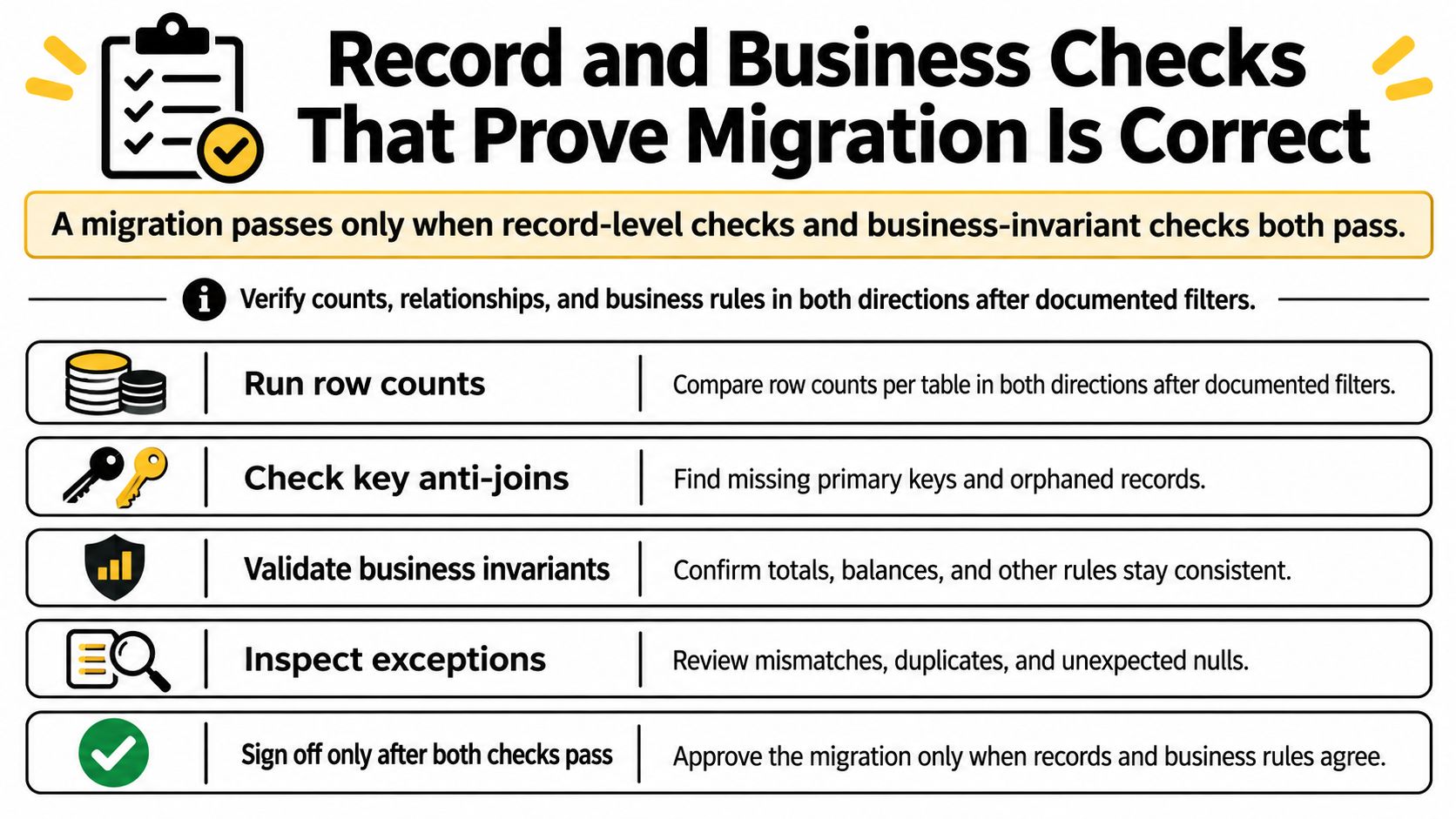
A migration passes only when record-level checks and business-invariant checks both pass. The first set proves records arrived. The second proves the business still works.
The stakes aren't theoretical. Bloor Research's September 2007 study found that more than 60% of projects overran their planned schedule, budget, or both, while industry spending on data migration was estimated at more than $5 billion annually at the time, as summarised in Dajon's review of how you know a migration worked. Those overruns came from weak disciplines and poor understanding of source and target data, not from slow file transfers.
Record-Level Checks and Their Gates
| Check | Method | Pass threshold |
|---|---|---|
| Row counts per table | Source and target COUNT(*) by table | Exact match after documented filters |
| Primary key set | Anti-join in both directions | Zero missing keys |
| Aggregate totals | Sum of order value, tax, refunds and quantities | Exact to the cent unless finance sets a tolerance |
| Row hashes | Hash of a canonical field set per record | Zero mismatches on the sample and the full set |
| Referential integrity | Orders to customers, line items to SKUs | Zero unresolved critical violations |
Run row counts per table in both directions after documented filters, then key anti-joins that list every primary key missing from either side. Add aggregate totals for order value, tax, refunds, and quantities, plus hashes over a canonical field set to catch precision, encoding, or rounding changes that counts can't see. Finish with referential integrity, every order linked to a customer and every line item linked to a SKU.
Log each discrepancy by severity. Critical covers missing keys and broken links, major covers totals outside tolerance, and minor covers formatting. Independent migration guidance reports that organisations using strict data-validation processes experience 43% fewer post-migration data incidents, while thorough testing is associated with 45% fewer post-migration issues, figures cited in Valorem Reply's guidance on cloud migration challenges.
Business Invariants That Must Survive
Now test the lifecycle, because identical counts don't prove it works.
- Orders reconcile end to end: Every order matches its payment and fulfilment state, including refunds and partial shipments.
- Subscriptions keep their terms: Cadence, next-charge date, and entitlement stay intact, so a monthly subscriber isn't moved to weekly billing.
- Inventory reconciles across channels: Online, POS, and B2B totals agree, with no double-counted reservations.
- Discounts apply once: Usage limits and single-use codes keep their history, so a redeemed code can't be redeemed again.
- Consent and attribution stay usable: SMS and email consent survives with its source, and orders still link to campaigns in the views described by our ecommerce analytics dashboard guide.
Check the commercial paths too. PlatformDTC Checkout offers flexible shipping methods and rates set by the merchant, priced by the destination the shopper enters, so test that migrated rate tables price the same basket identically on both stacks.
Reconcile every order and payment in full, sample content and analytics, and keep monetary tolerance at zero in cents unless finance documents a rounding rule. Join legacy IDs through a separate lookup table rather than overwriting new keys. Finish with a sign-off packet listing each invariant, its result, and any accepted exception with a named approver.
Using AI-Assisted Testing Without Missing Revenue Errors
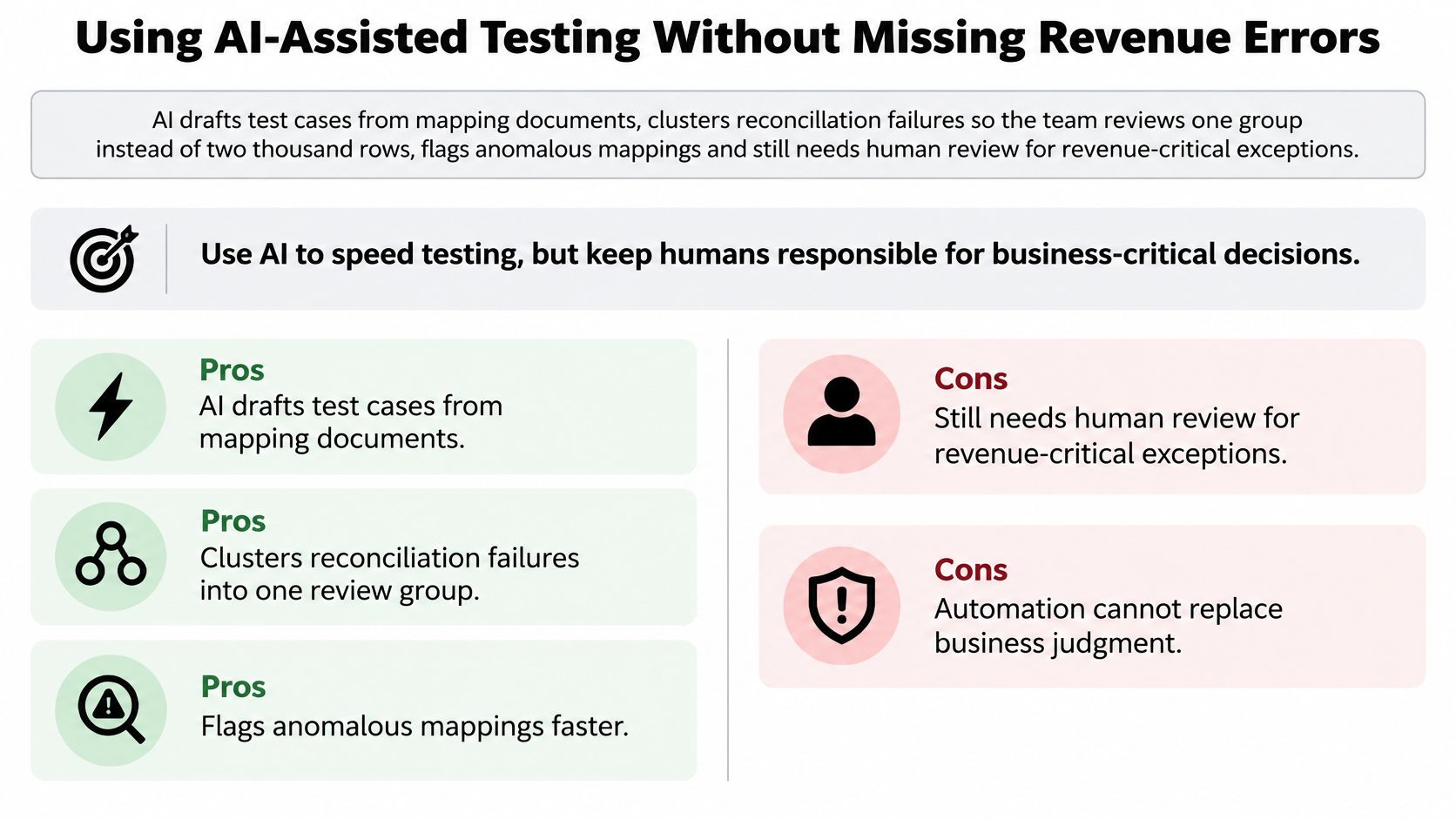
AI is useful inside migration testing tools, but only inside a boundary you set in advance. Let it draft test cases from mapping documents, cluster reconciliation failures so your team reviews one group instead of two thousand rows, flag anomalous mappings, and maintain browser tests after interface changes. Don't let it decide alone on payment totals, customer consent, tax, inventory availability, or the cutover itself.
What Adoption Numbers Actually Tell You
The 2025 State of Testing report found that machine-learning/AI testing adoption rose from 7% in 2023 to 16% in 2025, and 39% cited reduced manual work and faster execution as an AI benefit, according to the 2025 State of Testing report. A separate 2025 barriers study found more than 75% viewed AI-driven testing as strategically important, but only 16% reported adoption, as cited in that same source material. That gap is healthy scepticism, not lag.
For wider context on where automation helps and where it overreaches, AI's growing role in quality assurance from Zee Palm is a fair primer. Read it for capabilities, then apply your own gates.
Guardrails You Set Before Any Run
- Precision and recall for anomaly detection: Measure both, because high recall with poor precision buries reviewers.
- False-positive review cost: Count the minutes each bad flag costs, and cap it.
- Deterministic coverage: State the share of revenue records covered by SQL checks. I would require all of them.
- Reproducibility: The same input must produce the same flags on a repeat run.
- Approval thresholds and rollback triggers: Name who approves AI-cleared sets and what result forces a rollback.
AI prioritises the review queue. Deterministic checks prove every revenue record.
To prove AI missed nothing, run deterministic checks over the full revenue population and compare them with the sets AI flagged or cleared. Any revenue discrepancy found by SQL but cleared by AI ends the experiment until you understand why.
Govern agent access the same way. PlatformDTC agents can build storefronts, run campaigns, and answer support through scoped keys, an audit log, and per-agent keys that are restricted and revocable one at a time, with any spending action waiting for a person. Apply that pattern to testing agents too, narrow keys, logged actions, and a human on anything irreversible.
Confirm Your Cutover Go or No-Go Decision
Go only when every criterion is green or carries a signed exception. Otherwise you hold or you roll back. A majority vote in a tired room isn't a criterion.
The Exit Criteria Checklist
- Keys and links at their gates: Zero missing primary keys and zero unresolved critical referential-integrity violations.
- Totals inside tolerance: Order value, tax, refunds, and quantities exact to the cent, or inside a tolerance finance signed.
- Every business invariant signed: Orders, subscriptions, inventory, discounts, consent, and attribution each carry a named approver.
- Load and latency inside your targets: Measured on your storefront, under production-like load.
- Rollback rehearsed and timed: Proven inside the cutover window, not described in a document.
Set latency targets by measuring your own storefront with Playwright or Selenium and comparing page timings on the old and new stacks, rather than relying on vendor figures. For reference, PlatformDTC Checkout has a median time to first byte of 46ms and a largest contentful paint of 180ms, measured with Playwright over ten runs in August 2026, and uptime monitoring is published live at status.platformdtc.com. Your gate should still be your measurement on your catalog.
Downtime belongs in this decision. The 2005 Softek Data Migration Study reported that approximately 83% of migrations experienced problems, with unexpected downtime identified among the leading issues, as summarised in Zinstall's research on data migration failure rates, though sample descriptions differ across summaries, so treat it as a historical industry indicator. Record your measured window from the mock runs and compare it with your agreed downtime budget.
If you're sequencing a wider platform launch alongside the move, plan your CEF platform rollout from CEFCore offers a complementary go-live structure. After cutover, keep the parallel source available for a fixed rollback window and watch error rates and checkout completion daily.
Your next step is small and concrete. Run a pilot of one catalog and one month of orders through the utilities, check the results against these criteria, and decide from the evidence.
Put that pilot on a platform built for parallel running, catalog import, and verification before cutover, with storefront, checkout, subscriptions, and payments on one record. Start your migration test plan with PlatformDTC and let the discrepancy log, not optimism, make your go or no-go call.