A week before launch, the founder is still answering questions that should have been closed months ago. Which system owns inventory? Why does a test order create two fulfillment records? Why does the staging checkout pass until a customer uses a stored payment method? At 11:40 p.m., a PagerDuty board is filling with failures, while the team insists staging mirrors production.
That situation is common because ecommerce platform migration is an operations change with revenue exposure, not a database export. The platform may be new, but the business still has to price products, authorize payments, decrement stock, fulfill orders, send messages, preserve organic visibility, and reconcile finance records without ambiguity.
A disciplined migration treats every handoff as a control point. The work starts with system discovery, moves through repeated imports and parallel validation, and ends with an observable cutover that has named owners and a credible rollback. The platform choice matters, but the operating method matters more.
Table of Contents
- Why Most Migrations Break Before Cutover
- Inventorying Systems, URLs, and Data Before You Touch a Database
- Catalog Import That Survives a Second and Third Dry Run
- Choosing a Parallel Run Pattern That Actually De-Risks Revenue
- Verifying Orders, Payments, and Inventory End to End
- The Cutover Hour Checklist and Rollback Triggers
- Defending the Migration as a Revenue Decision
Why Most Migrations Break Before Cutover
At 9:00 a.m., the new storefront passes a guest checkout. By noon, a returning customer's subscription renewal creates a duplicate fulfillment record, the returns portal cannot find the order, and a promotion calculates a different total. The DNS change has not happened. The migration is already failing.
The defect usually begins with an incomplete map of the existing operation. A returns portal may read from a legacy order table excluded from scope. A product metafield may drive a comparison module on the product detail page. A webhook subscription may still send events to an old fulfillment service. Tax tables may be updated manually before campaigns, while a custom checkout script applies a discount that exists nowhere in the official promotion rules.
A product export will capture none of those dependencies. They appear when real workflows cross system boundaries, often during the parallel-run window when old and new outputs should be compared.
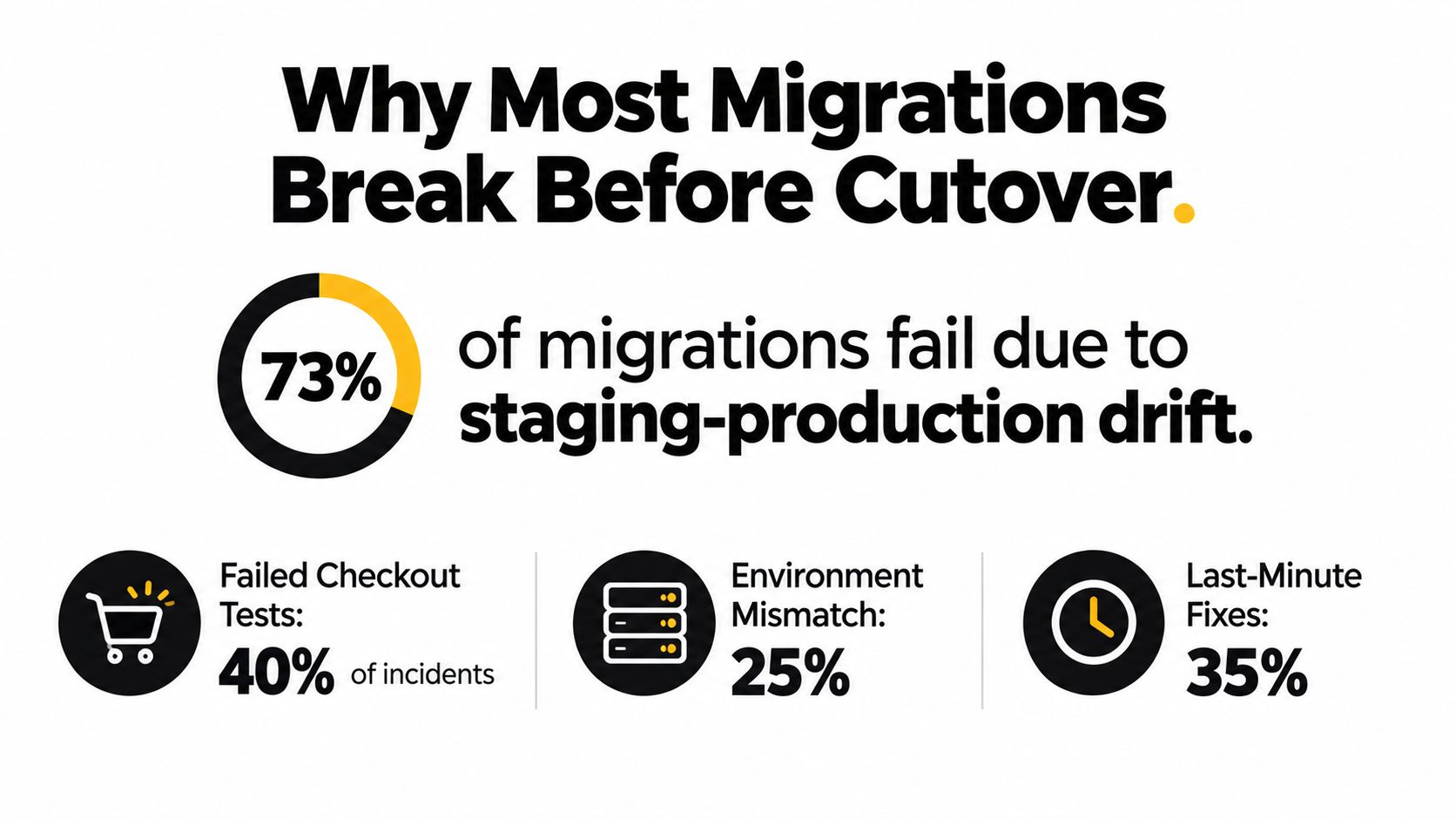
The failures that hide in the gaps
The expensive defects tend to sit between systems:
- Webhook ownership: Old subscriptions keep sending events, or new subscriptions fire twice.
- Payment identity: Customer payment tokens do not transfer, or the new gateway interprets a stored reference differently.
- Tax and pricing logic: A stale rate table, rounding rule, or promotion priority changes the final amount.
- Checkout customization: A script handles gift cards, subscriptions, or address validation but is missing from the functional specification.
- Environment drift: Production credentials, feature flags, product data, queue settings, and third-party callbacks differ from staging.
A clean guest checkout proves very little. Test returning customers, subscription renewals, refunds, gift cards, address changes, and fulfillment callbacks, then compare the resulting records across both platforms. The test plan must describe business scenarios, expected system events, reconciliation checks, and the owner who investigates a mismatch.
Practical rule: If nobody can name the owner, source of truth, consumer, and failure response for a data flow, that flow is not ready for cutover.
The commercial case supports disciplined testing. A 2024 survey of large ecommerce businesses found that 90% of recent migrators reported improved sales and revenue, while 94% said site performance improved after migration. The same commercetools survey found that 77% of respondents planning a platform change expected to migrate within the next year. These are self-reported outcomes from a vendor-sponsored survey of large merchants, so treat them as directional rather than as a forecast for a specific store.
The practical target is controlled operation, not feature parity on a demo site. Before cutover, document every integration, compare parallel transactions, confirm production configuration, and define the rollback trigger. Revenue stays protected when undocumented dependencies, mismatched data models, and untested production behavior have an owner and a response.
Inventorying Systems, URLs, and Data Before You Touch a Database
Start with discovery, not an importer. The first useful artifact is a system map that shows every service reading from or writing to the storefront.
Include the ERP, CRM, tax engine, payment gateway, subscription service, warehouse connector, returns portal, review platform, email provider, analytics property, tag manager, advertising pixels, fraud tools, search service, customer support system, and any scheduled file exchange. Record the direction of each flow, its authentication method, its owner, its retry behavior, and what happens when the connection fails.
Then build a URL map. Crawl the current storefront and combine that output with sitemap files, analytics landing pages, search console data, redirect rules, campaign links, and URLs embedded in email templates. Capture canonical URLs, parameterized variants, redirect chains, discontinued products, filtered collection pages, blog routes, and customer-facing account paths.
The question is not just whether an old URL has a replacement. It is whether the replacement preserves the same user intent, metadata, internal links, and commercial destination. URL structures, metadata, and redirect logic are repeatedly identified as essential protections against traffic and ranking loss in independent ecommerce migration guidance.
Build a data dictionary with ownership
A data dictionary should name each entity, its source of truth, its identifier, its transformation, its consumers, and its retention decision. Include products, variants, customers, addresses, orders, refunds, subscriptions, discounts, gift cards, inventory locations, media, reviews, pages, redirects, and event records.
The most useful question is often, “What won't move?” Archived accounts, obsolete promotions, abandoned catalog records, and redundant media may create risk without creating value. Make those exclusions explicit and get sign-off from operations, finance, marketing, and customer support.
| Artifact | Owns | Catches |
|---|---|---|
| System map | Integrations, credentials, owners, event flows | Orphaned webhooks, duplicate writes, undocumented dependencies |
| URL map | Old routes, new destinations, redirect rules, metadata | Broken links, redirect chains, lost landing pages |
| Data dictionary | Entities, fields, identifiers, transformations, consumers | Missing attributes, ambiguous ownership, incompatible schemas |
| Process register | Manual tasks, approvals, exception handling | Workarounds that never appear in API documentation |
Teams with complicated legacy estates may also benefit from finding data modernization partners when the migration includes fragmented databases or undocumented interfaces. That decision should follow the inventory, not replace it.
For storefront-specific architecture decisions, document the target model alongside the current one, using the custom ecommerce solution guide as a prompt for questions about ownership, extensibility, and operational fit. Don't write migration code until these artifacts have named owners and a review date.
Catalog Import That Survives a Second and Third Dry Run
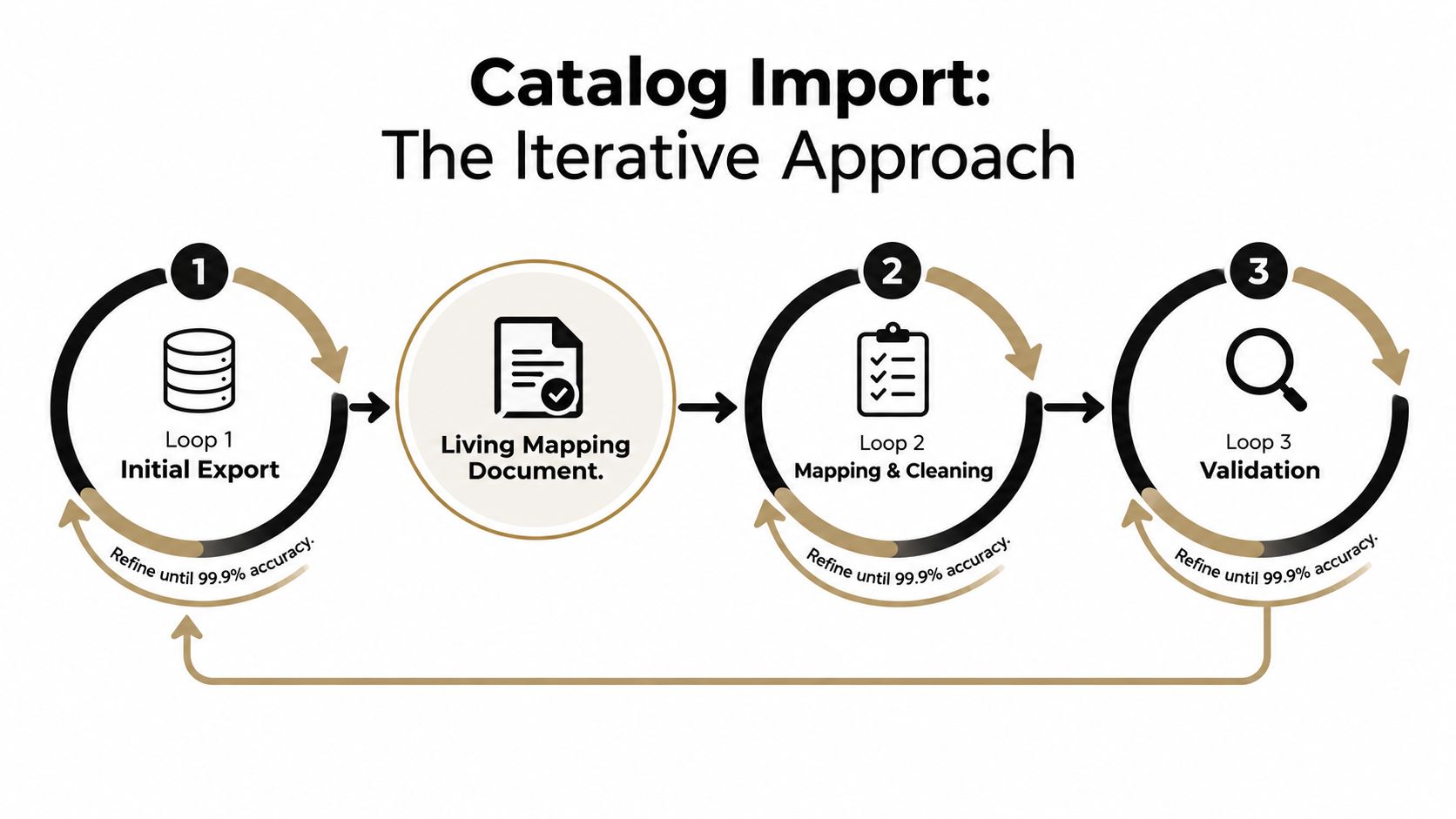
A catalog import is a controlled transformation pipeline, not a one-time upload. It needs an export, a mapping layer, validation checks, and an explicit decision for rejected records. Treat each run as evidence about whether the new system can support merchandising and revenue operations.
The mapping document should remain a living control file. For every field, record its source, destination, transformation, validation rule, owner, and exception behavior. A product title may transfer unchanged. A rich description may need HTML normalization. An option set may require restructuring instead of flattening. An image URL may need a CDN rewrite, while a weight may require unit conversion. An inventory location identifier may have no equivalent in the destination system, which requires an agreed fallback before cutover.
The first dry run should expose defects by design. A missing metafield is not merely a coding error. It may show that the mapping is incomplete, or that merchandising and operations have not agreed on the field's meaning. Record that decision rather than assigning a default value that becomes difficult to trace later.
Validate outputs, not just successful rows
A successful API response proves that the destination accepted a payload. It does not prove that customers can find, configure, purchase, or receive the product correctly.
After every import, compare:
- Record counts: Products, variants, images, categories, and active inventory locations.
- Identifier integrity: SKU uniqueness, parent-child variant relationships, and source-to-target IDs.
- Page rendering: Representative product pages, including configurable products, subscription products, out-of-stock items, and long descriptions.
- Search behavior: Exact SKUs, synonyms, partial terms, and products with multiple option values.
- Commercial rules: Prices, sale prices, tax treatment, availability, subscriptions, and promotion eligibility.
- Media behavior: Image dimensions, alt text, responsive variants, redirects, and missing assets.
Maintain a defect ledger with severity, affected records, root cause, owner, and retest status. Budget at least two full dry runs, ideally three. Later passes expose mapping defects and hidden dependencies that the first run cannot surface.
The same migration methodology reports roughly 25% lower infrastructure costs, about 0.71% higher conversion, 5% higher click-through, and 0.94% higher order volume when a faster, more reliable stack produces those gains. Those figures are not a promise for every store. They show why validation should measure commercial behavior alongside row counts.
Keep the import reversible
Never overwrite the only copy of the source export. Version the raw extract, transformed file, rejected records, and validation report for every run. Make imports idempotent so a retry updates the intended record instead of creating a duplicate product, customer, order, or subscription.
The final dry run should use production-shaped data and production-like integrations while customer-facing writes remain quarantined. Sign-off belongs to the people who manage the catalog daily, including merchandising, operations, and support, not only the engineer who built the importer. That approval should reference the defect ledger and validation report, giving the cutover team a clear record of what passed, what was rejected, and what still requires a controlled exception.
Choosing a Parallel Run Pattern That Actually De-Risks Revenue
Parallel running has different meanings, and each pattern answers a different risk question. Calling every approach “dual running” creates false confidence.
Shadow traffic replays production requests against the new stack without allowing it to write back. It can expose response-time regressions, server errors, routing problems, and differences in rendered responses. It can't prove that inventory, orders, payment states, or customer records remain synchronized.
A read-only mirror keeps catalog, price, and content data aligned for merchandising and storefront QA. It helps teams compare search, filtering, product pages, and promotional displays. It remains weak evidence for checkout, fulfillment, refunds, and other state-changing workflows.
A percentage split sends a controlled portion of real sessions to the new storefront, usually through an edge-routing layer. It reveals behavior synthetic tests often miss, including coupon abuse, unusual addresses, browser-specific checkout issues, and real product combinations. The trade-off is that support and analytics teams must distinguish old and new experiences, while inventory and order ownership must be unambiguous.
Full dual-write commits selected writes to both systems. It's the strongest test of revenue equivalence, but it doubles the write surface. The implementation needs idempotency keys, conflict resolution, retry handling, reconciliation reports, and a designated system of record. Without those controls, dual-write can create two different truths faster than a single platform can create one.
| Pattern | What it proves | What it misses | Cost to operate |
|---|---|---|---|
| Shadow traffic | Request handling, rendering, latency, error behavior | State changes and customer records | Lower |
| Read-only mirror | Catalog, pricing, merchandising, and content parity | Checkout and fulfillment truth | Moderate |
| Percentage split | Real customer journeys and edge cases | Complete system equivalence unless writes are controlled | Moderate to high |
| Full dual-write | Order, inventory, and operational parity | Little, if reconciliation is reliable | Highest |
Use the patterns as a progression rather than a menu. Move from shadow traffic when response and error comparisons are stable. Move from a read-only mirror when catalog and pricing reconciliation is clean. Introduce a controlled session split when support, analytics, and rollback ownership are ready. Add dual-write only when the team can explain what happens if one write succeeds and the other times out.
The exit criteria should be written before the test begins. They should cover error rates, latency, catalog parity, order reconciliation, inventory drift, webhook behavior, and unresolved defects. A parallel run that has no exit criteria is just an extended launch delay.
Verifying Orders, Payments, and Inventory End to End
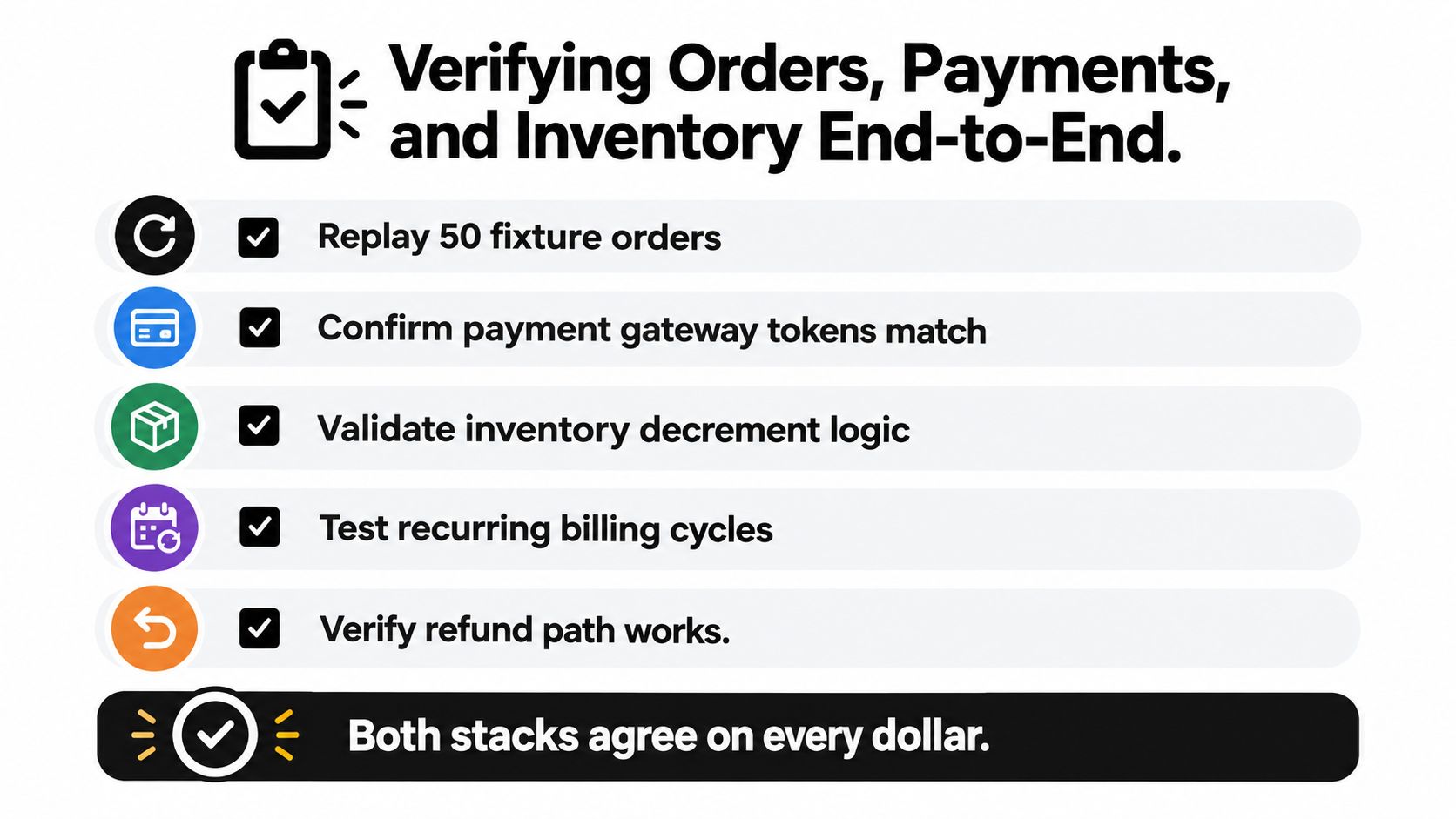
The most convincing test is a known-order protocol that follows a transaction through every system. Build a fixture set from real business scenarios, with sensitive customer information removed or replaced. Include one-time purchases, subscriptions, stacked discounts, gift cards, partial refunds, tax-exempt buyers, address changes, failed payments, and fulfillment exceptions.
For each scenario, compare the legacy and new results at the level finance and operations care about: line items, discounts, tax, shipping, authorization state, captured amount, refund amount, fulfillment status, and final customer communication. “The order was created” isn't enough if the tax line differs or the warehouse receives a duplicate.
Test payment state transitions
Run authorization, capture, void, refund, and webhook reconciliation against the payment provider's approved test environment. Include authentication challenges, address verification outcomes, forced declines, expired sessions, and a retry after a timeout.
Don't assume payment tokens transfer because customer emails transferred. Confirm the relationship between the customer record, payment reference, gateway customer identity, and recurring billing agreement. If the new platform can't use an existing token, define the customer communication and fallback path before launch.
For teams connecting online sales to physical operations, the same test should cover the handoff into the POS integration API workflow. A sale isn't reconciled until the order, payment, inventory movement, receipt, and downstream fulfillment record agree.
Prove inventory behavior under contention
Inventory tests must include concurrent attempts against the same SKU. Place orders through both environments, observe reservation and decrement behavior, and verify that the second attempt follows the intended oversell policy. Repeat the test for multiple locations, backorders, cancellations, partial fulfillment, and returns.
Email testing deserves equal discipline. Snapshot the complete message, including subject, sender, headers, body, dynamic values, tracking links, accessibility structure, and unsubscribe behavior. Test order confirmation, payment failure, shipment, refund, subscription renewal, and account messages.
Classify defects before the final rehearsal:
- Sev-1: Revenue, payment integrity, order creation, inventory integrity, or legal messaging is blocked.
- Sev-2: A major customer or operational path is materially degraded but has a documented workaround.
- Sev-3: A noncritical defect with limited commercial impact.
The launch decision should require no open Sev-1 defects and an explicitly approved disposition for every lower-severity issue. Store the new platform in a quarantine state until the evidence is signed off by engineering, finance, operations, and customer experience.
The Cutover Hour Checklist and Rollback Triggers
Cutover is a controlled operating window, not a dramatic button press. Assign one person to command the incident channel, one to own payments, one to own inventory and fulfillment, one to own SEO and analytics, and one to communicate with merchandising, customer experience, and finance.
Announce the freeze well before the launch. Stop catalog edits, promotion changes, fulfillment configuration changes, and integration releases according to an agreed schedule. Capture a final inventory and order snapshot, confirm backups are restorable, verify that the legacy site remains available, and record the exact build and configuration versions being promoted.
Run the switch as a sequence
A practical sequence looks like this:
- Freeze writes: Pause nonessential changes and record the final queue position for orders and events.
- Enable controlled maintenance: Prevent new checkout writes while the team completes the final reconciliation.
- Promote the approved release: Activate the tested storefront, integrations, payment settings, redirects, analytics, and monitoring.
- Replay queued events: Process orders and integration messages captured during the freeze, preserving idempotency keys.
- Reconcile inventory: Compare the new state with the final snapshot and investigate every unexplained difference.
- Run smoke tests: Place approved test orders, verify payment callbacks, inspect fulfillment events, check email delivery, and test redirects.
- Re-enable checkout: Open traffic gradually if the edge-routing setup supports it, then watch live telemetry before removing safeguards.
The exact time boxes belong in the runbook. Each action needs a named owner, completion evidence, and a next decision. Keep merchandising, CX, and finance updated at a fixed cadence so they can distinguish a planned freeze from an incident.
Rollback must be objective. Examples include a payment authorization failure rate above the agreed launch threshold, unexplained inventory variance, sustained checkout latency beyond the approved limit, duplicate order creation, or a critical transactional email defect. The thresholds should come from the pre-launch baseline and be approved before the window begins, not negotiated while customers are waiting.
Rollback means returning to service, not hiding the evidence. Re-point traffic to the legacy stack, replay any new-stack orders that didn't reach downstream systems, preserve logs, and open the incident channel.
Keep both systems observable after the switch. Maintain the parallel reconciliation window for the agreed stabilization period, watching order IDs, inventory movements, payment states, refunds, subscriptions, redirects, organic landing pages, and customer contacts. Don't decommission the legacy environment while unresolved drift remains.
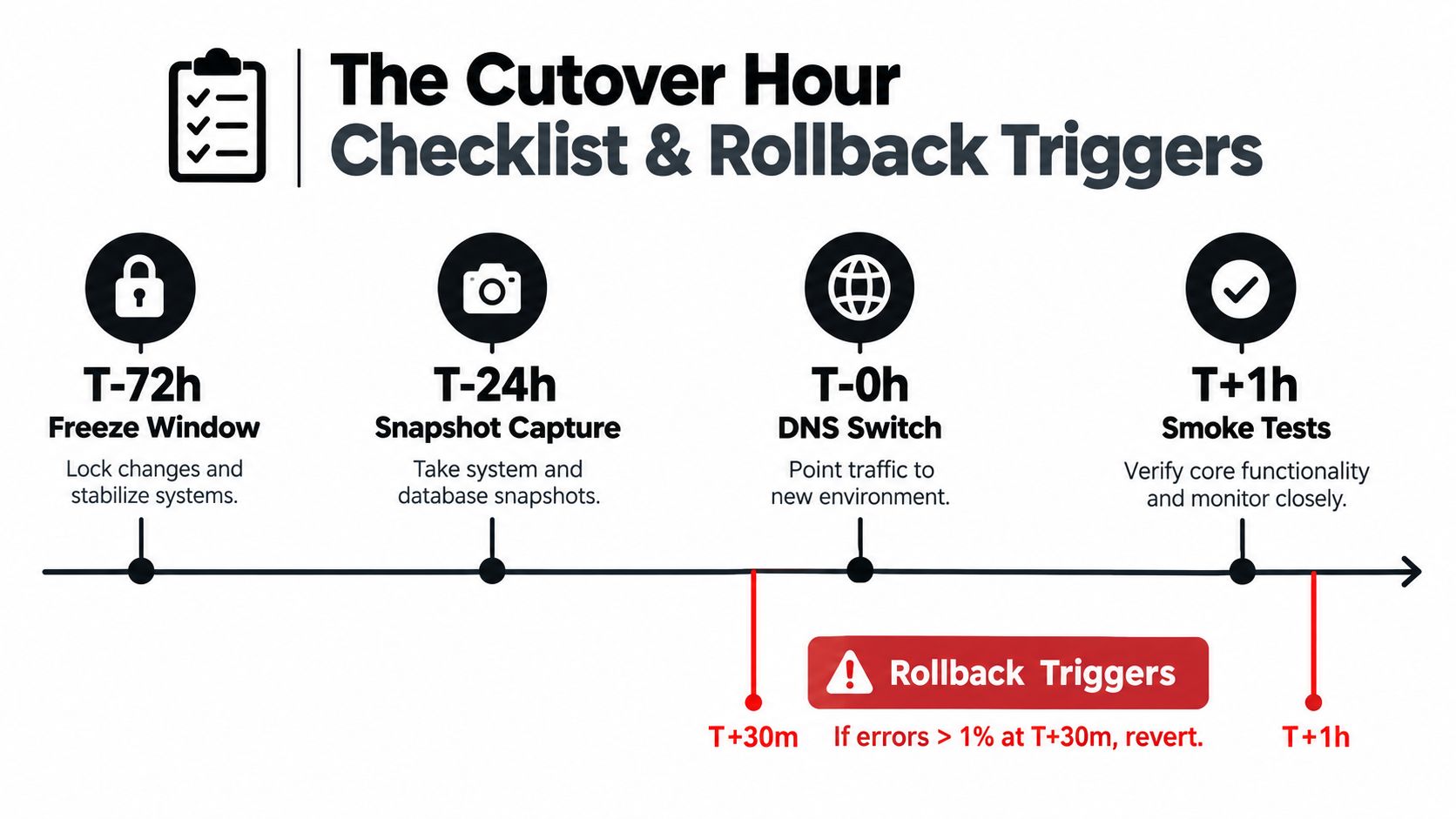
A visual walk-through can help nontechnical stakeholders understand the sequence, provided it supplements rather than replaces the runbook.
Defending the Migration as a Revenue Decision
At the board meeting before cutover, the question is not which platform has the longer feature list. The question is how much revenue is exposed, which controls limit that exposure, how success will be measured, and when the team will stop or reverse the change.
Set the baseline before development changes customer behavior. Record conversion, gross merchandise value, payment authorization outcomes, order volume, support contacts, organic landing-page traffic, organic revenue, checkout performance, refund behavior, and inventory reconciliation results. Segment those measures by device, market, product type, acquisition channel, and customer status where the data supports it. This baseline becomes the reference for the parallel run, cutover decision, and stabilization review.
The business case should separate expected benefit from operational proof. Migration may improve revenue, speed, reliability, or operating cost, but generic industry outcomes cannot stand in for store-specific evidence. Use the store's own trading history to estimate the exposure. If one trading hour is worth €18,000 and the approved risk window is four hours, the board is approving €72,000 of trading exposure, plus the cost of delayed fulfillment. That calculation makes the decision concrete and gives finance a figure to challenge.
Put measurable guardrails around the decision
Use one scorecard that finance, growth, operations, and engineering can read together.
| Metric | Pre-Migration Baseline | Target Post-Cutover | Measurement Window |
|---|---|---|---|
| Conversion rate | Approved legacy baseline | Parity or improvement against baseline | Sustained observation period |
| Gross merchandise value | Historical and parallel-run trend | No unexplained deterioration | Parallel run and stabilization |
| Support contact rate | Billing, shipping, payment, and account categories | Declining trend after operational adoption | Early post-launch weeks |
| Organic landing pages | Indexed routes, rankings, traffic, and revenue | Preserved against mapped baseline | Ongoing post-launch monitoring |
| Reconciliation accuracy | Orders, payments, refunds, and inventory | No unexplained material drift | Every operational cycle |
Make the risk window concrete. Estimate the value of a trading hour, delayed fulfillment, a payment outage, and an SEO regression from company records. Tie each estimate to an owner, a monitoring source, and a decision threshold. Internal order and support data is more useful here than a generic market assumption.
The board pack should contain the reconciliation report, dry-run defect burndown, final cutover runbook, rollback triggers, deferred-scope list, and stabilization plan. It should also explain which automation is required and which complexity is being deferred. For the architecture discussion, AI-native ecommerce architecture insights can help frame governed APIs, permissions, and observability in the commerce stack.
A migration is complete when the new system runs the business reliably, not when the old system stops accepting traffic. A unified operating model can reduce reconciliation boundaries. The unified commerce platform overview is a useful reference when evaluating whether storefront, checkout, subscriptions, payments, inventory, and fulfillment should share a record model.
PlatformDTC provides catalog migration utilities, parallel running before cutover, storefront and checkout, subscriptions, payments, inventory, fulfillment, messaging, analytics, POS, B2B workflows, and governed APIs for controlled automation. Visit PlatformDTC to discuss a migration plan that maps your current systems, validates the new stack in parallel, and gives your team a documented path from import to cutover.