Most e commerce API integration advice starts with the wrong success condition. A 200 OK response proves that a server answered, not that the payment was captured, inventory was reserved, or the order reached fulfillment. In production, a network timeout can arrive after a remote system has committed the business operation, and a retry can turn a temporary communication problem into a duplicate charge or an oversold product.
That distinction matters because digitally ordered commerce now operates at a scale where disconnected systems create material operational risk. UN Trade and Development estimated that businesses in 43 developed and developing economies generated approximately $27 trillion in e-commerce sales in 2022, an estimate covering economies representing roughly three-quarters of global GDP and trade. UNCTAD's e-commerce assessment makes the architectural point clear: integration is commerce infrastructure, not a convenience layer.
Table of Contents
- Rethinking Integration as Failure Convergence
- Designing Secure Authentication and Scoped Permissions
- Implementing Idempotency for Financial Mutations
- Processing Webhooks and Asynchronous Events
- Synchronizing Catalogs and Unified Order Lifecycles
- Executing Negative Testing and Chaos Engineering
Rethinking Integration as Failure Convergence
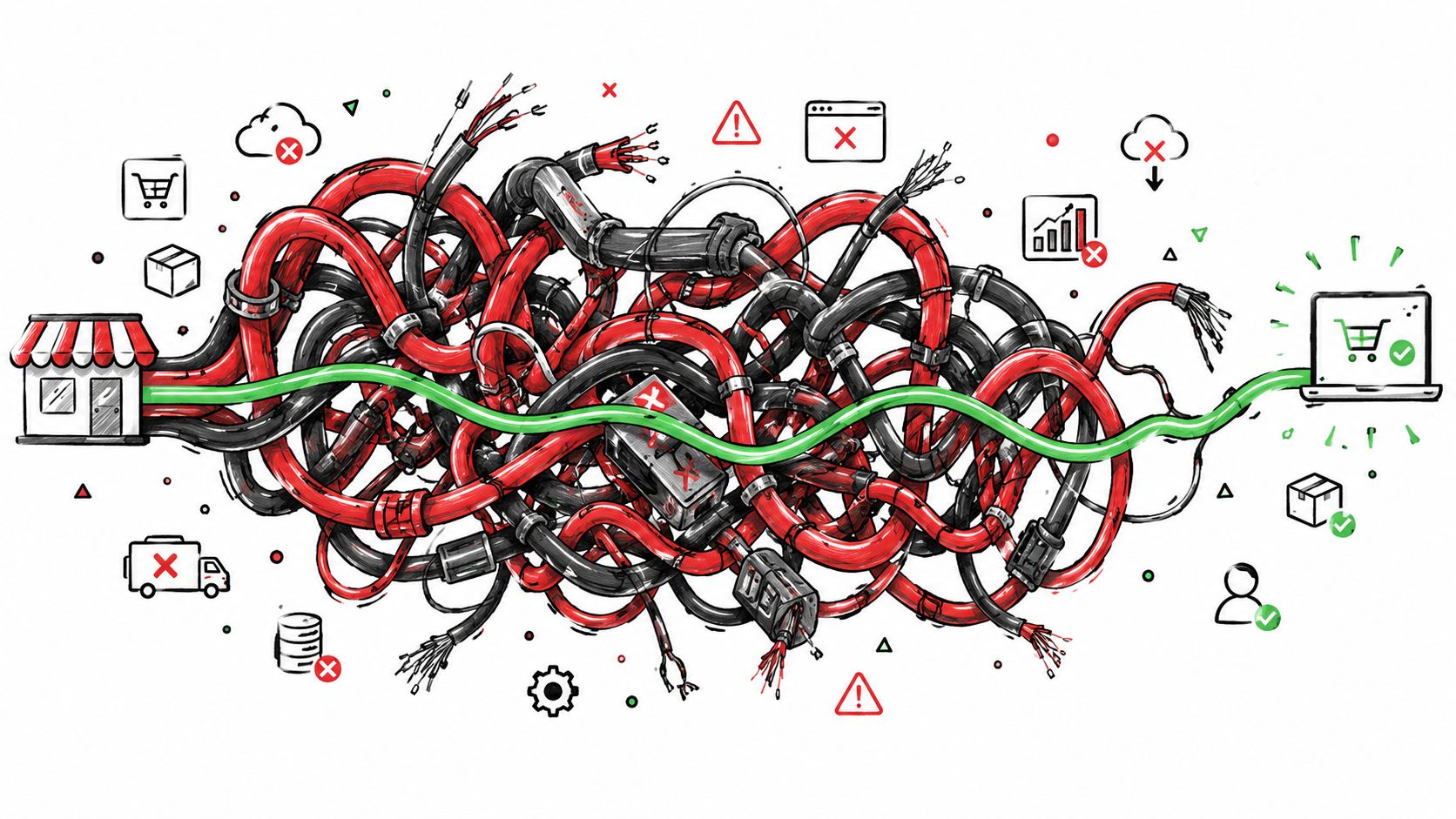
A basic connector moves fields from one endpoint to another. A production-grade integration converges multiple, sometimes contradictory observations into one trustworthy business state. The distinction becomes visible when checkout calls a payment gateway, the gateway authorizes the transaction, and the response disappears before the storefront receives it. The local system sees uncertainty. The provider sees a completed operation.
Treating the integration as a request/response pipeline encourages the wrong recovery action: send the same request again. Treating it as a failure-convergence workflow leads to a safer sequence:
- Define a canonical order and payment state model.
- Map every provider status into that model.
- Assign a correlation ID to each business operation.
- Make every mutating request idempotent.
- Reconcile uncertain local records against provider state.
Practical rule: A timeout is an unknown outcome, not proof that the remote operation failed.
This model also changes how teams handle rate limits and partial outages. A marketplace may accept product updates while throttling order reads. A payment provider may answer authorization requests while its reporting API lags. An inventory service may return a valid response based on stale availability. Each dependency needs its own retry, timeout, fallback, and reconciliation policy rather than one global “retry on error” setting. Teams working with Amazon's Selling Partner API can also review practical guidance on how to navigate SP-API rate limits before designing marketplace synchronization.
The canonical model should describe business meaning, not mirror every vendor's vocabulary. For example, payment_pending, payment_authorized, payment_captured, payment_failed, and payment_unknown are more useful internal states than passing through a provider's proprietary status values. The adapter translates external states into the internal model, while preserving the original status and response for investigation.
A durable operation record should include the correlation ID, idempotency key, provider, external object ID, current state, attempt history, and last observed error. That record gives support and engineering teams a way to answer what happened without reconstructing the event from scattered logs.
The commercial context reinforces the need for this discipline. UNCTAD's estimate of approximately $27 trillion in 2022 e-commerce sales describes a broad measure of digitally ordered commerce, not a niche online channel. At that scale, a duplicated payment or inventory decrement isn't an isolated technical blemish. It becomes a reconciliation problem spanning customer service, finance, warehouse operations, and marketing attribution.
Designing Secure Authentication and Scoped Permissions
API security belongs in the integration acceptance criteria, not in a post-launch hardening ticket. OWASP's API security material identifies broken object-level authorization, broken authentication, unrestricted resource consumption, and unsafe API consumption among major API risks. These failures can occur even when transport encryption and token validation work correctly.
Start with an inventory. List every endpoint, actor, data classification, trust boundary, and mutating action. “The order API” is too broad a description. Separate catalog reads from order writes, refunds from payment reads, customer data from analytics, and marketing actions from operational fulfillment.
Scope permissions by business consequence
A valid access token only proves that a credential was accepted. It doesn't prove that the current action is legitimate. An authenticated caller can still request another customer's order by changing an object identifier if the application checks route authentication but fails to verify object ownership or tenant boundaries.
Use permissions that reflect what the caller can do:
- Catalog access: Read product information, availability, and merchandising data without granting order mutation rights.
- Order operations: Create or update orders only within the permitted store, channel, or tenant.
- Financial mutations: Require separate scopes for captures, refunds, discounts, and payment method changes.
- Customer data: Restrict personal data access to the services that need it, and avoid returning unnecessary fields.
- Agent actions: Put approval gates around spend, refunds, promotions, and irreversible catalog changes.
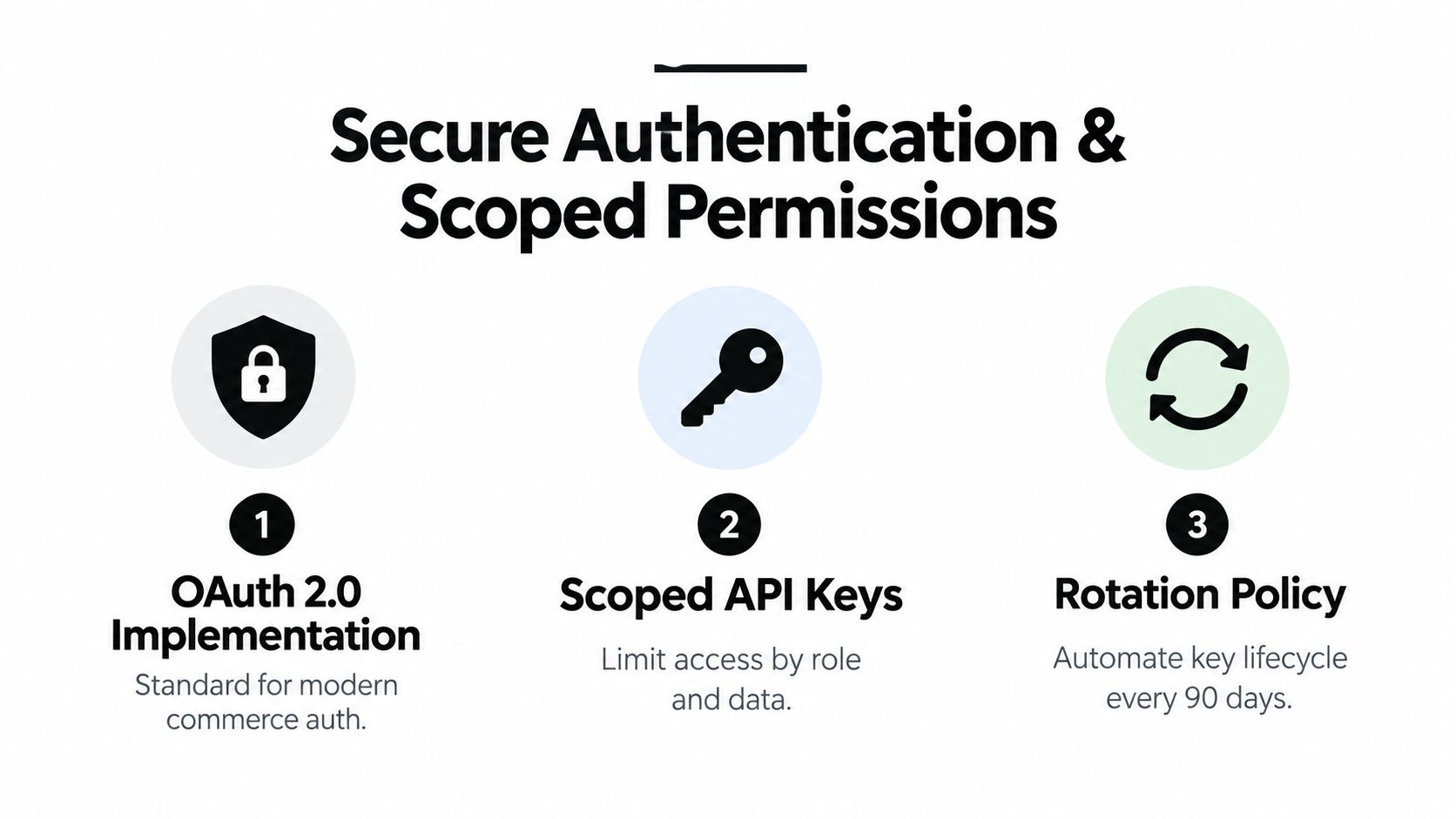
Short-lived credentials, secret rotation, TLS, schema validation, bounded payload sizes, replay protection, and rate limits reduce exposure, but they don't replace authorization. Store secrets in a dedicated secret manager, never in source code or ordinary logs. Rotate credentials through an overlap period so the old and new keys can coexist long enough to avoid an outage.
Log decisions, not sensitive payloads
A useful audit record identifies the actor, credential or agent identity, scope, object, request ID, result, and approval evidence. It should support an investigation without storing payment secrets or unnecessary personal data. For an agent-driven commerce workflow, record the instruction that led to the mutation, the tools invoked, the approval decision, and the final provider response.
Security testing should include altered object IDs, cross-tenant requests, expired credentials, replayed signed events, duplicate writes, excessive pagination, and attempts to escalate from read access to financial mutation. A route that passes a happy-path authorization test isn't ready if it fails when the resource identifier changes.
PlatformDTC is one example of a commerce platform applying this model through governed APIs, scoped agent tools, idempotent writes, approval gates, and audit trails. Teams evaluating PlatformDTC security controls should still map those controls against their own tenants, actors, and approval policies.
Implementing Idempotency for Financial Mutations
Idempotency prevents a repeated request from producing repeated side effects. It matters most for payments, inventory reservations, refunds, subscription changes, and fulfillment actions, where the remote service may commit before the client receives a response.
Generate one durable key for each logical operation, not for each HTTP attempt. A key such as order_123_payment belongs to the payment operation and must be reused across timeouts, connection resets, and safe retries. If a later request uses the same key with materially different parameters, the integration should reject it rather than reinterpret the operation without notice.
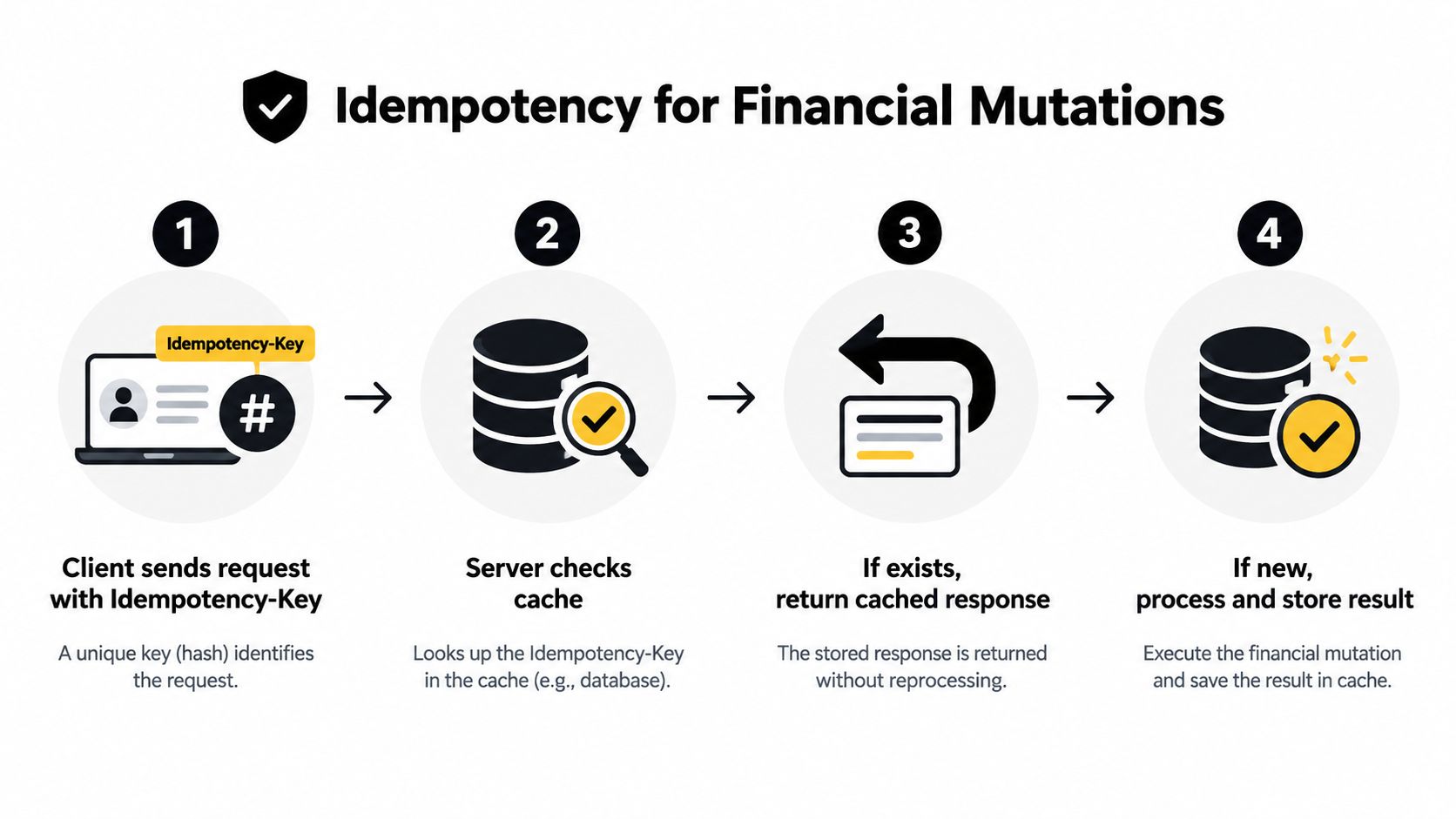
A well-structured mutation flow looks like this:
- Create the local operation record with its canonical state and idempotency key.
- Send the provider request with the same durable key.
- Persist the provider response, external object ID, and resulting state.
- On uncertainty, retry with the original key or reconcile instead of creating a new operation.
Stripe's guidance explains that idempotency prevents duplicate side effects, recommends exponential backoff with jitter, and supports safe retries of keyed requests for up to 24 hours. Stripe's explanation of idempotency is useful because it treats retries as a correctness problem, not merely a network-performance technique.
Classify failures before retrying
Retrying every error is dangerous. Network failures, rate limits, and transient server errors can be retryable. Validation errors, authorization failures, expired payment methods, and deterministic business-rule errors generally require correction or human review.
| Failure type | Safe default |
|---|---|
| Network disconnect or timeout | Retry with the same idempotency key, then reconcile |
| Rate limit | Back off with jitter and respect provider guidance |
| Transient server error | Retry within a bounded policy |
| Validation failure | Store the error and correct the request |
| Authorization failure | Stop and investigate credentials or scope |
| Unknown outcome after commit | Reconcile, never create a new transaction |
The local order model should distinguish pending, authorized, captured, failed, canceled, and unknown states according to the business operation. Don't let a provider's response status directly overwrite the order without checking whether the transition is valid. A captured payment should not move backward to pending because an old event arrived late.
The reconciliation worker handles the hardest case. It periodically compares the local record with the provider using the idempotency key, external object ID, amount, currency, and version. If the provider already committed the payment, the worker records that fact locally. It doesn't issue a second charge. For cart behavior and mutation boundaries, the commerce cart API guidance offers a useful reference point.
Use an outbox record when a local state change must trigger an external event. Write the state change and outbox entry in the same database transaction, then let an asynchronous worker deliver the event. This avoids the split-brain outcome where the order says “paid” but the notification to fulfillment was never recorded.
Processing Webhooks and Asynchronous Events
Synchronous calls are useful for immediate decisions, but they can't represent the entire order lifecycle. Payment capture, fulfillment, shipment updates, subscription renewals, returns, customer messaging, and inventory changes often happen after checkout has completed. Webhooks provide the event stream, but the receiver must assume that events can be duplicated, delayed, forged, or delivered out of order.
A webhook endpoint should acknowledge only after it has performed the minimum safe intake work. Verify the cryptographic signature against the raw request body, validate the schema, enforce a bounded payload size, and record the provider event ID before dispatching business processing. Never trust a client-supplied total or accept an unverified event just because it resembles a valid payment notification.
Separate intake from business processing
A practical receiver has two stages:
- Intake: Verify the signature, validate headers and schema, store the event ID and payload reference, then enqueue the event.
- Processing: Load the relevant aggregate, check the event version or timestamp, apply a valid state transition, and emit downstream actions through an outbox.
The event ID provides deduplication. The aggregate version or sequence information helps defend against stale updates. If a shipment-delivered event arrives before shipment-created, the processor shouldn't blindly overwrite the order. It can hold the event for retry, request the missing state, or route the conflict for review.
Dead-letter queues are part of the design, not a sign of failure in the design. A malformed payload, an unavailable dependency, or an unrecognized event type should become an inspectable record with retry history and a reason code. Replay must be deliberate and safe, using the original event ID and idempotent handlers. Otherwise, replaying a delivery event could send duplicate customer messages or trigger fulfillment twice.
Teams new to event-driven commerce can use this Mallary.ai webhook tutorial for a clear grounding in webhook mechanics, then apply stricter production controls around signatures, ordering, and replay.
Keep notifications off the checkout path
Marketing, analytics, and customer notifications shouldn't block the primary checkout transaction. Once the local order state commits, an outbox worker can publish events to the relevant services. Each consumer should track its own processing status and retry independently, so a slow email provider doesn't delay inventory synchronization.
Audit logs should distinguish the original provider event from the internal actions it triggered. That separation makes it possible to answer whether a customer message came from a genuine provider event, a replay, or a manual operator action.
Synchronizing Catalogs and Unified Order Lifecycles
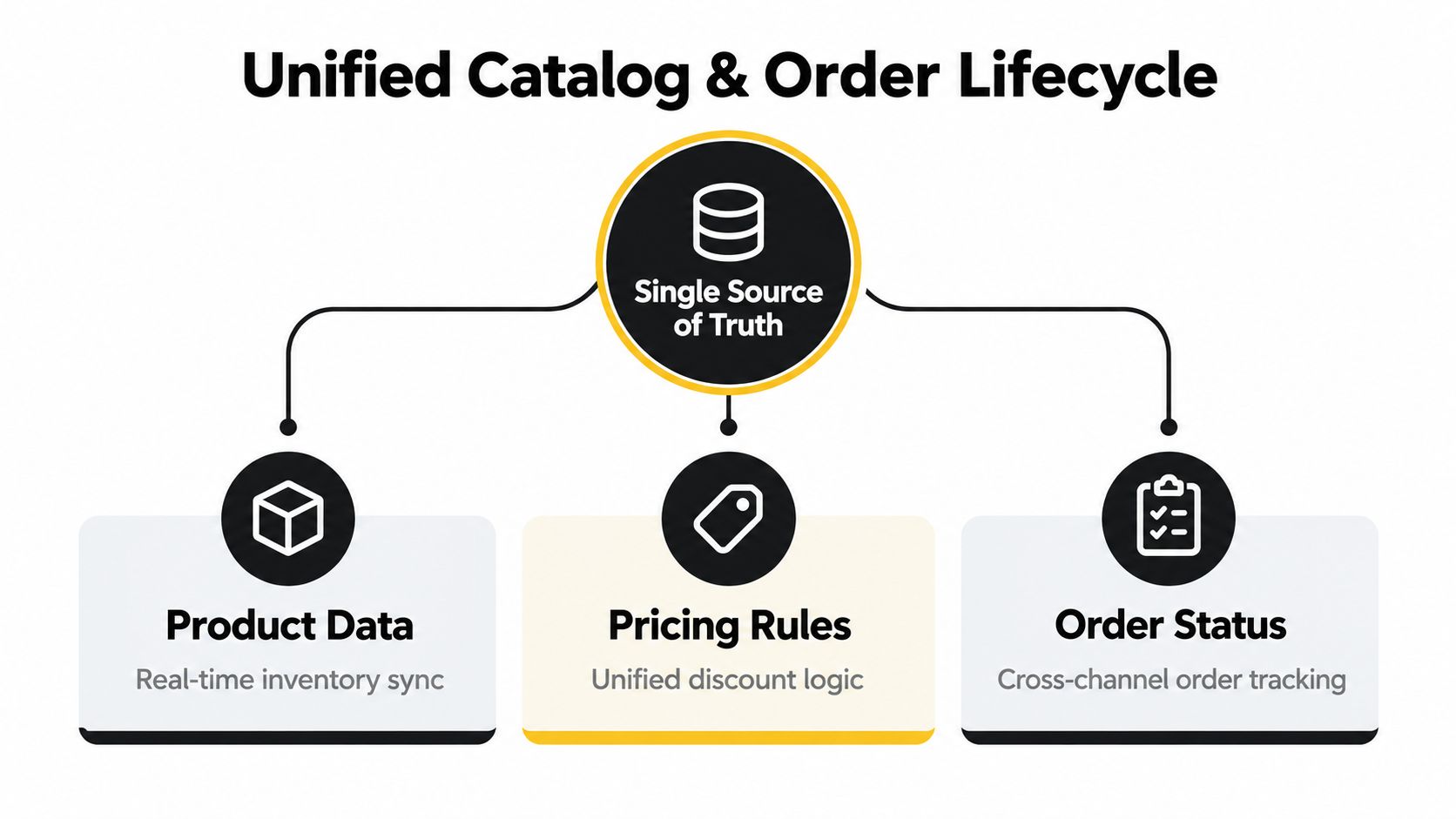
Catalog synchronization becomes unreliable when every channel owns a slightly different product record. One system stores the promotional price, another owns inventory, a third maintains subscription terms, and the POS keeps its own product identifier. The resulting drift isn't merely inconvenient. It can produce contradictory availability, inconsistent discounts, and customer-service answers that depend on which screen an employee opened.
A unified commerce model starts by assigning ownership to business concepts. Product identity, variants, price rules, inventory locations, customer identity, order status, payment status, fulfillment status, and return status need explicit sources of truth. External systems can cache or project that data, but they shouldn't redefine it.
Model the order as an aggregate
One order record should support more than a single online card purchase. The model may need to represent subscriptions and one-time items together, POS-originated sales, B2B draft orders, wholesale invoicing, partial fulfillment, returns, exchanges, discounts, and payment adjustments. The key is to keep these variations inside one governed lifecycle rather than creating separate order systems that later require translation.
A good payload preserves both stable identifiers and context:
- Product and variant IDs that remain consistent across channels.
- Price and discount references, with the applied values captured at order time.
- Customer and organization identifiers, including the source channel.
- Payment, fulfillment, return, and subscription states as separate dimensions.
- Version information for concurrency control.
- External references for marketplaces, carriers, and payment providers.
Cross-border operations make this model more demanding. UNCTAD estimated that digitally ordered exports from the 43 economies in its 2022 assessment reached about $3 trillion in 2021, representing an important share of that group's exports. UNCTAD's international e-commerce data illustrates why a commerce integration must coordinate currencies, payment states, tax data, delivery status, customer records, and regulatory information rather than only publish products.
Migration deserves the same rigor as steady-state synchronization. Import the legacy catalog, map identifiers, compare prices and inventory, and run the old and new stacks in parallel before cutover. Reconcile orders and customer records during the parallel period, then define a rollback point that doesn't require inventing a second order history.
For teams designing a shared commerce layer, the commerce layer API overview provides a useful framework for thinking about centralized catalog, order, and operational data.
Executing Negative Testing and Chaos Engineering
A commerce integration isn't production-ready because the happy path works. It is ready when the team has evidence that unauthorized, duplicated, delayed, malformed, and partially completed operations fail safely. That requires negative tests that target business logic, not just malformed JSON.
A 2025 survey of 1,548 IT and security professionals found that 57% of organizations had experienced an API-exploitation breach in the prior two years, while organizations tested 38% of their APIs for vulnerabilities on average, according to the 2025 Global State of API Security report. The figures point to a gap between the number of exposed interfaces and the depth of testing applied to them.
Test the mutation boundaries
Every high-risk mutation should have an automated authorization test, an idempotency test, and a recovery test for timeout-after-commit. The test suite should attempt to perform a valid-looking action with an invalid business context.
Use a checklist that includes:
- Cross-tenant identifiers: Request another tenant's order, customer, discount, or inventory record.
- Altered totals: Change item prices, discounts, currency, tax, or shipping values between client and server.
- Duplicate writes: Submit the same order, refund, inventory adjustment, or promotion mutation repeatedly.
- Replayed webhooks: Reuse a valid signed event and verify that the handler produces no duplicate side effect.
- Out-of-order events: Deliver fulfillment or payment events before their prerequisite state exists.
- Expired signatures: Confirm that stale or altered webhook signatures are rejected.
- Excessive pagination: Request unreasonable page sizes, deep offsets, or repeated exports.
- Privilege escalation: Attempt to use catalog or analytics credentials for refunds, customer exports, or price changes.
- Agent misuse: Give an agent an ambiguous instruction and verify that approval gates block financially consequential actions.
- Provider timeout after commit: Drop the response after the remote operation succeeds and confirm that reconciliation resolves the local state without a new transaction.
Chaos testing should introduce dependency failures deliberately. Stop a webhook consumer, delay a provider response, return rate-limit responses, corrupt a noncritical event, and interrupt a worker after it writes its local result but before it acknowledges the message. The expected outcome isn't that the platform never shows an error. The expected outcome is that the system preserves money, inventory, authorization boundaries, and an auditable recovery path.
A resilient integration doesn't hide uncertainty. It records uncertainty, prevents unsafe repetition, and gives operators a controlled way to resolve it.
Measure recovery evidence, not just uptime. Can the team identify every affected order? Can it replay a dead-lettered event without duplication? Can it revoke an agent scope without taking unrelated checkout operations offline? Can it reverse a discount or inventory mutation with an approved compensating action?
That is the practical standard for e commerce API integration. A connector that handles successful requests is useful. A governed workflow that converges after failure, limits authenticated actors, and survives adversarial testing is what a DTC business can safely build on.
PlatformDTC provides a unified commerce platform with governed APIs for storefronts, checkout, subscriptions, payments, inventory, fulfillment, messaging, analytics, and POS workflows. If you're replacing fragmented integrations or preparing commerce APIs for controlled agent actions, visit PlatformDTC to evaluate its scoped permissions, idempotent writes, approval gates, audit trails, and migration utilities.