Email returns about £42 for every £1 spent, according to the DMA's 2019 Marketer Email Tracker, nearly £10 more than the organization's previous study found, and roughly two-thirds of marketers in it said they measured email marketing return on investment.
It's tempting to read a number like that as permission to send more. The better reading is that email is one of the few channels where you can see, per recipient, whether a message earned its place. That cuts both ways. It shows you which flows pay, and it shows you which sends cost you subscribers without adding a penny of revenue.
So the two levers that matter most are message pressure (how much you send, to whom, and when to stay quiet) and incremental revenue (what the customer would have bought anyway, without the email). Nail those and the flows, segments and subject lines compound. Ignore them and better copywriting just accelerates the unsubscribes.
Table of Contents
- Which Ecommerce Email Flows to Build First
- How to Set Up Your Core Flows in Order
- Connect Store Data and SMS in One Customer Record
- Segments and AI Offers You Can Defend
- Deliverability Checks Before You Scale Volume
- Test Subject Lines and Offers Without Misleading Results
- Measure Flows and Set Send Limits by Incremental Revenue
- Pick Your First Flow and Go Live This Week
Which Ecommerce Email Flows to Build First
Cart abandonment is the clearest structural leak in ecommerce, and it's remarkably stable. A synthesis of Baymard Institute studies published in ecomhint's cart abandonment benchmarks puts average abandonment at approximately 70.22% across 50 studies, with averages sitting near 70% in every measured period from 2006 through 2025. More traffic doesn't fix that. Checkout quality and follow-up do. Email's job is to catch the shopper who already chose a product and bring them back before the intent decays.
That's why cart recovery goes first and a welcome series goes second. One recovers demand you already paid for. The other converts the cheapest audience you'll ever have, someone who just handed you an address.
| Flow | Trigger | Starting timing | Goal metric |
|---|---|---|---|
| Welcome series | Newsletter or account signup | First email within minutes, then 3 to 4 emails over 1 to 2 weeks | First-order conversion rate |
| Browse abandonment | Product viewed, no add to cart | 1 to 2 emails within 24 hours | Click-to-product and conversion rate |
| Cart recovery | Cart created, checkout not completed | First email about 1 hour later, reminders at about 24 and 72 hours | Recovered revenue per recipient |
| Post-purchase | Order paid | Shipping update, then review request 7 to 14 days after delivery | Repeat purchase rate and review volume |
| Replenishment | Predicted reorder date from purchase history | Before the expected run-out date | Reorder rate |
| Win-back | No purchase for 90 or 180 days | 2 to 3 emails over 2 to 3 weeks | Reactivation rate and revenue per recipient |
What each row buys you
The welcome series exists because a new subscriber is the most attentive reader you will ever have. Ask for the first order while attention is high, not after three weeks of promotions have trained them to skim.
Browse abandonment runs at lower intent than cart recovery and it converts accordingly, so judge it against its own baseline rather than against your cart numbers. It's cheap incremental revenue and a useful signal for merchandising.
Cart recovery carries the highest immediate return because the shopper did the hard part. Send the first email without a discount. If they needed a nudge, they take it, and you haven't taught a full cohort to wait for 10% off. Hold the incentive for the third message.
Post-purchase is where second orders come from. The shipping update is transactional and belongs in the receipt stream. The review request lands 7 to 14 days after delivery, when the product has been used and the parcel is no longer novel.
Replenishment only earns its place on consumables, refills and subscriptions, and it depends on one data field most stores never populate properly: a reliable predicted run-out date. Win-back is the last row because a lapsed buyer is worth more than a cold contact and far less than an active one.
Practical rule: if a flow can't name the event that starts it and the event that stops it, it isn't a flow. It's a campaign with a trigger attached.
Every row needs three things before it goes live: one named success metric, a suppression rule that fires the moment a customer buys, and a 5 to 10% holdout held out of the flow so you can see whether the revenue was incremental or just attributed.
How to Set Up Your Core Flows in Order
Automated emails respond to a customer's current intent; campaigns compete for attention on a schedule. A 2025 analysis of more than 20 billion campaign emails and 470 million automated sends from over 27,000 brands found that automated messages generated $3.41 in revenue per email, compared with $0.155 for broadcast campaigns, and converted at 1.49% versus 0.08%, roughly 19 times higher, according to Omnisend's email marketing benchmarks. Treat those figures as a reason to test flows, not a promise of results: attribution alone does not show whether a message caused an order.
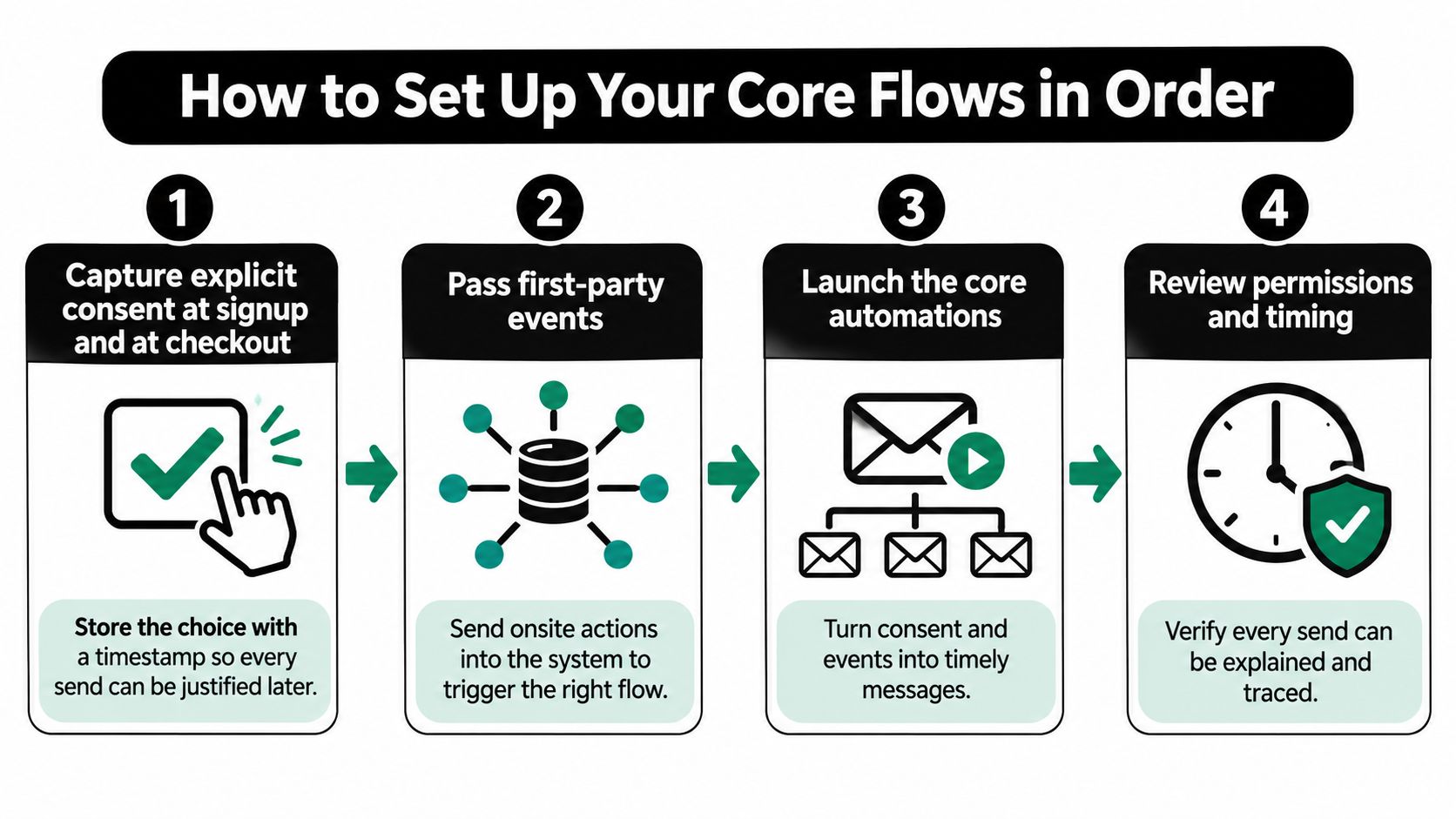
Build in this order:
-
Capture explicit consent at signup and checkout. Store the choice, timestamp and wording shown to the shopper. Importing subscribers without their original opt-in can harm deliverability and leave you unable to explain how the list was built.
-
Pass first-party events into one customer profile. Signup, product view, cart creation, purchase, subscription renewal and review eligibility should resolve to the same customer ID. If cart events sit in the storefront while orders live elsewhere, purchase suppression has nothing reliable to check.
-
Deploy browse and cart recovery, with purchase suppression. Set the purchase event to stop recovery messages immediately. Give cart recovery priority over a scheduled campaign, and set a weekly cap so overlapping sends do not crowd the inbox. Start without a discount; add an incentive only if testing shows it produces incremental orders.
-
Add a short welcome sequence. Use three or four emails: introduce the brand and bestsellers, offer relevant proof, show a category or use case, then consider an incentive. Keep the offer late enough that the sequence does not teach every new subscriber to wait for a discount. Make the first-purchase experience consistent with your order confirmation email structure.
-
Add replenishment, win-back and subscription-failure messages after the core flows run cleanly. Each needs a reliable trigger and a clear reason to send. If a message cannot change what the customer does next, the added volume may cost more than it earns.
What good looks like: each flow has one trigger, one exit condition and one frequency rule. A campaign should not crowd out a cart reminder, and internal promotions should not bury a failed-payment notice.
Keep campaign creative and timing distinct from automated journeys. A campaign asks for attention; a flow answers a customer's existing intent. Measure both against incremental revenue, and limit sends when added volume does not add orders.
Connect Store Data and SMS in One Customer Record
Before a single flow goes live, orders, carts, product views, subscriptions and consent records have to sit in one customer record that both email and SMS read from. Work through five checks.
-
List every event source. Storefront browsing, cart and checkout, order and fulfilment updates, subscription renewals and review requests. Anything you can't list, you can't trigger on.
-
Map each event to one customer ID, joining on email address plus account or order ID, and log the events that fail to match. Unmatched events are the silent cause of flows that never fire.
-
Store consent per channel. An email opt-in does not authorize SMS. Record the channel, the source, the timestamp and the wording shown.
-
Connect live inventory and price data, so a cart message reads stock and price at send time rather than quoting a snapshot from checkout. Selling three units of something you no longer have is worse than sending nothing.
-
Read from one suppression list across both channels. A customer who completed the purchase on SMS should not get a cart reminder by email an hour later.
The common failure is two systems holding different order records, which produces a reminder for an item already delivered. If your store runs separate email, SMS and commerce tools, this integration is usually the biggest line item in the whole build, so audit it before writing any flow copy.
Segments and AI Offers You Can Defend
Segment on behavior and recency before demographics, because behavior is what changes the message. Four groups cover most of the work.
New subscribers take the welcome path and nothing else for the first two weeks. Active buyers get replenishment or cross-sell, with recently purchased items suppressed so you're not selling a coffee drinker a second grinder. Lapsing customers, defined as no order in 90 to 180 days, enter win-back. Unengaged profiles, anyone who hasn't opened or clicked in a long window, drop to a reduced schedule or a sunset path, which protects the deliverability of every other segment. A segmentation model that updates nightly is enough for all four.
Then treat AI personalization as a controlled commerce workflow rather than a copywriting shortcut. The confidence gap is real: Omnisend's July 2025 survey of 1,224 U.S. consumers, reported by PR Newswire, found 85% had concerns about AI in shopping, including privacy and data security at 43%, AI misinterpreting preferences at 37% and irrelevant recommendations at 35%. Adobe's 2025 retail research in the same reporting found 74% of consumers considered disclosure of AI-generated content important, while only 26% of brands met that expectation.
Three checks before any AI-selected offer leaves the building:
- Is the customer contactable under the consent you hold? Channel, timestamp, source.
- Is the product in stock at the price you're quoting right now? Live catalog, not last night's export.
- Is this customer eligible for this discount? Margin rules, channel rules, and no replenishment offer that contradicts an active subscription. If the offer includes a shipping incentive, know how free shipping thresholds work before you promise one, because the threshold interaction with discount codes is where margin disappears.
Log every automated decision so you can explain it, and reverse it, when a customer asks why they got a particular message. Recommendation accuracy, complaint rate, unsubscribe rate and margin belong in the review alongside click-through.
Deliverability Checks Before You Scale Volume
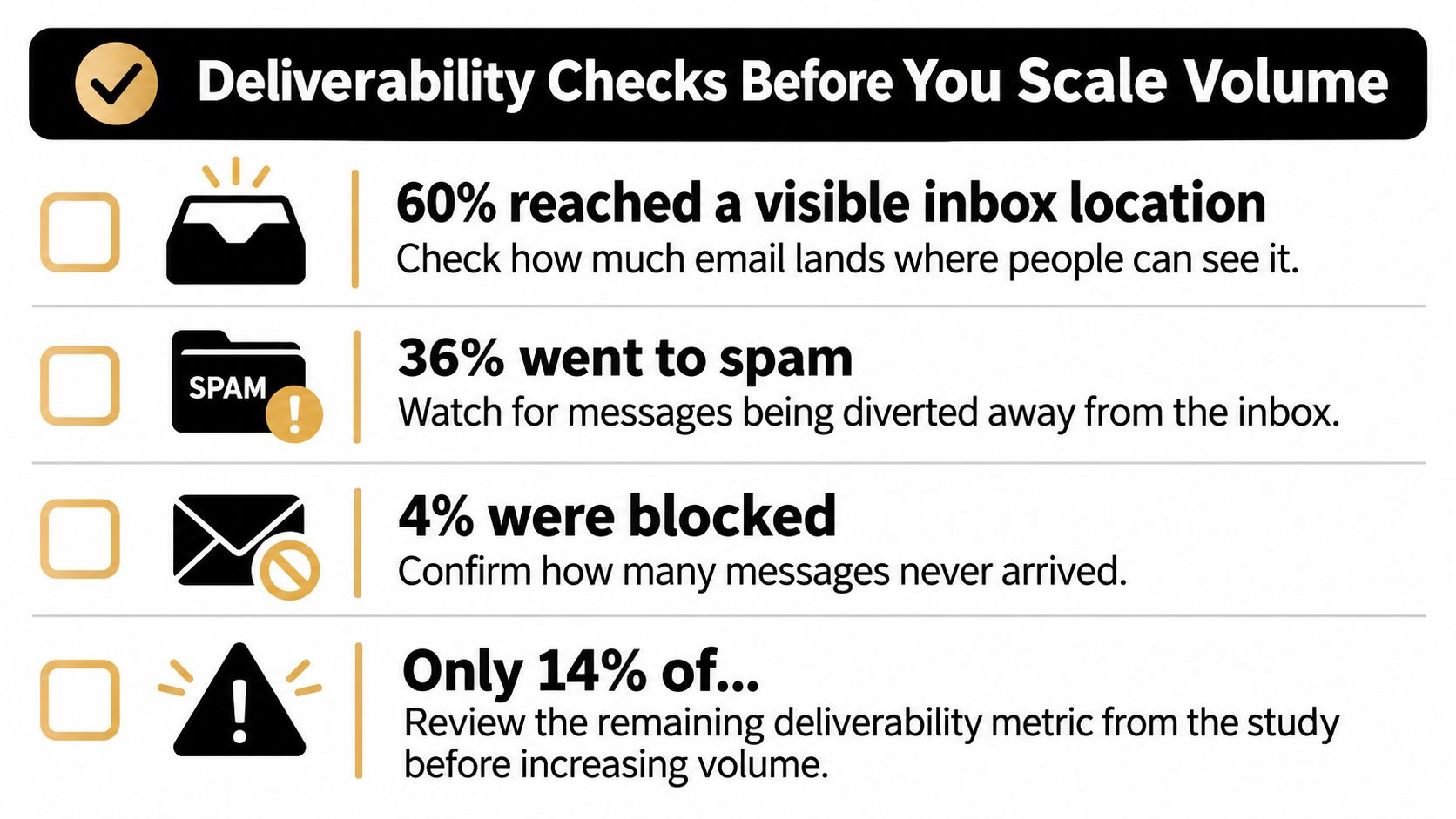
Deliverability is an engineering control, not a copywriting problem. A 2025 study of inbox placement found that only 60% of messages reached a visible mailbox location, while 36% went to spam and 4% were blocked, and that only 14% of senders implemented a compliant list-unsubscribe header, per the 2025 email deliverability benchmark report. Blocked and spam-foldered messages don't throw errors. They just don't sell anything.
The records to publish before you raise volume
Authenticate the sending domain with SPF and DKIM, publish DMARC with alignment to the From domain, and validate the records in a test send before a big campaign. Add one-click unsubscribe using the List-Unsubscribe-Post mechanism, honor requests the same day, and keep a single suppression list that every sending stream reads from. If your transactional and marketing mail leave through different tools, they still need the same suppression truth.
Warm up like you mean it
Start major volume with recently engaged recipients and segment new, active, lapsing and unengaged profiles separately. Increase volume gradually and watch complaint, bounce and placement signals by mailbox provider rather than in aggregate, because Google and Microsoft will judge you differently. Keep the spam-complaint rate below 0.1%; the benchmark notes this is increasingly expected even though older guidance used 0.2 to 0.3%. A rising complaint rate is your only early warning before placement collapses.
Failures repeat: purchased or imported lists, unauthenticated domains, abrupt infrastructure changes, inactive subscribers left on the file, and reporting that counts accepted delivery instead of inbox placement.
Connect provider-level telemetry to campaign analytics and pause any planned volume increase when complaints or bounces deteriorate. Since a blocked message generates no application error, the dashboard is the only place the damage shows up.
Test Subject Lines and Offers Without Misleading Results
Test one variable at a time and decide on revenue, not opens.
- Change a single element. Subject line, discount depth, send time or product block. Two changes at once and the winner is unattributable.
- Split only eligible recipients at random, and keep the holdout out of both arms so the test measures the message against no message.
- Set sample size and a stop rule before sending. A send to a few hundred contacts rarely produces a reliable difference, so run tests on larger segments or wait until enough orders land.
- Name the decision metric in advance. Revenue per recipient for offers, conversion rate for product blocks, unsubscribe rate for frequency tests.
- Test flows one step at a time, such as the timing of the first cart reminder, rather than rewriting a sequence and guessing which change did the work.
Open rates can guide subject-line ideas but can't pick a winner alone, because image-loading privacy features inflate them. Record each result with its audience, date and metric, so the next test starts from evidence rather than from a hunch someone remembers differently.
Measure Flows and Set Send Limits by Incremental Revenue
Teams still judge email by opens and last-touch revenue, which flatters every send and teaches the wrong lesson. Judge by what wouldn't have happened without the message.
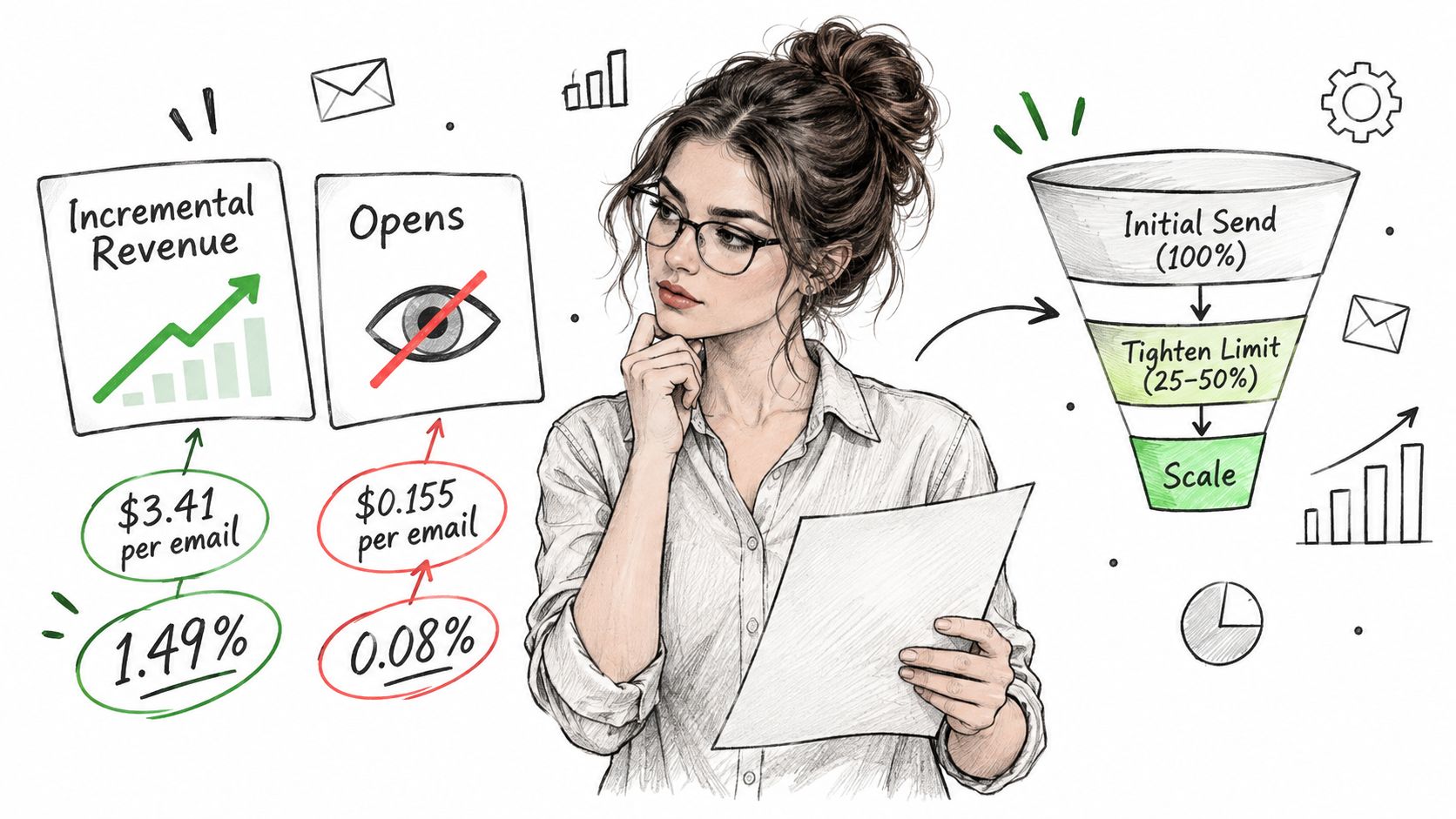
Set the bar with the automated-versus-broadcast comparison below, then check five metrics in this order.
| Metric | Automated flows | Broadcast campaigns |
|---|---|---|
| Revenue per email | $3.41 | $0.155 |
| Conversion rate | 1.49% | 0.08% |
- Revenue per delivered email. It normalizes for list size and makes flows comparable to each other.
- Conversion rate. Placed orders divided by delivered, not by sent.
- Unsubscribe rate per flow, not per campaign, because a single flow can be burning your list.
- Contribution margin after discounts, shipping subsidies and fulfilment. A 20% code that lifts conversion and kills margin is a loss dressed as a win.
- Incremental revenue against a holdout. This is the only number that answers whether the email earned anything.
Last-touch attribution overstates every result, because a welcome email often takes credit for a purchase the shopper was going to make anyway. Keep 5 to 10% of eligible customers out of a flow or campaign, then compare revenue per recipient between exposed and unexposed groups.
Fatigue is the risk nobody puts on the dashboard. In Optimove's 2025 consumer marketing fatigue study, 70% of respondents had unsubscribed from at least three brands in the previous three months because of message overload, and 36% from six or more, yet 59% still named email their preferred marketing channel. The channel isn't the problem. Uncoordinated frequency is.
Set one ceiling and let it override the calendar
Apply a weekly per-customer ceiling across email and SMS combined. Suppress recent buyers, anyone already in two campaigns this week, and customers with an open support ticket. Give transactional and cart-recovery messages priority over promotional sends, and treat a rising unsubscribe rate as an instruction to cut volume rather than rewrite subject lines.
Then run the one-month test: remove one weekly promotional send for four weeks and compare revenue per recipient and unsubscribe rate against the prior period. If revenue holds, you were paying for that send in list health. Keep a monthly review with one row per flow, the five numbers above, and a single decision: keep, change timing, reduce sends, or stop. An ecommerce analytics dashboard that joins campaign data to orders makes that review a fifteen-minute job instead of a spreadsheet project.
Every one of these benchmarks is directional. Your catalog, traffic quality, attribution window and consent quality move the numbers more than any template will.
Pick Your First Flow and Go Live This Week
Read your own numbers to choose. If checkout leaks, launch cart recovery. If first orders don't turn into second ones, launch post-purchase. Don't launch both in the same week with the same team.
Three prerequisites come first, and they're the ones teams skip: consent is stored with a timestamp and source, the sending domain passes SPF, DKIM and DMARC validation, and cart and order data resolve to the same customer record. Without all three, the flow either can't send legally or sends the wrong thing confidently.
Then build it with its trigger, its exit condition, suppression for recent buyers and a 5 to 10% holdout. Set the review date 30 days out and name the one metric that decides the outcome before you send anything. PlatformDTC builds email and SMS automations, including abandoned cart, abandoned checkout, welcome and win-back, on the live order, subscription and browsing records the storefront already produces, so suppression reads the same data the checkout does.
The commitment: one flow, one holdout, one metric, reviewed in 30 days. Then the next one.
That's the whole discipline. Fewer, better-suppressed sends, each one able to prove it earned its place, beat a busier calendar judged by opens every quarter. The stores that win at ecommerce email marketing aren't sending more than you. They're sending less, and measuring it properly.
Email only pays when the flows and the data behind them are one system. PlatformDTC runs campaigns, lifecycle flows and checkout recovery on the same customer, order and subscription records as your storefront, so a buyer is suppressed before the cart reminder goes out and every flow is judged against real orders rather than last-touch attribution. If you're rebuilding your lifecycle program, start with the flows that recover revenue you're already losing and give each one a holdout from day one. Visit PlatformDTC to see how the storefront, checkout, subscriptions and messaging work on a single record.