
Your subscription app says one inventory count, your storefront says another, and support is reconciling a return against a discount neither system records the same way. That's usually the moment founders stop shopping for another app and start looking for a direct to consumer platform. You're not short of tools. You're short of a system of record you can trust when an order, a renewal, a POS sale, and a return all touch the same customer.
Table of Contents
- What a Direct to Consumer Platform Actually Does
- DTC Platform vs Marketplace and Retail Tech Stack
- Core Features That Belong in a Modern DTC Stack
- Why Checkout Architecture Is a Conversion Lever
- The Case for Controlled Autonomy in AI Agents
- Migrating Without Breaking Revenue
- Founder's Checklist for Evaluating a DTC Platform
What a Direct to Consumer Platform Actually Does
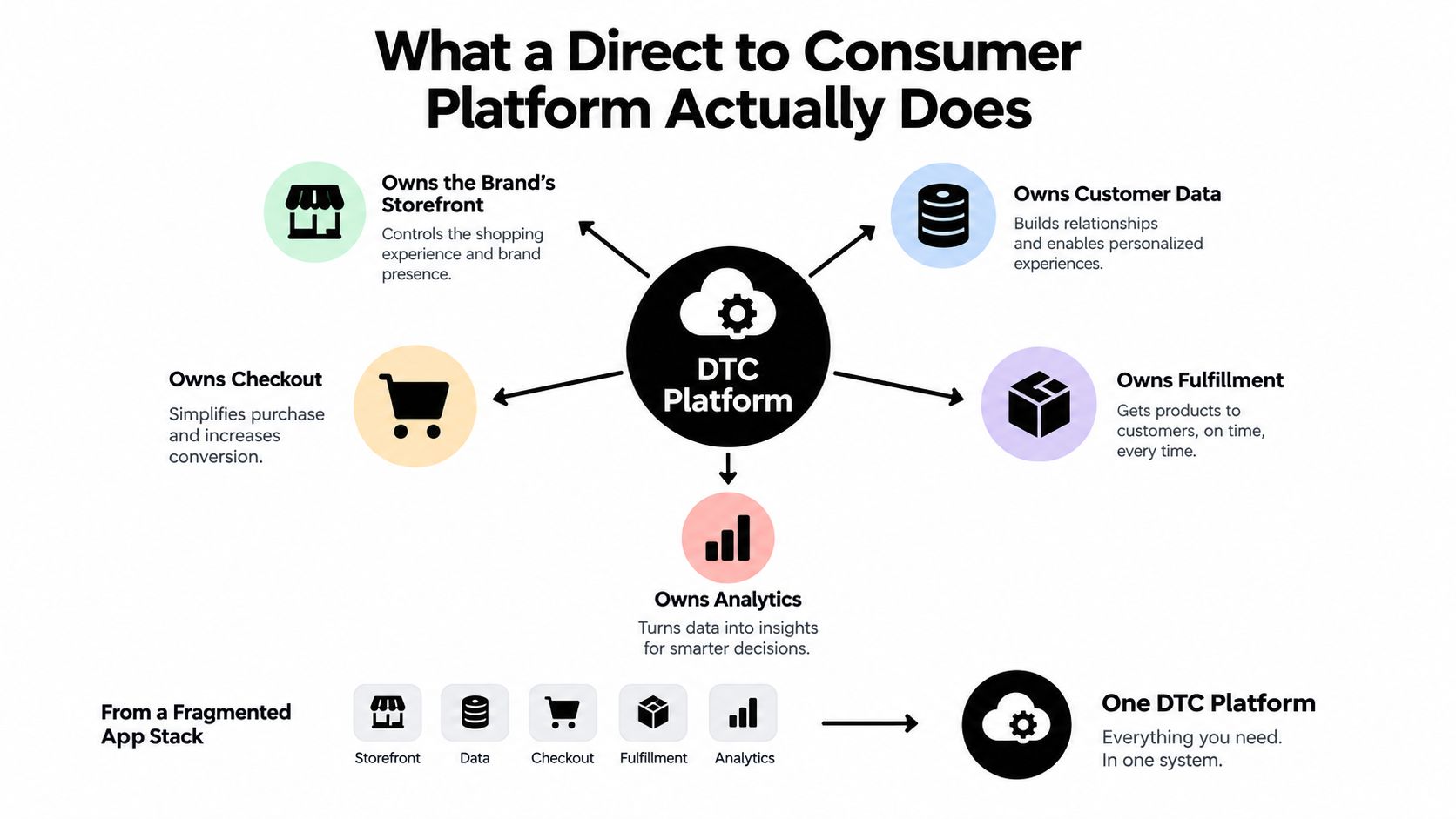
A direct to consumer platform isn't a prettier storefront. It's the unified system that owns your storefront, checkout, subscriptions, POS, payments, inventory, fulfillment, messaging, and analytics on one record model. When those functions live in separate apps, each app keeps its own version of the customer, the order, and the discount. You pay for that drift in reconciliation work, miscounted stock, and attribution nobody believes.
The diagram below shows the consolidation at the center of the decision.
One Order Lifecycle Instead of Five Partial Records
Start with the order. In a unified stack, a one-time purchase, a subscription renewal, a counter sale, and a wholesale invoice move through the same lifecycle. That means inventory decrements once, discounts allocate consistently, and refunds reference the original payment method without a support agent stitching records together in a spreadsheet.
That single record changes decisions, not just reporting. You can see whether a customer acquired through a campaign renewed, returned, bought in store, or churned, because those events attach to one customer record. Fragmented stacks force you to infer that story across exports. Inference is where margin leaks hide.
Why Ownership of the Record Matters Now
Online isn't a side channel you can run on patched together tooling. The U.S. Census Bureau quarterly retail e-commerce release for the fourth quarter of 2025 puts U.S. retail e-commerce sales at an estimated $316.13 billion, or 16.6% of total retail sales, up from 16.2% a year earlier, with e-commerce growing 5.3% year over year against 2.7% for total retail. Roughly one dollar in every six spent at retail now moves online.
If your owned channel carries that much revenue, treat its infrastructure as core operations, not marketing tooling.
My recommendation is blunt. Judge any platform by whether it eliminates record drift between storefront, checkout, subscriptions, POS, payments, and fulfillment. If it still needs a sync job to agree with itself, it's an app stack with better branding.
DTC Platform vs Marketplace and Retail Tech Stack
Marketplaces rent you demand. A direct to consumer platform gives you the system to keep the customer, the margin, and the data after demand arrives. Those aren't interchangeable choices, and treating a marketplace listing as your commerce strategy costs you more than fees.
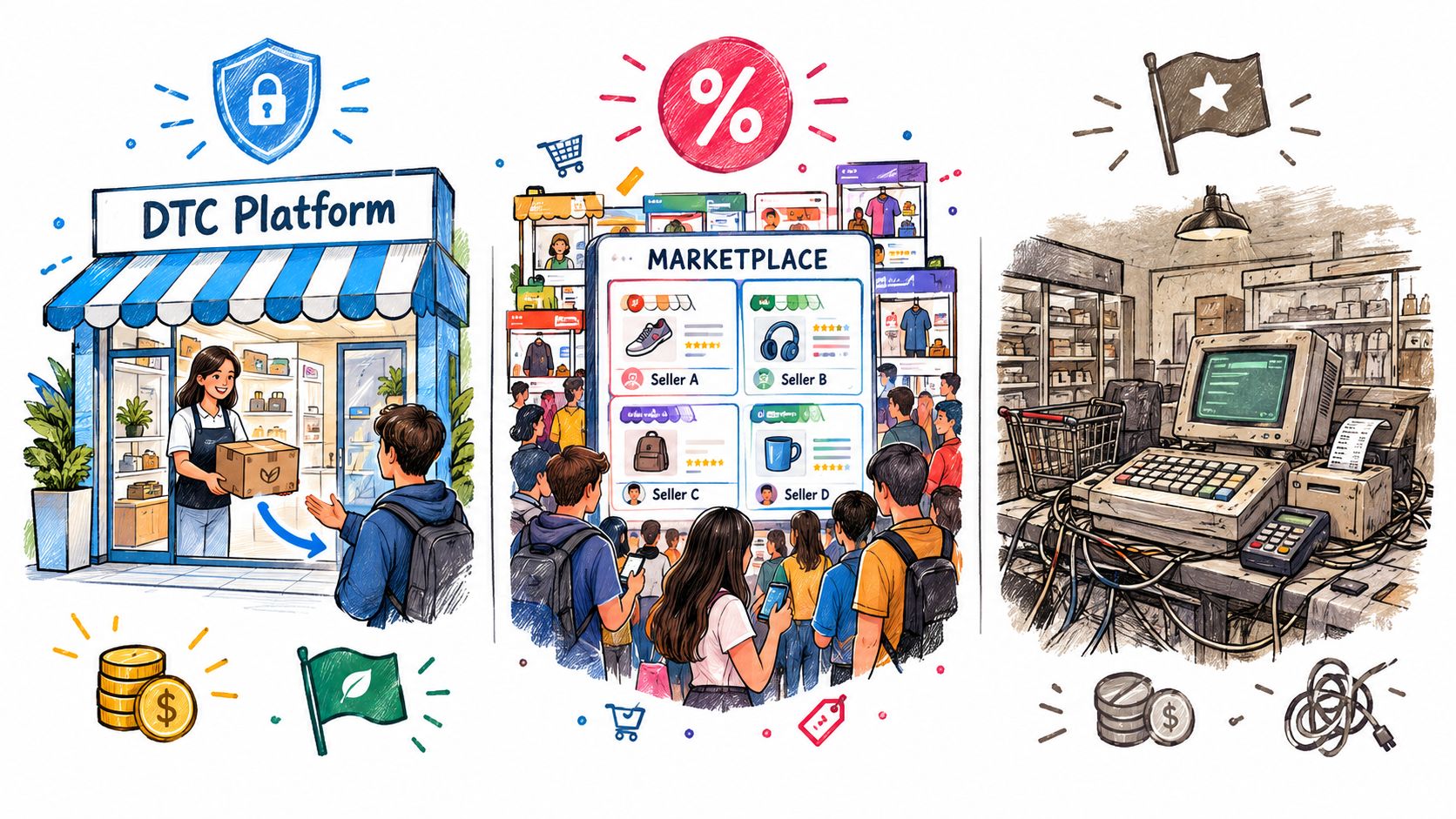
The comparison below separates the three models most founders confuse.
What You Trade Away on a Marketplace
On a marketplace, the customer relationship belongs to the marketplace. You get limited pricing control, restricted cross-sell data, and little ability to run subscriptions, bundles, or post-purchase offers on your terms. You also can't build a first-party record that connects an ad click to a second purchase in your own store.
That trade can make sense for discovery. It makes no sense as your only channel, because the asset that compounds, the customer record, accrues to someone else. Use marketplaces for reach if the economics work. Don't let them substitute for an owned storefront and checkout on your domain.
Why Legacy Retail Stacks Fail Differently
Older retail systems fail in the opposite direction. They're monolithic, built for store operations first, and they bolt e-commerce on as a separate module. Online orders, POS transactions, and wholesale invoices end up reconciled after the fact instead of sharing inventory and customer data in real time.
A modern platform takes a different structural approach. If you're weighing architectures, our breakdown of the composable commerce platform model explains how modular services can still share one source of truth. Composable doesn't have to mean fragmented. The point is interchangeable components reading from the same catalog, order, and inventory records.
Rent attention where it's cheap. Own the transaction system, the checkout, and the customer record. Any strategy that reverses that order will cap your margin and your ability to learn from your own buyers.
Core Features That Belong in a Modern DTC Stack
Vendor decks list everything. Your job is to separate core capabilities, which must share one record, from peripheral tools you can swap later. If a capability touches the order, the payment, the inventory count, or the customer identity, it belongs in the core.
Core DTC Platform Capabilities at a Glance
| Capability Area | What It Owns | Integration Risk If Fragmented |
|---|---|---|
| Storefront and checkout | Product pages, cart, domain owned checkout, express wallets | Slow pages, lost attribution, checkout data trapped in a bolt-on |
| Subscriptions | Plans, renewals, dunning, pauses, swaps | Renewals that don't decrement inventory or respect discounts |
| POS and B2B | Counter sales, draft orders, invoicing, wholesale terms | Separate stock counts and customer lists per channel |
| Payments | Authorization, settlement to your Stripe or PayPal, refunds | Refunds detached from orders, opaque margins |
| Messaging and discounts | Email, SMS, promotions engine, campaign attribution | Double discounted orders, campaigns credited twice |
| Analytics | Orders, customers, campaigns, checkout performance | Reports that disagree across tools |
Notice the pattern in the right column. Every risk is a version of the same failure, two systems disagreeing about one event. That's why subscriptions must run in the same order lifecycle as one-time purchases, not in an app that creates orders after the fact. It's also why POS has to read the same inventory your storefront sells from.
Messaging and Discounts Need the Same Record
Email and SMS inside the platform aren't a convenience feature. When campaigns run in the same system as orders, you can attribute revenue to a send without matching identities across tools, and your discounts engine can stop a campaign code stacking with a subscription offer. If you're pressure testing whether SMS earns its place in that core, this guide to SMS marketing ROI is a useful yardstick for what the channel should return before you expand send volume.
Payments deserve the same scrutiny. Demand direct settlement to your own accounts and a fee breakdown that separates platform charges from payment margins. PlatformDTC is one example of this consolidated model, combining storefront, edge-served checkout, subscriptions, POS, B2B, payments, messaging, and analytics on one record. Evaluate it, and any competitor, against the table above rather than against a feature count.
Why Checkout Architecture Is a Conversion Lever
Most founders treat checkout as design. It's infrastructure, and it's the most strategic surface your platform exposes. Small amounts of friction at payment erase expensive acquisition work upstream.
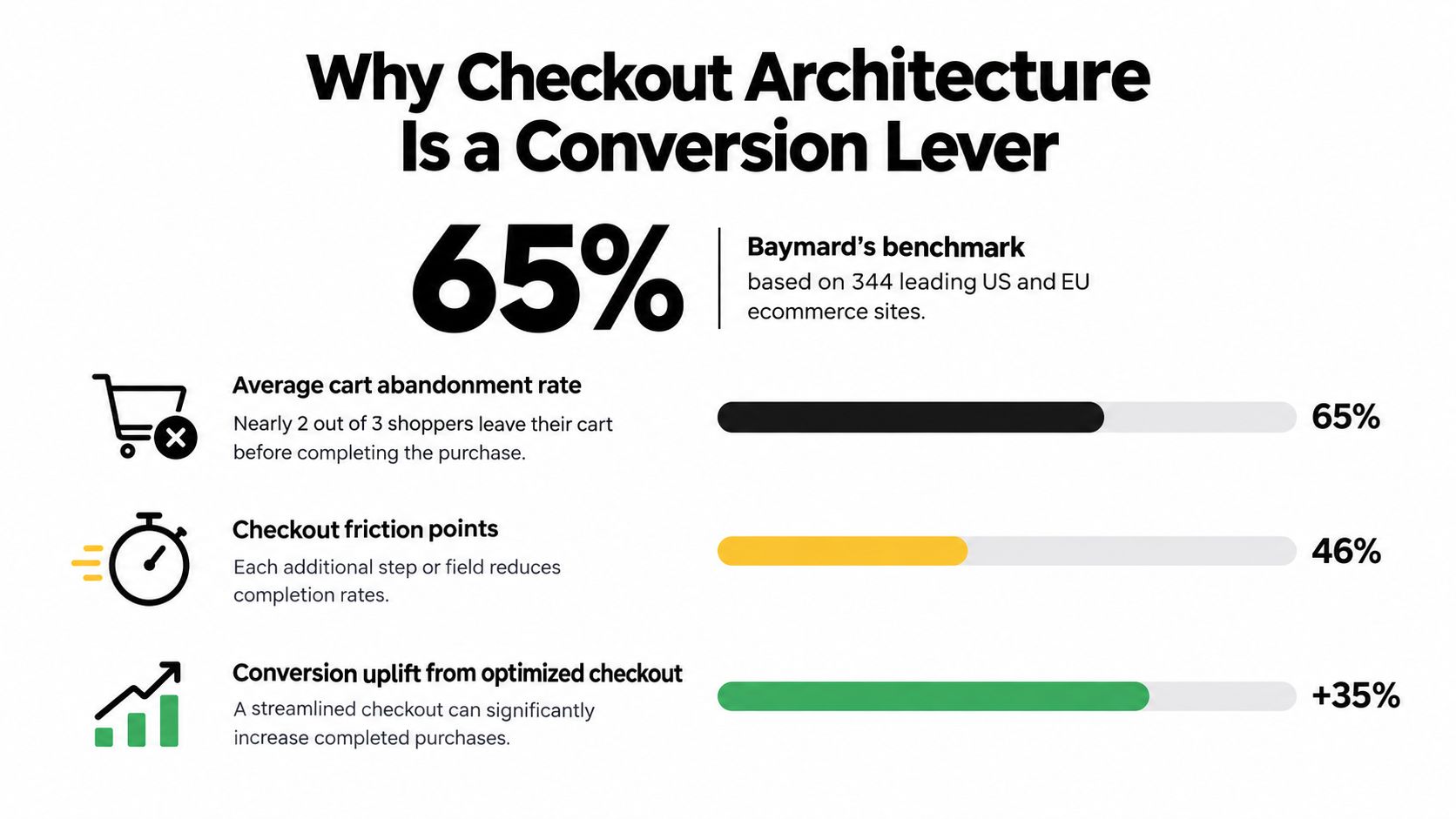
The benchmark evidence on how much room most sites leave on the table is unusually specific.
What the Benchmark Data Actually Says
Baymard Institute's checkout usability research, drawn from a benchmark of 344 leading US and EU ecommerce sites and more than 30,000 reviewed checkout elements, found that 65% of sites deliver a mediocre or worse checkout experience and only 2% rate as good. The same research estimates the average large site has roughly 32 available checkout improvements and could gain a 35% conversion increase from better checkout UX alone. It also reports a 70.19% average cart abandonment rate, and that an ideal checkout needs roughly 12 form elements against a US average of 23.48 shown by default.
Translate that into platform requirements:
- Edge-served, domain-owned checkout: Fewer round trips and no jarring redirect to a third-party domain at payment.
- Express wallets up front: Apple Pay, Google Pay, PayPal, Link, Amazon Pay, and Klarna cut form burden where it's worst, on mobile.
- Total landed cost before authorization: Surprise shipping and tax totals are a self-inflicted abandonment cause.
- Preserved cart state on retry: A failed payment shouldn't force a shopper to rebuild an order.
For tactical fixes you can layer on top of sound architecture, this walkthrough on how to reduce abandoned carts for Shopify covers recovery mechanics that pair well with a faster native checkout.
The video below walks through how checkout structure affects completion in practice.
Instrument checkout from day one. Track time to interactive, payment failure rate, wallet uptake, and conversion by device, geography, and payment method. Because your platform owns the order lifecycle, you can connect those metrics to refunds, renewals, and fulfillment outcomes instead of analyzing checkout as an isolated funnel.
The Case for Controlled Autonomy in AI Agents
Every vendor now promises agents that run your store. Almost none of them lead with the question that matters. What is that agent allowed to change, who approved it, and how do you reverse it?
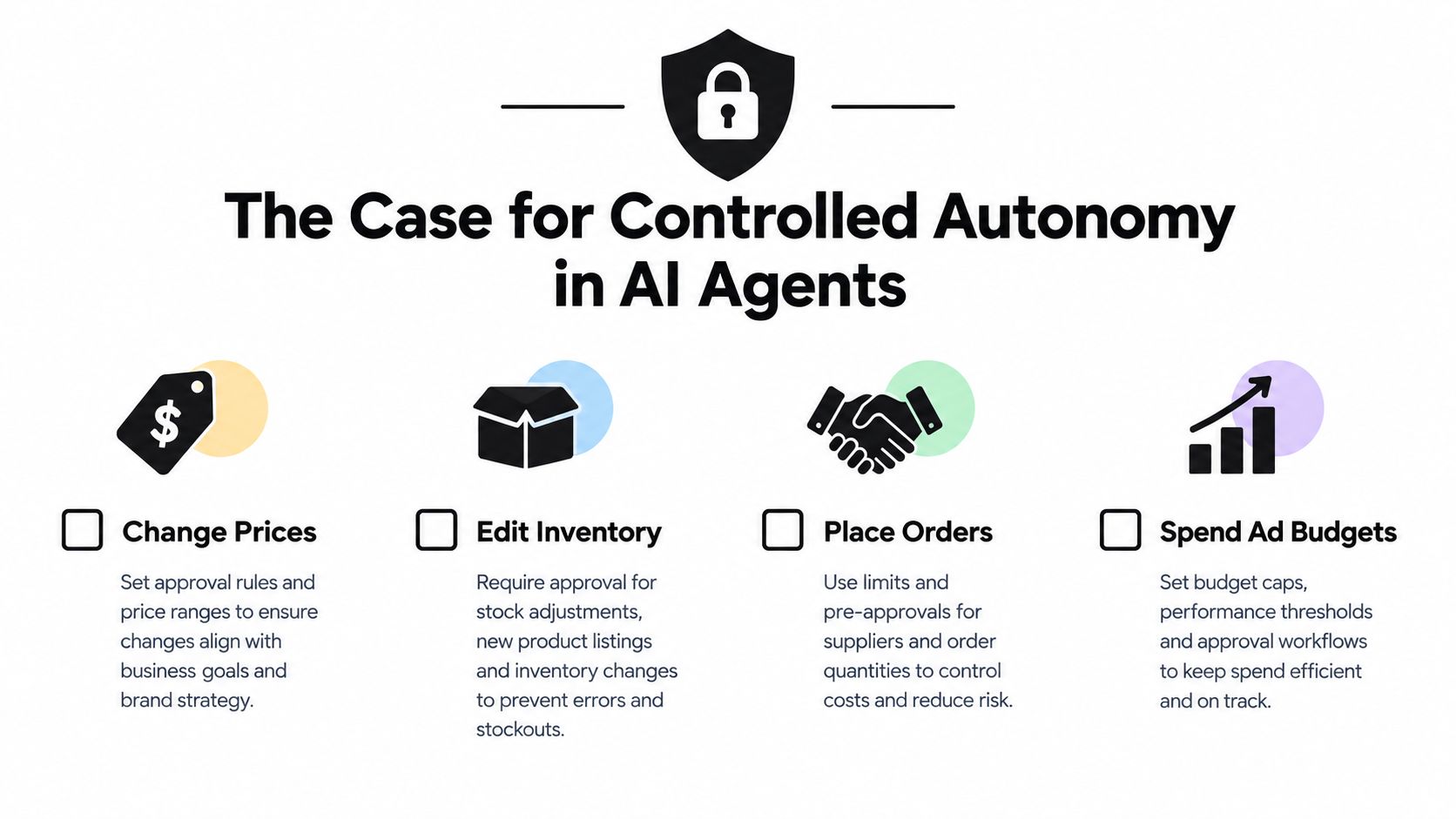
The checklist below frames the actions that need governance before any agent touches production.
Governance Is the Product
An agent that can draft product copy is a productivity tool. An agent that can change prices, edit inventory, place orders, issue discounts, or spend ad budget is a transaction actor with financial authority. ManageEngine's enterprise AI governance framework recommends least privilege across AI applications, data sources, APIs, and individual agent actions, plus evaluation of authentication, authorization, credentials, logging, and the impact of unintended actions before agents connect to enterprise resources.
Applied to a direct to consumer platform, that means five required controls:
- Scoped keys per agent: Narrow permissions per identity, with read access separated from write access by default.
- Approval gates: Human sign-off for spend, price changes, and anything irreversible, with thresholds you set.
- Idempotent writes: Retries after a network failure must not create duplicate orders, refunds, discounts, or campaign sends.
- Immutable audit trail: Every action records the initiating identity, requested operation, policy decision, resulting object, and timestamp.
- Segmented machine identities: Financial authorization stays separate from content and merchandising access.
PwC's guidance on trust in agentic commerce points the same direction, recommending that users can grant, manage, and revoke agent permissions, that decision logic and data inputs are documented, and that zero-trust controls govern agent to agent communication. If you're still forming a view on the category, our explainer on what agentic commerce means for brands lays out where agents are moving beyond recommendations into transactions.
Controlled autonomy beats maximum autonomy. The winning platform won't be the one whose agents do the most unsupervised. It'll be the one whose agents act fast inside boundaries you can inspect, approve, and roll back.
Before you enable any write-capable tool, require an explicit scope, a validation schema, idempotency behavior, an approval policy, an audit event, and a recovery path. If a vendor can't show you those six things in the product, their agent story is a demo, not an operating model.
Migrating Without Breaking Revenue
Platform decisions rarely fail on features. They fail at cutover, when traffic flips to a stack that hasn't proven it handles your catalog, your discounts, and your subscription renewals correctly. The fix is boring and effective. Run the new system in parallel and make it earn the traffic.
The Parallel Run Sequence
- Import and audit the catalog: Bring over products, variants, pricing, and inventory, then reconcile counts against your live system before anything else moves.
- Recreate commercial logic: Rebuild discounts, subscription plans, tax and shipping rules, and B2B terms, then test them against real historical orders.
- Run both stacks side by side: Process test orders end to end, including payment, fulfillment status, refund, and renewal, and compare records line by line.
- Verify customer data: Confirm accounts, saved payment methods where portable, order history, and consent records arrive intact.
- Cut over in a low risk window: Flip traffic only after the comparisons pass, and keep the old stack readable for support lookups.
Our detailed ecommerce platform migration guide breaks down sequencing and ownership for each of these stages if your team is planning the move now.
What to Compare Before You Flip the Switch
Don't accept a successful import message as verification. Compare order totals on identical carts, because tax and discount rounding differences surface there first. Compare inventory after a simulated renewal and a POS sale, since those are the flows fragmented stacks usually get wrong. Compare refund behavior against the original payment method, and confirm a return restocks to the right location.
Migrate the record, not just the storefront. If order history, subscription status, and discount logic don't survive the move, you've rebuilt your problems on new software.
The payoff after cutover is operational, not cosmetic. POS, subscriptions, B2B, and online orders read from the same inventory and customer record, so the weekly reconciliation work that followed your old stack around largely disappears. That, not the launch announcement, is the return on a careful migration.
Founder's Checklist for Evaluating a DTC Platform
Turn every vendor claim into a test you can run in a demo environment with your own data. If a capability can't be demonstrated on your catalog and your order flows, score it as absent.
Questions That Expose Weak Platforms
- Single order record: Can one customer record carry an online order, a subscription renewal, a POS return, and a B2B invoice without sync jobs between them?
- Edge checkout: Will the vendor publish time to first byte and largest contentful paint figures from real test runs, and does checkout stay on your domain?
- Agent governance: What's an agent's default scope, who approves spend, are writes idempotent, and can you open the audit log and reconstruct why a promotion changed?
- Migration: Can the new stack run in parallel against your current one, and how long is the verification window before cutover?
- Total cost: Are platform fees, payment margins, and the apps you'd retire shown side by side, or buried in separate invoices?
Returns Belong on the Checklist Too
Most evaluations stop at conversion and ignore what happens after delivery. That's a mistake. The National Retail Federation's 2025 returns outlook expected U.S. retailers to receive approximately $849.9 billion in merchandise returns in 2025, equal to 15.8% of annual sales, with 82% of consumers treating free returns as a major shopping factor and 71% saying a poor return experience made them less likely to shop again. Ask whether one order record preserves payment method, subscription status, discount allocation, inventory destination, and fraud signals across online and store returns. Store credit and exchanges often protect margin better than refunds, but only a unified record lets you offer them without manual reconciliation.
Round out the social proof layer the same way. Reviews influence conversion at the product page, so check how review data attaches to the customer and order record, and compare options like these Shopify review collection tools against what your platform handles natively before adding another integration.
My verdict on trade-offs: weigh governance depth over feature breadth, long-term total cost over time to launch, and one clean record model over a longer channel list. A direct to consumer platform is a multi-year operating decision. Buy the system that stays trustworthy when agents act, returns spike, and channels multiply.
If your app stack is producing more reconciliation work than insight, it's time to run your storefront, checkout, subscriptions, POS, B2B, and analytics on one governed record. PlatformDTC consolidates those functions into a single direct to consumer platform with scoped agent permissions, approval gates, and an edge-served checkout on your own domain. Visit the site to see how a parallel migration would work for your brand before you commit to a cutover.