Your campaign is ready, but your stack isn't. The subscription offer doesn't match the checkout discount, the email audience includes customers who already bought, and someone's checking inventory in a spreadsheet before approving the launch. You don't need another architecture diagram. You need to know whether rebuilding your commerce system will remove these problems or hand them to your engineering team.
A composable commerce platform is worth evaluating as a three-year operating decision: what you can change, who keeps it working, and how safely it handles customers' money.
Table of Contents
- Why DTC Operators Are Rebuilding Their Stack
- What a Composable Commerce Platform Actually Is
- The Modular Architecture Patterns That Matter
- Enterprise Outcomes Behind the Hype
- Checkout Performance as a Revenue Lever
- The Operating Burden Most Explainers Leave Out
- Making a Composable Stack AI-Ready and Safe
- Putting It Together With a Practical Decision Framework
Why DTC Operators Are Rebuilding Their Stack
Consider a hypothetical growing DTC brand. Its storefront runs on a commerce platform, subscriptions live in a specialist app, and lifecycle marketing runs in an email tool. Each product works well enough on its own.
The trouble starts between them. A customer changes their subscription address, but the next fulfillment request uses an older record. Marketing sends a replenishment reminder after a renewal has already processed. A discount applies to an initial purchase but behaves differently when support recreates the order.
The problem isn't simply too many apps
These failures raise uncomfortable ownership questions. Which system decides whether someone is an active subscriber? Who owns the discount definition? When the warehouse and storefront disagree about available stock, which value should checkout trust?
Buying another integration doesn't necessarily settle those questions. Without clear ownership, teams can automate the movement of contradictory data.
- Lifecycle teams need purchase and renewal events they can trust before triggering messages.
- Commerce operators need consistent promotion rules across checkout, support, and subscriptions.
- Engineers need to distinguish a delayed update from a failed business operation.
- Founders need to know whether the next launch requires product development or another reconciliation exercise.
How the rebuilding conversation started
Headless commerce helped establish the architectural direction. In a 2023 survey of 100 retail and brand leaders across the United States and Canada, 71% were already using headless commerce and 29% were implementing it; 54% cited easier integration and scaling as adoption reasons, while 56% had explored combining microservices, APIs, and cloud-native software products, according to the eTail headless commerce report.
That history matters because separating the storefront was a step toward separating other capabilities. Operators could begin asking whether subscriptions, inventory, or checkout should evolve independently rather than wait for a complete platform replacement.
But the business objective isn't separation for its own sake. It's dependable change: launching an offer without breaking renewals, updating a storefront without disrupting payment, and understanding a customer without comparing conflicting records.
Modularity promises more freedom to change the stack. It also redistributes the work required to keep that stack coherent.
What a Composable Commerce Platform Actually Is
A composable commerce platform organizes capabilities such as catalog, checkout, payments, inventory, subscriptions, and personalization into services connected through APIs. An API is the agreed interface through which software requests information or asks another system to perform an action.
Think of Lego blocks. You can replace a section without rebuilding the whole model, provided the connectors fit. In commerce, however, those connectors must agree on more than shape: they need compatible product identifiers, permissions, error responses, and business rules.
Separate the ideas before selecting tools
An all-in-one platform packages commerce capabilities under a common operating model. A headless implementation separates the customer-facing experience from the commerce backend. A composable implementation extends the separation into business capabilities that teams can deploy, scale, or replace independently.
Those aren't mutually exclusive categories. A consolidated platform can expose modular services, and a custom storefront can still depend on a tightly coupled backend. Ask what can change independently, not which label appears on the proposal.
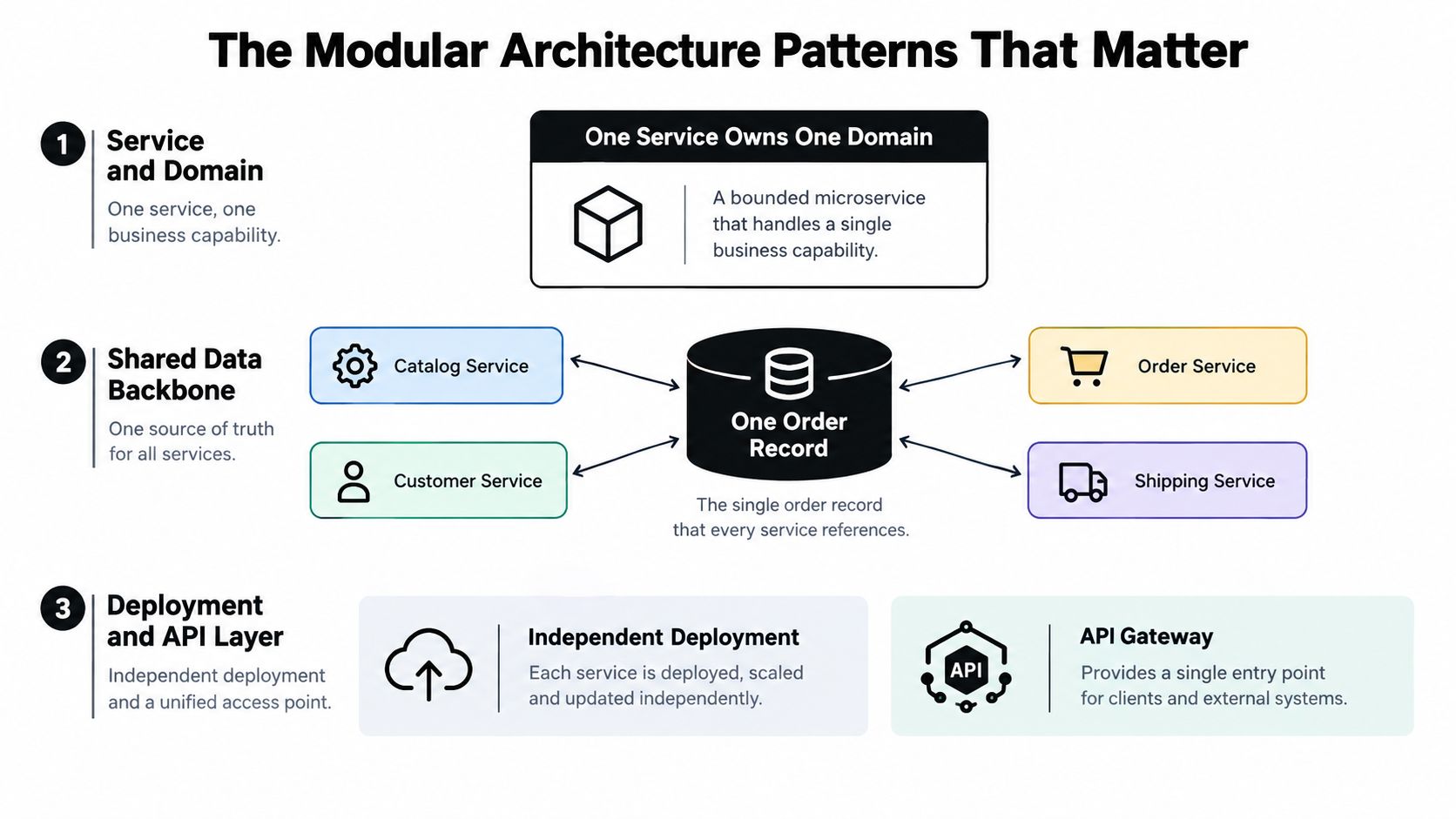
The diagram provides a useful way to visualize the architectural boundaries.
Translate MACH into practical questions
MACH is the implementation vocabulary commonly associated with composability:
- Microservices organize software around bounded business capabilities. Ask whether checkout changes require unrelated services to be released.
- API-first makes interfaces a deliberate product boundary. Ask how the provider handles versioning and compatibility.
- Cloud-native describes software designed for cloud operation. Ask who manages scaling, recovery, and deployment.
- Headless separates presentation from business logic. Ask whether your team requires independent storefront development.
For a companion explanation of the terminology, ECORN's API-first modular commerce guide offers another resource to use during architecture discussions.
The Lego analogy has a limit: software components don't arrive with universally interchangeable business semantics. Replacing a subscriptions provider may require mapping renewal states, cancellation rules, and historical records, even if both vendors have APIs.
Practical rule: Evaluate replaceability by the migration and operating work involved, not by the presence of an API.
The Modular Architecture Patterns That Matter
Follow a customer placing an order. Checkout accepts the purchase, inventory reserves stock, and a payment provider authorizes funds. If the payment request times out, the system must determine whether authorization failed or succeeded without returning a response.
That uncertainty is where an architecture proposal becomes an operating responsibility.
Give each domain a clear owner
A bounded service should own a business capability and its mutations. Inventory manages reservations; payments manages authorization and capture. Other services shouldn't bypass those boundaries by changing their underlying records directly.
A shared order record gives teams a common reference for the purchase, its status, and related identifiers. It needn't mean every service writes into the same database. Separate operational stores can still reference an authoritative order identity and publish changes through a governed event layer.
With separate databases, the complete customer action can't automatically rely on a single ACID transaction, the all-or-nothing guarantee available within a transaction boundary. Research describes eventual consistency and Saga-style workflows as approaches to coordinating distributed commerce operations, including compensating actions when a step fails, in this study of composable commerce engineering.
| Pattern | What to demand in a demonstration |
|---|---|
| Order-state machine | Defined transitions for pending, authorized, reserved, canceled, and refunded states |
| Idempotency keys | A repeated mutation doesn't create another charge or reservation |
| Durable domain events | Updates remain recoverable when a consumer is unavailable |
| Compensating actions | A failed workflow can release inventory or reverse an eligible financial action |
Test failures, not just the happy path
A Saga coordinates local operations rather than pretending they're a single database transaction. If payment fails after stock is reserved, the workflow needs a release action. If fulfillment retries, it must not create duplicate shipments.
Ask who investigates events that can't be processed, how operators replay them, and what happens when a refund succeeds externally but its local status update fails. A unified order view helps investigation; it doesn't remove these external failure conditions.
Use Magnitude Marketing's ecommerce API guide and this commerce API integration overview as preparation for vendor discussions, then request concrete failure demonstrations.
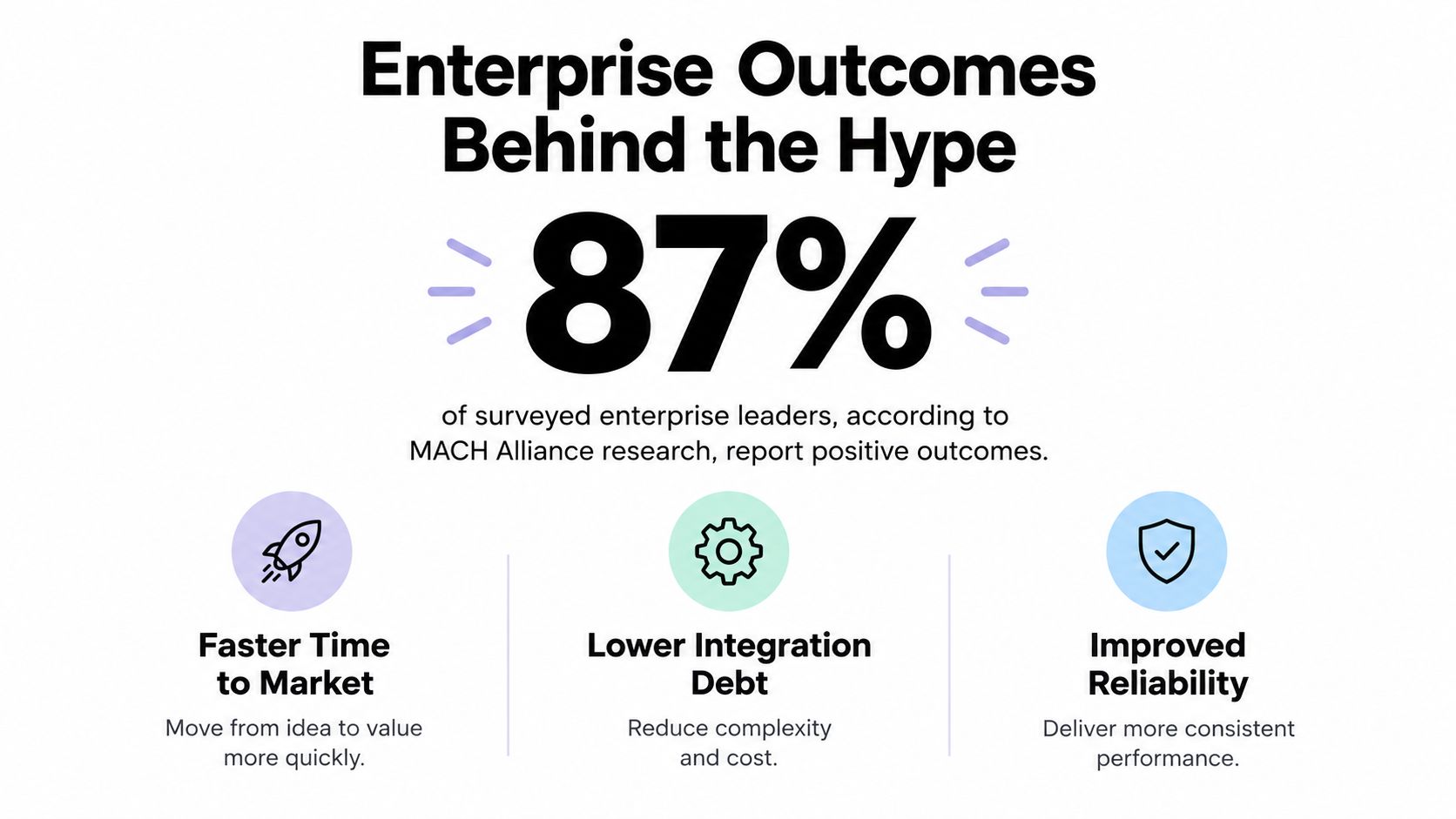
The enterprise graphic below needs a careful distinction: its caption describes outcomes, but the research figure represents implementation prevalence, not proof of reliability or reduced integration debt.
Enterprise Outcomes Behind the Hype
Enterprise adoption gives composable commerce credibility, but it doesn't establish that your brand needs an enterprise-style stack. A retailer with dedicated platform engineering and integration teams has a different operating capacity from a founder whose developer also handles campaign emergencies.
The MACH Alliance's fifth global annual study, covering 561 senior IT leaders and decision-makers across six markets, reported 87% widespread MACH implementation; among organizations implementing some MACH technology, 9 in 10 said it met or exceeded ROI expectations, while customer experience was the leading adoption driver for 61%, according to its global annual research announcement.
Turn adoption evidence into acceptance criteria
These findings describe respondents' experience and intentions. They aren't a forecast for your implementation, and they don't isolate architecture from team capability, investment, or execution.
For a DTC operator, translate the proposal into business tests:
- Integration flexibility means a planned provider change has documented mappings, compatibility tests, and a responsible owner.
- Experimentation capacity means marketing can launch an approved offer without unrelated releases or manual repair.
- Customer experience means shoppers can complete the intended journey across purchasing, renewals, and support.
- Return on investment means benefits remain persuasive after including migration, operations, and retained specialist services.
Agree on the baseline before signing. Record current launch blockers, incident patterns, and reconciliation tasks so the team can compare the new operating model against something concrete.
Separate illustrations from evidence
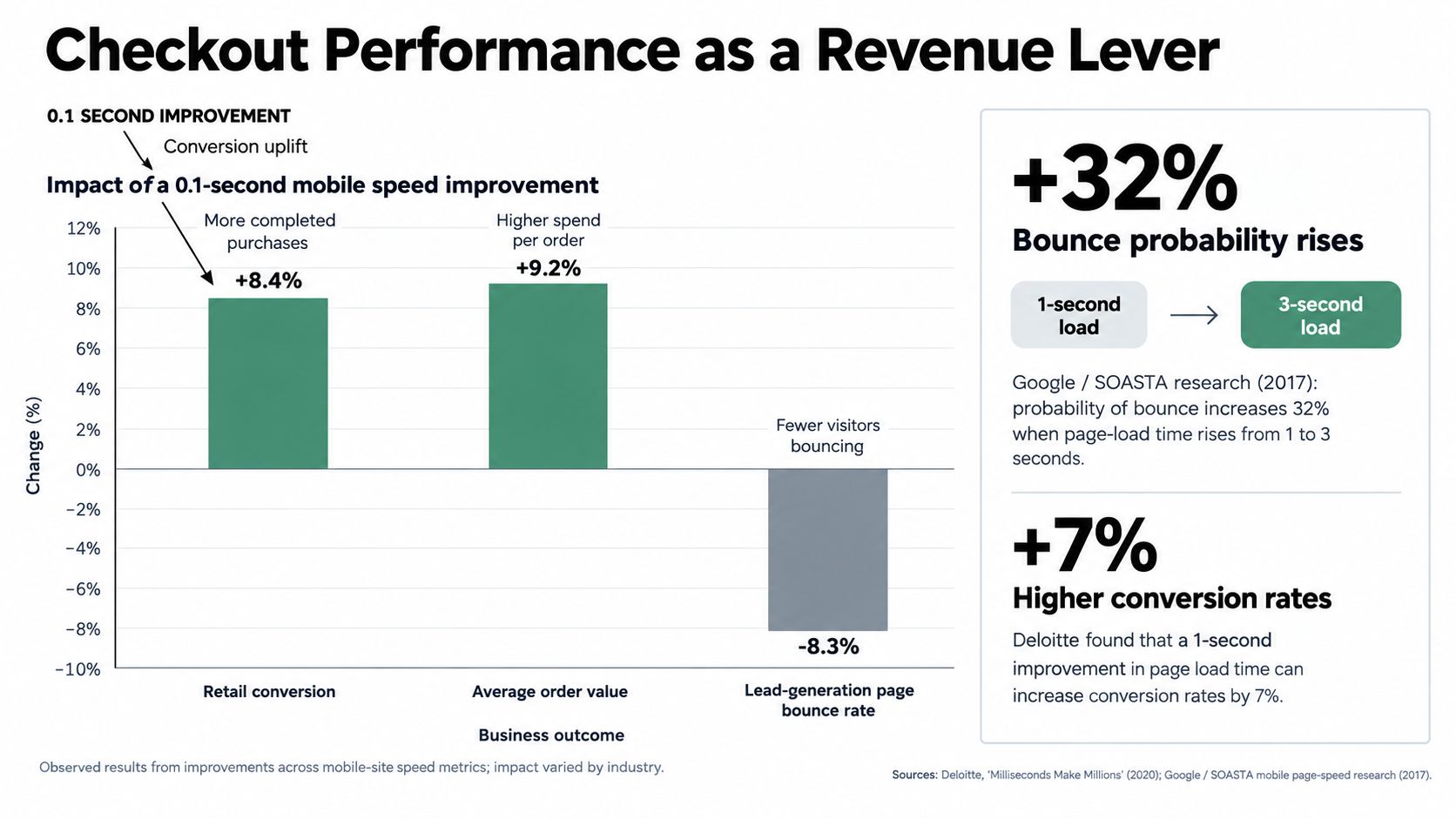
The performance illustration below introduces a business outcome worth measuring. It shouldn't be read as evidence for an uncited bounce-rate change or a guaranteed revenue gain.
Architecture can enable a better experience, but your team still has to demonstrate it under realistic traffic, devices, and customer journeys. An attractive storefront demonstration says little about payment delays or renewal exceptions.
For additional visual context, the accompanying video is available below.
Checkout Performance as a Revenue Lever
Checkout is where independent services can become a visible customer problem. A shopper doesn't care whether a delay comes from tax calculation, identity lookup, or payment-method eligibility. They see a stalled page and wonder whether clicking again will charge them twice.
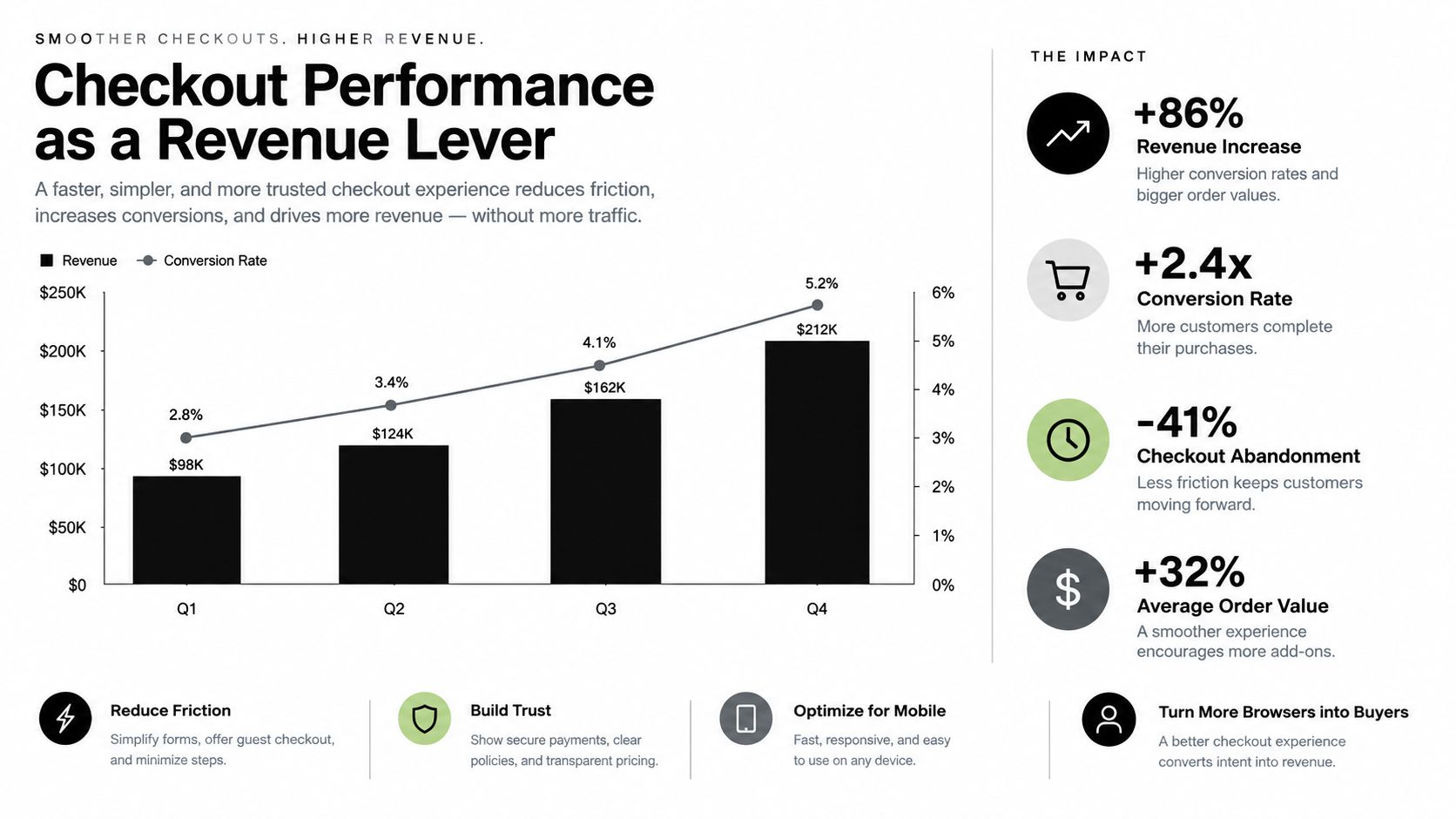
An independent summary of Google and Deloitte's mobile-speed research reports that a 0.1-second improvement in retail load time corresponded to an 8.4% conversion increase, across 37 brand sites and more than 30 million sessions, in this checkout performance audit. Treat that as an observational benchmark, not a guaranteed lift for your store.
The illustration frames the relationship to investigate rather than a revenue promise.
Shorten the critical path safely
Serve storefront and checkout assets from geographically distributed edge infrastructure. Defer nonessential analytics and personalization so customers don't wait for marketing systems before seeing their cart.
Where dependencies permit, use parallel fan-out: request independent checks concurrently instead of placing every call in a serial chain. Tax calculations may require an address, and payment eligibility may require currency or cart totals, so engineers must map actual dependencies first.
- Set strict timeouts for external calls and define what the customer sees when they expire.
- Cache suitable read models without treating stale inventory or pricing as final authorization.
- Use graceful fallbacks for optional features, such as recommendations.
- Preserve financial controls rather than bypassing required payment, tax, or fraud decisions to make checkout appear faster.
When reviewing the order-summary interface, you can browse the checkout review component from DOM Studio as a design reference. Then test your implemented interface with slow responses and unavailable dependencies.
Measure the slow customers too
Track p50, p75, p95, and p99 latency, together with time to first byte, largest contentful paint, payment authorization time, completion rate, and abandonment segmented by device and geography. These percentiles describe the distribution of waiting times; an average alone can hide a painful slow tail.
Pair real-user monitoring with controlled browser tests. Use cohort- or region-based experiments before attributing a conversion change to speed, and consult ecommerce conversion-rate benchmark guidance when choosing comparison context.
A checkout performance target should name both the customer experience and the failure behavior. Fast success isn't enough if retries create uncertainty.
The Operating Burden Most Explainers Leave Out
The best catalog tool, best subscriptions engine, and best messaging platform don't automatically produce the easiest system to operate. Each selection adds an interface someone must understand, monitor, and maintain.
Independent commerce research found that 93% of organizations' digital-commerce operations were affected by technology limitations, while 51% weren't completely satisfied with managing integrations across systems and third-party applications, according to the digital commerce report. These findings establish integration pain, not that a more distributed stack will cure it.
Use an ownership threshold, not a headcount rule
There isn't a defensible universal team-size cutoff. A team with strong platform expertise may operate a carefully bounded stack more effectively than a larger team divided by unclear responsibilities.
My recommendation is to use an ownership threshold. Composability becomes plausible when you can assign durable responsibility for architecture, production incidents, interface contracts, data reconciliation, and vendor escalation without abandoning the product roadmap.
It becomes drag when every service change needs the same overloaded engineer, nobody owns failures spanning vendors, or launch budgets cover implementation but not ongoing maintenance.
| Operating responsibility | What belongs in the cost comparison |
|---|---|
| Integration upkeep | Schema changes, contract tests, API upgrades, and release coordination |
| Production support | Alerts, tracing, incident response, and vendor escalation |
| Data integrity | Catalog validation, inventory reconciliation, and exception handling |
| Migration | Parallel operation, record verification, rollback, and historical access |
| Commercial overhead | Provider contracts, usage fees, and retained applications |
Consolidation can be a modular choice
Compare a federated stack, assembled across providers, with a consolidated platform offering governed extension points. The former may justify its burden when a specialist capability creates meaningful differentiation. The latter may suit a brand that needs flexible interfaces without owning every connection between core commerce functions.
A useful exercise is to walk through a subscription renewal failure with each candidate. Identify who detects it, who can repair it, which records require reconciliation, and who communicates with the customer.
Operating test: If a vendor can't explain who resolves a cross-service failure after launch, its architecture proposal is incomplete.
Build the comparison around your operating horizon, including support and migration work, rather than the launch invoice alone.
Making a Composable Stack AI-Ready and Safe
An AI agent that drafts a product description poses a different risk from an agent that changes pricing or issues refunds. Both may use APIs, but only the latter can directly alter financial outcomes.
Retail research found that 52% of respondents considered AI governance very important, yet only 46% had formal governance policies aligned with standards and best practices, and 44% had a framework for ongoing assessment and improvement, according to the retail state of AI report. The distinction between interest and operational control matters more than the availability of an agent interface.
Define authority before enabling actions
Suppose a merchandising agent can edit product listings. That shouldn't automatically permit it to alter subscription pricing, publish unrestricted discounts, or refund orders. Credentials should identify the agent, limit its tools, and constrain the resources it can change.
The commerce platform must enforce these boundaries. A prompt asking an agent to behave cautiously isn't a substitute for authorization.
Governance Controls an AI-Ready Composable Stack Must Expose
| Control | What it does | Failure mode it prevents |
|---|---|---|
| Scoped credentials | Identifies each agent and limits accessible resources | Shared access that can't be attributed or revoked selectively |
| Least-privilege tools | Separates reading, drafting, publishing, and financial actions | A content task gaining unnecessary transaction authority |
| Spend thresholds and approval gates | Holds designated financial actions for human authorization | Unapproved campaign spending, discounts, or refunds |
| Idempotent mutations | Applies retry protection to agent-triggered writes | Duplicate operations after interrupted responses |
| Reversible workflows | Defines eligible rollback or compensation paths | Recoverable errors becoming permanent changes |
| Cross-system audit logs | Records identity, inputs, policy decisions, approvals, and outcomes | Inability to reconstruct an incident |
| Policy testing and reassessment | Checks boundaries as tools and workflows change | Previously safe permissions becoming excessive |
Ask for an incident reconstruction
Have the vendor demonstrate an agent attempting an action outside its scope. Then ask it to show an approved financial operation, an interrupted request, and the resulting audit trail.
An effective record connects the agent's request to the business operation and its downstream outcome. It should show what context the agent used, which policy allowed or blocked the action, and whether a human approved it. Logging a request without its result leaves operators guessing.
Use this store AI-agent readiness guide to organize evaluation questions. Start with bounded, reviewable workflows before granting broader production authority.
AI-ready commerce requires accountable action, not callable APIs. Keep irreversible actions behind explicit authorization, and test recovery paths before an agent handles live customer transactions.
Putting It Together With a Practical Decision Framework
Start with the launch problem, not the replacement platform. Ask whether integration failures prevent growth, whether your team can operate independently changing services, and whether planned AI workflows need permission to write into production.
Score each evaluation area as demonstrated, partially demonstrated, or unproven. Don't average away an unproven financial-control or recovery requirement.
- Architecture needs clear domain ownership, compatible interfaces, and demonstrated failure handling.
- Governance needs enforceable permissions and traceable agent actions.
- Checkout needs measured performance under realistic customer and dependency conditions.
- Migration needs catalog import, parallel verification, and a credible cutover plan.
- Operations needs named owners and a cost comparison that includes ongoing support.
If your pain is concentrated in a specialist capability, consider changing that boundary rather than rebuilding everything. If the opening scenario reflects conflicting core records, evaluate consolidation alongside federation. If ownership remains unclear, resolve it before increasing architectural freedom.
A composable commerce platform fits when its flexibility serves your business and your team can sustain its operating demands. The right decision should make the next campaign easier to launch and the next incident easier to resolve.
PlatformDTC offers consolidated storefront, checkout, subscriptions, payments, inventory, and other commerce services, with governed APIs for AI-agent operations. Visit to evaluate its shared record model, agent controls, and migration utilities against your three-year operating plan, alongside a federated stack or your current platform.