
What Is Agentic Commerce? It's the shift from human-led browsing to delegated purchasing, where AI agents handle discovery, evaluation, and transaction completion on a user's behalf. That shift is already being priced as a major market, with one estimate putting the global agentic commerce market at USD 5.71 billion in 2025 and projecting growth to USD 65.47 billion by 2033.
The surprising part is that this isn't mainly a chatbot story. It's an infrastructure story about who gets to act, what data they can trust, and how a merchant keeps control when software, not a shopper, starts making buying decisions.
Table of Contents
- The Rise of Delegated Purchasing
- The Technical Execution Layer
- Governing Autonomous Agent Actions
- Winning the Machine Comparison Game
- Preparing Your Commerce Stack for Agents
- Agentic Workflows in B2B and Subscriptions
- The Future of Autonomous Retail
The Rise of Delegated Purchasing
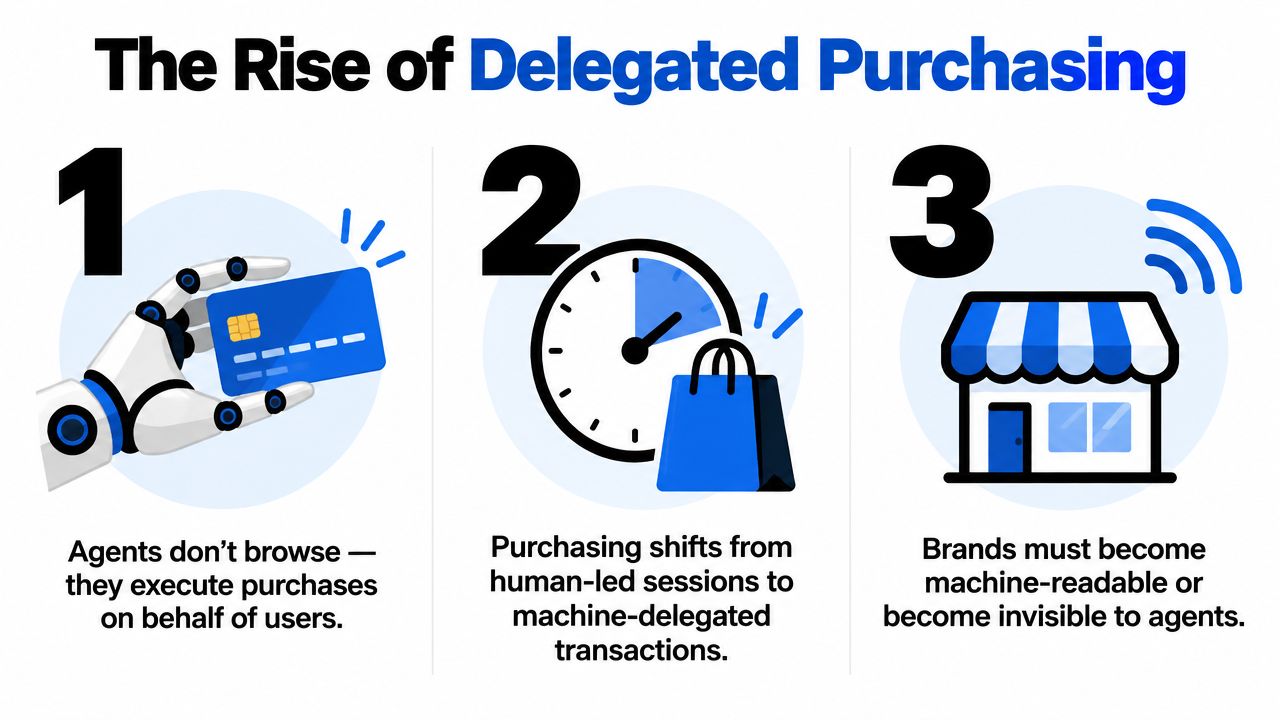
Agentic commerce becomes real when a brand stops treating AI as a recommendation layer and starts treating it as an execution layer. That is the shift from “here are some products you might like” to “this system can discover, compare, and complete the purchase for you.” The buyer is still human, but the work of shopping is increasingly delegated to software.
From browsing to buying on behalf of the user
The commercial unit changes with that shift. A traditional funnel assumes people visit, compare, decide, then check out. In an agentic model, the agent captures intent, evaluates options, and can carry the transaction through with far less human intervention, which is why the category is being discussed as a delegated-buyer layer rather than a nicer search box. Commerce autonomy only works when action, verification, and control stay tied together, which is why the agentic flywheel for security matters.
Market estimates point to why founders should pay attention. One estimate places the market at USD 5.71 billion in 2025 and projects growth to USD 65.47 billion by 2033 DevArmor. Another widely cited estimate puts total transaction value at $3.5 trillion in 2026. Those numbers do not mean every DTC brand needs to rebuild now, but they do show the category is being measured like infrastructure, not novelty.
Why this is bigger than chat
The architecture shift is larger than a conversational interface. In the early 1990s, e-commerce moved buying from physical stores to digital storefronts, and agentic commerce is the next step in that progression, where software does not just help the buyer, it executes parts of the purchase. That changes conversion economics, merchandising priorities, and how discovery gets routed across channels.
For DTC teams, the operational implication is direct. If your catalog cannot be consumed by software, you will be hard to find when a buyer delegates the task. If your business relies on visual persuasion alone, you are optimizing for a layer that may no longer be the deciding layer.
Agentic commerce is an API and governance problem as much as a shopping experience. Scoped permissions, approval rules, and audit trails determine whether an agent can act safely inside a merchant's systems. That is the practical standard, not the glossy interface.
The Technical Execution Layer
Agentic commerce fails fast when the backend is messy. AI agents can't act on stale catalogs, broken integrations, or inconsistent inventory states, because every decision they make depends on structured data and deterministic rules. That's why this is less a marketing trend than an execution problem.
What the agent actually needs
At minimum, the stack has to expose machine-readable product data, real-time price and inventory access, and clear checkout or approval paths. A headless architecture helps because it separates presentation from commerce logic, which makes it easier for agents to query the system directly instead of scraping a storefront built for humans. If the catalog is out of sync, the agent's output gets worse immediately, and the result can be a failed cart, a mispriced order, or a bad recommendation.
The cleanest way to think about it is in layers.
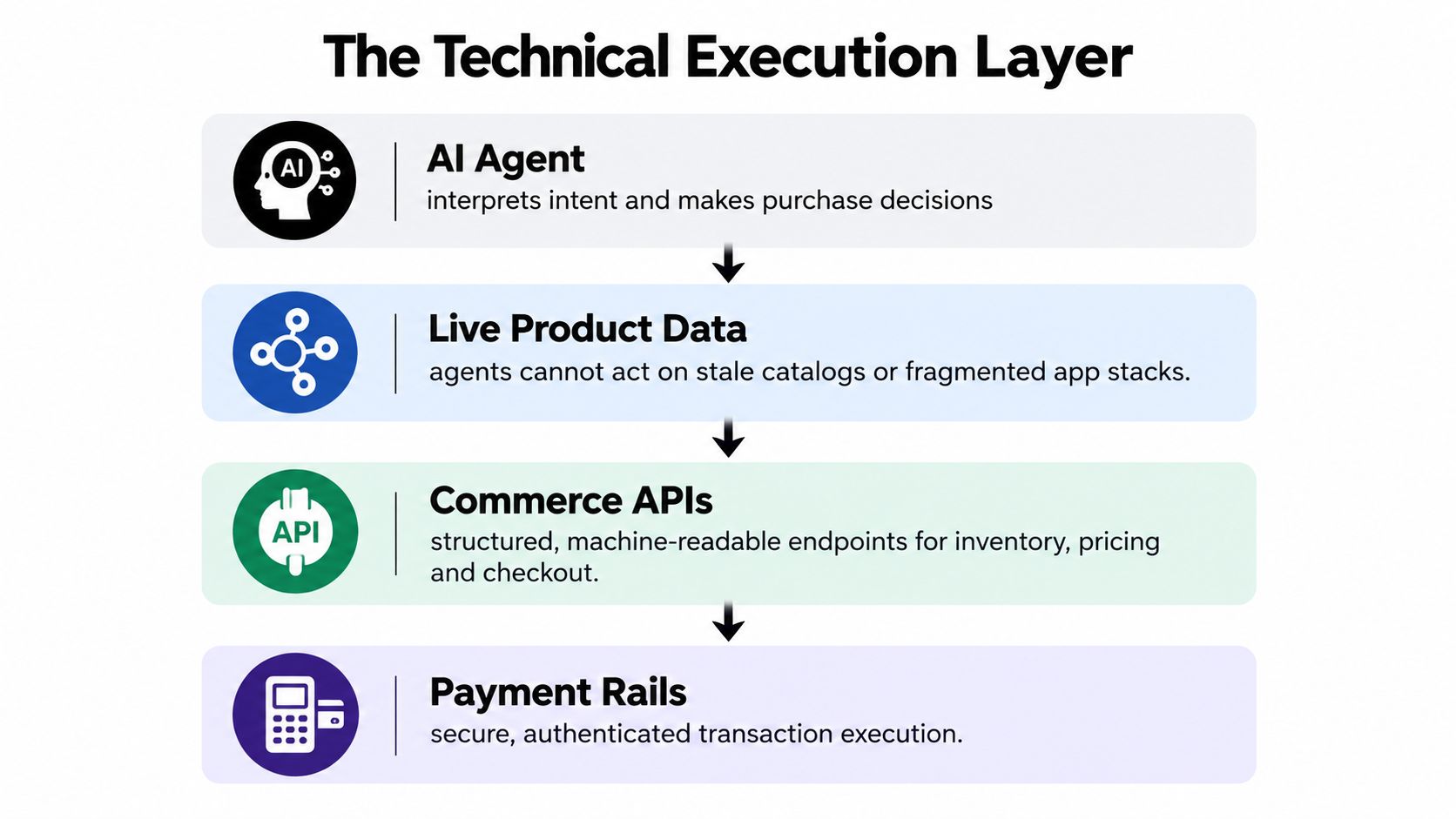
| Layer | What it must do |
|---|---|
| AI Agent | Interpret intent and make purchase decisions |
| Live Product Data | Stay current, so the agent doesn't reason from stale inputs |
| Commerce APIs | Expose inventory, pricing, and checkout in a machine-readable way |
| Payment Rails | Authorize secure transaction execution |
Why stale data breaks the buying path
A human shopper can forgive a lagging price tag on a page. An autonomous agent can't. If your availability feed says one thing and your checkout says another, the agent has no stable basis for action. That is why real-time APIs and deterministic policy controls are prerequisites, not optional upgrades.
Enterprise guidance keeps converging on the same conclusion, clean data, headless commerce, and security controls have to exist before autonomy can scale. One useful operational pattern is to treat every commerce action as a governed API call, with the same rigor you'd use for payments or customer identity. That mindset matters more than the interface, because the interface can be changed later. The data model can't.
Governing Autonomous Agent Actions
The biggest risk in agentic commerce is not that the system talks too much. It's that it acts too freely. If an agent can buy on behalf of a user, then the merchant has to answer a harder question than “Can it convert?” The actual question is “What stops it from spending outside the rules?”
Controls that prevent rogue spend
The safest implementations put narrow boundaries around what an agent can do. That means scoped keys per agent, explicit approval gates on spend, idempotent writes so repeated actions don't duplicate orders, and full audit trails for every action. Those controls don't slow useful automation down. They make automation defensible.
A merchant also needs a policy model that distinguishes between delegated authority and open-ended authority. If an agent can place a reorder, that doesn't mean it can override budget, switch shipping methods, or infer consent for unrelated purchases. Those distinctions matter because a failed transaction is annoying, but an unauthorized transaction becomes a liability event.
If you can't answer who approved the action, who can review it, and who can reverse it, the automation is too broad.
The legal blind spot is still real. Current frameworks were built for people entering card details, not for software completing purchases on a user's behalf. Questions around contract formation, consent, fraud, and dispute handling remain unresolved across markets, which means merchants need to design for traceability now instead of waiting for regulation to catch up.
How to keep trust intact
Governance starts with the ability to prove what happened. The agent should operate inside a logged permission scope, and every mutation should be attributable to a specific request, rule, or approval. That's the difference between an automation layer and an opaque black box.
If you're building this stack, the internal controls matter as much as the checkout flow. The security model described in PlatformDTC's agent gateway security model is a good example of how commerce actions can be constrained without killing automation. The design pattern is the same across systems, limit authority, log everything, and make the agent useful only inside clearly defined boundaries.
Winning the Machine Comparison Game
When an agent chooses the product, storefront polish stops being the main differentiator. The brand that wins is often the one with the clearest inventory, the most reliable delivery promise, and the least ambiguity in policy. That sounds unglamorous, but it's the new competitive surface.
What the agent values
Agents compare offers differently from people. They care about whether the data is readable, whether the price is current, whether the item can ship when promised, and whether the merchant appears trustworthy enough to execute the order safely. That shifts competition away from page design alone and toward operational signals that software can verify.
Product feeds, policy clarity, and fulfillment accuracy matter more than creative overlays. A beautiful PDP won't rescue a stale inventory feed. A strong brand story won't help if the agent can't confirm delivery timing or return logic. When the machine is comparing offers across multiple sellers, the merchant wins by being the easiest one to trust and the least likely one to create friction.
If you want a mental model for what the agent sees, this internal guide is useful because it frames discoverability from the agent's perspective, not the merchandiser's.
The standards layer is forming
The ecosystem is already organizing around machine-to-machine commerce rails. Industry coverage points to protocols and direct checkout flows that let agents and merchants coordinate without custom one-off integrations. That matters because the winning brand won't be the one with the prettiest front end. It'll be the one whose data and transaction rails can be consumed cleanly by whatever agent sits between the shopper and the store.
Merchandising for agents is less about inspiration and more about eligibility.
For DTC teams, that means machine readability becomes a growth input. If your catalog, shipping promises, and policy objects are explicit, the agent has a reason to surface you. If they're fuzzy, your offer gets skipped even if your brand is stronger to a human viewer.
Preparing Your Commerce Stack for Agents
The practical work starts with a stack audit. Most brands don't need to rebuild commerce from scratch, but they do need to remove the friction that makes autonomous actions unreliable. That means identifying where data drifts, where checkout slows down, and where policy rules live in disconnected systems.
A usable readiness checklist
Start with the source of truth. If storefront, subscriptions, payments, inventory, and fulfillment are spread across separate systems, the agent will see inconsistencies that humans can overlook. A unified record model is easier to reason about, easier to govern, and easier to expose through APIs without guessing.
Then look at latency and control points.
- Consolidate product and inventory records so the agent isn't reading conflicting states.
- Expose pricing, availability, and policy via deterministic endpoints instead of hidden logic in front-end code.
- Serve checkout with low latency so delegated buying doesn't stall at the final step.
- Keep approval logic explicit so spend limits and exceptions are enforced consistently.
- Run migration in parallel rather than cutting over abruptly and risking revenue loss.
A practical resource for teams mapping this out is the agent-ready agentic commerce glossary entry, which is helpful when internal teams need shared language for readiness and architecture decisions.
How to avoid breaking the current business
The biggest mistake is treating agent readiness as a separate experimental project. It has to sit on top of the current commerce system without disrupting live revenue. That's why parallel running matters. You need the ability to test agent-facing flows, verify that feeds stay in sync, and confirm that checkout still behaves correctly before you switch traffic.
The goal isn't to make everything autonomous on day one. The goal is to make the system legible, governed, and safe enough that autonomy can scale later.
PlatformDTC is one example of a unified stack that combines storefront, checkout, subscriptions, payments, inventory, fulfillment, messaging, and analytics in one system, with governed APIs for agent actions. That kind of consolidation reduces drift between systems, which is exactly where agentic failures usually start.
Agentic Workflows in B2B and Subscriptions
The clearest place to see agentic commerce in action is in repetitive, rules-heavy buying. B2B procurement and subscription renewals both fit that pattern because the agent can evaluate options, apply constraints, and execute tasks that don't require constant human review. That's why adoption is already moving faster in those environments than in simple one-off consumer purchases.
A B2B reorder scenario
A procurement manager wants to restock a standard product line. Instead of manually comparing vendors, the agent checks catalog compatibility, lead times, and price benchmarks, then drafts the order for approval. If the merchant exposes clean pricing and availability data, the agent can narrow the field quickly. If not, the buyer ends up with a manual workflow dressed up as automation.
The B2B case is important because buyers are already using agentic AI during product evaluation, configuration, contract review, and price benchmarking. That tells you the workflow is no longer theoretical. The automation is already sitting in the middle of the purchasing process.
Subscriptions behave differently, but they still need governance
A subscription renewal is another strong use case because the agent can inspect the renewal state, apply the correct plan logic, and keep the order inside the same lifecycle as the original purchase. That only works if billing, entitlement, and fulfillment are aligned in one system. If those records are split, the agent has to guess, and guessing is the enemy of reliable automation.
Repetition is where agents earn their keep. One clean renewal is useful. Fifty clean renewals are where the operating model changes.
For growth and lifecycle teams, the takeaway is practical. Build campaigns and renewal flows that assume a buyer may delegate the task to software. That means clean product metadata, clear renewal language, and order states that a machine can interpret without ambiguity.
The Future of Autonomous Retail
Agentic commerce is becoming a platform shift because the buying task is being redistributed across software layers. The brands that treat this as a UI trend will miss the harder truth: the competition is around APIs, permissions, and trust. The ones that prepare the stack now will be easier to discover and easier to transact with when delegated buying becomes routine.
Why early readiness compounds
The market is already moving toward standardized coordination between agents, merchants, and payment providers. As those rails mature, transaction volume will favor businesses that can expose clean catalog data, reliable fulfillment promises, and governed checkout flows. That's not a branding advantage. It's an infrastructure advantage.
If you want a broader perspective on how autonomous systems are being applied across commerce and operations, exploring Agentic AI with Faberwork is a useful adjacent read. The important idea is the same across vendors, autonomy only works when the system behind it is controlled.
The long-term change is straightforward. Brands won't just be selling to people browsing a site. They'll also be selling to agents acting under permission, inside constraints, and under audit. The merchant that adapts its data, governance, and checkout stack first will have a structural advantage when the market tips from experimentation to default behavior.
PlatformDTC helps DTC brands consolidate storefront, checkout, subscriptions, payments, inventory, fulfillment, and analytics into one governed system, which is the right foundation for agentic commerce. If you're mapping how scoped permissions, audit trails, and machine-readable commerce data fit into your stack, visit PlatformDTC and see how the platform is built for that shift.