
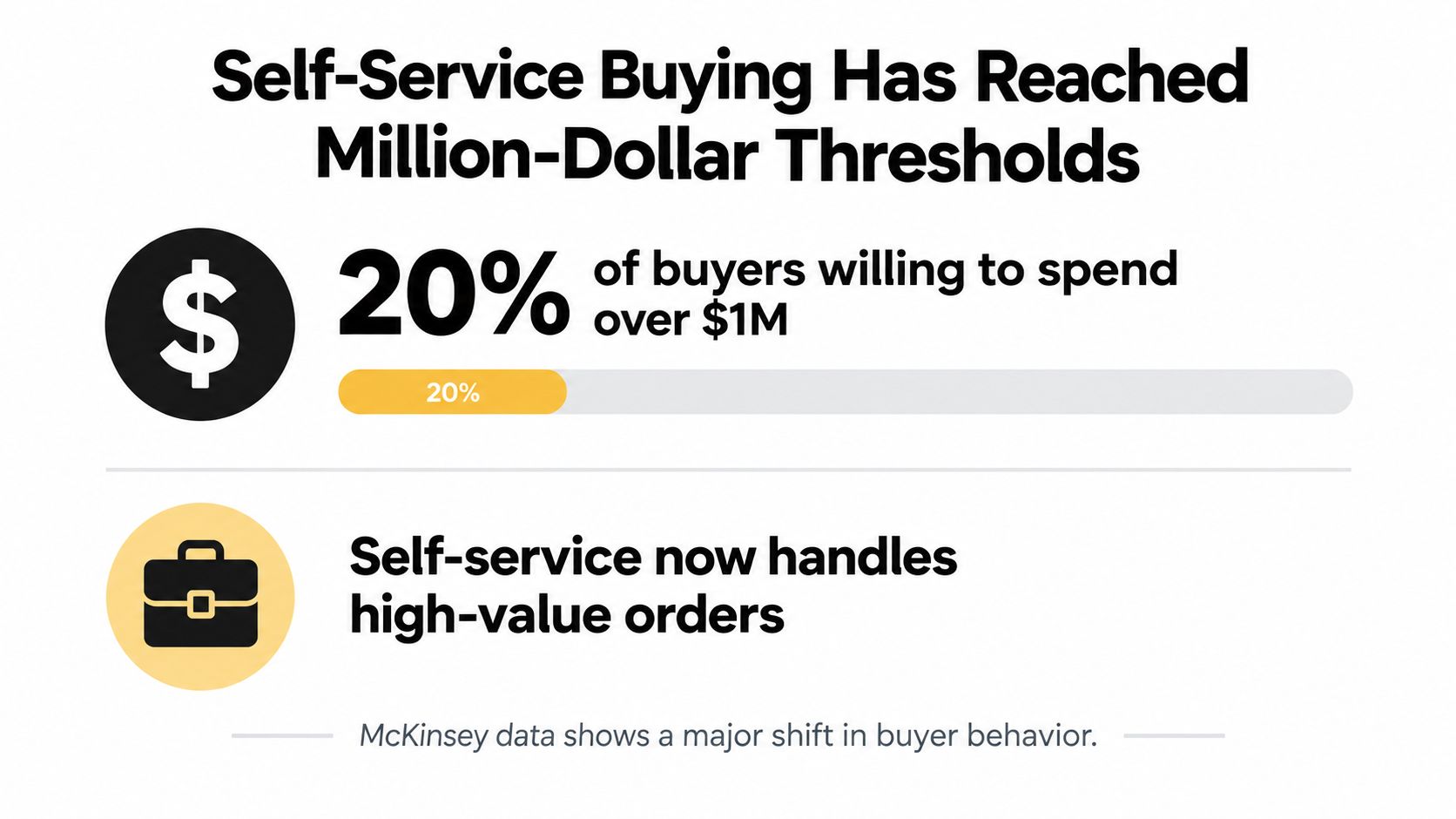
Twenty percent of B2B buyers said they were willing to spend more than $1 million through digital self-service or remote sales interactions in 2024, up from 15% two years earlier, according to McKinsey's Global B2B Pulse findings. For 2026, the signal is sharper than channel adoption: self-service clears that threshold only when pricing, permissions, payment terms, and order history stay governed across human and digital touchpoints. Agentic buying raises the bar, because an agent that can place orders can also expose bad data or break negotiated terms.
Table of Contents
- What B2B Commerce Trends Mean in 2026
- Buyers Now Use an Average of Ten Channels
- Self-Service Buying Has Reached Million-Dollar Thresholds
- Payment Terms Still Decide Whether Self-Service Actually Converts
- Composable Architecture Is the Substrate Beneath Every Other Trend
- Agentic Commerce Is Advancing Faster Than the Governance to Run It
- A 30-Day Operator Checklist for Acting on These Trends
What B2B Commerce Trends Mean in 2026
B2B buyers work through an average of ten interaction channels, spanning websites, e-commerce, sales representatives, video, email, mobile apps, chat, and procurement portals, according to McKinsey's 2024 Global B2B Pulse survey. The figure reframes the debate. Buyers circulate among channels rather than migrating from sales to digital in one direction, and they expect the account, the catalog, the contract price, and the order history to stay coherent at every step.
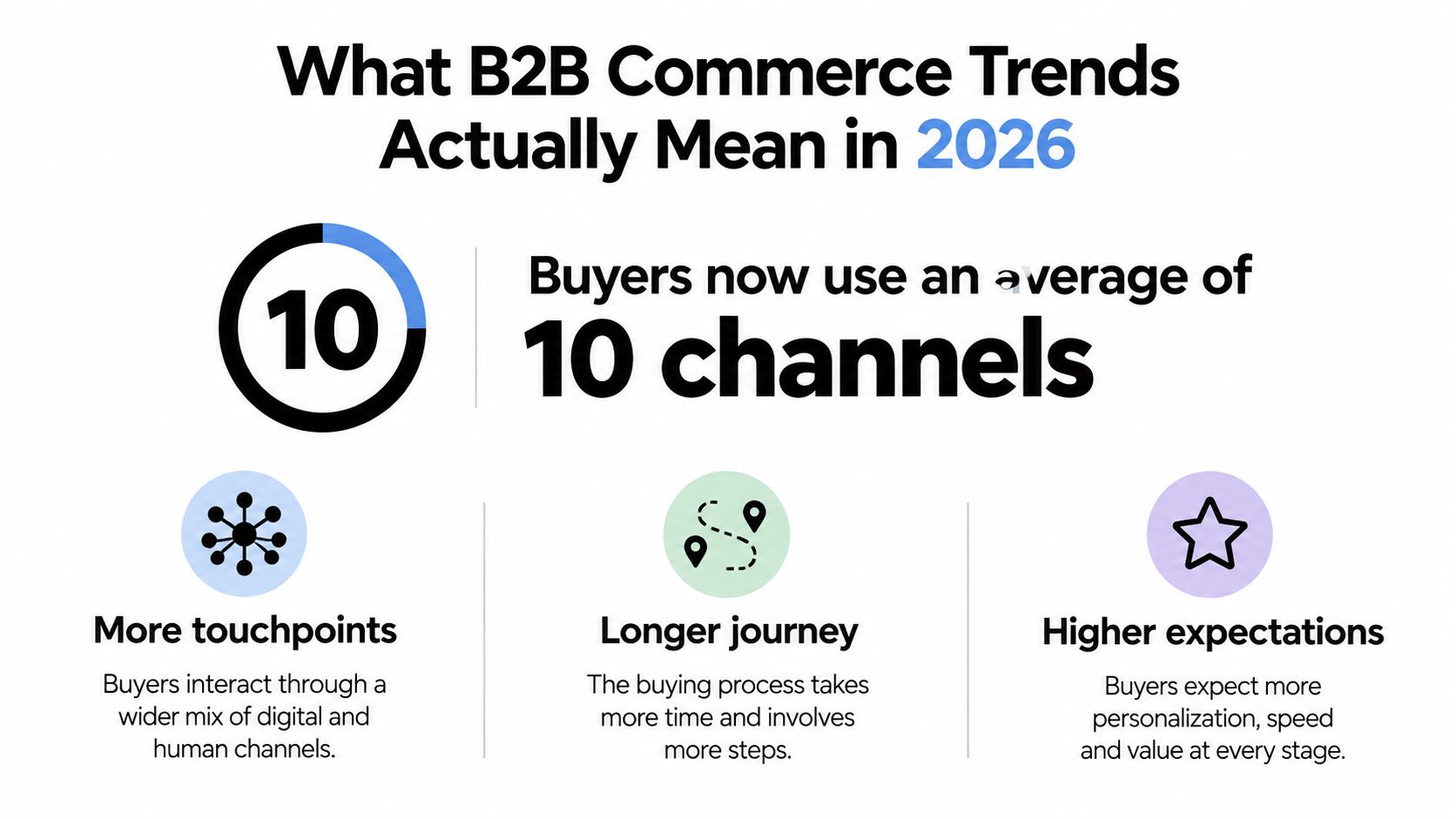
McKinsey's 2024 research also found that 71% of surveyed suppliers offered e-commerce, and among those companies, online sales generated 34% of revenue, the leading revenue channel for the second consecutive year. Two implications follow. Digital commerce is now a core revenue route for B2B sellers, and the blended motion still includes remote sales conversations and in-person engagement. The operating question for 2026 is consistency across all of them, because adoption alone is already settled.
Five trends, one operating model
Read together, the findings put five connected priorities on the leadership agenda, and each one depends on the same underlying asset: governed commercial data.
- Omnichannel orchestration: Keep catalog, account, pricing, inventory, and order information coherent as buyers change channels.
- High-value self-service: Make digital purchasing dependable enough to support significant orders, not just routine reorders.
- Payment-term preservation: Let buyers transact digitally while retaining invoicing, credit arrangements, and approvals.
- Composable architecture: Build shared data and services that feed multiple interfaces rather than standing up a separate system per channel.
- Agent governance: Give AI tools access to commerce functions without letting them bypass negotiated terms or commercial controls.
A useful shorthand is B2B commerce as a unified record. The storefront is one view of the relationship; it should never hold a separate version of the truth. Most 2026 coverage will track channel counts and AI feature launches, while the trend that decides outcomes is whether pricing data, credit terms, and order permissions stay consistent wherever a buyer, or a buyer's agent, shows up. For an adjacent-industry view of how shifting customer expectations reshape operating models, NZ hospitality trends for 2025 offers a useful comparison.
The practical test for leadership teams is direct. Count channels if you like, but audit whether each one runs on the same commercial facts.
Buyers Now Use an Average of Ten Channels
The 42% of buyers McKinsey found using more than eleven touchpoints is what makes the ten-channel average operationally serious. Journeys that long cross portals, sales conversations, procurement systems, email, and mobile, sometimes inside a single purchase. The same McKinsey research reports that about half of B2B buyers are likely to switch suppliers when cross-channel experiences aren't smooth. Every channel a supplier adds without shared data is one more place to lose the account.

The failure point is the record, not the screen
A buyer who sees one price in a portal and a different figure on a sales-assisted quote will report it as a checkout problem. The negotiated pricing that should reach every channel often lives in a contract system only the sales team can read. Rebuilding the storefront does nothing for a price that never arrives there.
The data model that prevents this has four moving parts. Identity connects each user to the right buying organization, role, and permissions. Pricing applies account, contract, volume, currency, and tax rules in one place rather than once per channel. Availability and quoting expose inventory and negotiated offers wherever a buyer or sales rep needs them. Order state keeps a single version of the transaction across storefronts, sales tools, and service workflows.
Shared APIs can publish that model while each channel keeps an interface suited to its users. A procurement portal can lead with approval workflows while a storefront favors browsing and reordering. What the buyer sees may differ by channel. What the system knows cannot.
Operator test: Trace one account from product discovery through quote, checkout, invoice, and reorder. At every handoff, ask whether price, permissions, and order status traveled with the buyer or stayed behind in the last channel.
Teams that run this audit usually find the divergence early: a pricing table maintained in a system the portal can't query, a permission set that never synced, an order status that stops updating once fulfillment takes over. Fixing those records comes before any redesign, because a faster interface over inconsistent data produces confident errors at more touchpoints.
Self-Service Buying Has Reached Million-Dollar Thresholds
Self-service has crossed the line where mistakes stop being refunds and start becoming disputes. According to the McKinsey Global B2B Pulse findings cited in the introduction, 39% of buyers would spend more than $500,000 through digital self-service or remote sales interactions, up from 28% two years earlier, and the share willing to exceed $1 million climbed from 15% to 20% over the same period.
That second figure changes what a storefront is. A half-million-dollar order placed without a rep is a credit decision, a contract event, and a delivery commitment made at interface speed. Teams that built self-service for reorder convenience are now running transaction sizes that once required procurement review and a signature.
Convenience needs transaction controls
The control model that fits these values splits a transaction into two states. A draft order or quote captures the buyer's intent without obligating anyone. Commitment happens only after account-level authorization confirms the right permissions, pricing, and terms were applied. At checkout the system should validate applicable pricing and availability, log which permissions and commercial terms governed the order, and route exceptions to an authorized person instead of resolving them without notice.
Durability matters as much as authorization. A network retry or a handoff between portal and sales tool should never produce a second order. Idempotent writes, which let a repeated request be recognized as the same intended action, keep the transaction whole when systems retry or workflows cross channels. At seven figures, a duplicate order is a dispute that lands in accounts receivable.
Trust comes from visible rules
When a buyer questions an invoice six months later, the storefront needs to answer a short list of questions: why this buyer saw this price, whether an approver was required, what delivery commitment was displayed, and how a failed payment or inventory change was handled. A portal that cannot reconstruct those answers is running self-service as a front-end feature rather than an operating capability. For brands working through the workflow requirements behind wholesale portals, this guide to ecommerce platforms for wholesalers provides a relevant implementation lens.
The practical boundary is explicit thresholds. Define which transactions run unattended, which pause for human review, and which always require negotiation, typically by order value, account standing, or off-contract items. Buyers handle eligible purchases independently while sales and operations stay present for the exceptions. As order values climb, the cost of a silent failure climbs with them.
Payment Terms Still Decide Whether Self-Service Actually Converts
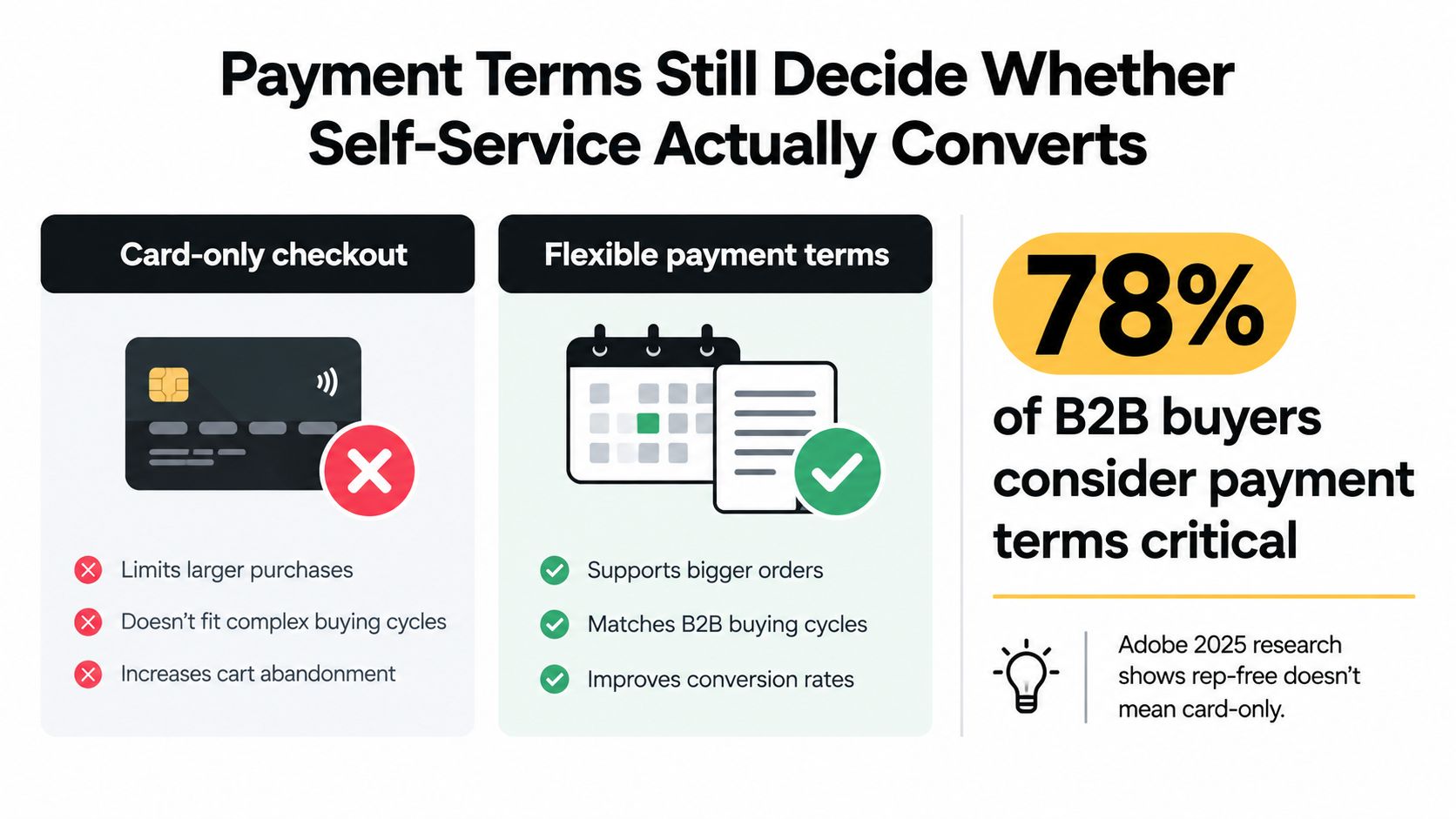
In Adobe's 2025 survey of B2B organizations and buyers, 78% of buyers considered payment terms essential when choosing suppliers, and two-thirds had abandoned a purchase when terms were not offered, according to Adobe's research on the future of B2B digital commerce.
That is a conversion variable, not a preference.
The same Adobe survey found that 80% of buyers preferred bank transfers and 57% preferred direct debit, while 73% chose webstores, marketplaces, or mobile apps as their preferred buying interface. Read together, these figures capture two separate choices: where buyers want to place orders and how they want to settle them. A portal that only offers card checkout answers the first half and fails the second.
Where self-service loses the terms
The failure pattern is predictable. Digital projects rebuild the front of the transaction, meaning catalog, cart, and order submission, while the commercial layer stays in email and spreadsheets: credit approval, net terms, invoicing, reconciliation. The buyer gets a modern interface attached to an old-fashioned settlement process, and the order either routes back to a sales rep or stalls at checkout.
A terms-aware flow carries the account's commercial agreement through the entire order rather than treating payment as a checkout setting.
| Moment | What the account expects |
|---|---|
| Before checkout | Its negotiated catalog, contract prices, and a quote path for exceptions |
| At commitment | A credit decision and its agreed terms applied to the order |
| After the order | An invoice it can reconcile, with visibility into partial fulfillment and returns |
| On reorder | The same terms and purchasing permissions, without re-negotiation |
Adobe's survey also reported that 60% of B2B organizations rated the impact of increased digital self-service and post-sale interactions as major. The operative word is post-sale. Storefront budgets concentrate on discovery and checkout, while the processes that determine whether a terms-based account reorders, such as invoicing accuracy and credit availability on the next order, sit in systems the storefront never touches.
The design rule follows directly. Self-service should digitize the transaction and preserve the arrangement: pricing, credit, terms, and approval limits stay attached to the account regardless of channel. This matters even more as ordering shifts toward agents, because an agent that submits an order without the account's payment terms introduces an exception.
Composable Architecture Is the Substrate Beneath Every Other Trend
A wholesale buyer can place the same order through a rep, a portal, or an API and still receive three different answers on price. That is the architecture problem in miniature. Omnichannel reach, seven-figure self-service, terms-aware checkout, and agent ordering all depend on whether account identity, contract pricing, inventory, credit status, and order state resolve to one governed record.
The monolith-versus-suite debate misses that operational point. The sharper question is which system owns each commercial fact and how many downstream tools are allowed to reinterpret it. A modular stack can still behave like five disconnected channels if pricing logic lives in the storefront, entitlements live in the ERP, and order exceptions live in email.
One sentence test: can a buyer change channels mid-transaction without changing the deal?
For a brand adding wholesale to a direct business, shared services matter more than shared screens. Customer accounts, catalog, price logic, availability, credit exposure, and lifecycle events should sit behind governed APIs, while reps, portals, POS, procurement integrations, and future agent interfaces render their own workflows on top. For a more detailed look at that model, this overview of composable commerce platforms gives useful context, but the organizational decision comes first: name the owner of every commercial rule before choosing components.
Audit three failure points in order. Identify where account permissions are copied instead of referenced, where negotiated prices are recalculated instead of retrieved, and where order state can diverge after commitment. Each copy creates a quiet exception factory: the portal approves what finance later disputes, or the rep sees stock the API already promised elsewhere.
Composability pays when teams share rules, not when they multiply services. The substrate is governance expressed through architecture: one version of the account, one version of the agreement, and channels that consume rather than reinvent both.
Agentic Commerce Is Advancing Faster Than the Governance to Run It
The central AI-commerce risk for B2B operators isn't that an agent can't find a product. It's that an agent can act on incomplete or conflicting commercial data. Salesforce reports that 27% of commerce organizations have fully unified customer data across teams, while 30% already use AI agents in production and another 45% plan deployment within six months. Those findings appear in Salesforce's B2B ecommerce trends research.
That gap should give leaders pause. An agent can recommend an SKU based on product information; authorizing a purchase requires it to apply the correct account, price, payment terms, permissions, and order state. In wholesale commerce, a plausible recommendation and an approved transaction are not the same thing.
Govern actions, not just access
B2B operators need to specify what an agent may do and where human review begins. That means using scoped permissions, approval thresholds, a traceable record of actions, safe handling of repeated requests, ways to reverse eligible changes, and escalation paths when the agent encounters an exception.
A useful rollout sequence is to let agents answer questions and prepare draft actions first. Once teams can verify that the agent is using current account and transaction data, they can assess which actions are safe to automate, which require approval, and which should remain with a person. That's a better starting point than granting broad transaction authority because the agent performs well in product discovery.
Unified transaction data isn't a side benefit of agentic commerce. It's part of the control system that makes agent actions reliable.
For teams defining where agents should sit in a business workflow, this guide to deploy AI agents with measurable outcomes is a useful companion. A related primer on agentic commerce can help clarify the difference between agents that assist and agents that transact.
The leadership decision is not whether to pursue AI. It's whether the organization can define, monitor, and constrain the actions it delegates. Until the underlying account, pricing, and order data are trustworthy, keep consequential actions within clear approval boundaries.
A 30-Day Operator Checklist for Acting on These Trends
Use the next month to inspect the operating system behind your B2B experience, not just its storefront. Assign each check to the team that owns the relevant data or workflow, then record what needs a policy change, integration, or product decision.
Data and architecture
- Trace ownership: Identify the system that governs customer accounts, products, pricing, availability, and orders.
- Follow one transaction: Check whether account and order context persists across your storefront, sales tools, POS, and invoicing.
- Test consistency: Confirm that a change to a price or order state appears wherever the buyer interacts.
Self-service controls
- Check account pricing: Can checkout return account-specific pricing without a representative manually intervening?
- Verify approvals: Can the workflow route a purchase to the right approver before commitment?
- Test retries: Can a repeated request or handoff avoid creating a duplicate order?
Payment and post-sale workflows
- Preserve terms: Can eligible buyers use their agreed payment arrangements instead of being pushed into a card-only flow?
- Inspect after checkout: Can the buyer see invoice and fulfillment status and get support for returns or partial shipments?
- Try a reorder: Does the existing account context carry forward into a repeat purchase?
Agent governance
- Limit permissions: Do agents have scoped access to the actions they need, rather than blanket transaction authority?
- Require review: Are approval gates defined for consequential orders and exceptions?
- Keep an audit trail: Can your team see what an agent changed and reverse eligible actions?
Invest first where your business is exposed. A self-service-led operation should test account pricing and approvals; a sales-assisted operation should unify quotes and order records; a wholesale-heavy operation should protect payment terms, invoicing, and repeat ordering. In every case, verify the data and permissions before expanding autonomous actions.
PlatformDTC combines storefront, checkout, subscriptions, payments, inventory, fulfillment, messaging, and analytics around a shared catalog and order record, with B2B workflows for draft orders and invoicing. If you're assessing how to connect online, wholesale, and in-person selling while governing agent actions, visit PlatformDTC to explore the platform.