Nearly 30% of annual subscriptions are canceled within the first month, according to RevenueCat's 2025 subscription app report. Operators usually read a number like that as a persuasion problem and go shopping for a better cancel-save flow. Often it's an operations problem wearing a retention costume: a card expired, a retry fired twice, a shipment left the warehouse after a skip.
Subscription lifecycle management is the controlled path a subscriber travels from their first paid order through every renewal, plan change, failed charge, pause, and exit, recorded on one order record instead of five. A billing plugin knows how to charge a card. The lifecycle knows what that charge means, what to ship because of it, and what to do when it fails.
This is written for DTC founders and lifecycle teams selling replenishment, memberships, or curated boxes, where a subscription is a repeating order rather than a feature bolted onto checkout.
Table of Contents
- Why Existing Customers Fund the Model
- The Stages from Signup to Exit
- Payment Failure Is Not a Cancellation
- Plan Changes Pauses and Extra Revenue
- A Replenishment Brand Through One Cycle
- Cancellation Notices and a Clean Exit
- Run Renewals on One Order Record
Why Existing Customers Fund the Model
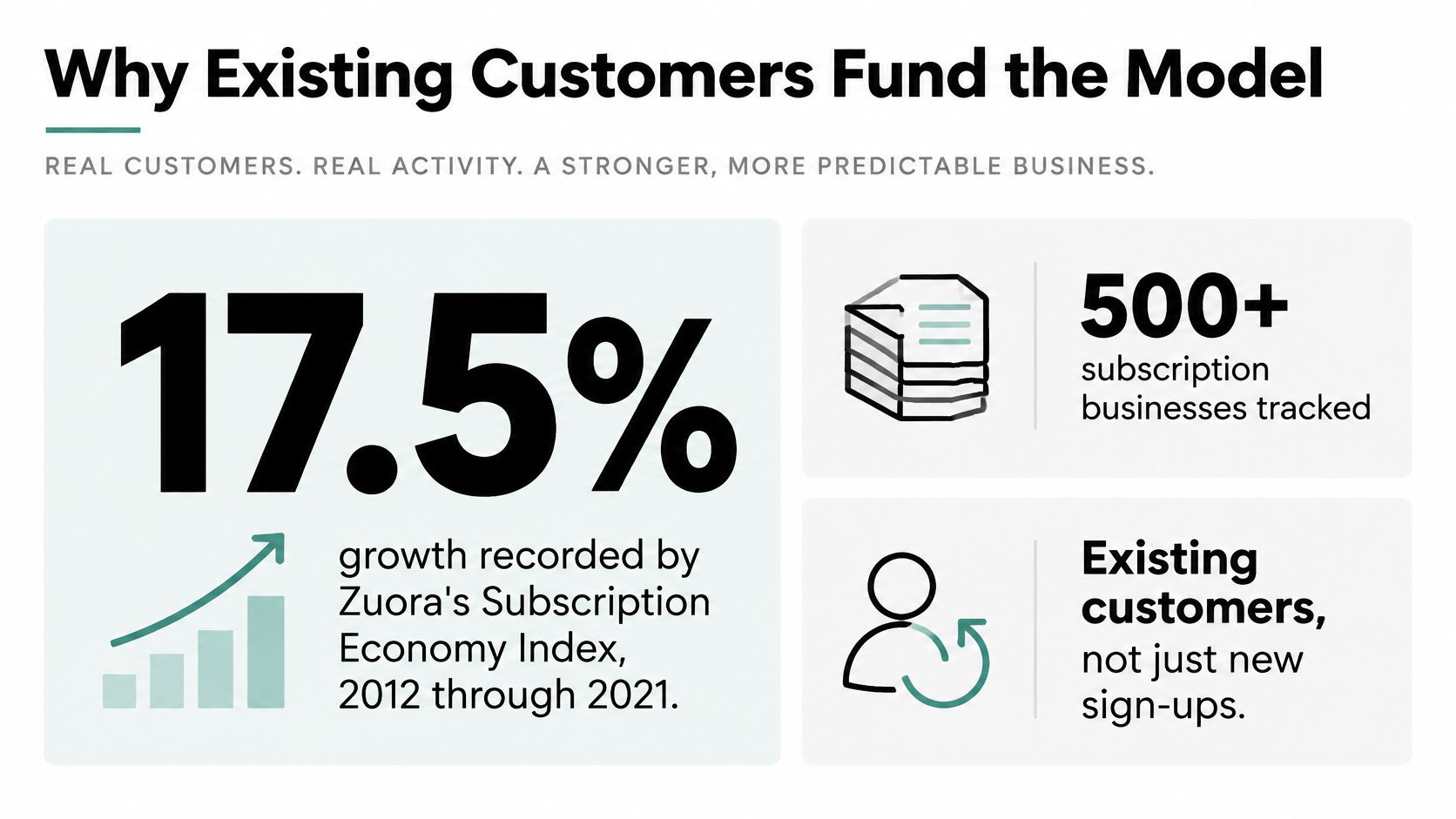
Start with the growth gap. Zuora's Subscription Economy Index tracked anonymized, aggregated activity from more than 500 subscription businesses and recorded a 17.5% compound annual revenue growth rate from 2012 through 2021, against 3.8% for the S&P 500. That's roughly 4.6 times faster. In 2021 alone, those businesses grew revenue by 16.2% while the S&P 500 grew 12%.
The more useful number sits underneath the growth. The same index research found that approximately 70% of subscription revenue came from existing customers on average. New signups get the headlines, but renewal, recovery, and account expansion are the revenue system. A blended churn rate hides that work, which is why a subscription cohort analysis beats a single cancellation percentage: it shows which signup month stopped renewing, and which one never got a working card in the first place.
A receipt ends, a lease keeps running
A one-time order closes when the parcel ships. The money clears, the obligation clears, and nobody thinks about it again. A subscription keeps three things alive at once: an entitlement (what the customer may receive), a payment method (what gets charged next), and a next fulfillment date (what the warehouse must pick).
That's closer to a lease than a receipt. You don't stop managing a lease because January rent arrived. You manage the term, the renewal notice, the change of terms, and the exit.
Working rule: if switching off the billing integration would end the relationship, you didn't have a lifecycle. You had a payment plugin.
Where the value actually gets made
Most of the money is decided between charges, not at them. A subscriber who swaps flavor, moves from 30 to 45 days, or pauses for a month isn't a churn risk being managed. They're a customer telling you how they want to keep buying, and the system either records that or loses it.
Everything that follows reads as a stage outcome: renewal-attempt success, decline reason, recovery rate, voluntary cancellation, revenue recovered, pause rate. Read them separately and the picture sharpens. Read them as one cancellation rate and you'll fund discounts for people whose card expired.
The Stages from Signup to Exit
Here's the whole lifecycle on one page. Seven stages, each with a trigger, what the subscriber still holds, and the operation that has to stay in sync with it.
Subscription lifecycle stages and the job of each one
| Stage | Trigger | Subscriber still has | Operation that must stay true |
|---|---|---|---|
| Signup and first order | Paid checkout of a plan | Access for the first paid period | One customer, one payment method, one subscription, one order |
| Recurring billing | Start of the next cycle | Entitlement only if the charge or grace rule allows it | Charge once, idempotent, then create or hold the order |
| Renewal | Cycle boundary with a valid plan | The same plan unless a change is already scheduled | Price, interval, and any required reminder on record |
| Plan change | Upgrade, downgrade, add-on, skip, swap, or frequency edit | The revised next order, not a second subscription | Next charge and next shipment rewritten together |
| Failed payment | Issuer or network decline | Grace-period access only, never a silent cancel | Decline reason stored and retry clock started |
| Recovery or pause | Successful retry, or an approved pause | Active again, or paused with history kept | No duplicate order; fulfillment suppressed only while paused |
| Cancellation | Customer asks to stop | Access until the paid period ends | Reason stored, renewal off, win-back separate from the exit |
The right-hand column is your build checklist. The middle column is only what the customer experiences.
Where the handoff breaks
Say a dog food brand sells a 6 kg bag every four weeks. A customer skips one cycle in the account portal because they're travelling. Billing records the skip and pushes the next charge out by 28 days. Fulfillment never hears about it, because it reads a nightly export of subscriptions where active means ship.
The bag goes out on the original date. Billing, honoring the skip flag, raises no charge. The customer gets a parcel they didn't ask for and a support ticket opens, or the payment fires as a surprise invoice for food that already arrived. Either way, the brand pays for product, postage, and a human to apologize.
Three systems, three statuses, three truths about one customer. The fix isn't more email notifications between teams. It's a single order record where a skip is a state that suppresses the shipment and moves the charge date in the same transaction.
Name the seven states in your stack
Open your admin and try to produce a count of subscribers in each row of that table. Most stacks can name active and canceled without effort, and stall on retrying, paused with a resume date, and recovered. Whichever state you can't query is the gap, and it's usually the one holding your missing revenue.
Diagnostic: ask customer support to find every subscriber whose last charge failed and whose access is still on. If the answer takes a data request, the state machine lives in someone's head.
Mark which of the seven states your stack can name today. That short list is your build order for the next quarter.
Payment Failure Is Not a Cancellation
A failed renewal isn't a cancellation, and treating it as one is the most expensive mistake in this lifecycle. Involuntary churn is a lapse caused by a payment problem when the subscriber had no intention of leaving. No cancel click, no exit survey, no complaint. The card just stops working, and the relationship ends inside a system that logs it as a departure.
The scale of that blind spot depends on where the payment runs. In RevenueCat's 2026 analysis of billing error churn, covering more than 115,000 apps and over $16 billion in tracked revenue, billing errors accounted for 32.3% of Google Play subscription cancellations against 15.2% on Apple's App Store. Two rails, two failure profiles, one dashboard that usually calls both "churn".
How much of your churn was never a choice
Benchmarks put involuntary churn at roughly 20% to 40% of total subscription churn, as summarized in Curlec's guide to failed recurring payments. A published example in Swell's recurring revenue statistics shows a 2024 median monthly churn rate of 3.27%, split into 2.41% voluntary and 0.86% involuntary. Small in points, large in consequence, because that slice is the one you can fix with engineering instead of offers.
The recovery path, in order
- Classify before anything fires. Read the issuer decline code first. Insufficient funds, expired card, issuer block, and do-not-honor each need a different next move, and the code tells you which one you're in.
- Retry on a reason-specific clock. Insufficient funds often clears near a funding date, so a retry a few days later beats three attempts in an hour. Put that sequence into dunning logic the platform owns, not a spreadsheet someone remembers to run on Mondays.
- Send the customer to a card-update flow that authenticates them. A link that opens a working payment form on the device they're reading email on recovers subscribers. A reply-to-this-email dead end does not.
- Keep entitlement only inside a defined grace window. Access continues while the retry clock runs and stops when the window closes, not when the first attempt fails.
- Pause or end, then store the outcome. Once the window closes, set the final state and attach the decline reason, so the next person reading the account knows what happened and why.
A successful charge doesn't prove the recovery worked. If a retry settles after the subscription was canceled or the inventory was released, you've collected money for a box nobody will ship. Count recovered subscribers and recovered revenue, not successful API calls.
The failure rate also depends on the instrument on file, which is why one retry policy for every card underperforms:
| Signal | Usual meaning | Benchmark | Response |
|---|---|---|---|
| Customer clicks cancel | Voluntary churn, choice made | 2.41% of a 3.27% example monthly rate | Complete the exit, store the reason, offer a save only after leaving is possible |
| Renewal fails and nobody cancels | Involuntary churn | 0.86% in that split, and about 20 to 40% of all subscription churn | Grace period, then reason-specific retry |
| Prepaid card decline | High payment-risk churn | About 23% involuntary churn, per Stripe's subscription churn benchmark | Prompt for a lasting card before the next cycle |
| Debit card decline | Mid payment-risk churn | About 11% involuntary churn | Retry near typical payday or funding dates |
| Credit card decline | Lower payment-risk churn | About 6% involuntary churn | Standard dunning, then card update |
| Billing error with no complaint | Misread as product churn | Drives more cancellations on Google Play than on the App Store | Classify the rail and reason before offering any discount |
A 20% discount aimed at someone who clicked cancel sometimes works. It will never fix an expired card. Match the tool to the cause: recovery for payment failures, plan flexibility for price objections, product for non-use.
Then watch five numbers separately: renewal-attempt success, decline reason, recovery rate, voluntary cancellation, and revenue recovered. If your dashboard can show only one, it will be the wrong one.
Plan Changes Pauses and Extra Revenue
A fixed monthly charge that repeats until someone cancels is the training-wheels version of a subscription. The subscribers who stay longest are the ones who can bend the plan to fit their life.
The index data supports that. Zuora's later Subscription Economy Index reporting, covering more than 600 recurring-revenue businesses, found that companies using four or more revenue models grew revenue per account 2.3% faster per year than companies using two or three, and 4.5% faster than companies using only one. Read that as an argument for letting a subscriber change the deal without leaving it.
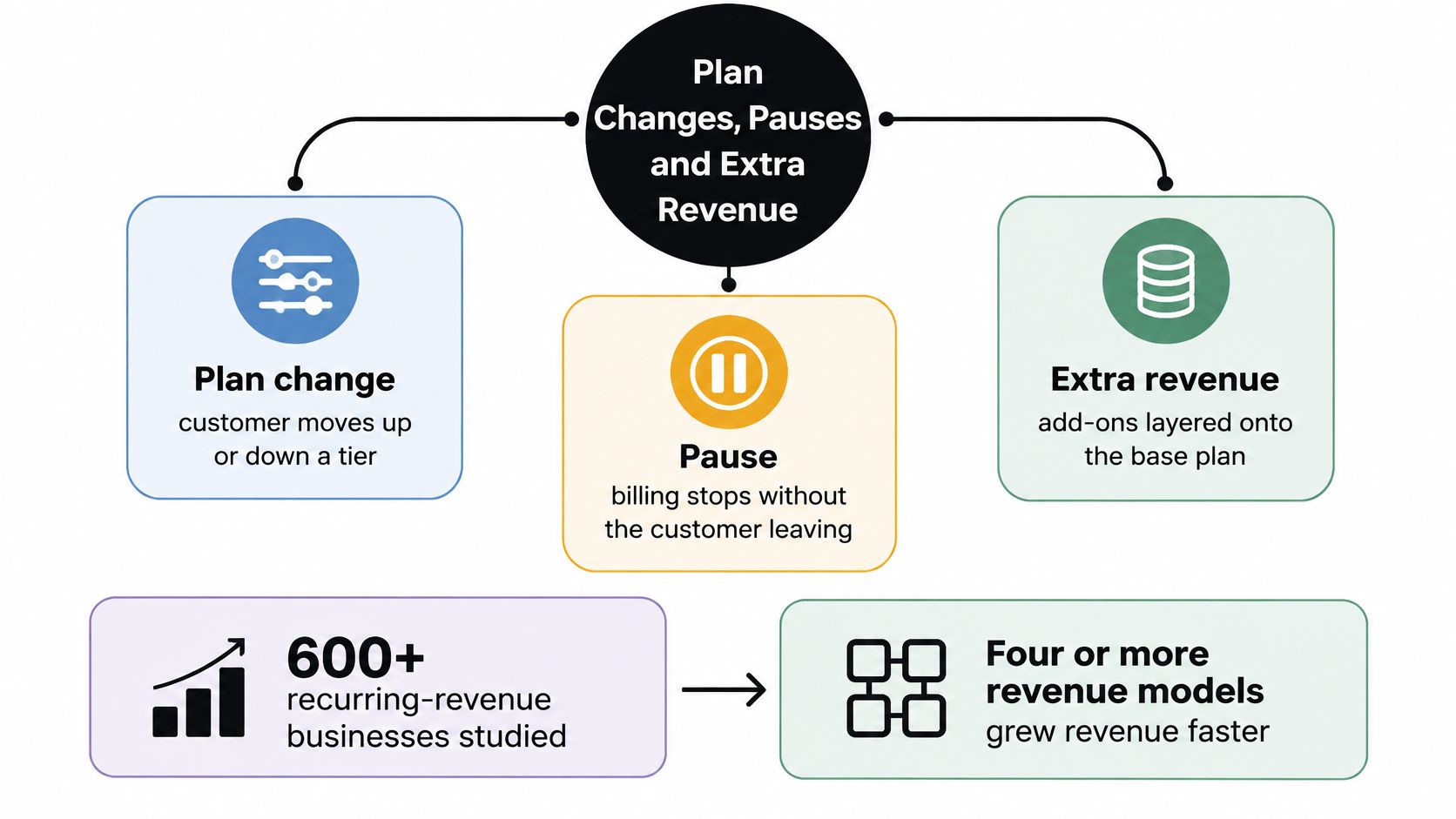
Translate that into DTC events one record has to absorb: a frequency change from 30 days to 45, a swap to a seasonal SKU, a single skipped cycle, a pause with a resume date, an add-on riding the same cadence as the base plan, and a discount that expires when its promotion does.
Every change rewrites two things
A plan change touches the next charge and the next shipment, and both move together. Miss one and you get the two classic failures: a customer billed for a product that isn't coming, or product shipped against a charge that never existed.
Proration is simpler than it sounds. An upgrade can bill the difference immediately or roll it into the next renewal. A downgrade usually waits until the paid period ends, so the customer keeps what they already bought. Which rule you pick matters less than applying it in one place rather than in a support macro.
The skip that ships anyway
Coffee is the clearest example. A subscriber skips one bag before a holiday. If the skip only updates the billing record, the roastery still reserves the beans, the roast date is still planned, and a shipping label gets generated for a bag nobody will be charged for.
A working skip has to suppress the roast slot and the label in the same action that defers the charge. Usage or consumption charges are just one more model sitting on that same account, not a separate system with its own customer list.
Test a change worked: one next charge date, one next shipment, one customer timeline. If a change produces two of any of those, the change broke.
A Replenishment Brand Through One Cycle
Take a skincare brand selling a 30-day serum plan at checkout next to one-time minis. Watch one subscriber move through the whole machine.
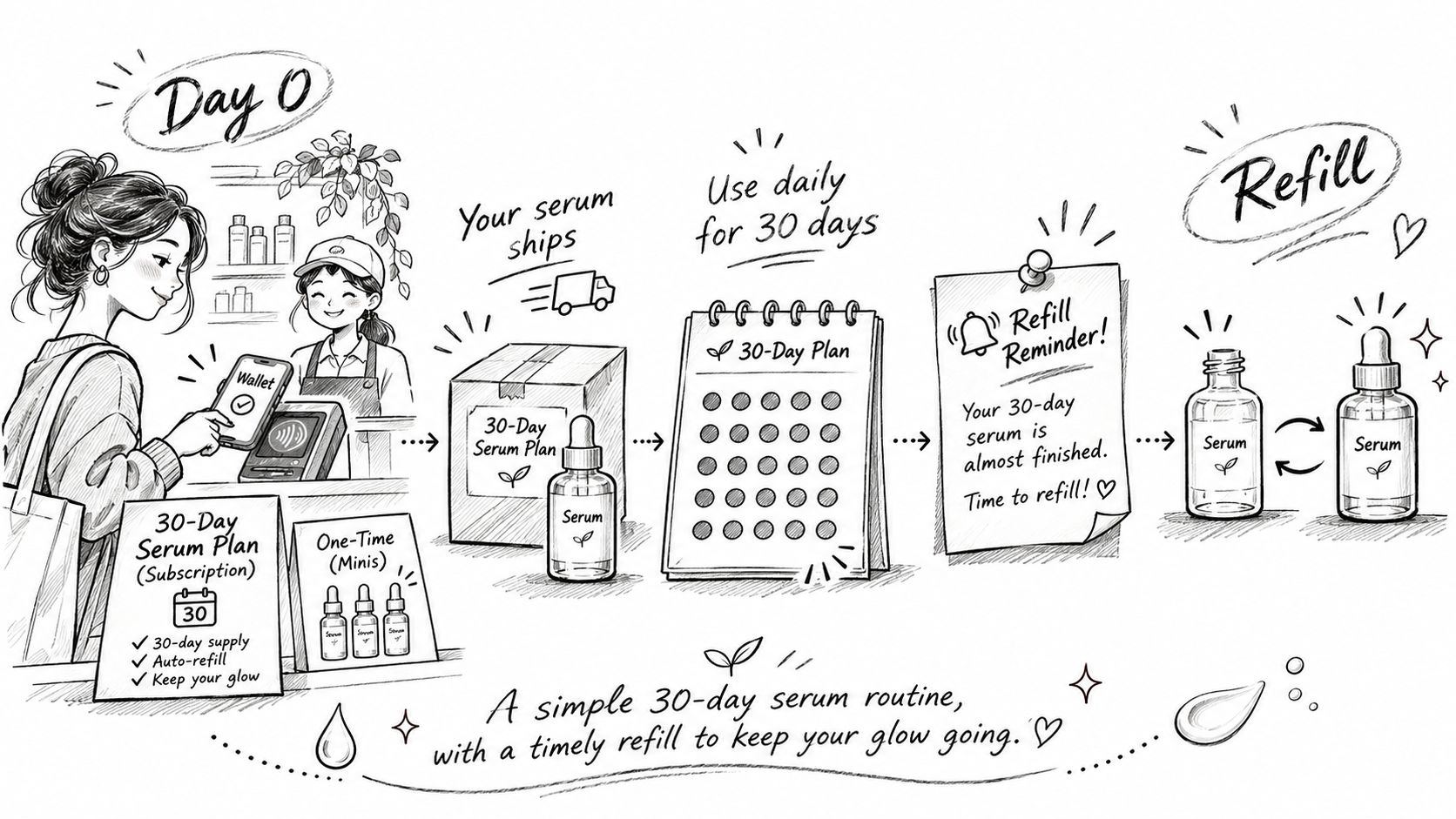
On day 0 she pays with a wallet, agrees to automatic renewal, and the first order ships. The system writes one customer, one payment method, one subscription, one order. Her consent record carries the price and the interval, which is what a renewal disclosure is supposed to hold.
The change that has to reach the warehouse
On day 20 she swaps to the fragrance-free formula and stretches the cadence to 45 days. Both the next charge date and the next allocation move, and the email flow reads her live subscription instead of a static "serum buyers" segment built last quarter.
At the second renewal her debit card comes back insufficient funds. The brand doesn't cancel. It holds the shipment, emails an authenticated card-update link, and retries after a few days rather than the same afternoon.
Here's the same reasoning walked through in video, if you'd rather watch it than read it.
The retry succeeds. One order is created, not two, and recovered revenue is counted on its own line, separate from new-customer revenue, so the team can see what recovery is worth each month.
A month later she pauses for six weeks of travel. Fulfillment stops. Her customer record and her future billing intent stay exactly where they are, and no win-back campaign treats the pause as a quit. When she returns, billing resumes on the paused plan with the resume date already on file.
The version that goes wrong
Same subscriber, same intent, opposite economics. The retry creates a second order and she's charged twice for one serum. The pause still ships because the warehouse reads her status as active. The dashboard labels both the decline and the pause as churn, so the team spends the next month building a win-back offer for a customer who never left.
Nothing about that failure is a marketing problem. It's a record problem.
An audit log should be able to replay this person's timeline end to end: signup, swap, frequency change, decline, notification, card update, recovery, pause, resume. If any of those events lives only in an email provider's log, the timeline has a hole in it.
Cancellation Notices and a Clean Exit
Cancellation is the stage often designed last and regretted first. Under the UK's 2026 subscription-contract regulations, traders must give pre-contract information about auto-renewal, send reminder notices before certain renewals, and offer a simple way to stop auto-renewal. Where the required information isn't provided, the consumer's cancellation window can extend to as much as 12 months.
That changes the job. A cancellation screen isn't a retention tactic anymore. It's a compliance state machine with evidence attached.
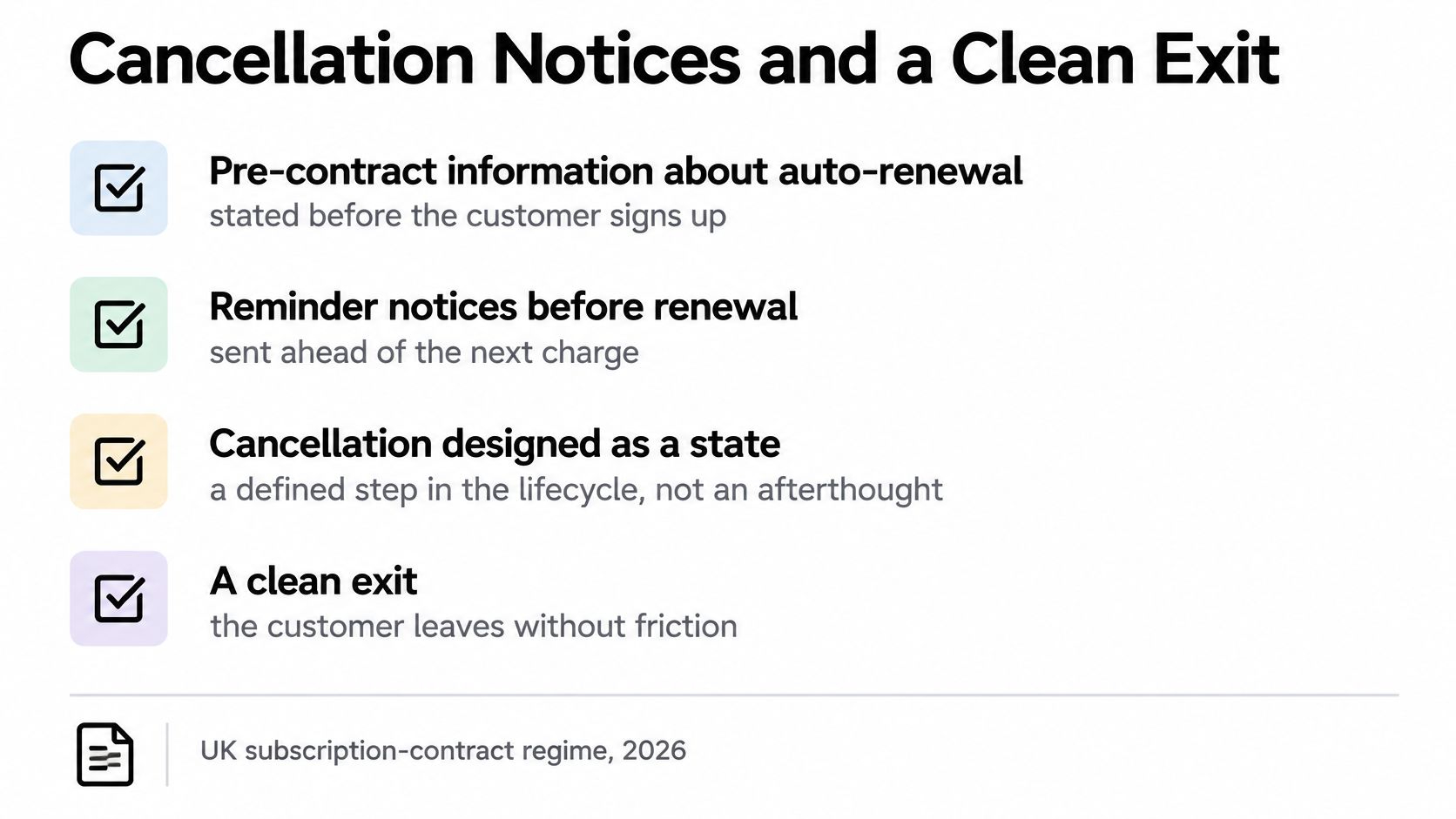
The six-step exit
- Show the renewal price and date before the first charge. Not in the terms page, on the order confirmation the customer reads.
- Send the reminder early enough for the market's rule. Different markets set different timing, so the subscriber record stores which notice applies rather than the code assuming one.
- Let them cancel in the channel they subscribed in. Web checkout means a web cancel path. A call-only dead end is the complaint generator.
- Confirm the end date and that access continues through the paid period. Ambiguity here turns a clean exit into a chargeback.
- Decide the refund from written policy, not agent discretion. Your subscription refund policy should answer the question before the customer asks it.
- Keep the record. Consent, disclosure, notice, request, and end date, all retrievable months later when a dispute lands.
Take a monthly plan. The fee is billed at the start of the cycle, so a cancellation stops the next renewal rather than clawing back days already provided, unless a stated refund right applies. Annual plans are different: they usually need a short initial refund window that monthly plans never need, because the customer has committed a year in one charge.
Design rule: a save offer can follow the exit. It can't block it.
When the cancel control is buried, the metrics look fine and the damage runs underneath: complaints, chargebacks, and regulator contacts that a retained-revenue number never captures. Measure post-exit outcomes too, including reactivation, since a customer who left cleanly is far more likely to come back than one who had to fight.
The last piece is boring and important. If notice timing differs by market, store the notice on the subscriber and keep one customer record. Forking the customer per market is how a brand ends up with three versions of the same person and no reliable compliance trail.
Run Renewals on One Order Record
Three checks worth running this week, each answerable from your own admin:
- Can you name a failed payment separately from a cancellation? If those two numbers share a column, you can't tell a customer who chose to leave from one whose card expired.
- Does a skip or swap rewrite the next order on its own? If it opens a support ticket for someone to adjust manually, the change will eventually be forgotten.
- Does the cancellation confirmation state an end date? "Your subscription has been canceled" with no date invites a dispute.
If any answer is no, the gap is the record model, not the effort. One system of record for the subscription and its orders means a retry can't duplicate a shipment and a pause can't look like a lost customer.
PlatformDTC is one option to test against that same checklist. Merchants can sell subscriptions at checkout, renewals charge automatically, and failed payments are retried automatically. The subscriptions engine includes plans, renewals, and dunning that read the issuer decline code, which keeps the churn customers chose apart from the churn their cards caused. Subscribers can skip the next order, swap the product, change frequency, or pause.
Start with a list of every live plan, write down the decline-to-cancel rule, and run one renewal cohort through signup, a forced decline, a skip, and a cancellation before migrating payment tokens. Treat the move to PlatformDTC as a diligence pass on payment tokens and URLs, not a blind import.
PlatformDTC runs subscriptions inside the same order lifecycle as one-time purchases, so a retry can't mint a second shipment and a pause can't be mistaken for a lost customer. Plans, renewals, and dunning read the issuer decline code, keeping the churn a customer chose separate from the churn a card caused. Start with a diligence pass on your live plans and payment tokens at PlatformDTC.