More than $5 million went back to 40,249 consumers in 2025 because one company kept billing them after they had asked to cancel, as the FTC's announcement of refunds in its case against Cerebral records. Nobody was fined for clumsy wording in a policy document. The money moved because charges landed after a cancellation request, and the remedy was refunds, not a rewritten FAQ.
That's the frame worth holding onto. A subscription refund policy isn't a courtesy paragraph under a pricing table. It's the written half of a billing control that decides who gets charged, who gets money back, and what evidence exists when those two answers disagree.
What follows is the working version: what the policy has to state, how to keep cancellation and refund decisions in separate boxes, where the legal floor sits above your own terms, and how to test all of it before the next renewal run.
Table of Contents
- Why a Subscription Refund Policy Is a Compliance Document
- Refund Policy Components at a Glance
- Cancellation and Refunds Are Separate Decisions
- Eligibility Windows, Exceptions and Required Refunds
- Billing Disputes, Chargebacks and Failed Cancellations
- Jurisdiction and Price Increases
- Enforcement Cases That Show What Goes Wrong
- Sample Policy Wording and Partial-Period Math
- Audit Your Policy Before the Next Renewal Run
Why a Subscription Refund Policy Is a Compliance Document
The FTC reported nearly 70 complaints per day about negative-option practices in 2024, compared with 42 per day in 2021, an increase of roughly 67% over three years, according to the Commission's negative-option rule page.
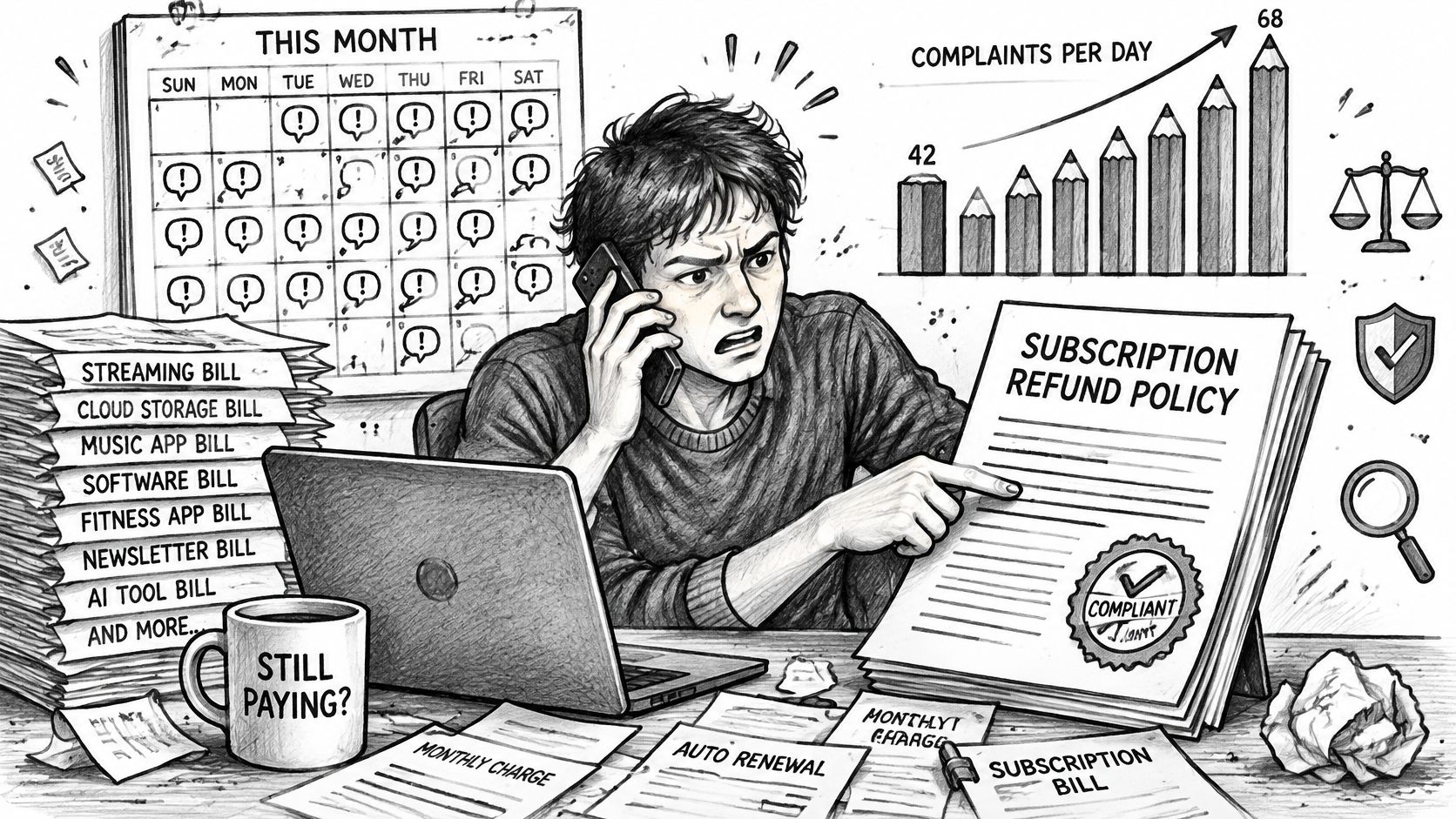
Negative-option billing means a subscription continues charging the payment method on file until the customer cancels. Silence allows the next charge to go through. That makes the refund policy part of the billing process, not just a customer-service document: its promises need to match what happens when someone cancels, is charged, or asks for money back.
The FTC's 2024 click-to-cancel rule would have required sellers to make cancellation at least as easy as enrollment and clearly disclose that a consumer will be charged, the amount, the timing or frequency, and how to stop future charges. A court later vacated the rule. Federal ROSCA requirements still apply to US sellers, including clear disclosures, informed consent, and a simple way to stop recurring charges.
The scale helps explain the attention. The FTC's rulemaking record estimated that about 106,000 firms offer negative-option plans and cited 106 million online cancellations for subscriptions entered into online, as described in the Commission's supporting analysis. Cancellation is routine operational work, not an unusual request to leave in a shared inbox.
A refund policy is one part of a dispute-prevention system. Consent records, renewal notices, cancellation access, billing history, and support procedures should all describe the same customer journey. The related user agreement should also be consistent with the refund terms. A policy is only defensible if the checkout and billing system can show it ran, so document the controls behind it as carefully as the wording. For a practical reference, browse the user agreement.
Evidence matters when a customer disputes a charge. If the policy promises a simple cancellation but the live process takes several screens, or support follows a different procedure, the gap can undermine the business's account of what happened. Clear terms and records help connect the customer's choice to the charge, cancellation, and refund decision.
Refund Policy Components at a Glance
A working subscription refund policy answers seven questions, and it answers each with a value a customer could check against a receipt rather than a sentiment.
| Policy component | What the policy must state | Example value |
|---|---|---|
| Annual plan | Full-refund window after the initial annual purchase | 14 days from the initial purchase |
| Monthly plan fees | Whether charged fees are refundable and whether partial months are prorated | Non-refundable once charged; no proration |
| Refund destination | Where approved refunds are returned | Original payment method only |
| Cancellation effect | When cancellation stops renewals and when access ends | Stops the next renewal; access runs to the end of the billing cycle |
| Refund timing | Time from approval until funds appear | 5 to 10 business days after approval |
| Request handling | Response deadline for refund requests | Within 3 business days |
| Excluded goods | Categories a seller may exclude if disclosed at purchase | Downloaded digital goods, custom or perishable items |
Walk the rows in the order a customer meets them, because each one prevents a specific argument.
- Annual plan window: The full-refund period after the initial annual purchase is the headline commitment. Put the same number in the checkout confirmation email that appears in the policy, since customers quote the email, not the page.
- Monthly plan fees: Say plainly that charged monthly fees aren't refundable and that partial months aren't prorated. Without that second half, someone who cancels on the 12th assumes they've earned back 18 days, and support ends up arguing about arithmetic.
- Refund destination: Approved refunds return to the original payment method only. Money can't be redirected to a different card, bank account or wallet, which is both a fraud control and a hard limit of how card refunds work.
- Cancellation effect: Cancelling stops the next renewal and access continues to the end of the billing cycle. This is the row most often misread as "my account closes today".
- Refund timing: Give the window in business days counted from approval. Separating "we approved it" from "your bank posted it" heads off the follow-up complaint that arrives on day two.
- Request handling: Publish a deadline. Brand owners selling on PlatformDTC commit to replying within 3 business days and to processing an approved refund within 10 business days of approval. Refund requests about PlatformDTC's own subscription fees reach us at contact@platformdtc.com and we respond within 5 business days.
- Excluded goods: Name the categories you exclude, whether that's downloaded digital goods, personalized or custom items, perishable goods, services already rendered, or final-sale stock, and disclose them before payment.
Fourteen days is a policy choice, not a legal standard. It's the value we use for annual plans, and it's the kind of number a customer can verify against an invoice date. Statutory rights can override it, which is the subject of the market-by-market section below.
Completeness test: every row should be answerable from a receipt. If a customer can't find the matching line on their invoice or confirmation email, that row is a hope rather than a term.
The policy is finished when each row holds a specific, verifiable value. A row that says "contact support for details" isn't a policy term. It's an invitation to negotiate, one ticket at a time, with whoever happens to be on shift.
Cancellation and Refunds Are Separate Decisions
Cancel a gym membership and the next direct debit stops. Ask for last month's fee back and you're making a different request, about money the club already collected. Subscription software behaves the same way, and most disputes that reach a payments team start with a customer who assumed the first action included the second.
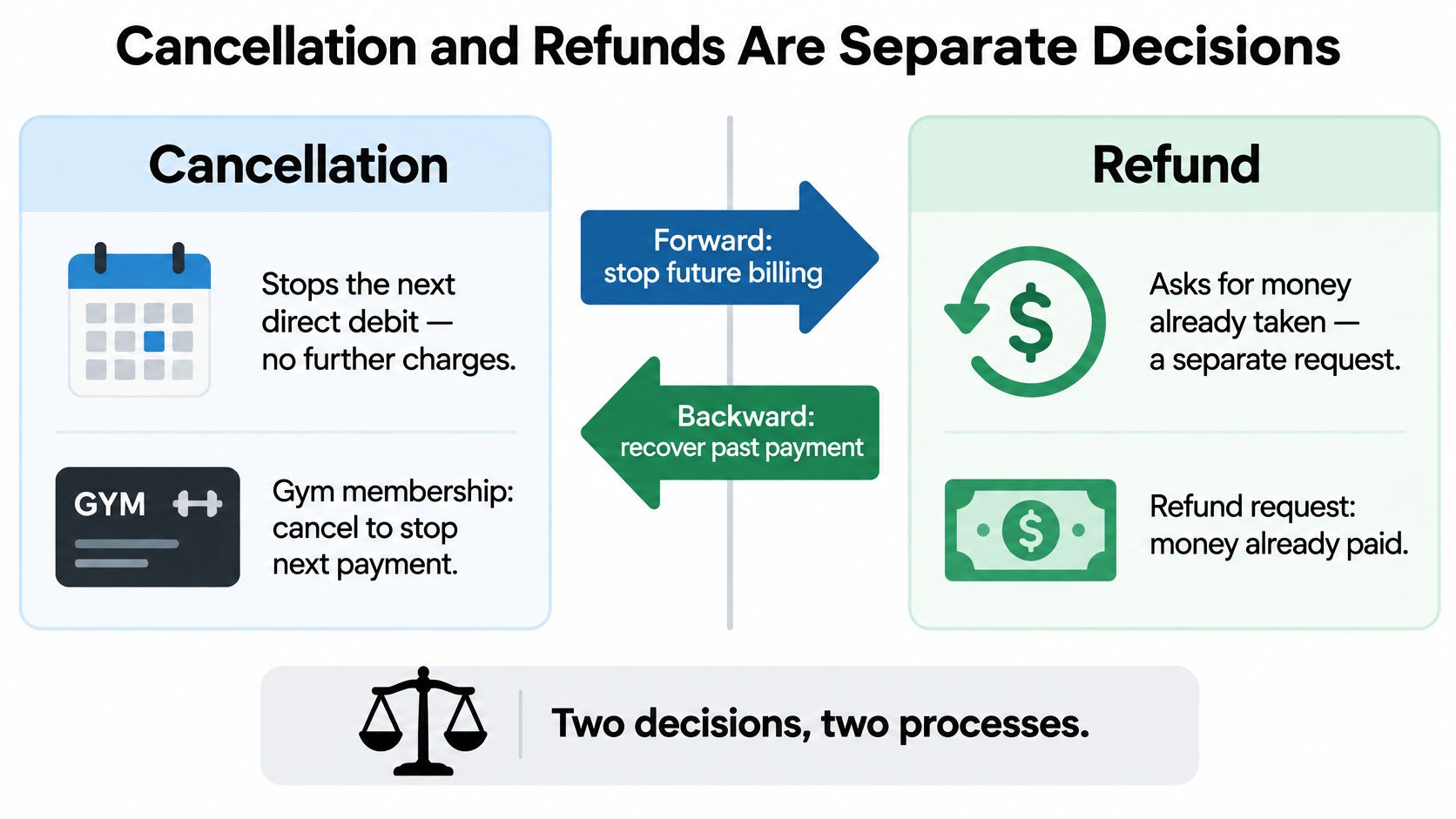
Under the FTC's 2024 negative-option framework, sellers had to disclose material terms, including price, billing frequency, trial-end timing, cancellation deadlines and the cancellation method, before taking billing details. Cancellation had to be at least as easy as enrollment and had to halt recurring charges. Cancelling the negative-option feature does not necessarily end the underlying contract or create an automatic refund entitlement, as the FTC's business guidance on the click-to-cancel rule explains. That one distinction resolves a large share of confused tickets.
Two questions, two records. Cancellation state answers whether the next renewal happens. Refund entitlement answers whether money comes back.
| Field | Holds | Example value |
|---|---|---|
| subscription_status | Whether the next renewal happens | active, cancel_at_period_end, canceled |
| refund_eligibility | Whether money comes back | eligible, ineligible, manual_review |
| billing_period_start/end | Dates of the charged cycle | Bounds used for cancellation timing and proration |
| cancellation_timestamp | When the valid cancellation event occurred | Used to decide whether renewal was blocked |
| refund_amount | Amount approved for refund | Partial or full, against the captured charge |
| idempotency_key | Unique key on each refund mutation | Prevents duplicate refunds on retry |
Keep the fields apart in the database as well as on the page. Attach an idempotency key to every refund mutation so a retried queue job, or an agent clicking twice, can't pay the same charge out twice. Block the renewal authorization the moment a valid cancellation lands, then decide the refund separately, on consumption, shipment status, promotional terms, jurisdiction and any approved exception.
Say a customer on a monthly plan cancels on day three of a 30-day cycle. Monthly subscriptions can be cancelled at any time on PlatformDTC, and cancellation takes effect at the end of the current billing cycle while access continues until then. No refund follows, because monthly fees are non-refundable once charged. What the customer should receive is a single confirmation carrying both answers: the date access ends, and the refund decision.
Operators in service businesses run into the identical confusion, and car wash plans are a good illustration. This walkthrough of membership advice for frequent GTA drivers shows the same split, where ending a plan stops future billing but never returns money for washes already used.
Eligibility Windows, Exceptions and Required Refunds
A refund policy needs three clear lanes: refunds a business must honor, refunds the platform may approve, and exclusions disclosed before checkout. Keeping those lanes distinct helps customers understand the decision and gives support staff a consistent record to use if a billing dispute follows.
| Case | Refund position | Policy note |
|---|---|---|
| Service outage longer than 72 hours in one billing cycle | Refund at platform discretion | Decided case by case |
| Duplicate or billing error | Refund may be issued at platform discretion | Correct the record and confirm the amount |
| Unauthorized charge caused by a security breach on PlatformDTC's side | Refund at platform discretion | Investigate and reverse the charge |
| Paid feature not delivered as advertised | Refund at platform discretion | Compare with the offer shown at purchase |
| Product not delivered within the advertised timeframe or 30 days, whichever is shorter | Refund required | Brand owner obligation |
| Product materially different, defective or damaged | Refund required | Brand owner obligation |
| Downloaded or accessed digital goods | Can be excluded | Only if disclosed at purchase |
| Personalized, custom-made, perishable or final-sale items | Can be excluded | Only if disclosed at purchase |
Where discretion is the honest answer
PlatformDTC may issue refunds at its sole discretion for a service outage exceeding 72 hours within a billing cycle, duplicate or billing errors, unauthorized charges caused by a security breach on its side, or inability to deliver a paid feature advertised at purchase. The policy should explain that these cases are reviewed individually rather than promising a fixed result. For example, an outage from Friday evening to Tuesday morning may warrant a refund, but the outcome depends on the review.
A duplicate charge needs a clear resolution path. If a payment retry times out but still settles, the customer may be charged twice. The business should identify the extra charge, correct the record, and explain the amount being refunded. A clear explanation helps prevent the customer from treating the unresolved charge as a separate billing problem.
Three obligations a brand owner can't waive
- Delivery within the promised window: Honor refunds for products not delivered within the advertised timeframe or within 30 days, whichever is shorter.
- Products that don't match the description: Honor refunds when an item is materially different from what its listing promised.
- Defective or damaged goods: Honor refunds for products that arrive damaged or are defective.
These requirements give customers a predictable remedy when the order itself falls short. A policy should state them plainly, rather than burying them under general exclusion language.
Exclusions that hold only if the checkout said so
Brand owners may exclude digital goods that have been downloaded or accessed, personalized or custom-made products, perishable goods, fully rendered services, and final-sale or clearance items, if the exclusion is clearly disclosed at purchase. A customer who downloads a course and then requests a refund illustrates why timing and disclosure matter: the exclusion applies only if the customer saw clear wording before paying.
Access-based perks raise the same question. A set of subscription terms for fan support shows how terms can explain what a supporter receives and when access ends. Clear terms set expectations before a customer has to ask for a refund.
Use the same check for every exclusion. Is it visible before payment? Can a shopper understand it without legal training? Does it relate to something already consumed, downloaded, or made to order? If an exclusion is hidden, unclear, or unrelated to consumption or customization, it is unlikely to help prevent a dispute.
Billing Disputes, Chargebacks and Failed Cancellations
About 19% of chargebacks are linked directly to an attempted subscription cancellation, and nearly 85% of consumers want their bank to cancel subscriptions for them, according to an analysis of the click-to-cancel pause in policy. Mastercard-reported research cited in the same analysis found 29% of consumers have disputed a recurring payment because they thought it was fraudulent, and 25% have blocked one.
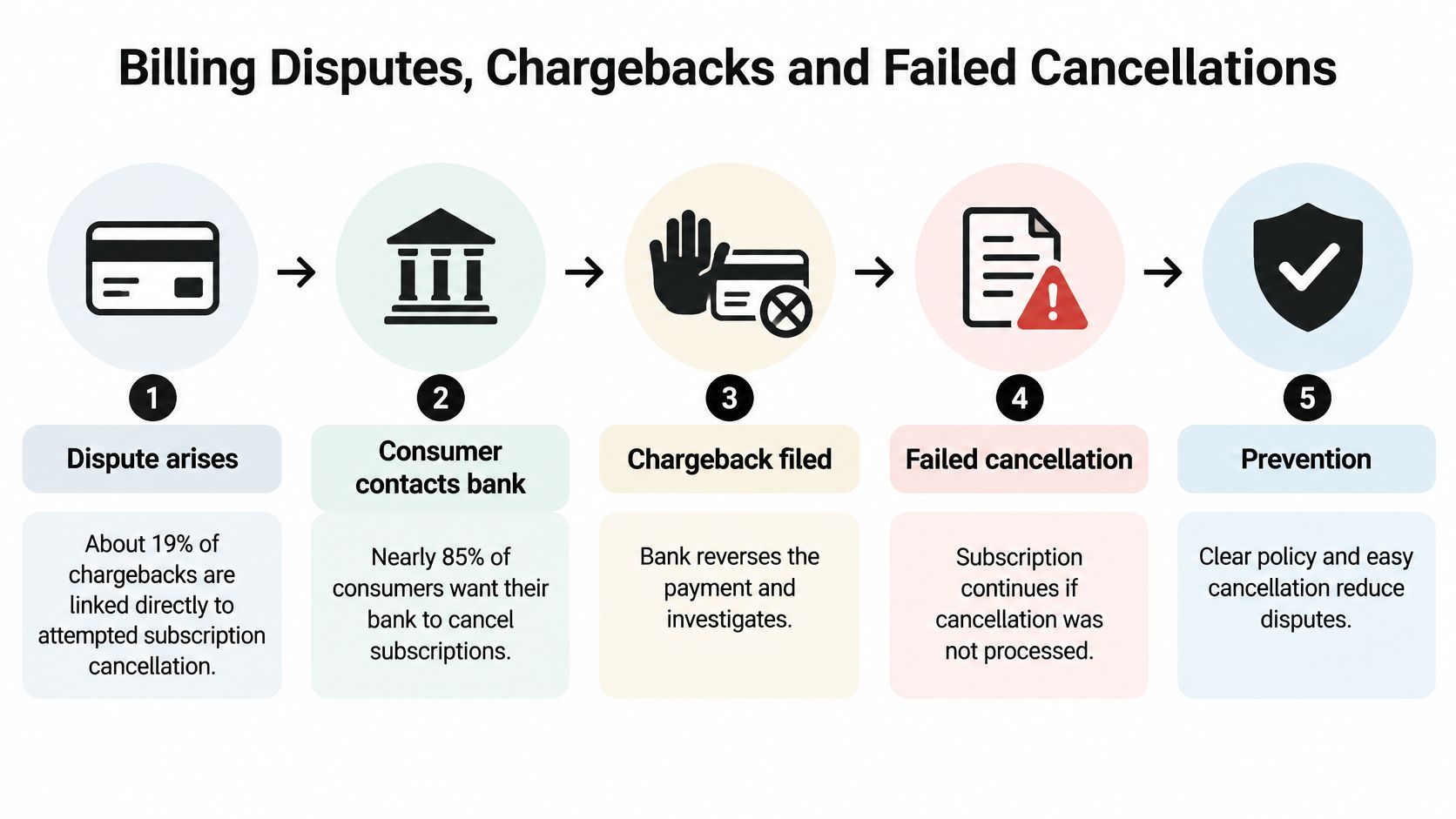
The instinct when those numbers appear is to tighten everything. Shorten the window, harden the wording, refuse the unusual request. That instinct costs money. A strict rule doesn't stop a confused customer from calling their bank; it moves the argument to a venue where you're the defendant. Chargebacks bring fees and representment hours, and a climbing rate degrades the risk signals a processor uses to price your account, as our chargeback glossary entry sets out.
Build the process as a sequence a support agent can follow without judgment calls:
- Log the request with timestamp, channel and the confirmation sent to the customer.
- Check whether the renewal was blocked after that cancellation event.
- Acknowledge in writing the same day the request arrives, against the deadline your policy publishes.
- Decide eligibility against the policy and answer with a stated reason, not a template.
- Submit approved refunds to the original payment method and track the gateway's status separately from your approval. Stripe's refund support documentation covers how full and partial refunds are issued against the original charge and why the customer's statement lags the submission.
Four questions decide whether a policy prevents disputes or feeds them. Does cancellation stop the next renewal immediately? Can someone who cancelled shortly after billing get a post-renewal refund? What evidence is kept, including timestamp, channel, confirmation and renewal notice? And are partial-period refunds possible at all?
If any of those answers is missing from the page, the customer will fill the gap with the least generous interpretation available, and then escalate to someone with more authority than your support queue.
Jurisdiction and Price Increases
When a statutory right applies, your published policy doesn't set the answer. A single global no-refunds line reads as confident and misleads customers in several of the markets DTC brands sell into, as this review of subscription checkout rules sets out. In the United States, the FTC's 2025 click-to-cancel rule was vacated, but federal ROSCA requirements still generally require clear material disclosures, informed consent and a simple way to stop recurring charges. California's updated automatic-renewal requirements took effect July 1, 2025, and New York's November 2025 rules require advance affirmative consent to an increased subscription price, or a 14-day cancellation period with a pro-rata refund. The same review records Instacart agreeing to $60 million in consumer refunds over allegations involving free-trial conversion disclosures and limited refund terms.
| Market | Ordinary cancellation | Price increase | Partial-term refund |
|---|---|---|---|
| United States (federal) | ROSCA requires clear material disclosure, informed consent and a simple way to stop charges | Disclose the new amount as a material term before charging | Set by the merchant's policy, subject to state law |
| California | Updated automatic-renewal requirements in force from July 1, 2025 | Handled under the same updated automatic-renewal rules | Set by those rules where they apply |
| New York | Cancellation handled under the November 2025 requirements | Advance affirmative consent required | 14-day cancellation period with pro-rata refund |
| European Union | 14-day right of withdrawal where applicable | Handled under the withdrawal right | Pro-rata where the withdrawal right applies |
Take the trial customer whose monthly price rises after conversion without a clear affirmative yes. That person isn't an ordinary cancellation inside your window. The price change itself can create a refund obligation the published window never covered, and the answer has to come from the market rules, not from the paragraph you wrote last year.
No merchant exception overrides a statutory right, and the EU 14-day right of withdrawal applies where it does. Every brand selling on PlatformDTC must publish a clear, accessible refund policy on its storefront, but that policy sits underneath local law rather than above it. List every market you sell into, note the price-increase and partial-period rules for each, and only then write the final text.
Enforcement Cases That Show What Goes Wrong
Two 2025 settlements show the failure in money terms. Neither turned on the size of a single refund. Both turned on whether the customer's experience matched what they had been told.
Chegg and the cancellation path
Customers trying to stop a recurring subscription described a cancellation route that was harder to use than the signup route, alongside refund terms that didn't match the pitch. The FTC required Chegg to pay $7.5 million to affected consumers over allegedly difficult recurring-subscription cancellation and refund practices, as the Commission's guidance on the settlement records. A compliant policy would have named the cancellation method at the point of sale, described it in the same number of steps as enrollment, and explained what happens to money already collected.
Amazon and the enrollment screen
In the Prime matter, the FTC required Amazon to provide $1.5 billion in consumer refunds related to deceptive enrollment practices, per the FTC's announcement of the settlement. Customers believed they had made one choice and were enrolled in another. A compliant version states the price, the renewal frequency and the cancellation method before billing details are captured, on the same screen rather than one click deeper.
Read the two together and the pattern is not about generosity. Neither case involved a company refusing too many refunds. Both involved a gap between the story the customer was told and the mechanics they met afterwards.
Chegg's exposure came from friction after the decision to leave. Amazon's came from ambiguity at the moment of joining. Your own policy has two equivalent failure points, and both are testable from the outside: time your cancel flow against your signup flow, and read your checkout screen as somebody who is tired and in a hurry.
The lesson to carry into your own document is narrow and practical. Enforcement attention lands where a disclosure, a consent step or a cancellation path fails to match the promise. The refund amount is rarely the story.
Sample Policy Wording and Partial-Period Math
Write the clause before you argue about it, and keep it short enough that a customer reads it at checkout.
Sample clause: Annual plans can be refunded in full within 14 days of the initial purchase. Monthly fees are non-refundable once charged and are not prorated. Cancelling stops the next renewal, and access continues to the end of the current billing cycle. Approved refunds return to the original payment method only, within the published window. Digital downloads may be excluded once accessed, as disclosed at checkout.
Every sentence there maps to a row of the components table. The clause doesn't explain the reasoning, doesn't apologize, and doesn't contain a word a shopper would need to look up.
Where a policy or a local rule does grant a partial refund, use one formula and apply it consistently: refund = amount paid × unused days ÷ total days in the term. A 120 dollar annual plan cancelled after 30 days of a 365-day term refunds 120 × 335 ÷ 365, which is 110.14 dollars, less any excluded use. The same math on a monthly plan cancelled on the 20th of a 30-day month returns a third of the fee, which is exactly why many merchants decline to prorate at all.
State where the formula applies and where it doesn't. PlatformDTC doesn't prorate monthly fees, so a pro-rata calculation applies only where the policy or a local right creates it, such as a withdrawal period. A published formula that nobody applies, or an unpublished one applied case by case, produces the worst outcome: two customers with the same facts and different refunds.
Running the arithmetic by hand each quarter doesn't scale. It helps to see how a subscription management platform keeps the billing period, the cancellation timestamp and the refund amount on the same order record, so the calculation reads from stored values instead of a support agent's memory.
Before publishing, read the clause against the invoice and the confirmation email line by line. If any sentence describes something those two documents don't show, rewrite the sentence, not the invoice.
Audit Your Policy Before the Next Renewal Run
A refund policy helps prevent disputes only when it matches what your billing system does. Before the next renewal run, compare the live policy with your records and check whether each promise can be confirmed from an invoice, cancellation log or customer message.
- Confirm cancellation stops the next renewal. Read the confirmation message and make sure it states the effective date in plain words. If access continues until the end of the billing cycle, say so clearly.
- Compare signup and cancellation paths. Walk through both as a customer, using a phone. Cancellation should take no more steps than signup.
- Publish the policy on your storefront. Include your business contact details, such as an email address and support hours, so customers can find the right way to ask for help.
- Set up your own refund-request channel. Use your business email address or a support form, and specify the information customers should provide: account email, date of charge, amount and reason for the refund. Route requests into a tracked queue rather than a personal inbox.
- Keep a record of each cancellation and refund. Capture the timestamp, channel, person handling the request, approval decision and confirmation sent to the customer.
Use the audit to identify policy statements that your invoices and logs cannot support. Check timing, exclusions and where approved refunds are sent. When those details differ between the policy and the billing process, customers have reason to dispute a charge instead of accepting the outcome.
For brands using PlatformDTC, subscriptions, payments and other commerce operations are managed within a single system. This can help teams compare the policy with billing and cancellation records without reconciling a separate subscription database.
Set a reminder before your next renewal run to review the policy with whoever handles support. Their records of customer questions can show which wording needs to be clearer. A cancellation confirmation that states when billing stops, for example, can prevent confusion before it becomes a refund request or chargeback.