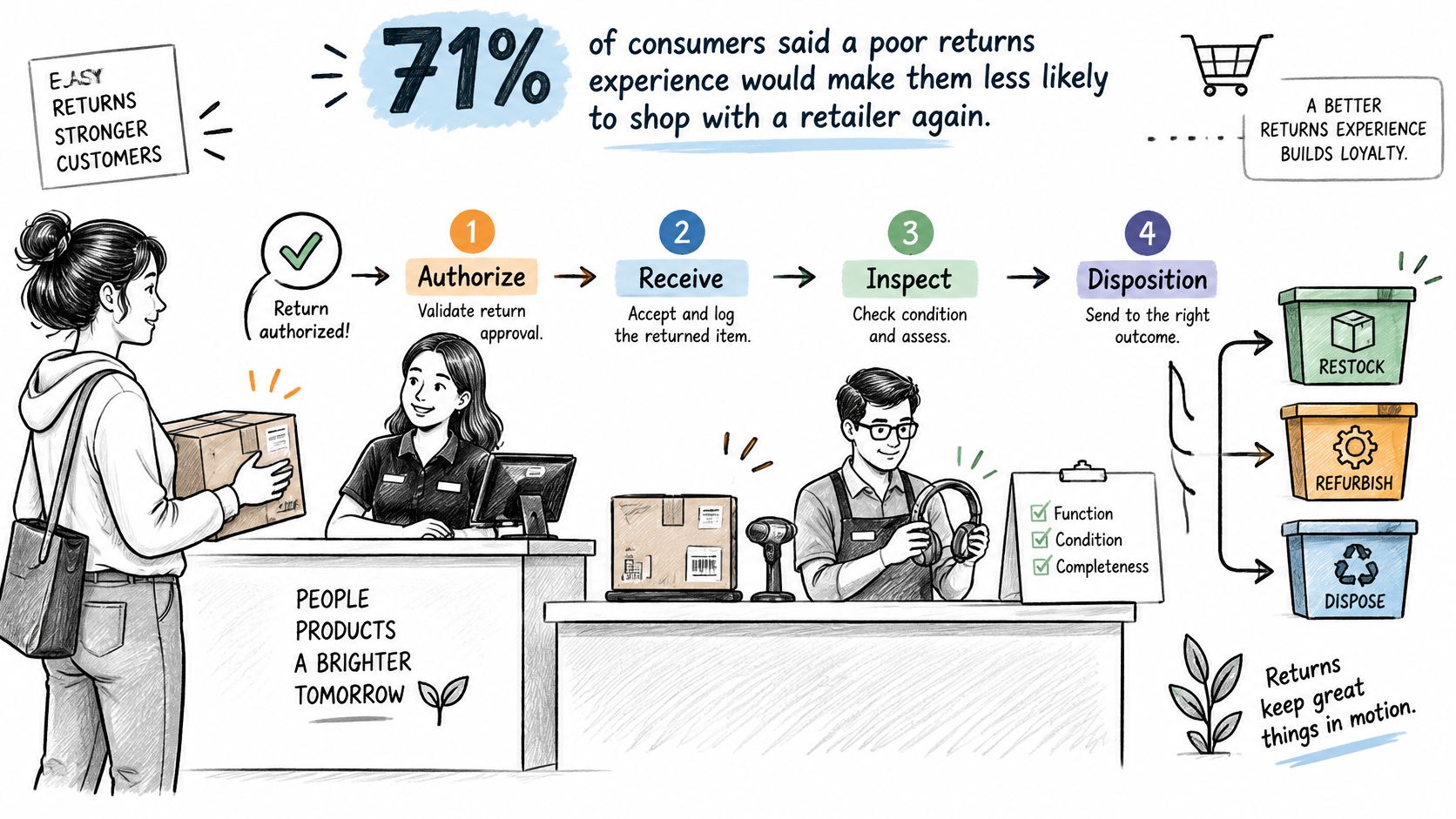
71% of consumers said a poor returns experience would make them less likely to shop with a retailer again, according to UPS's 2025 returns findings. That makes returns an operating decision with consequences for the next sale, not just a support ticket attached to the last one.
The same principle applies throughout the order fulfillment process. Your warehouse can pick quickly and your carrier can deliver reliably, but customers still suffer when checkout, inventory, payments and support disagree about the order. Start with the record that connects those teams, then improve the physical work around it.
Table of Contents
- The Order Fulfillment Lifecycle Stage by Stage
- How to Capture and Validate Each Order
- How to Pick, Pack and Verify Shipments
- Choosing Carriers and Delivery Options
- Handling Returns, Refunds and Disposition
- Automating and Integrating the Order Record
- Review KPIs and Fix the Biggest Failure First
The Order Fulfillment Lifecycle Stage by Stage
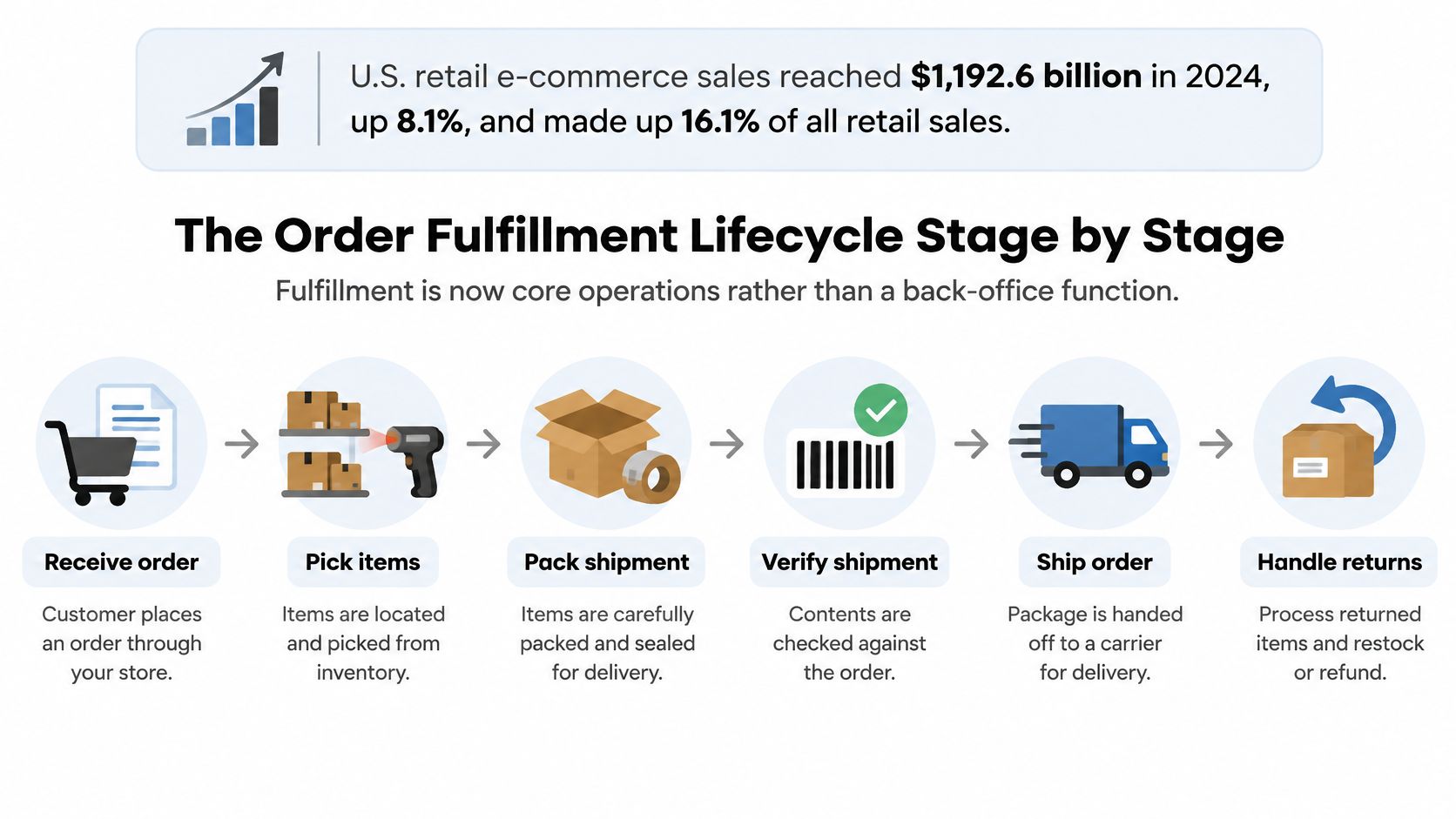
American retail e-commerce sales reached $1,192.6 billion in 2024, up 8.1% from 2023, according to the U.S. Census Bureau's annual estimates. At that scale, fulfillment belongs in core operating decisions, alongside merchandising, acquisition and cash management.
A DTC order passes through distinct stages, but the customer has bought a single outcome. Each stage needs an explicit output that the next team can trust.
| Stage | What Happens | Output Record | Main KPI |
|---|---|---|---|
| Order capture | Order arrives from site, marketplace, POS or B2B draft | One order record with all lines | Order intake error rate |
| Allocation | Stock reserved for each line with an expiry | Reservation tied to the order line | Oversell rate |
| Pick | Items retrieved by SKU, quantity and lot | Confirmed pick list | Picking accuracy |
| Pack | Items boxed, weighed and labelled | Packed order with expected weight | Pack error rate |
| Ship | Manifest sent and carrier takes custody | Tracking number on the order | Same-day dispatch rate |
| Deliver | Carrier delivers or logs an exception | Delivered or exception status | On-time delivery rate |
| Return and refund | Return authorized, received, inspected and refunded | Disposition decision and refund record | Return rate and recovery rate |
The physical flow is straightforward. The handoffs need just as much attention.
Make each handoff explicit
One order record doesn't mean every employee uses the same screen. It means the screens read consistent order identities, line quantities, reservations and status changes.
An item offered at checkout must become a reservation, then a verified pick, then a shipment with valid tracking. If it comes back, the return must identify which shipped unit changed condition and whether its refund has completed.
Practical rule: A status change isn't complete until the next team can act on it without retyping anything.
Sketch your own lifecycle and mark where someone last changed a quantity in a separate spreadsheet or screen. Investigate that handoff first, especially if the receiving team can't explain which record takes precedence.
How to Capture and Validate Each Order
Speed starts with clean intake, not a faster walk to the shelves. In a 2024 survey of 3PL professionals, almost 30% reported average order-processing times below 30 minutes, five percentage points higher than in 2020, according to Statista's fulfillment survey summary. Treat that as context, not a promise your operation should copy without matching its scope.
Build a release-ready order
-
Consolidate channel intake. Bring storefront, marketplace, POS and B2B draft orders into a canonical record. Preserve the channel's original order identifier so an import retry updates the existing order instead of creating another fulfillment request. A marketplace acknowledgement isn't permission to create a separate internal sale.
-
Validate the destination. Check addresses against the selected carrier's accepted formats, including unit numbers and restrictions on PO boxes. Flag an incomplete address before warehouse release. Otherwise, staff can complete a perfectly accurate pick for a parcel the carrier can't deliver.
-
Reserve each line with an expiry. Separate available stock from stock already committed to another buyer. Release expired reservations when checkout or payment doesn't complete, and handle delayed payment methods deliberately rather than leaving abandoned purchases locked against inventory indefinitely.
-
Authorize payment and triage risk. Billing and shipping mismatches or unusually valuable first orders should trigger proportionate review, not automatic rejection. Suby's guide to layered controls for online payment fraud is useful when designing checks beyond a single fraud score. Assign held orders to a named review queue, or legitimate customers will wait without anyone owning the decision.
-
Assign the fulfillment source. Route lines to a warehouse, store or supplier before release. With dropshipping, the store automatically sends the order to the supplier, which prepares it and ships directly to the customer; the seller pays for products after selling them. The trade-off is less direct control over packaging and dispatch, so supplier acceptance and tracking updates need explicit ownership.
Set the cutoff before promising dispatch
Define your daily cutoff by working backward from carrier collection through packing, picking and validation. A checkout cutoff that leaves no time for address review isn't an operational cutoff, it's an unsupported promise.
This week, inspect orders that missed collection despite arriving before the advertised deadline. Tag the actual intake cause, such as an address correction, payment hold or unassigned supplier, rather than recording every delay as a warehouse failure.
How to Pick, Pack and Verify Shipments
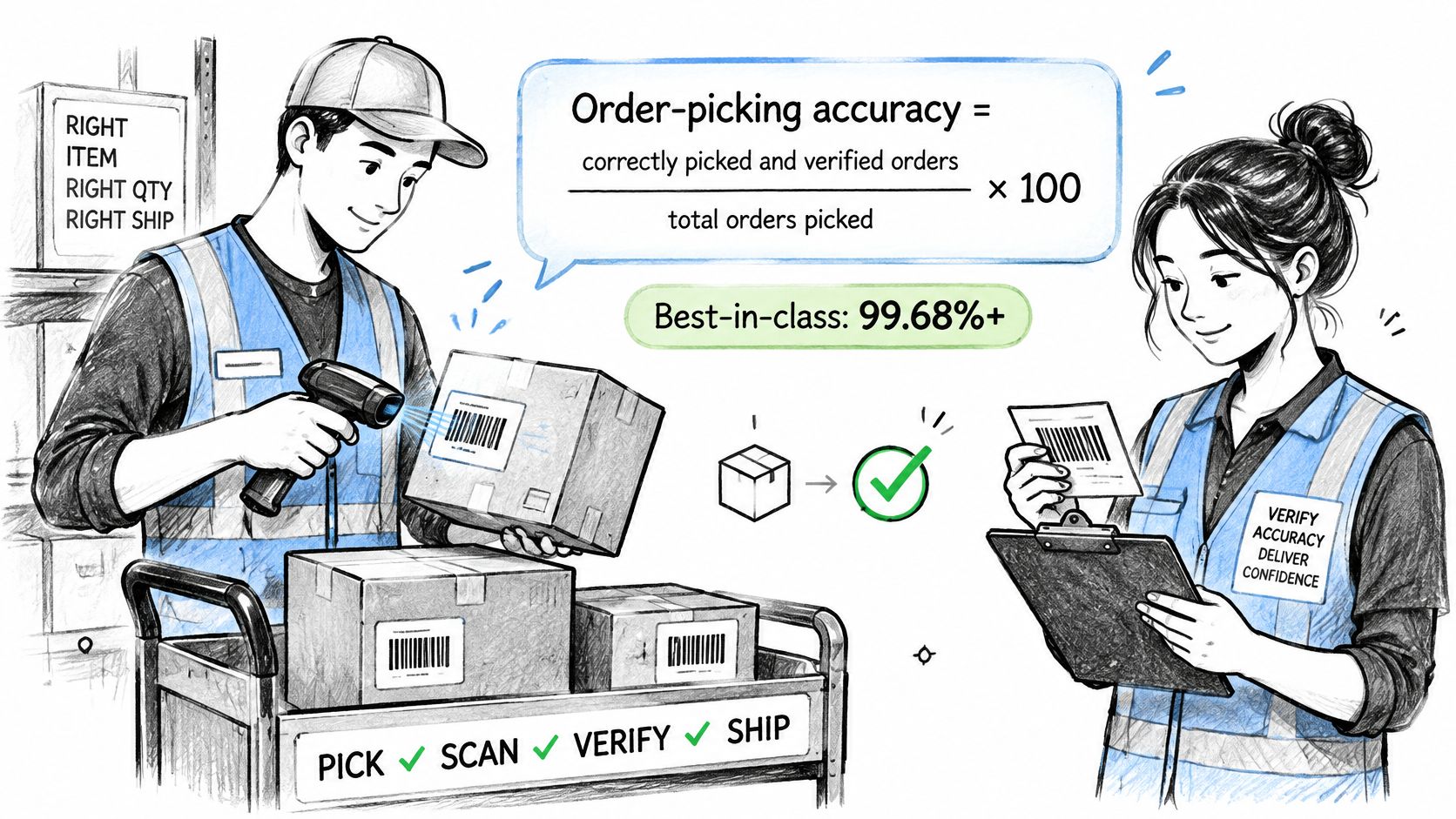
Picking accuracy measures correctly picked and verified orders divided by total orders picked, multiplied by the percentage conversion factor. Yale's distribution-center benchmarking guide identifies 99.68% or better as best-in-class performance, which still implies approximately 3.2 errors per 1,000 orders, compared with 10 per 1,000 at 99%.
The operational lesson is that verification belongs before dispatch. Returns and replacement shipments are expensive ways to discover a wrong pick.
Scan confirmation should connect the physical item to its reserved order line.
Release, pick and resolve mismatches
-
Release work the floor can complete. Put fully allocated orders into waves organized around carrier cutoff and warehouse zone. Keep backordered lines out of normal waves unless you've explicitly authorized partial fulfillment and its additional shipping cost.
-
Scan the required attributes. Confirm SKU, quantity and applicable lot or serial details against the reservation. For bundles, verify the component list rather than treating the bundle's marketing name as a pickable SKU.
-
Stop mismatched lines. Don't give pickers an unrestricted override to clear a warning. Send the exception to a supervisor who can check the bin, correct the reservation or initiate a stock investigation. Record the resolution so repeated faults remain visible.
Pack for protection and verification
-
Use product-specific packing rules. Select the smallest suitable box that still allows proper protection. Include the correct packing slip and required handling information. Saving carton space isn't a win if staff compress protective fill around a fragile product.
-
Compare actual and expected weight. Calculate expected packed weight from item quantities and packaging, then compare it with the scale reading using tolerances appropriate to the product. Weight can expose a missing unit or wrong pack size, but it won't distinguish products with similar weights.
-
Create the shipping documents. Generate the label from the verified package dimensions, weight and service selection. Transmit the manifest and keep label voids separate from live shipments.
-
Confirm handoff and tracking. Write the tracking number to the order, then distinguish label creation from carrier custody. Customer notifications shouldn't imply movement merely because a printer produced a label.
Use this warehouse walkthrough when reviewing how your team moves between picking and shipment preparation.
Record which station detected each discrepancy, not just who performed the original pick. That distinction helps separate poor slotting from packing mistakes and catalogue errors.
Don't scan a single unit from an opened case and assume the remaining units match. Mixed lots, substitutions and incorrect case quantities require item-level checks appropriate to the product.
Choosing Carriers and Delivery Options
81% of shoppers abandon a purchase when their preferred delivery option is unavailable, while 79% abandon when their preferred return option is missing, according to the Ryder e-commerce study findings. The practical decision isn't whether to buy faster shipping. It's which promises your customers want and your operation can profitably keep.
Compare options against the actual product mix and destination, not a carrier's headline rate.
| Option | Best For | Main Trade-off |
|---|---|---|
| Standard home delivery | Low-cost products and broad markets | Longer promise; exposure to failed home-delivery attempts |
| Express home delivery | Gifts and high-margin items | Higher parcel cost that needs margin or customer funding |
| Scheduled delivery | Bulky items and B2B drops | Needs carrier slot coverage in each area |
| In-store pickup | Local shoppers with stock in a store | Needs accurate stock by location and staff capacity |
| Parcel locker | Urban shoppers and return flows | Limited box size and local locker availability |
Price the promise, not just the label
- Contribution margin. Include pick-and-pack labor, packaging, surcharges and likely exception handling when evaluating a service.
- Postcode coverage. Check the service at the destination level. National availability doesn't establish eligibility for every address.
- Collection timing. Match checkout availability to the warehouse's remaining processing time and the carrier's pickup.
- Location stock. Offer pickup only when the store can reserve the product and staff can prepare it without selling the same unit at the counter.
Shipping rates should reflect the shopper's entered destination, while service eligibility should also reflect stock and processing capacity. Keep the operational rules consistent with the published shipping policy, particularly around dispatch, delivery estimates and exceptions.
Say a brand advertises same-day home delivery but closes same-day processing in early afternoon. Orders arriving afterward need a different promise at checkout, not an apology after payment. A clear next-day option plus a convenient locker may be a better offer than an express label attached to an impossible dispatch schedule.
Don't fund a faster service until you've checked whether customers actually need a different delivery option.
List your leading delivery options and check each against margin, coverage and stock visibility. Remove unsupported combinations before negotiating another carrier contract.
Handling Returns, Refunds and Disposition
A generous return policy won't rescue a confusing return journey. U.S. retailers were expected to receive approximately $849.9 billion in returned merchandise in 2025, equivalent to 15.8% of merchandise purchased, according to Digital Commerce 360's reporting on NRF's returns estimates. Managing that reverse flow requires an inventory and recovery decision, not just a refund button.
Use a defined reverse flow so support, receiving and finance agree on what happens next.
Separate customer resolution from item recovery
- Authorize against the original order. Capture the line, quantity, reason code and return instructions.
- Receive and inspect. Compare the item's identity and condition with the authorization. A customer's selected reason isn't a substitute for inspection.
- Choose disposition. Decide what to do with the item before making it available to sell.
- Issue the refund. Follow the brand's published trigger and record the payment outcome separately from the inspection outcome.
- Reconcile stock and money. Close the return only when inventory treatment, disposition and financial records agree.
| Disposition | Use When | Cash and Inventory Effect |
|---|---|---|
| Restock | Item is unopened and sellable | Returns stock to sale with limited rework |
| Refurbish or repair | Minor defect on a high-value item | Recovers value but adds labor and parts cost |
| Liquidate | Aged or seasonal stock that still sells | Lower recovery, frees storage space |
| Donate or recycle | Unsellable item with low resale value | Little recovery; may carry disposal or write-off cost |
Keep damaged goods in a non-sellable location until inspection clears them. A parcel arriving at the dock doesn't mean its contents belong in available stock.
For equipment purchases, review the refund and return policy from Material Handling USA before arranging reverse freight. For stores operating with us, the refund policy also matters: we may refund customers directly when warranted, including for defective products, undelivered orders or fraud, and deduct the amount from the seller's balance.
Calculate recovery value minus handling, shipping and write-off costs by SKU and reason code. Avoid counting the same loss twice, and compare disposition routes rather than automatically restocking everything.
Automating and Integrating the Order Record
Automate a controlled transition before automating a judgement. Address checks, reservation updates and shipment acknowledgements have defined inputs and outcomes. Substituting a product, rejecting a disputed return or approving an unusual refund needs more context and may need human approval.
The authoritative order record can feed warehouse, carrier and accounting tools without pretending those tools don't maintain local data. The important distinction is that their local copies aren't allowed to invent conflicting order truth.
Connect events before adding decisions
Start by publishing order, reservation, pick, shipment and refund events through webhooks or an event stream. Include the order identifier, line identifier, event identifier and event version so receiving systems can recognize what changed.
Then build the integration in a deliberate sequence:
- Define ownership. Specify which system can change each field. A carrier can report delivery status; it shouldn't change the purchased quantity.
- Apply release rules. Require approved payment status, cleared holds and allocated lines before warehouse release. Model approved partial shipments explicitly rather than bypassing the checks.
- Connect physical confirmations. Have scanner events update the relevant order line and return a clear acceptance or rejection to the device.
- Make consequential calls idempotent. Attach an idempotency key to allocation, shipment, refund and return operations. When a request times out, retry the same business operation with the same key rather than assuming it failed.
- Reconcile balances. Compare on-hand, reserved, shipped and returned quantities on a scheduled basis. Route differences to an owner instead of overwriting them without notice.
Test failure paths before expanding
A successful checkout isn't enough evidence that the integration works. Disconnect the warehouse endpoint, resend an event, deliver updates out of sequence and cancel an order while it is awaiting release.
A retry should repeat the request, not repeat the business consequence.
Keep an immutable event log and a queue for messages that couldn't be processed. Alert someone who can resolve those failures, and provide a safe replay path after correction.
Pilot with a narrow product group and measure the delay between checkout acceptance and warehouse release. Expand only after the team can explain held orders, recover failed events and reconcile the resulting stock movements. Otherwise, automation will move uncertainty between systems faster without removing it.
Review KPIs and Fix the Biggest Failure First
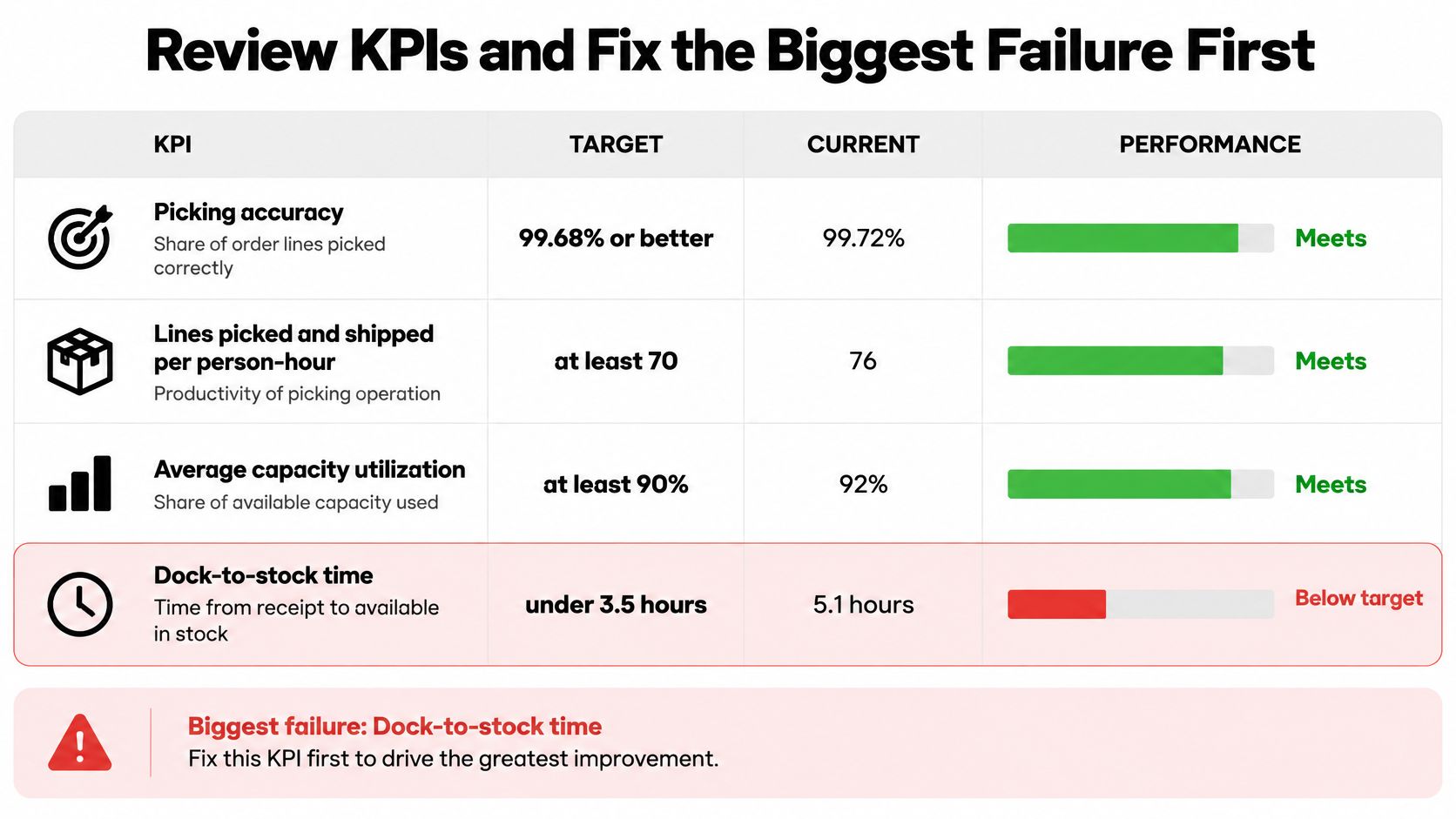
Use benchmarks as diagnostic references, not isolated targets. Yale's distribution-center metrics guide identifies best-in-class reference points of 99.68% or better picking accuracy, at least 70 lines picked and shipped per person-hour, at least 90% average capacity utilization, and dock-to-stock time below 3.5 hours.
| KPI | Benchmark | How to Calculate |
|---|---|---|
| Order picking accuracy | Best-in-class reference above | Correctly verified orders divided by orders picked, expressed as a percentage |
| Lines picked per person-hour | Best-in-class reference above | Lines picked and shipped divided by labor hours |
| Average capacity utilization | Best-in-class reference above | Used capacity divided by available capacity, averaged over the period |
| Dock-to-stock cycle time | Best-in-class reference above | Time from receipt to available-to-sell status |
| Order processing time | Set an internal target by order type | Time from order capture to release for picking |
| Same-day dispatch rate | Set by advertised cutoff and service promise | Orders shipped same day divided by orders released, expressed as a percentage |
The benchmark view helps identify where to investigate, but your team still needs the underlying exceptions.
Work the exception queue before the dashboard
Split relevant metrics by warehouse, picker, SKU class and fulfillment wave. Keep canceled orders and short picks visible, because a report limited to shipped orders excludes work the operation failed to complete.
Use Supply Automate's supply chain KPI guide to check metric definitions across functions. An e-commerce analytics dashboard should help teams trace an outcome to affected orders, not just display a favorable average.
Prioritize stockouts, short picks, address failures, carrier delays and return-to-stock discrepancies by frequency and total cost. Avoid pushing utilization upward without checking congestion, replenishment access and peak headroom.
Choose the first fix
Use this readiness check before approving more automation:
- Channel consistency. Every intake route preserves the authoritative order identity.
- Stock control. Reservations have an expiry and receiving status governs sellable availability.
- Physical verification. Pick confirmations identify mismatches before shipment.
- Return recovery. Each received return has an inspection result and disposition.
- Measurement ownership. Daily warehouse results include failed and incomplete work.
Take a baseline across a normal trading cycle before changing the workflow. Identify the exception type with the highest avoidable cost, assign an owner and change that process first.
I would start with stock visibility when incorrect availability is causing cancellations and short picks. If carrier exceptions cost more, address those instead. Re-measure the affected outcome before choosing the next fix, rather than launching several changes that make attribution impossible.
PlatformDTC brings storefront, checkout, inventory, fulfillment, messaging and analytics into a single system, with one stock ledger across locations and one order record that other surfaces read from. Visit PlatformDTC to explore how that shared operating model can connect your online, POS and B2B orders without making your team reconcile separate versions of the sale.