If your team has ever opened three dashboards and found three different answers for the same SKU, you already know why this topic matters. One system says stock is healthy, another says the store is almost out, and a third still accepts a subscription renewal for inventory that isn't really there. That kind of mismatch doesn't feel like a software issue for long, it starts looking like a business model problem.
A unified commerce platform is the response to that problem. It brings storefront, checkout, inventory, fulfillment, customer data, and sometimes POS into one shared operational record, so teams aren't constantly reconciling separate systems after the fact. The point isn't just cleaner tech. It's a single commerce operation that can keep its own promises.
Table of Contents
- Why DTC Brands Are Consolidating Their Commerce Stack
- What a Unified Commerce Platform Actually Is
- Core Capabilities That Define the Category
- Benefits of a Single Order Lifecycle, Inventory, and POS
- How Unified Commerce Compares With Composable and Legacy Suites
- Adoption Considerations Most Teams Underestimate
- Evaluating and Migrating to a Unified Commerce Platform
Why DTC Brands Are Consolidating Their Commerce Stack
Most DTC brands start with a sensible stack. One platform powers the site, another handles retail, a third manages subscriptions, and a separate tool covers wholesale or B2B. That works while the business is small, because each channel can survive on its own assumptions.
Then the brand grows, and the assumptions start colliding. The warehouse becomes a shared constraint, the customer starts moving between channels without caring how the backend is organized, and every integration becomes another place where data can drift. Independent market research estimated the omnichannel retail commerce platform market at $7.48 billion in 2025, with projections reaching $14.57 billion by 2030 at roughly a 14.2% to 14.3% CAGR over the forecast window, while another estimate put the broader omnichannel retail solutions market at about US$8 billion in 2024, projected to reach US$16.6 billion by 2030 at a 12.9% CAGR (market research overview). That growth reflects a real shift in how retailers are buying software, they're consolidating the operational layer instead of stitching more tools together.
The pressure points show up fast
A founder usually notices the pain in three places. First, customer lifetime value gets harder to defend when every channel runs its own numbers and its own reporting logic. Second, brittle integrations create hidden labor, because a break in one sync can send finance, support, and ops into a reconciliation loop. Third, teams spend too much time arguing over what is true instead of serving customers.
Practical rule: if three systems describe the same order, inventory position, or customer profile differently, your architecture is already taxing the business.
That's why consolidation is happening. Not because brands want fewer tools for the sake of it, but because they want one operational record that survives the move from web to store to subscription to wholesale. For a practical glossary-style reference, see this unified commerce platform definition.
What a Unified Commerce Platform Actually Is
Multichannel meant selling in more places. Omnichannel meant customers could move between those places without the experience falling apart. Unified commerce goes deeper, it means every channel reads from and writes to the same catalog, order, customer, and inventory records in real time.
That single-record model is the architectural shift. Instead of one order in the storefront, another in the POS, and a third in the subscription engine, there is one order entity that every channel understands. The same idea applies to product data, customer data, and inventory positions. A unified commerce platform is less like a set of connected apps and more like one shared system of record with multiple surfaces.
Why middleware isn't the same thing
Middleware can make tools talk to each other, but talking isn't the same as agreeing. A federated stack may sync data after events happen, yet each app can still hold its own version of the truth in the meantime. That's where the edge cases live, oversells, duplicate customer profiles, odd discount behavior, and returns that don't match the original sale.
A unified model removes that gap by making the underlying record the same across the business. The storefront doesn't invent its own inventory truth, and the store register doesn't maintain a separate customer identity. The platform becomes the place where the transaction lives.
A useful test is simple, ask whether the system can answer the same question the same way from any channel without a manual lookup.
That's the difference between “integrated” and “unified.” For teams comparing architectures, the distinction matters because a system can look omnichannel on the surface while still behaving like a patchwork underneath. If you want a side-by-side framing, this comparison page is a useful starting point.
Core Capabilities That Define the Category
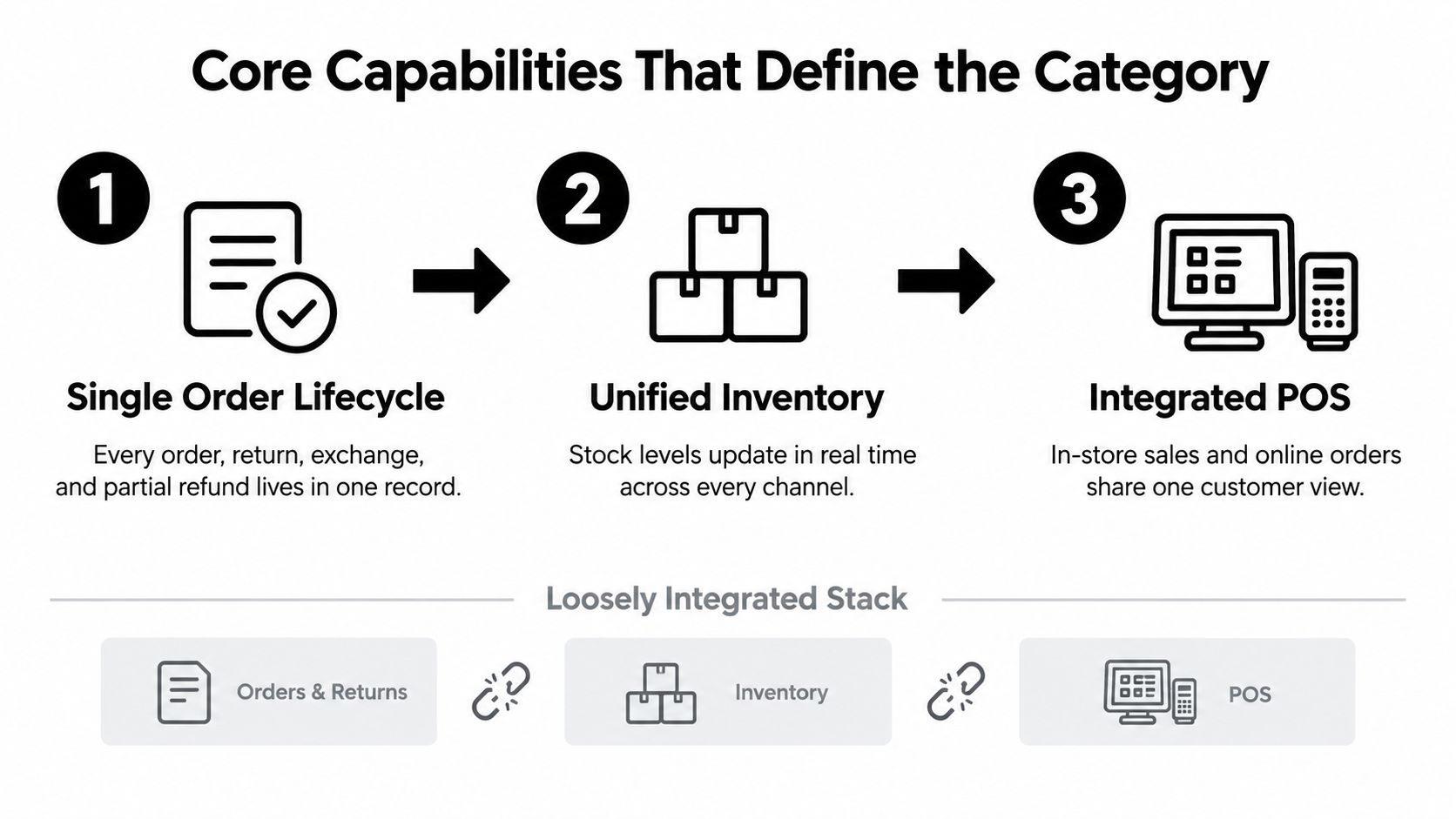
A unified commerce platform becomes real through a few operational pillars, not a generic feature list. The first is the single order lifecycle, the second is unified inventory, and the third is integrated POS. Each one removes a different kind of data drift.
Single order lifecycle
Every order, return, exchange, partial shipment, and refund belongs to one record. That matters because support teams and ops teams stop chasing fragments across systems when a customer changes their mind after checkout. The order history stays intact, even if the customer began on the web, completed part of the journey in-store, and finished with a later adjustment.
Unified inventory
Inventory gets more useful when stock, allocations, and available-to-sell logic live in one model. A bulk wholesale order and a DTC sale should draw from the same counted pool, not from different snapshots that update on different schedules. When every channel reads the same availability state, promise accuracy improves and the business spends less time repairing oversells.
Integrated POS
The register stops being a separate island. In-store teams can sell from the same customer view, apply the same promotions, and trigger ship-from-store or buy-online-pickup-in-store workflows without switching systems. That's the practical difference between a store that participates in the commerce operation and a store that just logs transactions.
If you want to see how that operational view connects to order orchestration, inventory, and service, NanoPIM's guide to achieving seamless omnichannel operations is a useful external reference.
Benefits of a Single Order Lifecycle, Inventory, and POS
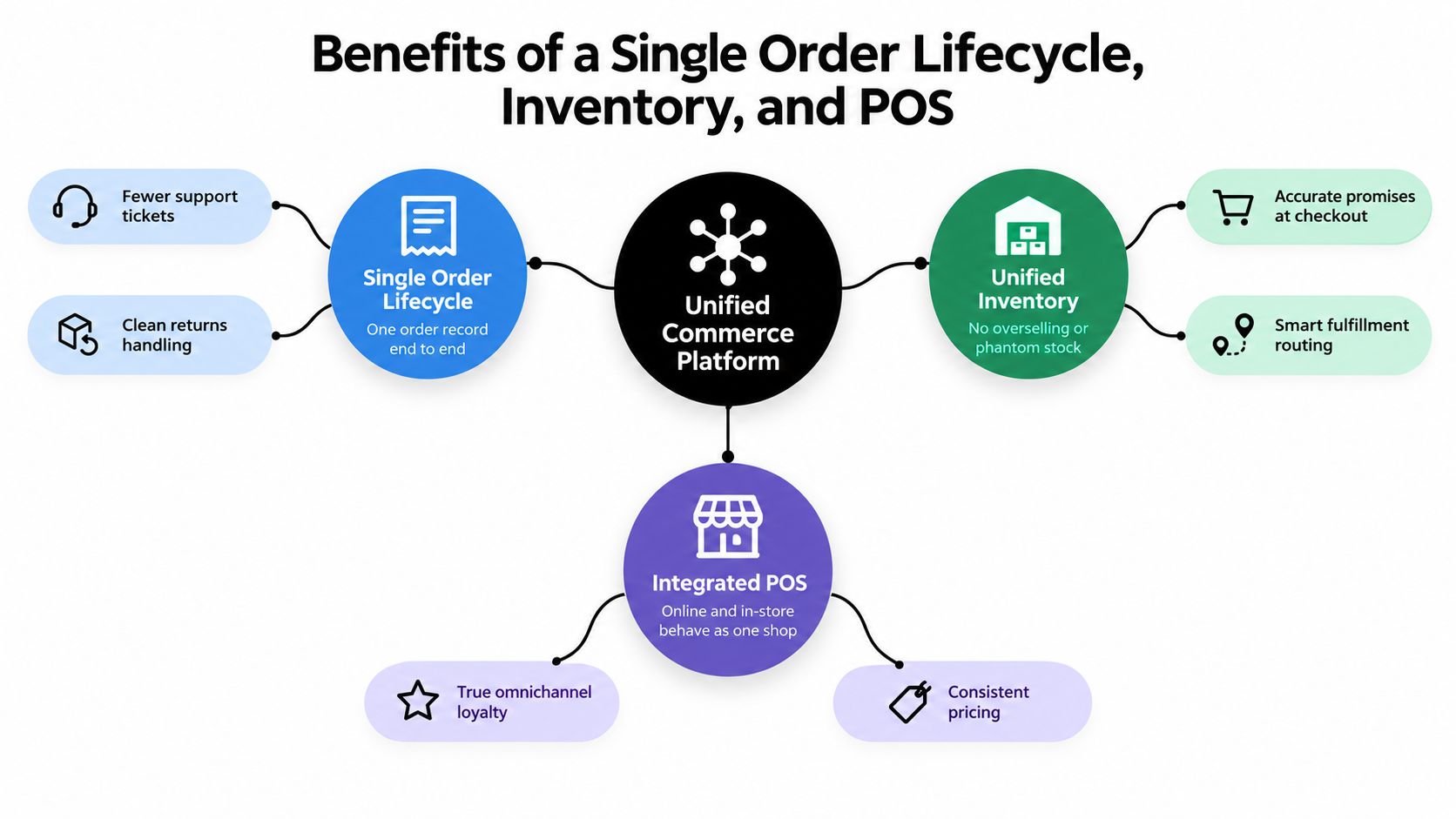
The value of unification shows up in day-to-day commerce mechanics. A platform is only as good as the records it keeps and the decisions it lets teams make from those records. When the order lifecycle, inventory, and POS share a system, the business gets cleaner execution across almost every customer touchpoint.
One order record from start to finish
A customer can start on a website, add a subscription, make a return in-store, and still have one continuous history behind the scenes. That reduces orphaned orders and split refunds, which are common when each channel owns its own transaction. Finance, support, and operations all work from the same record instead of three partial versions.
Inventory becomes trustworthy enough to act on
When the inventory model is shared, the availability shown on the site, in the store, and in the warehouse lines up. That makes pickup promises, transfer decisions, and fulfillment routing far easier to manage. It also removes a lot of the manual reconciliation work that teams often accept as normal until it becomes overwhelming.
POS becomes part of the broader commerce engine
A store associate can behave like a commerce operator, not just a cashier. The same screen can handle an in-store sale, an endless-aisle order, and a clienteling interaction with one customer profile. That consistency matters because pricing, loyalty, and service rules stop changing depending on where the customer happens to be standing.
The broader operational payoff is simple. Leadership gets one number to trust, teams spend less time fixing record drift, and customers experience fewer weird handoffs. In a platform built this way, analytics also become more useful because they reflect one commerce system, not a pile of reconciled exports.
How Unified Commerce Compares With Composable and Legacy Suites
Choosing a commerce architecture is really about where complexity lives. In a composable stack, your team strings together best-of-breed services for search, cart, payments, OMS, and customer data. That can give you flexibility, but it also pushes integration and governance pressure onto engineering.
A legacy suite sits at the other end of the tradeoff. It bundles many capabilities under one vendor contract, which can make procurement and support simpler. The downside is that modernization often moves slowly, and newer channel patterns can fit awkwardly into older product assumptions.
A unified commerce platform lands between those poles. It collapses the core transactional layers into one record model, while still allowing APIs and extensibility for storefronts, marketing tools, and adjacent services. For founders, the question isn't which architecture is “best” in the abstract. It's whether your advantage comes from front-end differentiation, operating simplicity, or enterprise consolidation.
| Dimension | Composable Stack | Legacy Suite | Unified Commerce Platform |
|---|---|---|---|
| Core model | Separate services connected by APIs | Bundled modules from one vendor | Shared record model across commerce functions |
| Flexibility | High | Moderate to low | High at the edges, unified at the core |
| Operational burden | High on engineering | Lower on integration, higher on vendor dependence | Balanced, with less record drift |
| Fit for modern channels | Strong if the team can support it | Often uneven | Strong when channels must share one truth |
| Governance | Internal team owns the glue | Vendor-led | Platform-led with extensibility |
The choice often comes down to whether your organization wants to keep maintaining the glue. If you'd rather evaluate options on migration fit and operational load, the PlatformDTC comparison resource can help frame the decision.
Adoption Considerations Most Teams Underestimate
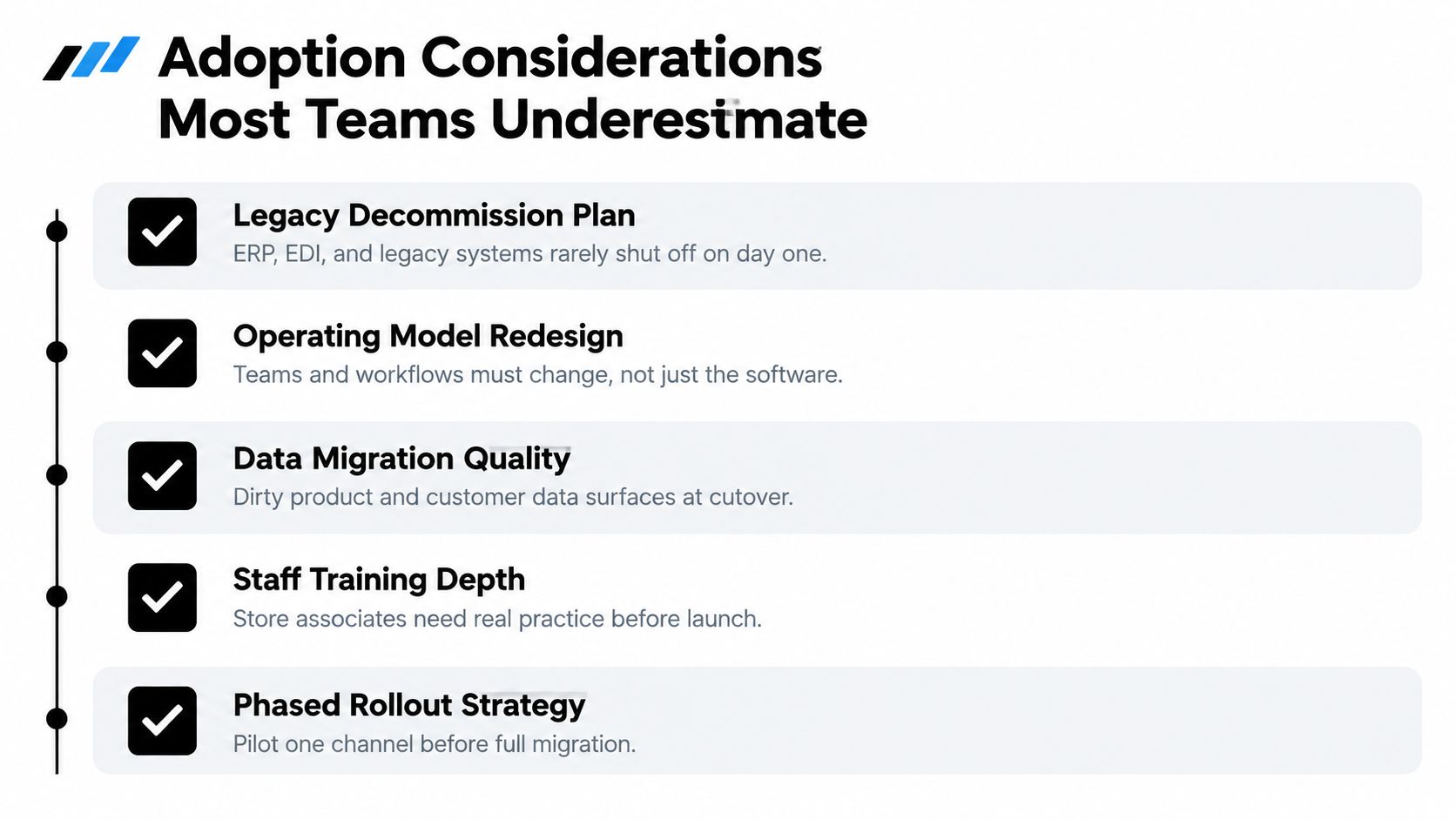
Most unified commerce projects don't stall because the platform is missing a feature. They stall because the company underestimates the change required around the platform. The software is only one layer of the move.
Legacy systems won't disappear on day one
ERP, EDI, accounting, and warehouse systems often keep talking to the new platform for a long time after launch. That means the migration plan has to include transitional flows, not just a cutover weekend. If your team assumes every old system can be switched off at once, the rollout will probably surprise finance and operations.
Data migration carries hidden business logic
Customer records, gift cards, loyalty points, subscriptions, and historical orders are not flat tables. They carry rules that affect support, billing, and fulfillment. When those rules are mapped badly, the failure may not show up until a customer tries to return something or renew a subscription.
Training and operating-model change take longer than expected
Store associates need practice with new POS flows, and support teams need to understand the new order lifecycle. Managers also need to learn new approval paths and new KPIs, because a single source of truth changes how decisions get made. If the org keeps the old habits, the new platform just becomes another dashboard.
The hardest part is usually not the launch, it's the reset of roles and routines after launch.
A phased rollout helps. Start with one channel, one location group, or one order flow, then expand once the team can prove the process holds under real traffic. That kind of migration discipline matters more than a polished demo.
Evaluating and Migrating to a Unified Commerce Platform
A good vendor review starts with architecture, not feature demos. You want to know whether the platform really enforces a single record model for catalog, order, and customer, or whether it just synchronizes separate systems behind the scenes. From there, the shortlist should get more operational.
First, ask for total cost transparency. That includes platform fees, transaction fees, and any add-ons tied to communications or POS hardware. If a vendor can't show the whole cost picture, finance won't trust the proposal later.
Second, verify migration tooling. Historical order history, customer profiles, subscriptions, gift cards, and store credit all matter. A tool that imports only SKUs is not enough for a live business with customers already in motion.
Third, review role governance. POS staff, warehouse users, marketers, and wholesale buyers shouldn't all have the same access. Least-privilege controls matter when one system now touches more of the business.
Fourth, demand a sandbox replay before cutover. Use your own transaction volume, your own edge cases, and your own workflows. That rehearsal surfaces the weird failures before customers do.
For a deeper migration walkthrough, this PlatformDTC migration guide is a practical reference point. If you're evaluating vendors today, PlatformDTC offers storefront, checkout, subscriptions, payments, inventory, fulfillment, messaging, analytics, and governed APIs in one system, so it's worth comparing against the way your current stack handles order records and operational control.
If you're mapping a move away from fragmented commerce tools, PlatformDTC can help you evaluate what changes when the order record, inventory, and checkout all live in one system. Visit PlatformDTC to review the platform, compare your current stack, and start planning a cleaner migration path.