Your storefront redesign is ready, but nobody wants to approve the release. Marketing wants a better product page, engineering worries about checkout, and operations wants reassurance that promotions and order records won't change. What looked like a design project has become a negotiation over the whole commerce system.
A headless commerce platform can help separate those concerns. But the decision isn't whether a new storefront will look better or load faster. It's whether your team can afford, operate, and govern the architecture behind it, especially when automated agents start changing orders.
Table of Contents
- Why Headless Commerce Platforms Are Gaining Attention
- How Headless Architecture Separates the Front End From Commerce
- Benefits of Flexibility, Performance, and Composability
- Trade-offs and Hidden Costs Teams Often Miss
- Integration Patterns From APIs to Edge Checkout
- Governing Agents and Automation Safely
- Evaluating Platforms for DTC and Omnichannel Use
- Next Steps for Choosing Your Platform
Why Headless Commerce Platforms Are Gaining Attention
Consider a DTC brand planning a product launch. The creative team wants an editorial shopping experience, while retail wants an in-store ordering screen. Neither request should require rewriting payment rules, yet the team can't confidently separate presentation changes from commerce changes.
That's the problem headless architecture addresses. Headless commerce separates the customer-facing experience from the underlying commerce functions, allowing teams to change how customers shop without necessarily replacing how the business processes purchases.
A change in architectural thinking
The term was coined in 2013 by Dirk Hoerig, co-founder of commercetools. That same year, a Forrester Research report argued for a looser connection between front-end experiences and back-end commerce functions, as documented in the history of headless commerce.
The important development wasn't a particular programming language. It was the idea that commerce capabilities could serve different interfaces rather than remain attached to a single website.
For a commerce director, that distinction makes the conversation more useful:
- Experience constraint: Your team can't change product discovery without touching checkout-related code.
- Channel constraint: A mobile application or retail interface needs access to existing commerce capabilities.
- Ownership constraint: Teams can't release independently because responsibilities overlap inside the same application.
Headless is worth evaluating when tight coupling prevents a valuable business change, not merely because the current storefront looks dated.
A conventional storefront may still suit a business whose requirements are straightforward. My recommendation is to identify the blocked change first, then decide whether architectural separation would remove the blockage. Otherwise, you risk paying for flexibility your team won't use.
The next question is practical: what exactly gets separated, and what must remain connected?
How Headless Architecture Separates the Front End From Commerce
Think of your commerce operation as a restaurant. The dining room is the experience guests see, the kitchen prepares orders, and the order window carries requests between them. You should be able to rearrange the dining room without rewriting every recipe.
In a headless system, the presentation layer is the dining room. The commerce engine is the kitchen. An application programming interface, or API, is the agreed way they exchange requests and responses.
The layers and their responsibilities
The architecture is easier to inspect when each layer has a clear job.
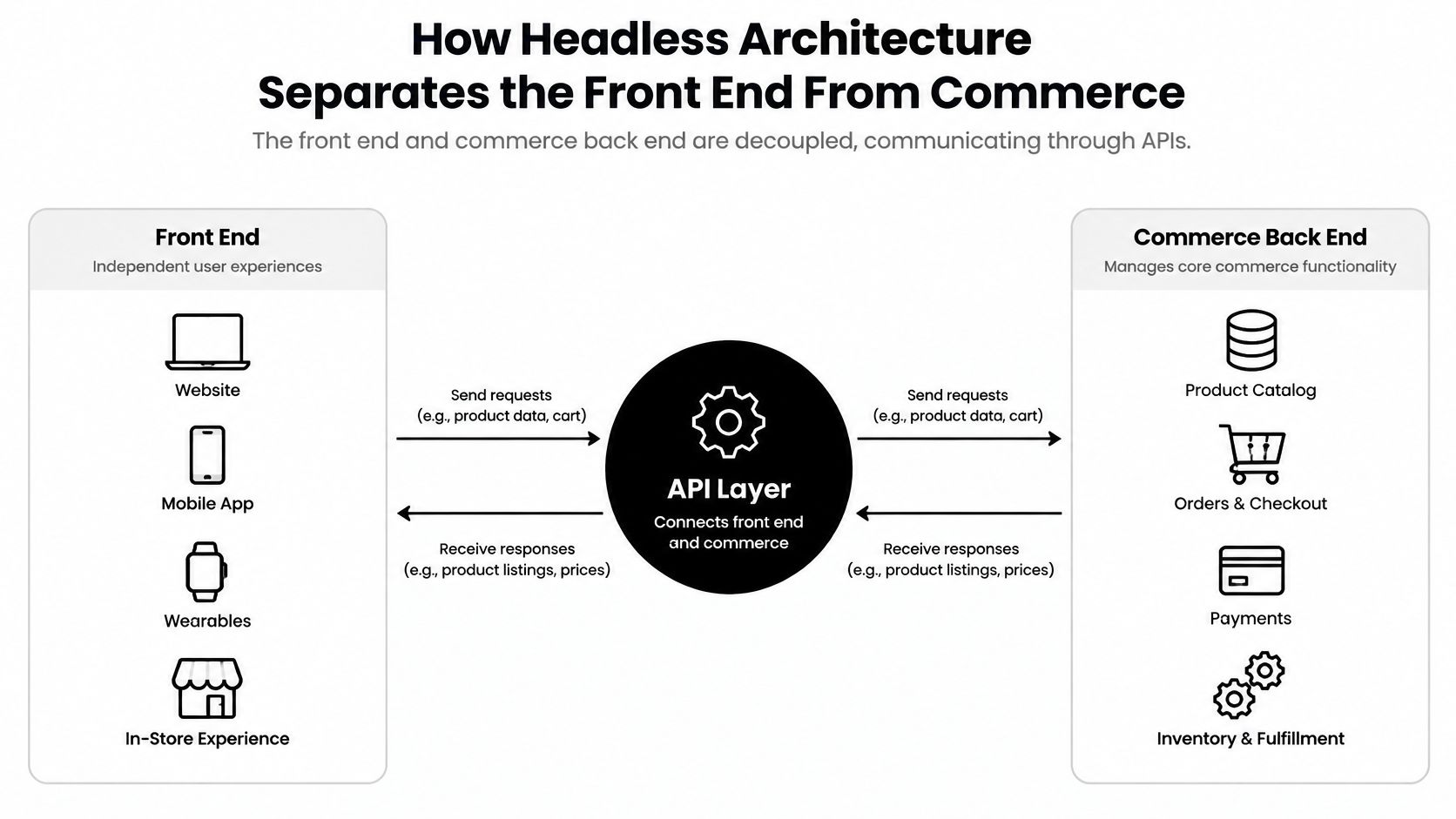
- Presentation layer: The website, mobile app, or in-store screen displays products and collects customer input. For example, it decides how a size selector looks.
- Integration layer: API connections carry requests, enforce access boundaries, and translate responses into something the interface can use.
- Commerce services: The back end manages catalog, cart, checkout, payment, and order behavior. It decides whether the selected product can be purchased under the applicable rules.
Suppose a shopper selects a shirt and adds it to their cart. The interface sends the product selection to the commerce API. The commerce engine returns the updated cart, and the interface displays it.
The design team can change that interaction without taking ownership of pricing calculations. Conversely, the commerce team can maintain purchasing rules without deciding where the cart button belongs.
Separate responsibilities, not communication
Headless doesn't mean disconnected. It means the connection is explicit rather than embedded throughout a shared storefront application. A JavaScript storefront alone doesn't establish that separation, and headless doesn't require every back-end capability to become a separately operated service.
The practical work is agreeing on contracts: required fields, loading behavior, error messages, and who owns each failure. When designers and engineers define those interface states, Figr's developer handoff best practices provide a useful handoff resource.
In restaurant terms, the order window needs a clear ticket format. A beautiful dining room won't compensate for ambiguous instructions reaching the kitchen.
Benefits of Flexibility, Performance, and Composability
The benefits become meaningful when you connect them to a specific operational change. A redesigned collection page, a faster mobile purchase, and a shared retail catalog are different goals. They shouldn't be approved under one vague promise of modernization.
Flexibility without replacing everything
A brand might want a content-rich landing page for a seasonal collection. With a properly separated presentation layer, the team can build that experience while retaining the existing commerce engine.
That's useful when the underlying purchasing behavior already works. The business gets room to experiment without turning every creative change into a replacement project. However, the team still needs to test that the new interface handles unavailable products, invalid discounts, and checkout errors correctly.
Performance with measurable boundaries
Headless creates opportunities for edge delivery and deliberate rendering choices. It doesn't guarantee a fast experience.
Google's mobile ecommerce analysis found that a 0.1-second load-time improvement increased retail conversions by approximately 8% on average, as reported in Milliseconds Make Millions. That finding supports investing in performance, not promising an equivalent lift from a platform migration.
For a merchandising page, I'd recommend:
- Render near the customer: Serve static or incrementally rendered content from the edge where appropriate.
- Cache shared responses: Reuse non-personalized catalog data with explicit invalidation rules.
- Fetch independent data concurrently: Don't make unrelated requests wait for one another.
- Limit browser work: Review client-side JavaScript, media weight, and third-party scripts before adding more personalization.
Measure time to first byte, Largest Contentful Paint, Interaction to Next Paint, and checkout API latency across important markets and device classes. Treat those as release criteria, not dashboard decoration.
Practical rule: Measure the purchase journey your customers actually use, not just the homepage your team presents in meetings.
Composability with a business purpose
Reusable commerce capabilities let another interface consume established functionality. A retail ordering screen, for example, can request product information rather than maintain its own unrelated product database.
But headless and maximum composability aren't the same decision. You can separate the storefront while keeping a coherent commerce back end. Choose additional service boundaries only when their benefits justify the responsibility of operating them.
Trade-offs and Hidden Costs Teams Often Miss
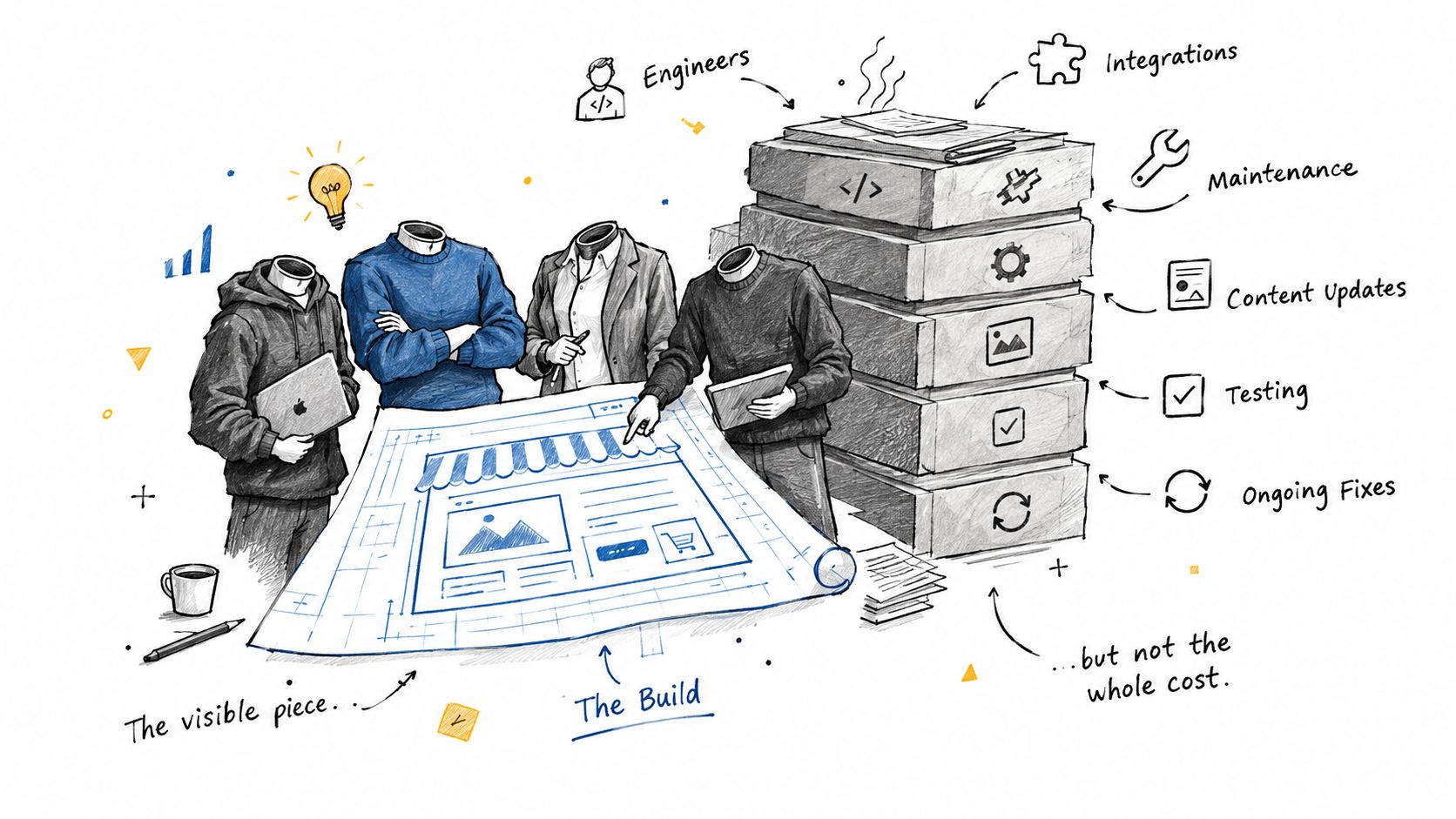
The storefront build is only the visible part of the investment. Someone must also maintain connections, investigate failures, test releases, and support the old system while the replacement is being verified.
Think of the development work alongside those continuing responsibilities.
Compare scopes before comparing prices
A useful cost model distinguishes these scenarios:
| Scenario | What changes | What to budget beyond the build |
|---|---|---|
| Frontend-only decoupling | A custom interface uses the existing commerce back end | Front-end ownership, API compatibility, monitoring, and regression testing |
| Hybrid migration | Selected capabilities move while others remain | Temporary connectors, reconciliation, and parallel operations |
| Full composable replacement | Multiple commerce capabilities move to separately selected services | Integration maintenance, service ownership, contracts, and cross-system incident response |
A summary of available estimates cites $60,000–$150,000 for a mid-complexity implementation and $2.4 million–$4.8 million over three years for a full composable build. It also reports that 65% of technology and marketing leaders viewed budget as a barrier despite 73% already using headless approaches, according to headless commerce cost and adoption coverage.
Those estimates aren't interchangeable quotes. Their different scopes are the reason to request an itemized operating model rather than adopt a headline price.
Assign the continuing work
Ask who handles a payment integration change, a broken promotion, or an inventory mismatch after launch. Include engineering capacity, observability, quality assurance, and incident ownership in the business case.
For a migration, explicitly budget the overlap. Running both systems means verifying records and managing exceptions, not just paying for another hosting environment.
Use the accompanying video as a discussion prompt alongside that scope review.
My recommendation is to consolidate capabilities where separation doesn't create a clear advantage. Choosing a specialized service can be reasonable, but your team inherits its contracts, failure behavior, and integration tests.
The financial question isn't whether headless is cheaper. It's at what operational complexity does composability stop producing economic value?
Integration Patterns From APIs to Edge Checkout
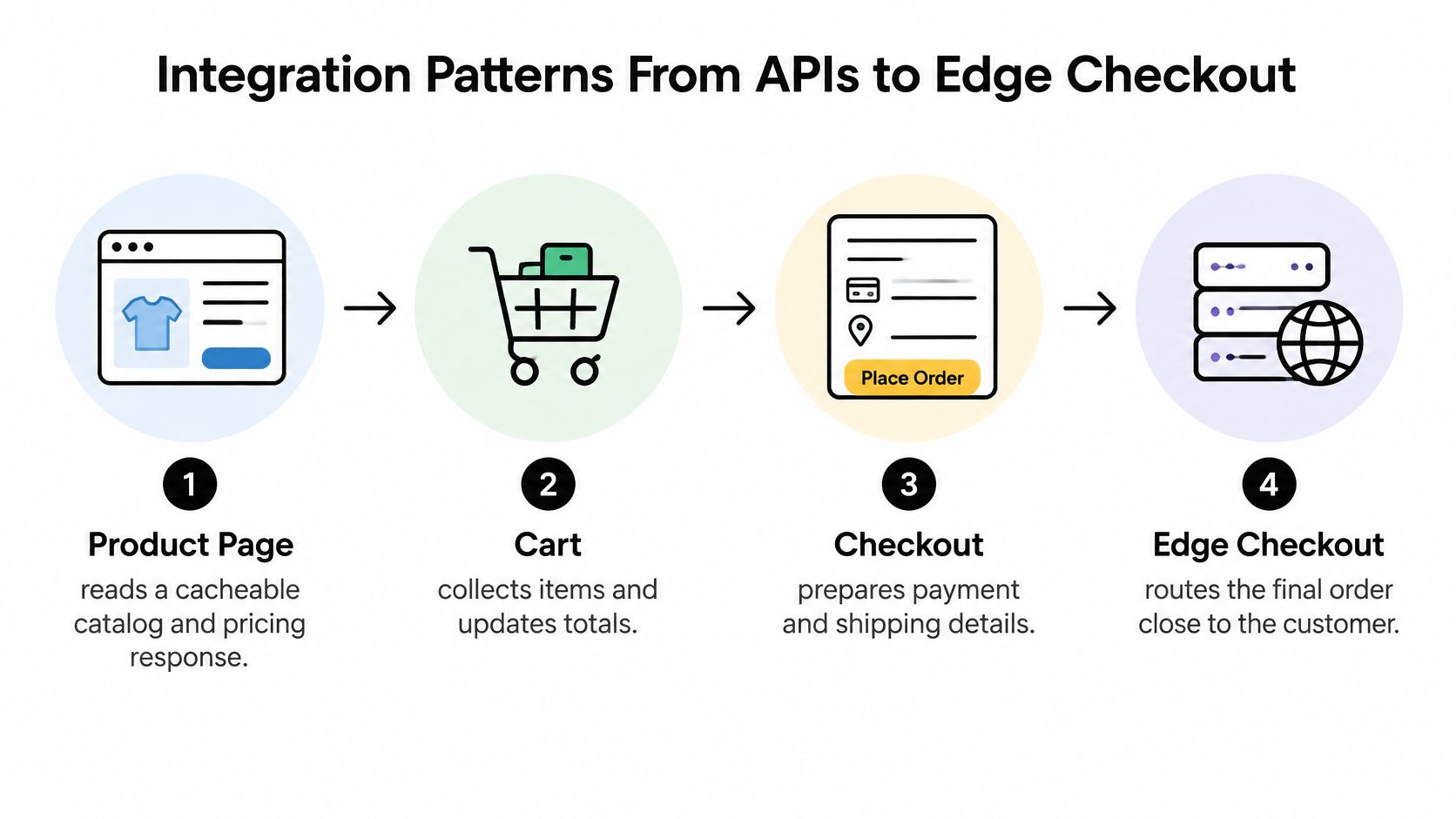
Follow a shopper buying a jacket. The product page needs descriptive content and a price, the cart needs an authoritative total, and checkout needs to complete the purchase without creating duplicate financial actions.
A production design should make that sequence visible.
Reads should avoid unnecessary waiting
Start with cacheable catalog and pricing representations where the business rules permit them. A public product description can be reused differently from a customer-specific wholesale price. Document the cache boundary so one shopper's personalized response isn't treated as shared content.
Independent requests should run concurrently. Dependent requests need an explicit sequence: you can't authorize an unknown payment amount, but you may be able to fetch product imagery while retrieving availability.
Google found that increasing page load time from one to ten seconds raised the probability of bounce by 123%, illustrating the commercial risk of unnecessary waiting in its mobile page-speed benchmark analysis.
For a proposed edge-served checkout on the brand's domain, distinguish interface delivery from transaction processing. Serving the checkout page nearby doesn't remove dependencies on payment, inventory, or order services. Map those dependencies in an e-commerce API integration plan.
Writes must survive retries and conflicts
The difficult moment comes when the shopper submits payment and the connection drops. Did the operation fail, or did only the response fail to arrive?
- Idempotency keys: Give payment, order, and fulfillment operations stable identifiers so a retry doesn't create another action.
- Explicit state machines: Define permitted cart and order transitions. A paid order shouldn't accidentally return to an unpaid draft state.
- Inventory version checks: Detect when another purchase changed availability before accepting an update.
- Verified webhooks: Check signatures before accepting external notifications, and make event consumers safe to replay.
- Linked request IDs: Connect storefront, checkout, payment, and fulfillment logs so support can reconstruct the transaction.
These are design decisions, not optional cleanup work. Ask the implementation team to demonstrate a payment timeout, a repeated fulfillment notification, and competing inventory updates.
A successful checkout demonstration proves the happy path. A credible architecture also explains what happens when the response never arrives.
The restaurant equivalent is a missing acknowledgment from the kitchen. Resending the ticket must not cause the same meal to be prepared and charged again.
Governing Agents and Automation Safely
Can an AI agent change prices, launch campaigns, modify inventory, issue refunds, or place orders? Technically connecting the agent is only part of the answer. The more important question is which actions it may perform, under whose authority, and with what recovery path.
Reporting on the 2025 State of Agentic AI Security found that 69% of enterprises were piloting or running agents in early production, while four out of five lacked a formal governance policy for agents or Model Context Protocol connections, according to coverage of autonomous AI security risks and controls.
Permission belongs at the action boundary
Consider an agent asked to resolve a delayed subscription delivery. It may need to inspect the order, propose a refund, and notify the customer. That doesn't mean it should also change payment settings or edit unrelated customer accounts.
Use a minimum control set:
- Scoped credentials: Give each agent its own identity and only the tools required for its job.
- Approval thresholds: Require human approval for spending, discounts, or financially sensitive exceptions.
- Safe mutations: Apply retry protection and preserve reversible changes where possible.
- Human escalation: Stop when policy, customer intent, or order state is ambiguous.
- Immutable audit logs: Record the actor, authorization, requested action, outcome, and approval.
AletheionAGI's discussion of layered enforcement for safer AI agents is a useful companion when designing controls across tool access and execution.
Govern the whole lifecycle
The authorization decision must follow the action across checkout, payments, subscriptions, POS, B2B orders, and fulfillment. For example, approving an invoice adjustment shouldn't implicitly authorize changing a warehouse shipment.
International operations add another review boundary. A proposed refund may involve currencies, tax treatment, and payment methods that differ from the storefront's presentation.
Treat agentic commerce as delegated operational authority, not a chatbot feature. My position is straightforward: don't permit autonomous writes to the order lifecycle until the permission model, escalation route, and audit evidence have been tested.
Evaluating Platforms for DTC and Omnichannel Use
A useful platform comparison starts with evidence, not feature checkmarks. Give each candidate the same order scenario and ask its team to demonstrate both completion and recovery.
Platform evaluation criteria for DTC and omnichannel teams
| Evaluation criterion | What to verify | Why it matters |
|---|---|---|
| API versioning and permissions | Version policy, scoped credentials, and access boundaries | Makes change management and delegation explicit |
| Idempotency and state handling | Retry behavior, valid transitions, and conflict handling | Protects financial and operational writes |
| Channel coverage | Online, B2B, and POS workflows | Tests fit beyond the web storefront |
| Single order record | Shared history across purchases, renewals, and channels | Supports consistent operational decisions |
| Migration tooling | Catalog import, parallel running, reconciliation, and rollback | Makes cutover readiness testable |
| Cost transparency | Platform fees, payment margins, replacements, and engineering work | Supports a realistic ownership model |
| Performance and uptime evidence | Measurement methods, service status, and relevant test conditions | Separates published evidence from promises |
| Engineering access | Escalation path to the people building the system | Clarifies accountability when problems cross boundaries |
Use demonstrated, requires custom work, or unverified as assessment labels. Don't assign a positive score just because a salesperson says an API exists.
Compare a consolidated option with assembled services
PlatformDTC is one option for teams evaluating a unified commerce platform. It combines a storefront and edge-served checkout on the brand's domain with Apple Pay, Google Pay, PayPal, Link, Amazon Pay, and Klarna. Its subscriptions share an order lifecycle with one-time purchases, while its payments product uses Stripe-hosted fields and direct settlement to merchant Stripe and PayPal accounts.
Its POS synchronizes with online orders and customer lists, and its B2B tools cover draft orders and invoicing. Migration utilities support catalog imports and parallel running before cutover. Agent controls include scoped keys, approval gates, idempotent writes, and an audit trail.
For due diligence, request the developer documentation, published service status, and checkout measurement methodology. Published median measurements from Playwright runs aren't a substitute for testing your own customer journeys. Also examine its cost breakdown and engineer-connected support model against your operating requirements.
An assembled alternative should face exactly the same review. Specialized services may justify their additional ownership when you need distinctive capabilities. A consolidated platform may be preferable when your main problem is maintaining connections and reconciling records.
Decision test: Choose the architecture your team can operate during a failed payment or disputed order, not merely the one it can demonstrate during a sales call.
Next Steps for Choosing Your Platform
Start this week by mapping which systems own catalog, pricing, inventory, checkout, subscriptions, and orders. Mark every place where staff copy data or reconcile disagreements. That map gives engineering and commerce leaders a shared description of the problem.
Turn the map into a buying exercise
- Model the alternatives: Compare frontend-only decoupling, hybrid migration, and full composable replacement. Include people, observability, testing, and parallel operations.
- Request evidence: Ask shortlisted vendors to demonstrate your purchasing flow, a failed transaction, and an agent action requiring approval.
- Plan verification: Require catalog import checks, reconciliation during parallel running, cutover criteria, and a recovery plan.
- Inspect supporting costs: Include adjacent tools rather than treating them as free. For a café retailer, reviewing BonusQR's rewards program costs for cafés is a concrete example of pricing a supporting capability separately.
For the consolidated option discussed above, review its developer APIs and documentation, then ask how its migration utilities would handle your catalog and existing order workflows. Bring an actual exception from your operation, such as a subscription refund involving a retail purchase history.
Before committing, answer a single decision question: does consolidation or composability create more value for your operating model?
PlatformDTC offers consolidated commerce capabilities and governed APIs for teams evaluating headless storefronts and agent-operated workflows. Visit to review its developer resources and request a migration discussion using your catalog, checkout requirements, and agent approval rules.