A 2013 McKinsey estimate, reproduced in Microsoft's market-basket analysis discussion, attributed 35% of Amazon purchases to product-recommendation algorithms. That's a reason to take recommendations seriously, not a forecast for your store or proof that every frequently bought together module makes money. The operator's job is to separate useful additions from purchases that inflate revenue while reducing profit.
Table of Contents
- Why Co-Purchase Recommendations Still Earn Their Place
- Pick the Right Recommendation Logic for Each Catalog
- Read Support, Confidence and Lift Before You Trust a Pair
- How to Build Your Pairing Rules Step by Step
- Placement, Labels and Privacy Controls That Build Trust
- Measure Attach Rate and Incremental Margin, Then A/B Test
- Confirm the Pilot Before You Roll Out Site-Wide
Why Co-Purchase Recommendations Still Earn Their Place
Frequently bought together recommendations use purchasing relationships to suggest products alongside something a shopper already wants. A compatible filter beside a coffee maker solves a different problem from a generic bestseller carousel. The shopper doesn't have to search the catalog to complete the purchase.
That context is the advantage. You're offering an accessory, consumable, or complementary item while purchase intent already exists, rather than interrupting someone with an unrelated advertisement.
Start with the commercial outcome
Plan for wider baskets and useful discovery, but don't treat either as sufficient evidence of success. A discounted accessory can increase order value while adding picking costs, shipping expense, and returns exposure that exceed its margin.
Before launch, establish your baseline:
- Average order value: Record what shoppers spend without the new module.
- Attach rate: Track how often orders already include the proposed accessory.
- Margin per order: Include discounts and the operational costs your finance team uses to evaluate profitability.
- Conversion: Check whether additional choices distract shoppers from completing their main purchase.
Reddog Consulting Group's guidance on how to increase average order value profitably is a useful companion when deciding whether a larger basket benefits the business.
Keep recommendations close to purchase intent
Prioritize surfaces that already receive qualified traffic: product pages, carts, and the post-purchase experience. Condition the suggestion on the current product, basket, or relevant order history. Don't put the same accessory everywhere because it has inventory to clear.
Regional merchandising also matters. Local assortment, customer habits, and fulfillment options can make a sensible pairing in one market unsuitable in another. Maintain market-specific eligibility rather than pushing a universal pairing list across every storefront.
Commercial rule: A module that adds items while reducing contribution profit hasn't earned its space.
Choose the recommendation logic, placement, and operating rules around that standard. The design can be simple, provided the recommendation is relevant and the economics hold up.
Pick the Right Recommendation Logic for Each Catalog
Recommendation logic compared
| Logic | Data it uses | Best fit | Main risk |
|---|---|---|---|
| Rules-based pairs | Order history reviewed by the team | Small catalogs with obvious accessories | Pairs go stale when the range changes |
| Segment-based bundles | Order history split by buyer segment | Catalogs with distinct buyer groups | Thin data per segment produces noisy pairs |
| Real-time recommendations | Live session data plus order history | Large catalogs with steady traffic | Can show out-of-stock items unless inventory is checked |
Rules-based pairs are the best starting point when compatibility is easy to verify. A merchant can map an insulated bottle to the correct replacement lid without needing a complex model. Manual control also helps with new products that lack purchase history.
The trade-off is maintenance. When a product changes dimensions, connectors, packaging, or fulfillment location, someone must review its approved accessories. Assign that responsibility to a named merchandising owner.
Segment-based bundles suit catalogs where buying intent differs meaningfully between groups. A first-time skincare buyer may need a starter routine, while a repeat buyer needs replenishment rather than another starter kit. Keep segments broad enough that their purchase patterns reflect repeated behavior, not isolated orders.
Earn the complexity of personalization
In a 2025 bookstore case study, Algonomy's Cashing in on Bundles reported 76% higher click-through rate and 16% more revenue per 1,000 views from personalized bundles than from basic frequently bought together recommendations. That result supports testing a different approach, not assuming the same improvement across unrelated catalogs.
Real-time systems can account for browsing intent and changing baskets, but they introduce more dependencies. Session events, identity resolution, product attributes, pricing, and availability must agree before the offer appears. Evaluate those requirements alongside the broader architecture considerations in this guide to AI ecommerce platforms.
- Choose rules when product fit is clear and merchandising capacity is available.
- Choose segments when customer groups have clearly different needs and sufficient order history.
- Choose real-time logic when live signals improve decisions and inventory feeds are dependable.
Bought together describes an observation. Needed together requires a product-level judgment.
A shared promotion can create a strong purchasing relationship without making the products useful companions. Conversely, a required adapter may deserve a clear compatibility recommendation even before enough transactions exist to support a statistical claim.
Keep operational exclusions outside the ranking model. Suppress items that create avoidable split shipments, duplicate an active subscription, or approach stockout. A recommendation engine shouldn't be allowed to override those constraints merely because an item is likely to attract a click.
Read Support, Confidence and Lift Before You Trust a Pair
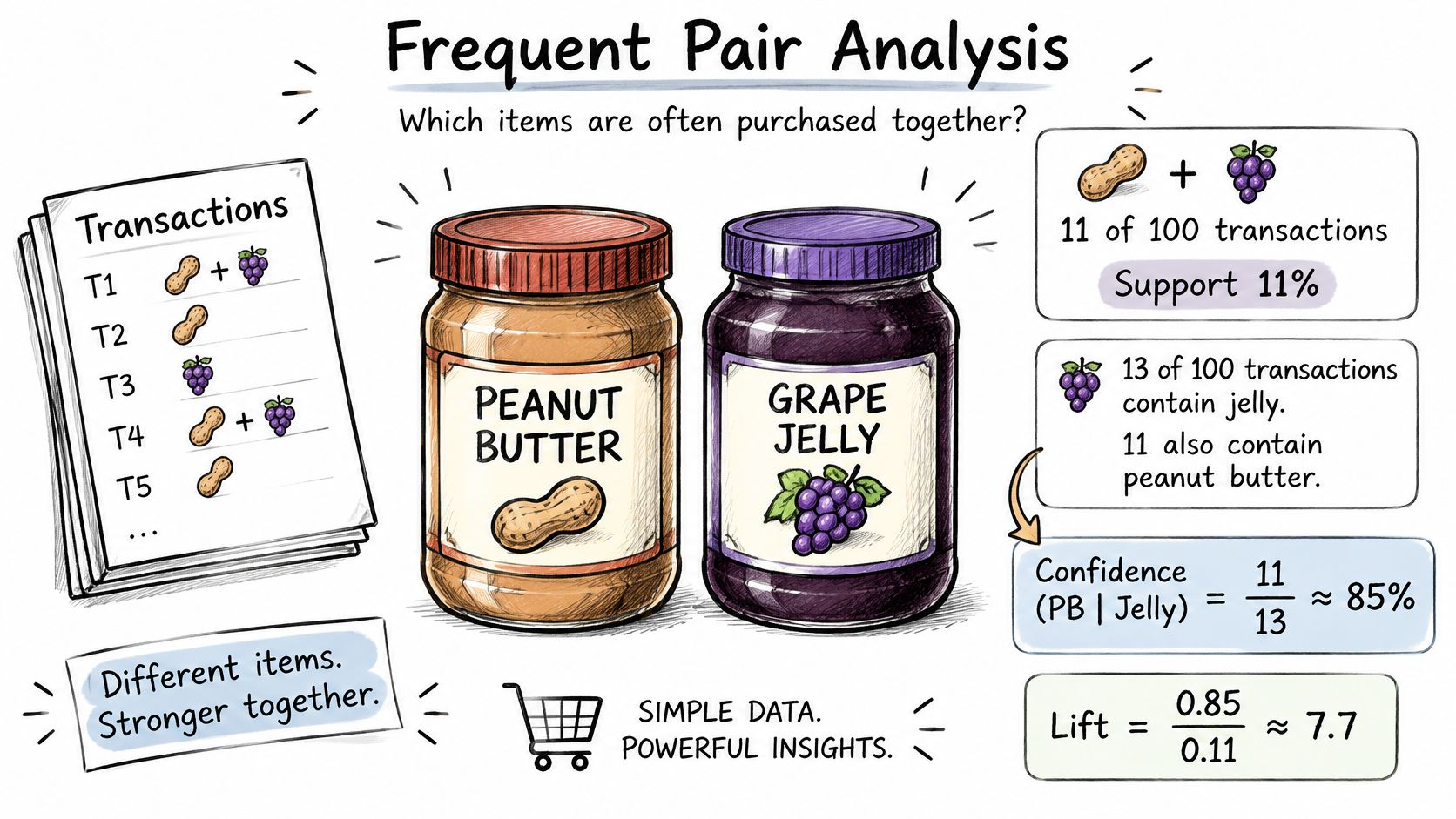
In the worked example in this market-basket analysis paper, peanut butter and grape jelly appear together in 11 of 100 transactions, giving 11% support; jelly appears in 13 transactions, and 11 also contain peanut butter, giving approximately 85% confidence for recommending peanut butter from jelly purchases.
Support measures how often the combination appears across all eligible transactions. Confidence measures how often the recommended product appears when the starting product is present.
The distinction matters because confidence is directional. Recommending peanut butter to jelly buyers isn't necessarily as strong a rule as recommending jelly to peanut butter buyers.
The visual below separates the calculations used to evaluate a pair.
Use lift to challenge apparent strength
Lift compares the observed co-purchase rate with what you'd expect if purchases were independent. Confidence alone can flatter a pairing with a bestseller because that product appears in many baskets regardless of what else customers buy.
Say a phone case and a compatible screen protector have modest support but a strong association relative to their individual popularity. They may be better recommendation candidates than a hoodie and socks that appear together more often because both sell widely.
A below-independence relationship doesn't automatically prove substitution, either. Customers may buy the products in different seasons, through different channels, or for different purposes.
Set evidence gates before publishing
There isn't a universal minimum transaction count that makes every pair reliable. Set the minimum co-purchase count before reviewing results, require the relationship to persist across separate review periods, and reject automated rules that depend on isolated baskets.
Use a spreadsheet pivot table, SQL query, or association-rule tool to inspect these checks:
- Evidence volume: Show the underlying joint-order count beside the percentage, including counts within each market or segment.
- Pattern stability: Compare ordinary-price orders with promotion-driven baskets and inspect changes over time.
- Product usefulness: Verify model, size, connector, or formulation compatibility before approval.
Keep statistically weak but necessary accessories in a manually governed compatibility list. Don't label them frequently bought together unless transaction history supports that description. Equally, don't preserve a statistically strong pair when its only explanation is a shared discount.
How to Build Your Pairing Rules Step by Step
Build a reproducible candidate file before configuring the storefront widget. SQL works well for larger exports; a spreadsheet can handle a smaller catalog if you keep order-level and product-level records separate.
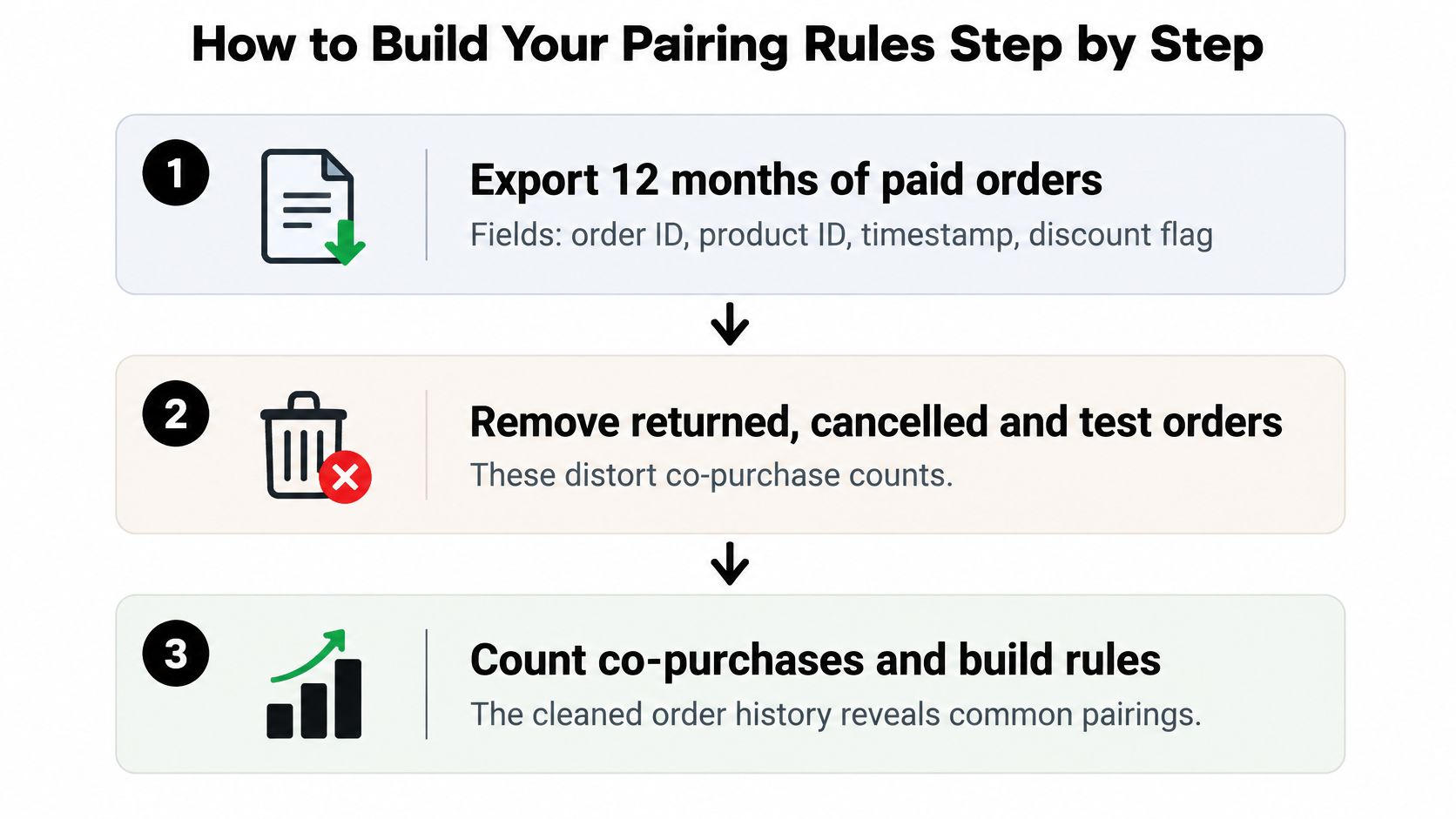
The workflow starts with clean transactions, not widget settings.
Prepare the candidate file
-
Export paid order lines. Include order ID, product ID, variant ID, timestamp, quantity, market, channel, and discount flags across a representative trading period. Pull catalog attributes, inventory availability, fulfillment location, and subscription status alongside the export; a common slip is treating historical availability as current availability.
-
Remove cancelled and test orders, then reconcile returned lines against their original purchases. Preserve a separate returns file for later evaluation, because deleting every trace of returned products would hide whether a recommendation creates regretted purchases.
-
Normalize products before counting baskets. Deduplicate repeated lines within each order and distinguish true accessories from alternative sizes or colors of the same product. Otherwise, quantities and variant exchanges can masquerade as purchasing relationships.
-
Count eligible baskets containing each product and each pair, then calculate support, directional confidence, and lift using the same transaction population. Don't calculate product popularity from all channels while calculating joint purchases from online orders alone.
Turn candidates into governed rules
-
Apply the evidence gates. Remove candidates that fail your minimum count, stability, or association requirements, then inspect promotional orders separately. Mixing campaign bundles into ordinary purchasing behavior can make a temporary discount look like durable customer demand.
-
Tag remaining relationships as accessory, refill, alternative variant, or complementary product, and prioritize accessories and complements for the initial release. Add an explanation and approver to each rule; the common mistake is publishing a pair whose statistical relationship nobody can explain.
-
Check eligibility and economics. Validate available-to-promise stock, shipping compatibility, subscription conflicts, and combined gross margin after any bundle discount. Reject pairs below the store's margin floor, then assess incremental fulfillment expense separately rather than confusing gross margin with contribution profit.
-
Load approved pairs into the product-page module and assign a refresh owner. Refresh purchase patterns according to catalog turnover, but validate price and inventory at display and purchase time; a scheduled rule refresh isn't a substitute for live eligibility checks.
A healthy initial file is short enough to audit. Each row should contain the starting product, recommended variant, evidence counts, relationship type, exclusion conditions, approval owner, and expiry or review status.
Release check: If customer support can't explain why the item belongs with the main product, don't publish the pair yet.
Keep a versioned export of every release. When a rule performs badly, you'll need to distinguish a changed pairing from a price change, stock issue, or promotion.
Placement, Labels and Privacy Controls That Build Trust
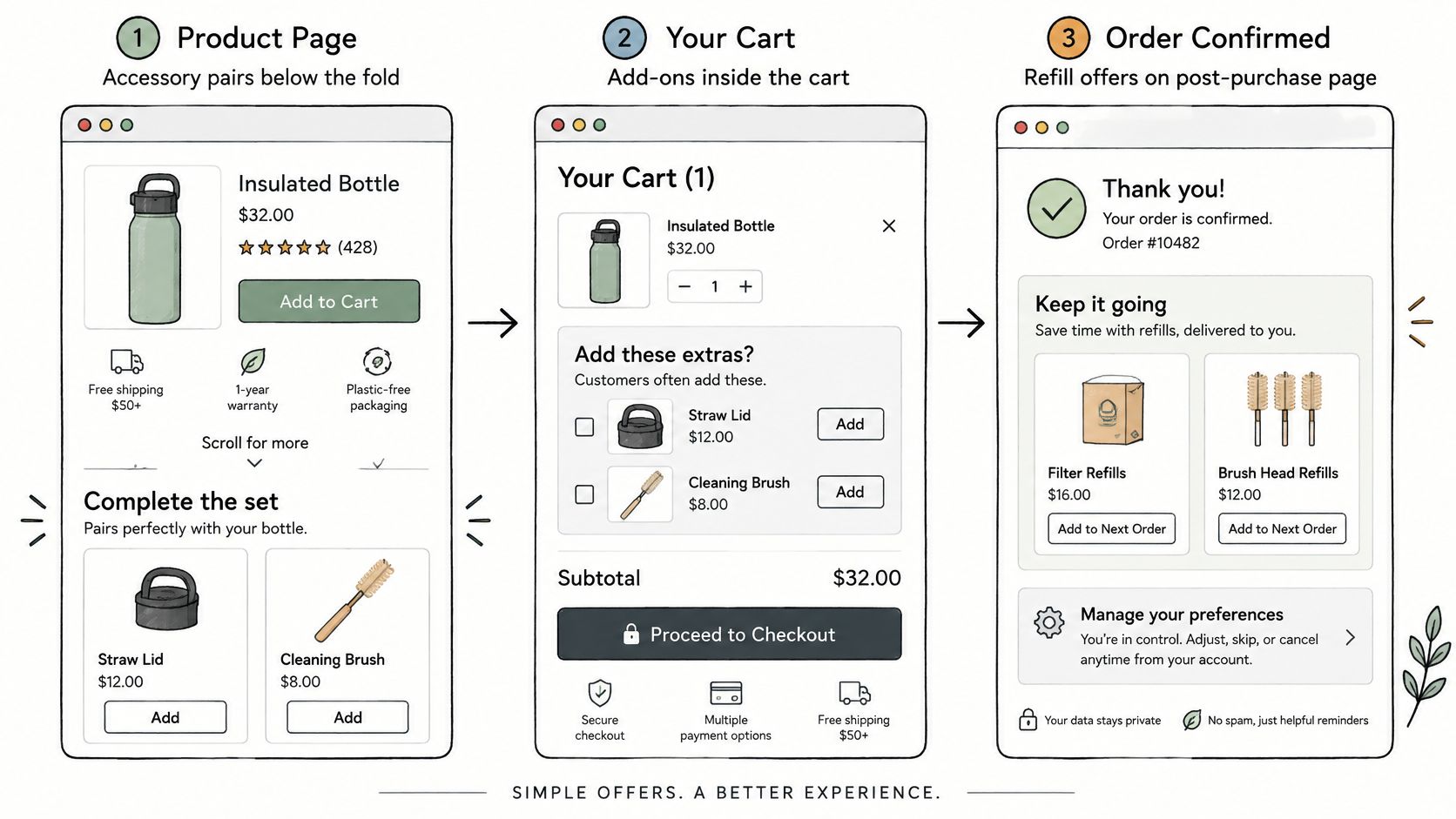
Put accessories below the main product information, basket-specific additions in the cart, and replenishment prompts where timing makes sense. Don't force shoppers to dismiss a recommendation before they can buy the item they came for.
This journey illustrates how the offer should change with the shopper's task.
Placement and suppression by surface
| Surface | What it shows | Label | Suppress when |
|---|---|---|---|
| Product page | Accessory pairs below the fold | often purchased with this item | Either item is low stock or the pair splits a shipment |
| Cart | Add-ons matched to the current basket | often bought with items in your cart | The add-on conflicts with an active subscription |
| Post-purchase page | Refills timed to likely run-out | time to reorder | The item is regulated or age-restricted |
A run-out label belongs on a returning customer's post-purchase or order-status page when the timing is credible. Immediately after an initial purchase, use a complementary add-on instead of pretending the shopper already needs replenishment.
Explain the recommendation without exposing the shopper
In a July 2025 U.S. survey covered by Chief Marketer's report on Omnisend's shopper survey, 43% cited privacy and data security as their leading concern, while 35% feared irrelevant recommendations. Transparency should be part of the interface, not buried in a privacy policy.
Use aggregated co-purchase signals as the product-page default where practical. These don't require identifying the current shopper, although the underlying transaction data still needs appropriate handling.
Individual-history personalization is different. Treat consent and preference controls as explicit design requirements, and document which first-party data each recommendation uses.
Offer controls customers can understand:
- Explain: State whether the suggestion comes from the current basket, aggregate purchases, or personal history.
- Opt out: Let shoppers disable personalization without blocking ordinary shopping.
- Reset: Let customers clear inferred preferences after gift shopping or shared-device use.
The accompanying video provides another format for considering the recommendation experience.
Don't infer sensitive medical needs or age-restricted interests from loose purchasing associations. Keep additions optional, avoid preselected extras, and monitor complaints and privacy opt-outs as warning signals, not merely customer-service issues.
Measure Attach Rate and Incremental Margin, Then A/B Test
Metrics for judging a frequently bought together module
| Metric | What it tells you | Healthy signal |
|---|---|---|
| Attach rate | Share of orders that include a recommended item | Rising without a fall in margin per order |
| Incremental gross profit | Margin added beyond orders that would have happened anyway | Positive against the holdout arm |
| Return rate | Whether recommended items come back | Flat or lower than the holdout arm |
| Cancellation rate | Orders cancelled after a recommended item is added | No increase against the holdout arm |
| Complaint rate | Shopper reports about irrelevant or misleading suggestions | Stays near zero and does not rise over time |
| Privacy opt-out rate | Shoppers who switch off personalization | Low and stable after launch |
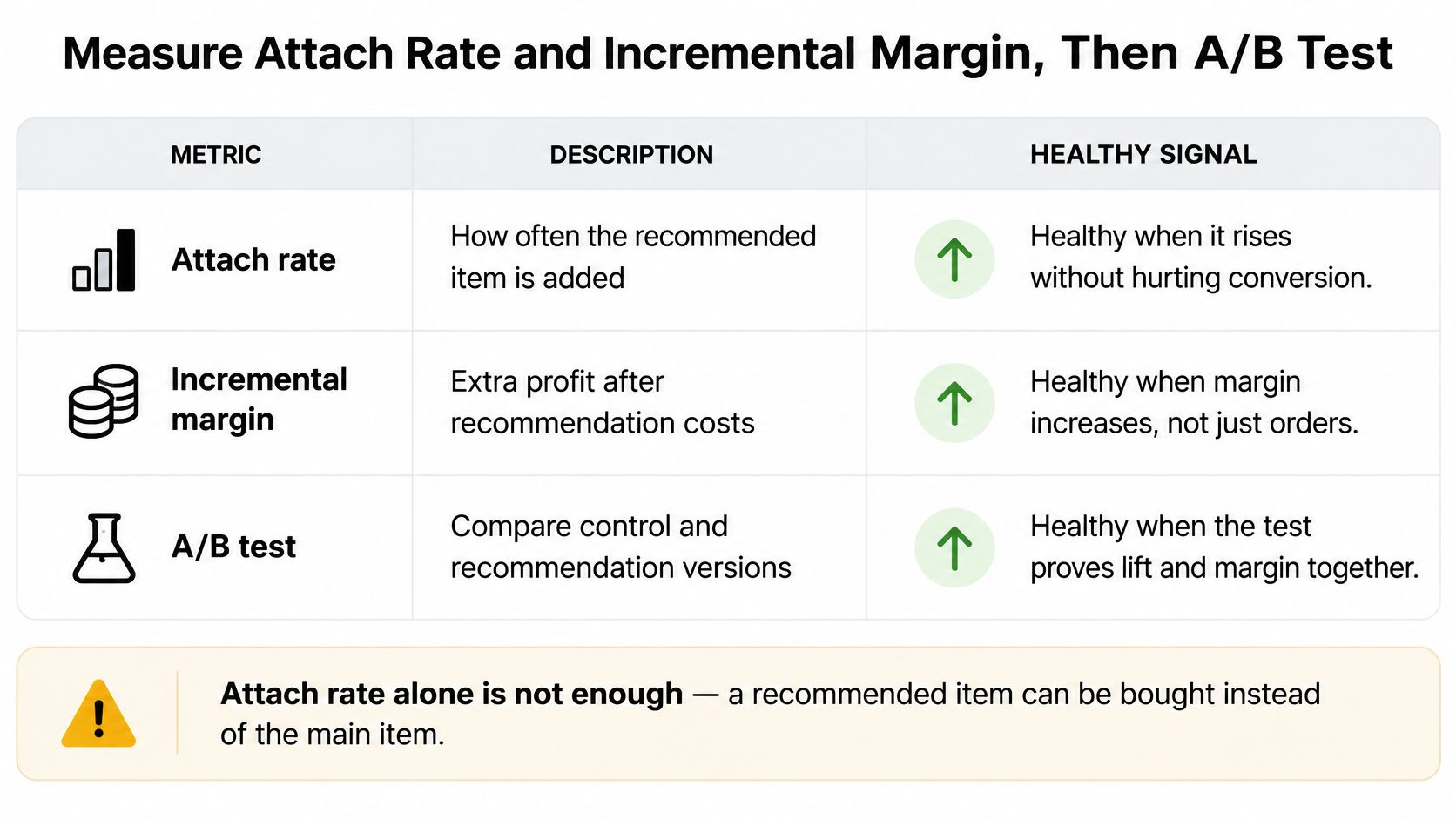
Attach rate tells you whether customers buy the suggested product. It doesn't tell you whether the recommendation caused an additional purchase. Someone might have found that accessory through navigation anyway, or substituted it for a more profitable item.
Compare against a genuine holdout
Randomly assign eligible shoppers to a control without the module and a treatment with it. Keep assignment stable for returning shoppers so they don't alternate between experiences during the same buying decision.
Choose the allocation and required sample size from baseline conversion, profit variability, and the smallest improvement worth acting on. Don't use a convenient order-count target as a substitute for a power calculation.
Compare profit per eligible shopper or session, not only profit per completed order. A module can improve order-level economics while discouraging enough purchases to reduce total profit.
Use this measurement view to keep engagement separate from economic value.
Account for costs and delayed outcomes
Calculate incremental gross profit from the difference between treatment and control, then deduct additional fulfillment, shipping subsidies, payment costs, and recommendation-system costs to evaluate contribution profit. Use consistent cost definitions across both groups.
Allow enough time for representative purchasing behavior and the category's normal returns and cancellation lag. An early revenue increase isn't a final result when the recommended products haven't passed through their usual return window.
- Instrument exposure: Record whether the module rendered, which rule it used, and whether the item remained eligible.
- Track the purchase: Connect impressions, additions, completed orders, refunds, and cancellations through stable identifiers.
- Separate experiments: Change placement before testing label wording or recommendation logic, rather than changing everything simultaneously.
Bring these measures together in an ecommerce analytics dashboard, with breakdowns by rule, market, device, and customer segment. Use those breakdowns to diagnose failures, not to hunt for a winning subgroup after the overall experiment disappoints.
Predefine pause conditions for misleading offers, fulfillment failures, worsening complaints, and negative incremental contribution. Stop harmful rules immediately when the issue is operational or customer-facing; statistical significance isn't permission to keep displaying an incompatible accessory.
Confirm the Pilot Before You Roll Out Site-Wide
Run the pilot on a limited set of revenue-leading products, using the product page only. Keep the broader candidate pool separate from the deployment list so you can evaluate promising pairs without expanding exposure prematurely.
Choose pilot products with dependable inventory, clear accessory relationships, and enough eligible traffic to evaluate the result. Avoid making the initial test dependent on a clearance campaign or an unusually seasonal launch.
Require commercial and operational approval
Expansion needs explicit gates, not enthusiasm about the widget's appearance:
- Commercial approval: Incremental contribution is positive against the holdout under the agreed cost model.
- Customer approval: Complaints remain stable, and support can explain the offers without apologizing for misleading labels.
- Operational approval: Stock and subscription exclusions work in actual storefront and checkout behavior, including after inventory changes.
Test suppression deliberately. Make a recommended variant unavailable in a controlled environment, change its fulfillment eligibility, and confirm that the offer disappears and can't still be purchased through a stale cart.
The operational risk comes from separate systems disagreeing. A recommendation may read yesterday's stock feed while checkout uses current availability, or a lifecycle tool may suggest a refill that the subscription system has already scheduled.
PlatformDTC is one option among several: we keep one stock ledger across locations and one order record that every other surface reads from, and our daily summaries tell merchants what is leaking money, what is waiting on them, and what to grow next in plain words.
Expand only what the team can maintain
Apply the same gates regardless of your stack. Once the product-page pilot passes, evaluate cart and post-purchase placements separately, then introduce segment-based bundles within a contained category.
Name an owner for rule quality, another for financial evaluation, and an escalation contact for fulfillment problems. Keep a rollback path that removes the recommendation without requiring a storefront deployment.
For the coming week, export a representative period of paid orders and create a ranked candidate pool from your leading products. Compute support and lift, approve a small set of explainable pairs, and publish only those attached to the selected pilot products. Don't launch another placement until you can show which pairs added profit and which exclusions protected the customer experience.
PlatformDTC brings storefront, checkout, subscriptions, inventory, fulfillment, and analytics into a single system, giving your team a consistent operating foundation for complementary-product offers. Visit PlatformDTC to explore whether a unified catalog and order record fit your recommendation pilot and the controls you need before expanding it.