You're reviewing last night's abandoned carts while your growth lead asks why a discount failed and customer support tries to explain a subscription renewal. The storefront, payment dashboard, and subscription app tell different stories. Adding an agent that can act across those systems sounds useful, until you ask which version of the order it will trust.
Table of Contents
- Why DTC Operators Are Rebuilding Their Stack in 2026
- What an AI Ecommerce Platform Actually Is
- Core Capabilities That Actually Move Revenue
- Why Governance Is the Real Differentiator
- Enterprise DTC Patterns That Run on This Stack
- Implementation Roadmap Without Revenue Risk
- How to Choose Between Vendors Without the Demo Theater
- What to Decide in the Next 30 Days
Why DTC Operators Are Rebuilding Their Stack in 2026
That morning reconciliation is the right starting point for a platform review. Don't start with the chatbot. Start with the work your team can't complete without opening another system, exporting a file, or asking engineering to explain a transaction.
Consider a routine promotional order. Marketing expects the advertised discount, the warehouse needs an accurate reservation, and finance needs to match the captured payment to the final total. If those systems disagree, your team must investigate before anyone can safely change the order.
An agent doesn't remove that dependency. Giving it write access makes resolving the disagreement more urgent.
Discovery is changing, but execution still matters
AI-driven shopping deserves attention on its own merits. Adobe reported that generative-AI referrals to U.S. retail sites increased 1,300% year over year during November and December 2024, according to the compiled AI ecommerce statistics.
That's a reason to make product information accessible and reliable. It isn't evidence that an autonomous agent should control your pricing or payments.
The architectural decision is whether you want another interface over fragmented systems or a platform that can execute against authoritative business records. A composable commerce architecture is worth evaluating through that lens, not through the number of integrations it supports.
Buying principle: Don't purchase autonomy to compensate for transaction data your own team can't reconcile.
Before discussing features, bring concrete operating questions into the review:
- Commercial accuracy: Which system determines the final price after promotions, shipping, and tax?
- Operational ownership: Who resolves a payment that succeeded when order creation failed?
- Financial traceability: Can finance reconstruct what changed without collecting screenshots?
Buy the platform that can answer those questions with records and executable workflows, not presentation slides.
What an AI Ecommerce Platform Actually Is
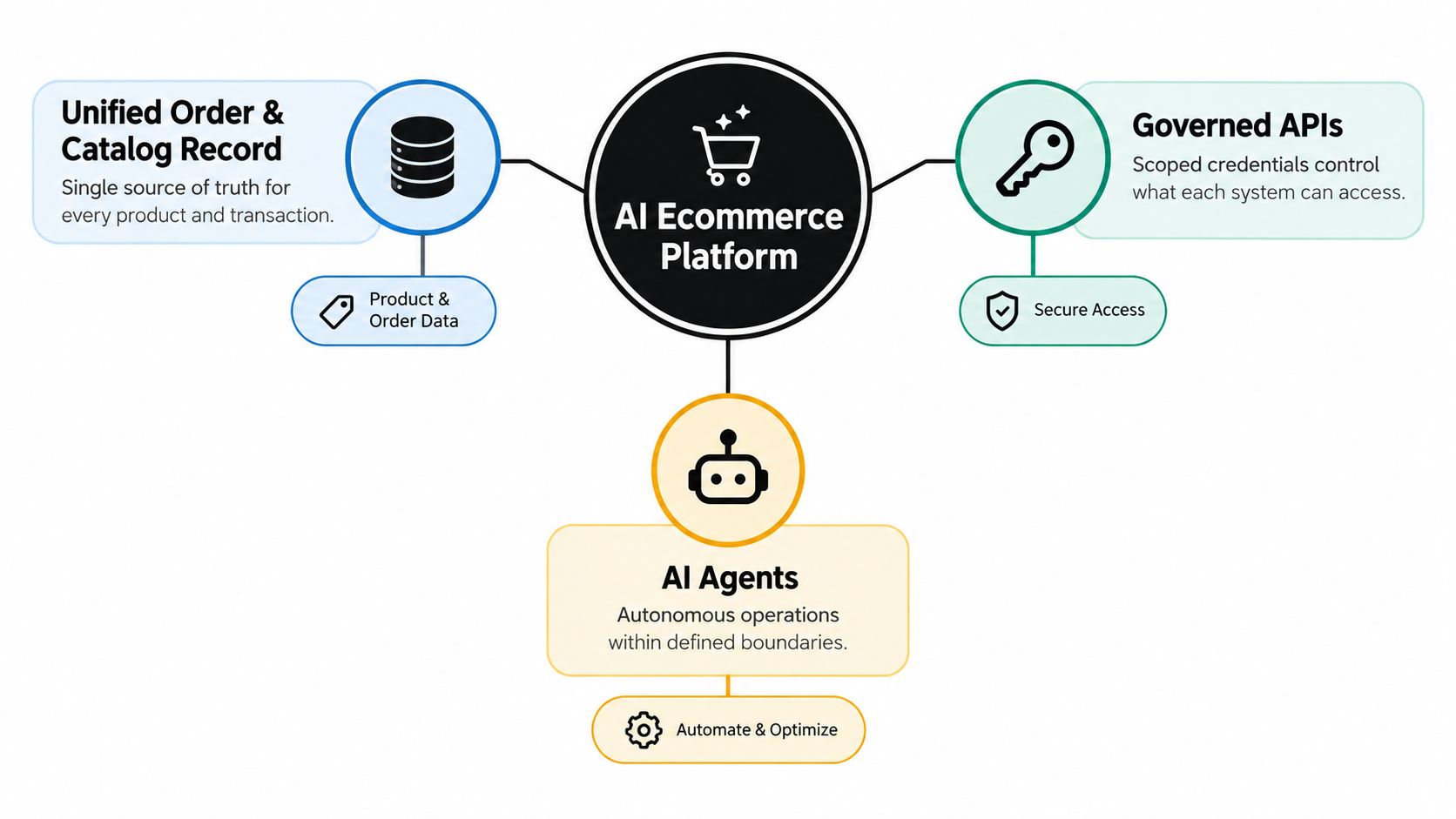
An AI ecommerce platform should be a commerce operating system with an intelligence layer, not a conversational interface attached to disconnected apps. My working definition requires a unified business record, governed APIs, and agents that use those APIs within explicit boundaries.
The architecture should make those dependencies visible.
Start below the model
The unified order and catalog record establishes what products exist and what happened to each transaction. An order should retain its identity through authorization, fulfillment, renewal, return, and refund. A shared dashboard isn't enough if each underlying service still defines the transaction differently.
Governed APIs expose business operations through documented contracts. An operation such as creating a draft promotion needs defined inputs, validation, permissions, and predictable failure responses. The language model shouldn't decide what constitutes a valid transaction.
Scoped agents select and invoke those operations. Their job is to interpret intent and coordinate permitted work, not bypass business rules because a prompt sounds persuasive.
- Record layer: Supplies authoritative product and transaction context.
- API layer: Enforces which operations are valid.
- Agent layer: Proposes or executes permitted work using that context.
For orientation on customer-facing applications, ServeApps' guide to AI in ecommerce is useful background reading. Keep that application discussion separate from the architecture you're buying.
Distinguish architecture from packaging
A conventional suite with an AI add-on may be adequate when your team only needs content assistance. A point plugin may also be appropriate for a narrow workflow with clearly bounded data access.
Neither arrangement automatically provides an operating system for autonomous commerce. Conversely, an AI-native label proves nothing about transaction integrity.
Ask the vendor to trace a proposed action from source record through API validation to its recorded outcome. If the demonstration stops at generated text, you're evaluating an assistant, not an operational platform.
Core Capabilities That Actually Move Revenue
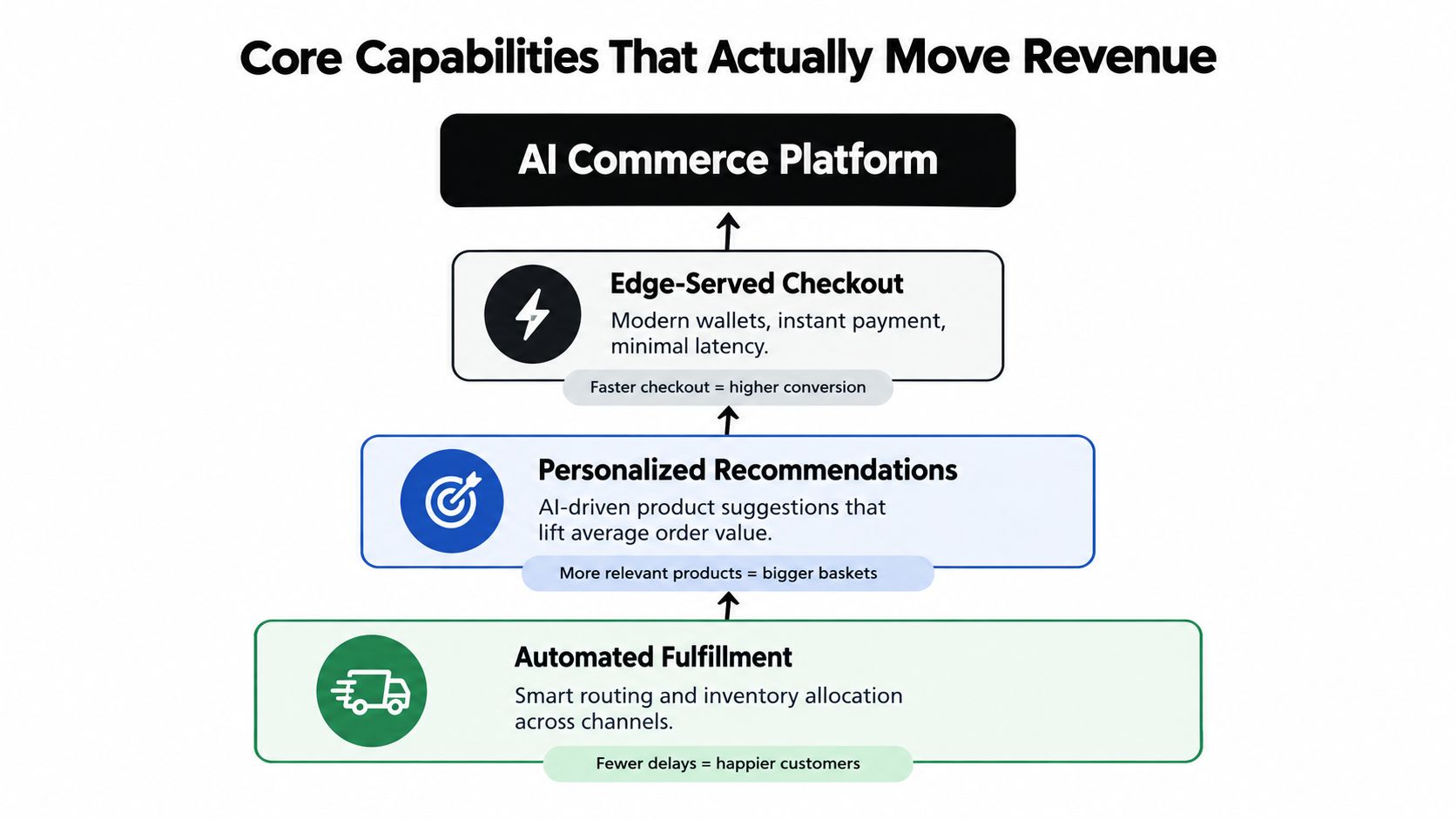
Prioritize capabilities by the customer or operator failure they prevent. Page generation is easy to demonstrate. Correct checkout totals, reliable renewals, and reconcilable payments deserve more scrutiny.
Use the capability map as a starting point, not evidence of business impact.
Protect the purchase path
Checkout should support guest purchases and relevant wallets, including Apple Pay, Google Pay, PayPal, Link, Amazon Pay, and Klarna where appropriate. Edge delivery is useful, but test the complete purchase path rather than accepting a fast page render as proof of a fast checkout.
Baymard reports that 17% of U.S. online shoppers abandoned an order because checkout was too long or complicated, making workflow design a commercial requirement, not a cosmetic preference (checkout usability research). Track field failures, abandonment by step, payment authorization latency, and completion by device and payment method.
Subscriptions need the same operational scrutiny. Require renewals and one-time purchases to share order handling so support can investigate a failed renewal without switching transaction models. Watch renewal completion, recovery outcomes, and unexplained customer charges.
Payments should have explicit ownership and settlement arrangements. If you require your own Stripe or PayPal accounts, verify that requirement contractually and test reconciliation through partial refunds.
Connect selling channels to operations
| Capability | Failure to test | Metric to watch |
|---|---|---|
| POS synchronization | Retail sale leaves online availability stale | Inventory discrepancies |
| B2B drafts and invoices | Negotiated terms disappear at fulfillment | Order corrections |
| Fulfillment routing | Allocation uses unavailable stock | Reservation failures |
| Unified analytics | Campaign revenue ignores returns | Reconciliation differences |
Require analytics to connect orders, customers, and campaigns through consistent definitions. Recommendations should also respect availability and merchandising exclusions rather than optimize clicks in isolation.
For the product walkthrough, use the video alongside your own acceptance checklist.
Treat DTC Agents as scoped operational tools for page building, merchandising, and campaigns. Require them to use the same documented APIs developers use.
Discovery work belongs alongside this infrastructure. If you're considering AY Rank's ecommerce SEO services, include catalog accuracy, indexable product pages, and campaign landing-page ownership in the scope. Acquisition work shouldn't depend on product information your commerce system can't keep consistent.
Why Governance Is the Real Differentiator
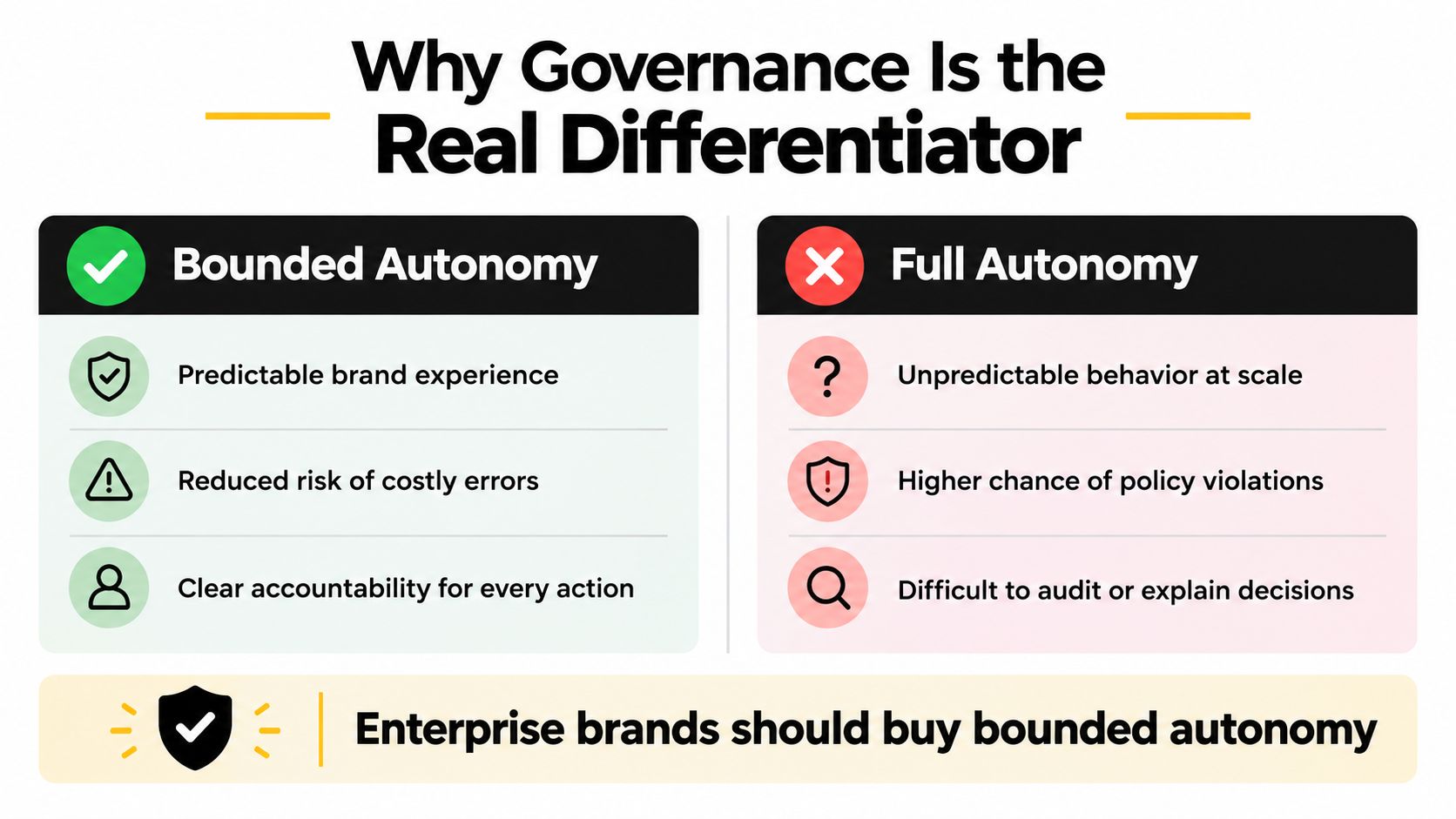
More autonomy isn't automatically more valuable. A page-layout mistake and an unauthorized refund don't deserve the same permissions, approval process, or recovery procedure.
Consumer confidence also warrants restraint. Bain reports that 72% of surveyed U.S. consumers had used AI in some form, but only 24% were comfortable using it to complete a purchase, with security and privacy the leading concerns (Bain's analysis of agentic commerce trust).
Buy bounded autonomy: explicit authority for specific actions, with intervention points matched to financial and customer risk.
Make controls transactional
The NIST AI Risk Management Framework provides a structure for identifying and managing AI risks. Use it to organize ownership and evaluation, then demand concrete enforcement in the commerce system.
- Agent-specific credentials: Give a merchandising agent catalog access without automatically granting refund authority. Avoid shared administrator keys.
- Approval gates: Require authorization for spend, discounts, price changes, and customer messaging according to written policy. Approval must bind to the proposed action, not a vague session-level permission.
- Idempotent writes: Assign a stable key to a business operation so a network retry can't create another order or issue the same refund again.
- Immutable audit records: Preserve the actor, authorization context, input, proposed mutation, result, and recovery reference.
A system prompt saying “don't overspend” isn't a spending control. The execution service must reject actions outside policy even when the agent requests them confidently.
The agent may propose the action. The transaction service must decide whether it is allowed.
Test recovery before granting authority
Ask what “reversible” means for each operation. A draft page can be discarded; a captured payment may require a compensating refund rather than a literal rollback. Customer messages can't be unsent.
Test policy rejection, duplicate requests, expired approvals, and interrupted execution. Measure unauthorized actions, duplicate mutations, approval escapes, and recovery success.
Don't accept an audit screen that only records successful actions. Finance and engineering also need rejected requests and failed attempts to understand what the agent tried to do.
Enterprise DTC Patterns That Run on This Stack
The same architecture serves different operating models, but the acceptance tests should change with the business. Treat these as illustrative workflows, not promised customer outcomes.
Catalog-heavy brands need controlled publishing
Your merchandising team needs to refresh collection pages as assortment and availability change. A standalone writing tool can draft copy, but your team still has to verify product eligibility and publication rules.
An operational agent should select products from approved catalog attributes, prepare page changes, and submit a reviewable draft. Compare the approaches on publishing accuracy, not how quickly the demo produces attractive text.
- Keep human ownership: Merchandisers approve positioning and product claims.
- Test the boundary: Remove a product from eligibility while the draft is awaiting approval and confirm publication revalidates it.
Subscription brands need explainable renewals
A customer combines a recurring product with a one-time purchase, then requests a partial return. Support needs a coherent account of what was ordered, charged, shipped, and refunded.
Compare a separate subscription ledger against a shared lifecycle using that exact scenario. The useful outcome is traceable customer history, including failed collection attempts and recovery decisions, not merely a renewal calendar.
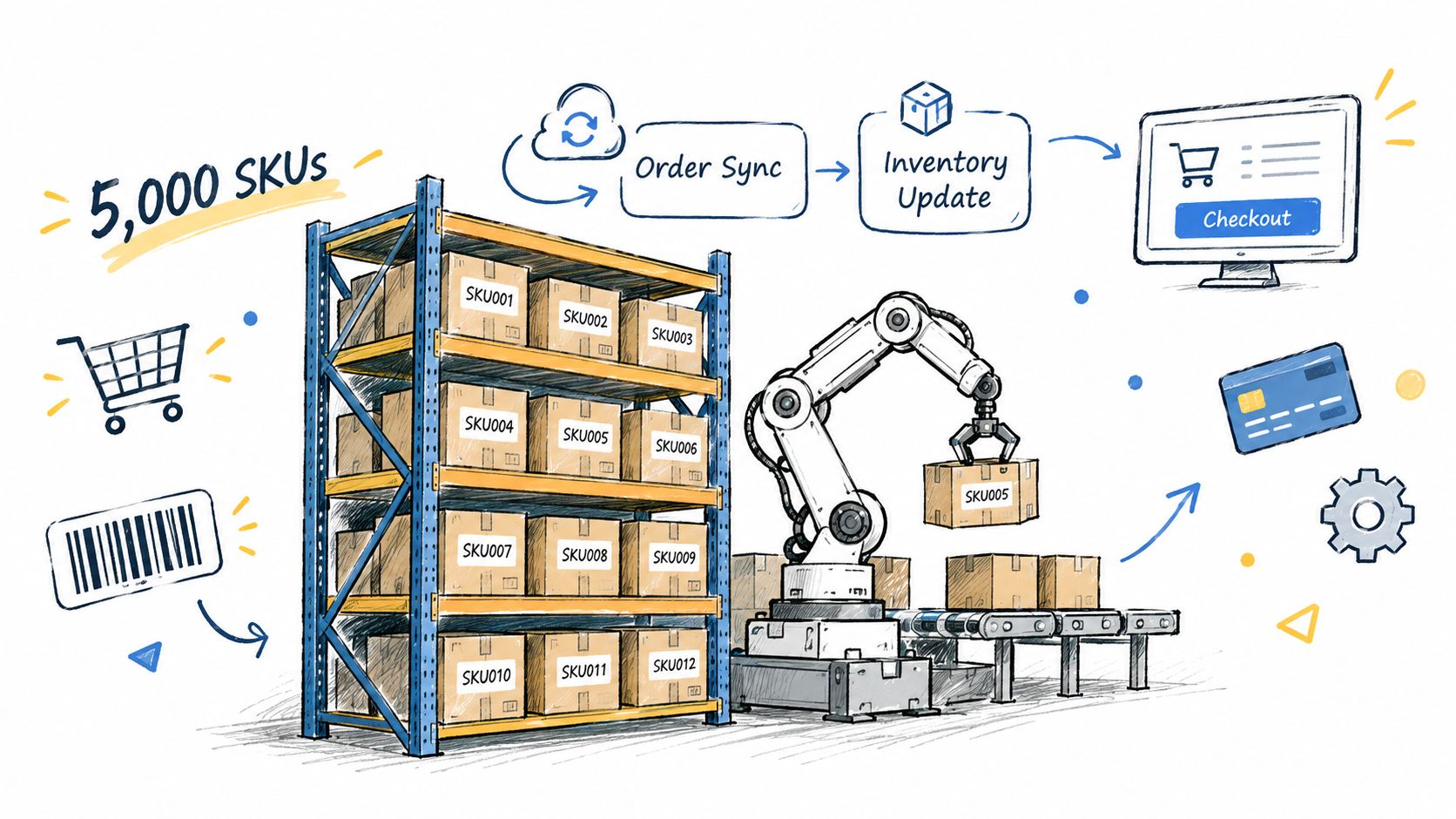
Operational automation also needs to stay connected to physical stock and fulfillment.
Omnichannel retailers need reservation discipline
A retail associate sells an item while a wholesale buyer's draft order is still open. Your platform must distinguish available, reserved, and committed inventory across online, POS, and B2B workflows.
Test concurrent demand and cancellation behavior. A consolidated interface is insufficient if the warehouse still receives contradictory allocation instructions.
Growth teams need constrained campaign execution
Your growth lead wants always-on Meta and Google campaigns to respond to product availability and creative fatigue. Separate creative drafting from campaign publication, budget changes, and bidding adjustments.
The agentic commerce operating model is useful for deciding which actions software should execute on the brand's behalf. Require the vendor to demonstrate each advertising action rather than assuming an integration includes bidding control.
Judge the workflow on approved changes, spend-policy compliance, and attributable outcomes. Don't let an agent declare success using a campaign metric that finance can't reconcile to returned and fulfilled orders.
Implementation Roadmap Without Revenue Risk
No migration is risk-free. Reduce exposure by making every phase conditional on evidence and a named person's approval.
Establish evidence before touching production
Begin with a data audit. Map catalog identifiers, customer identity, inventory states, historical orders, discounts, and payment references. For international operations, include currency, regional tax treatment, consent, and payment differences.
The checkpoint is a reconciled sample covering normal and exceptional transactions. Stop if your team can't explain differences between the old and proposed records.
Move into a sandbox. Build repeatable fixtures for stockouts, subscription retries, partial refunds, promotion conflicts, and payment failures. Include rejected actions, not just successful purchases.
The checkpoint is reproducible results with inspectable logs. Keep production credentials out of this environment.
| Phase | Required evidence | Stop condition |
|---|---|---|
| Data audit | Explained reconciliation results | Unresolved ownership or totals |
| Sandbox | Repeatable policy and transaction tests | Unexplained execution |
| Parallel run | Comparable live inputs and proposed outputs | Material state divergence |
| Cutover | Verified routing and recovery procedure | Failed acceptance checks |
| Agent rollout | Approved action-level evaluation | Policy or recovery failure |
Separate migration from autonomy
During the parallel run, feed live events to the new stack, but keep proposed writes from changing production. Compare totals, reservations, customer matching, and fulfillment instructions before allowing execution.
Use an ecommerce platform migration plan to assign ownership of imports, verification, routing changes, and rollback. Document which system is authoritative throughout the transition.
At controlled cutover, freeze unrelated configuration changes and establish a staffed escalation path. Define when routing returns to the prior system, and how transactions created during the transition will be reconciled.
Only then expand agent permissions. Start with reads and drafts, followed by narrowly authorized execution after policy tests pass.
Release gate: Migrating checkout and granting money-moving agent permissions should be separate approval decisions.
Keep logs and fixtures replayable. When a production issue appears, your team should be able to reproduce the conditions without experimenting on another customer's order.
How to Choose Between Vendors Without the Demo Theater
A polished chatbot can conceal unresolved data ownership. A marketplace slide can hide connector maintenance, and a free tier may exclude the audit features your finance team requires.
Use a weighted scorecard, but don't invent universal weights. Give governance and data integrity the greatest importance for transactional agents; increase the importance of performance when checkout is the migration driver. Treat essential security and financial controls as pass-or-fail gates.
Platform Evaluation Scorecard
| Criterion | What to Ask | Red Flag |
|---|---|---|
| Governance model | Can you demonstrate denied actions, bound approvals, and recovery? | Prompt instructions presented as enforcement |
| Data model unity | Which record owns totals, refunds, reservations, and renewals? | Reconciliation depends on undocumented connectors |
| Performance evidence | Can we inspect checkout tests and payment-path errors? | Front-end speed presented as complete transaction performance |
| Total cost of ownership | What are the platform, payment, usage, integration, and supervision costs? | App replacement savings without transition costs |
| Engineering access and support | Can our developers inspect API contracts, logs, status, and escalation procedures? | Every technical question requires a sales intermediary |
Demand an adversarial demonstration
Bring your own transaction scenarios. Ask the vendor to process a partial refund, retry an interrupted request, reject an unauthorized discount, and explain an inventory conflict. Require written answers when the demonstration can't establish behavior.
Cost deserves equal scrutiny. Retail research reports that 53% of surveyed organizations identified cost as the top barrier to scaling AI analytics, reinforcing the need to evaluate the full operating burden rather than the subscription alone (retail AI adoption challenges).
Include retained apps, connector maintenance, data cleanup, approval workload, and incident response in your model. Consolidation is only valuable if you can retire work and systems.
For customer-facing requirements, Exerta's AI engagement tools for DTC brands can inform a separate engagement shortlist. Evaluate those experiences alongside the transaction platform, not as substitutes for its controls.
What to Decide in the Next 30 Days
Treat the AI ecommerce platform as the place where your team governs data, decisions, and execution together. Don't approve a broad autonomy mandate before assigning responsibility for individual operations.
Take a short decision list into your leadership meeting:
- Initial delegation: Choose the operations agents may handle first, such as catalog analysis and landing-page drafts. Name the owner who accepts their output.
- Approval policy: Define which spending, discount, and messaging actions require human authorization. Put the boundaries in writing before configuring tools.
- Retirement candidate: Select an integration to remove only after the parallel run proves its replacement handles the required exceptions.
- Executive visibility: Choose a launch metric tied to the actual change, such as checkout completion for a checkout migration or reconciliation exceptions for order consolidation.
- Stop authority: Name who can suspend an agent or halt cutover, and give that person access to the relevant evidence.
Leave the meeting with owners, acceptance tests, and a review date. Your next vendor conversation should concern a workflow they must prove, not a feature tour they've already rehearsed.
PlatformDTC offers an enterprise AI commerce platform that brings storefront, checkout, subscriptions, payments, inventory, and analytics together with governed agent APIs. Visit PlatformDTC to review its capabilities against your order scenarios, approval requirements, and parallel-run acceptance tests.