The common advice is simple, insert the chip and the payment is secure. It's also incomplete. A dip doesn't always mean a PIN was checked, a tap doesn't always mean anyone verified the cardholder, and a terminal that falls back to a swipe can undo the protection the chip was built to provide. EMV chip and PIN credit cards work in two separate parts. The chip authenticates the card and the transaction. The cardholder verification method is meant to check the person. Confusing those two jobs is where costly mistakes start, especially for brands that sell at a counter, at a pop-up, and online to the same customer.
Table of Contents
- When a Chip Card Actually Asks for a PIN
- How the Chip Builds a One-Time Code
- Who Pays When Chip Liability Shifted
- Where Card Fraud Goes After the Chip
- Chip Acceptance at a Counter, Pop-Up, and Abroad
- Why a Chip Card Fails or Declines
- Run a Counter and Checkout Test
When a Chip Card Actually Asks for a PIN
EMV chip-and-PIN is the global card standard in which the chip, not the magnetic stripe, authenticates each sale, and the PIN is only one of several ways the cardholder can be verified. Inserting a card does not guarantee a PIN prompt. The issuer sets the preferred verification order on the card, the terminal checks what it supports, and together they settle on one method for that sale.
That flexibility is useful. It's also why the same customer can enter a PIN in one store, sign in another, and tap without any check in a third. As Ingenico's EMV guidance explains, an issuer and terminal can require a PIN, signature, or no cardholder verification for an eligible low-value transaction, and a PIN can be checked online by the issuer or offline by the card chip.
The Decision at the Terminal
Work through the sale in this order. First, is it contact or contactless? A dipped card can use PIN or signature, while a low-value tap may need no check at all. A phone or watch tap works differently again, because the device passcode, fingerprint, or face check happens on the consumer's device before the payment begins.
Second, can the terminal reach the issuer? If it's online, an online PIN travels with the authorization request and the issuer decides if it matches. If connectivity is weak and the card supports it, an offline PIN is checked against a secret held on the chip itself. That distinction matters for travelers, for stores with intermittent connections, and for anyone whose PIN fails abroad. The terminal may be working perfectly while the card's own counter counts down the tries left.
Third, which method did the issuer select? Many US credit cards still prefer signature or no verification on chip transactions. Don't treat that as a malfunction, and don't treat it as PIN security either.
How EMV Cardholder Verification Actually Works
| Method | Typical situation | Who checks | If it fails or is skipped |
|---|---|---|---|
| Online PIN | Contact chip while the terminal is online | Card issuer during authorization | Wrong PIN is declined by the issuer |
| Offline PIN | Contact chip with weak or no issuer connection | Secret on the card chip | Repeated mismatches can block the PIN on the card |
| Consumer-device check | Phone wallet tap with a device passcode or biometric | The phone or watch, not the store PIN pad | Payment does not start until the device unlocks |
| Signature | Many US credit dips where the issuer does not request a PIN | Clerk or stored signature, if collected | A lost card can still be used |
| No cardholder verification | Eligible low-value contactless taps | Nobody at the terminal | Speed is higher and so is lost-card exposure |
| PIN bypass | Terminal allows the prompt to be skipped | The terminal records the skip while network rules assign outcomes | Liability for a later dispute can move to the merchant |
Some terminals permit a limited PIN bypass, letting staff or the customer skip a requested prompt. That keeps a line moving, but bypassing a PIN prompt can affect liability when the sale is disputed later. Turn bypass off unless you have a clear operational reason to keep it.
A dipped card is not automatically PIN-secure. Look at the verification method printed in the payment record before you judge how well the person at the counter was actually checked.
How the Chip Builds a One-Time Code
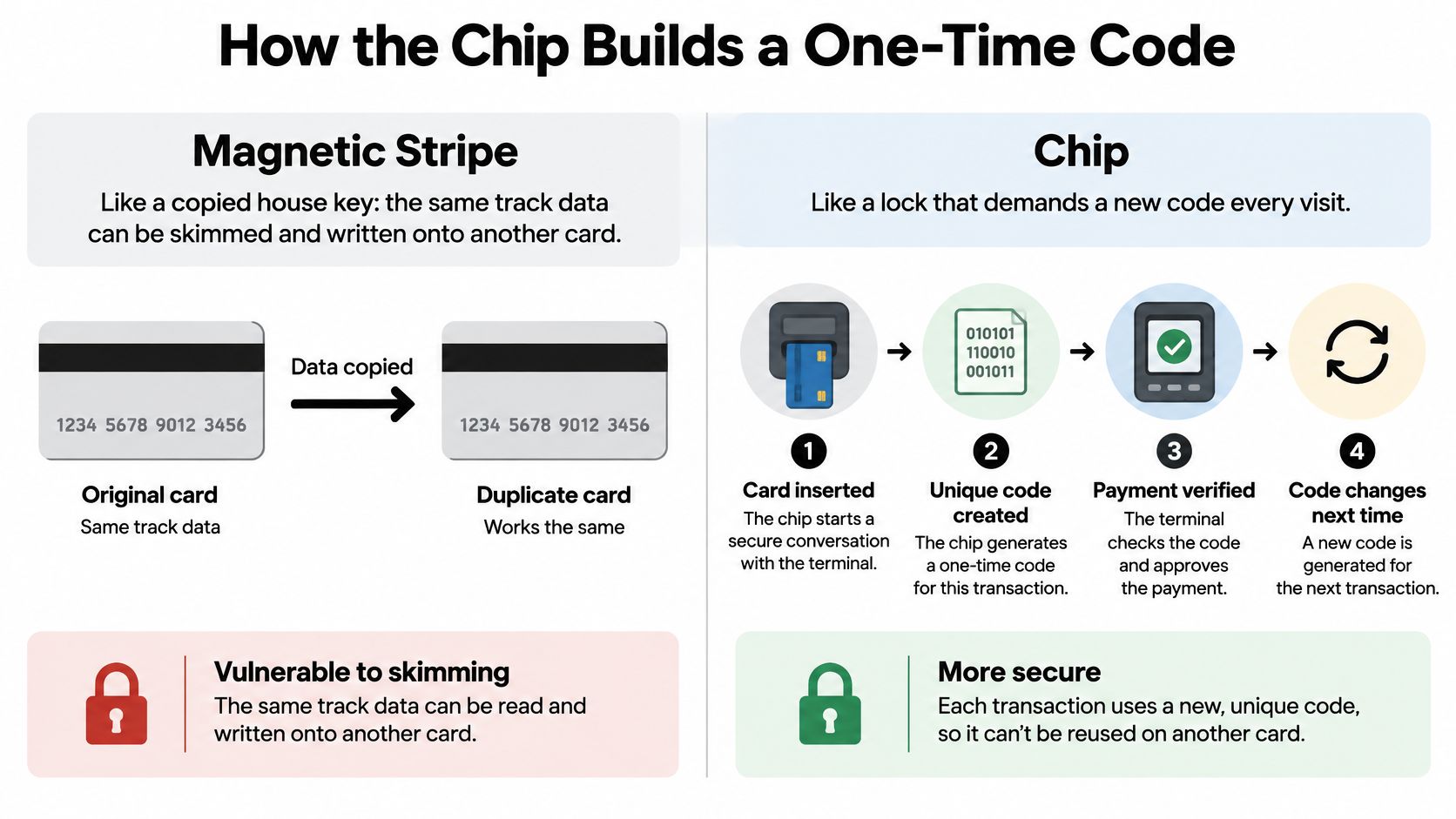
A chip card does not send the same payment data each time it is used. A magnetic stripe works like a copied house key: it carries the same track data on every swipe, so someone who skims it can copy that data onto another card. A chip instead creates a transaction-specific code. The code is not a reusable secret that a counterfeiter can copy and replay.
One Sale Step by Step
A customer inserts a chip card to buy shoes. The terminal and chip establish what kind of transaction is taking place. The ACS EMV technology overview describes how they use inputs such as the amount, currency, terminal data, and an unpredictable transaction number to produce an application cryptogram. The issuer checks that cryptogram during authorization.
The chip combines those inputs with a secret key that stays on the card. Its cryptographic result is tied to that amount, terminal, and moment. The terminal sends the result to the issuer, which checks it using its own related key. If the check succeeds, the issuer can verify that the request came from a genuine chip. If it fails, the transaction may be declined.
A copied card number cannot generate valid future cryptograms without the chip's secret key. Nor can a counterfeiter reuse yesterday's cryptogram for a new purchase at a compliant chip terminal. The code is specific to the transaction, much like a one-use entry code that stops working after its intended visit.
Two Quieter Checks
The main exchange is supported by other checks:
- Offline data authentication: EMV specifications support offline data authentication with public-key cryptography. This lets a terminal check card data when it cannot contact the issuer, such as at a remote counter or transit gate.
- Issuer authentication: The card checks that the authorization response is genuine. This helps prevent a fake terminal or tampered message from falsely telling the chip that payment was approved.
Customers do not see these checks, but the card must remain in the reader while they take place. Pulling it out early can interrupt the exchange before it finishes.
What Retailers Need to Preserve
Choose terminals that prefer chip insertion or a genuine contactless read over magnetic-stripe fallback. Keep the entry mode, chip, contactless, or fallback, in the payment record for each sale. That record gives retailers a way to review how a transaction was accepted, especially when fallback was used.
Practical rule: If the card has a working chip, treat the stripe as the exception, not an equal option. Log every fallback for later review.
Fallback accepts reusable stripe data instead of using the chip's transaction-specific code. Retailers should know when that happened and retain the entry-mode record, so they can examine the circumstances if a payment is disputed.
The protection also has a clear boundary. If a buyer pays online, the chip never meets a terminal, so no chip cryptogram is created. EMV was primarily designed to address counterfeit card-present fraud. Wider chip use can make copied stripe data less useful at chip-enabled counters, but it does not secure online checkout or eliminate fraud.
Who Pays When Chip Liability Shifted
A chip transaction does not automatically mean the cardholder entered a PIN, and it does not make every kind of fraud the merchant's responsibility. Liability depends on what happened at the counter, which verification method the issuer selected, and whether the merchant used chip-capable equipment correctly.
Liability rules followed the technology, market by market. As the Kansas City Fed payments briefing records, by 1994 all French bank cards reportedly carried chips based on a French specification, helping reduce fraud involving counterfeit, lost, and stolen cards. International payment systems began developing common chip specifications in the 1990s. The first EMV specifications were published in 1996, and EMVCo was established in 1999 to manage and maintain the standard.
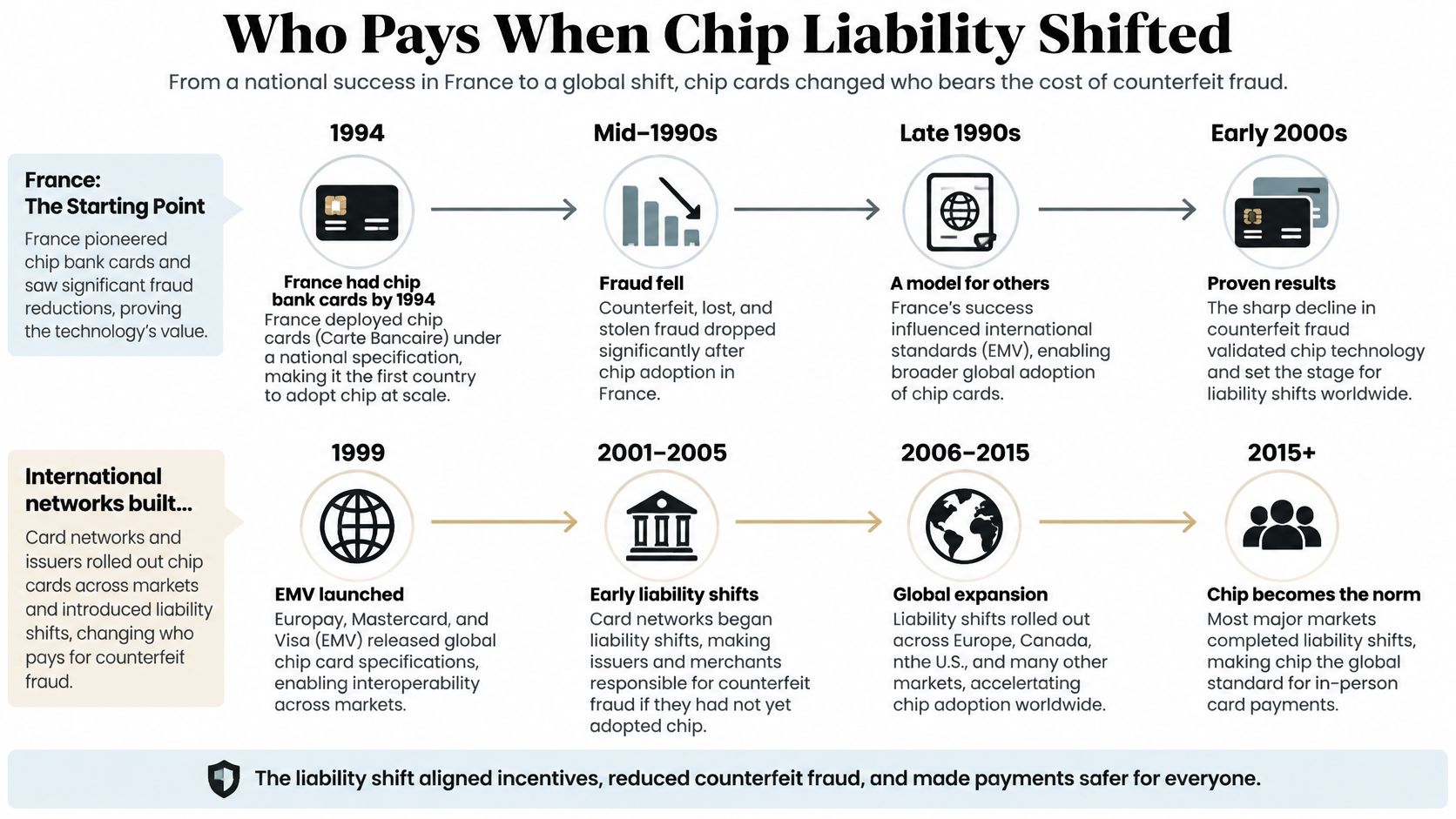
The United States adopted chip payments later than some other markets. Cards were in wallets before chip-ready terminals were common at counters. The October 2015 liability shift changed the financial incentive: merchants could become responsible for certain counterfeit-card losses if they did not support chip transactions. The practical rule is that, for eligible counterfeit losses, the party using the weaker technology at the point of sale may carry the shifted loss.
Four Outcomes at the Counter
- Chip or genuine contactless read succeeds. A counterfeit card cannot produce a valid cryptogram, so the issuer typically keeps the loss when a properly processed chip sale later proves fraudulent.
- Stripe-only terminal accepts a cloned stripe. The merchant may carry the shifted counterfeit loss because chip acceptance could have prevented that transaction.
- Staff force fallback on a chip card. If the chip was available but staff used the stripe, the merchant may be exposed even with an EMV-capable terminal.
- A requested PIN is bypassed. Cardholder verification is a separate issue. Bypassing the requested PIN can affect the dispute outcome.
The PIN path is not universal. The issuer may request a PIN, a signature, or no cardholder check, so a successful chip read alone does not prove that the person presenting the card was verified. Keep the chip, contactless, or fallback indicator and the cryptogram result with the transaction record. When a cardholder asks their bank to review a payment, the resulting card-payment chargeback may turn on those records, not staff recollection.
Counterfeit and Fallback Outcomes After the Chip Liability Shift
| What happened | Fraud type | Typical exposure | What to fix |
|---|---|---|---|
| Chip or genuine contactless read succeeds | Counterfeit plastic | Issuer, because the chip check should fail a clone | Keep terminals certified and chip-first |
| Stripe-only terminal accepts a cloned stripe | Counterfeit plastic | Merchant for the shifted counterfeit loss | Replace or enable chip acceptance |
| Staff force a stripe fallback on a chip card | Counterfeit plastic | Merchant if chip was available but not used | Disable casual fallback and train staff |
| Requested PIN is bypassed | Lost or stolen card | Merchant liability can be affected by the bypass | Turn off unnecessary PIN bypass |
| No PIN requested on a valid chip sale | Lost or stolen card | Issuer rules decide, and EMV alone does not resolve it | Do not treat every dip as PIN-secure |
| Online, phone, or invoice charge | Card-not-present fraud | Outside the in-person chip shift | Use separate online authentication and screening |
The boundary is straightforward. The chip liability shift concerns certain in-person counterfeit losses. It does not cover online, phone, or invoice payments, where no chip is read. Online checkout can present other payment choices too; myhalo's Singapore BNPL guide describes how pay-later purchases are structured. Chip security and remote-payment controls address different parts of the transaction.
Where Card Fraud Goes After the Chip
Chip adoption closes an important route for counterfeit cards, but it does not make card fraud disappear. Fraud shifts toward the gaps: transactions without a PIN check and sales where no chip is read.
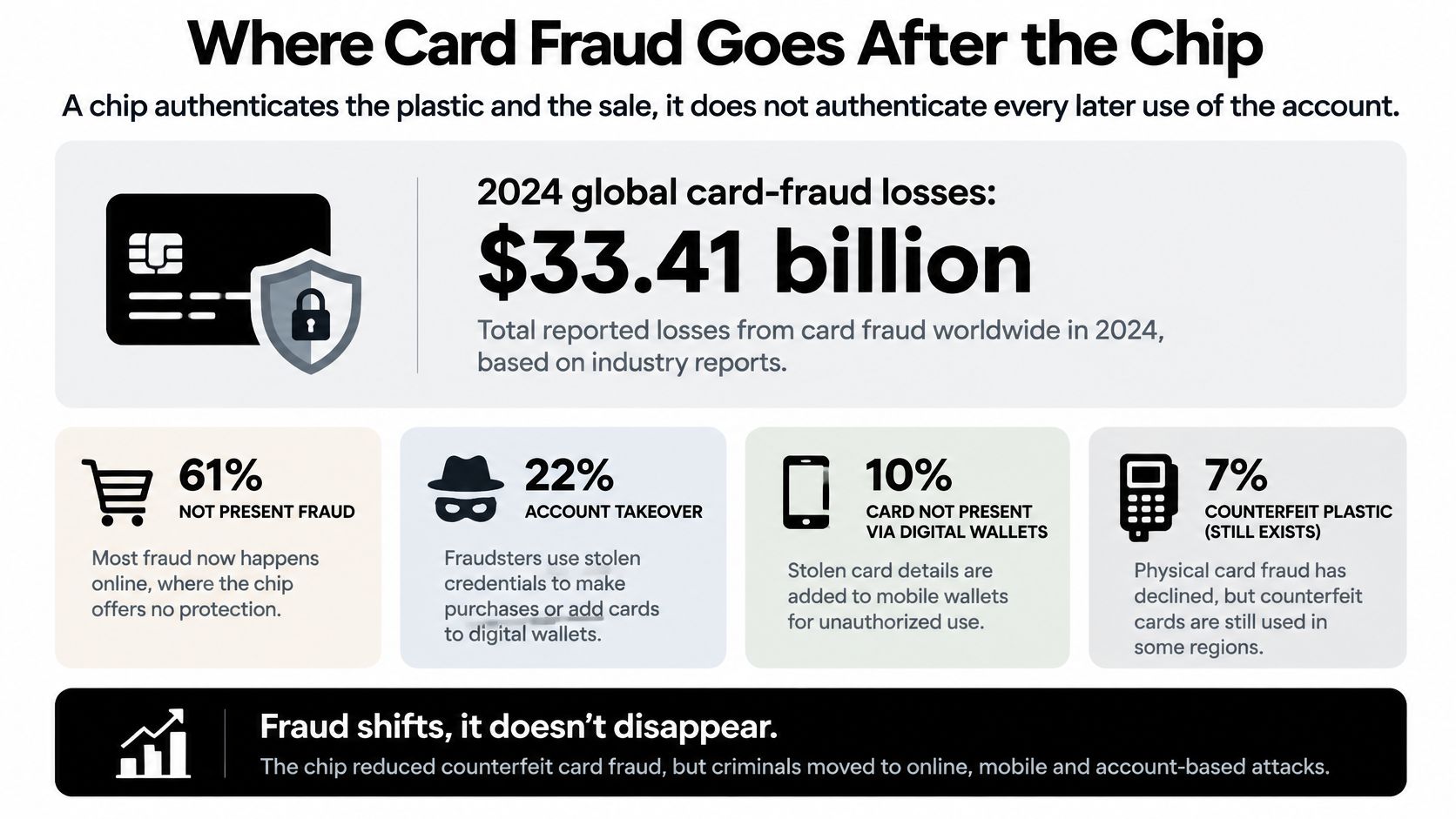
According to the GlobeNewswire release, citing Nilson Report figures, global card-fraud losses totaled $33.41 billion in 2024, equal to 6.43 cents per $100 in card sales. That figure is easier to understand alongside chip adoption: the American Express EMV FAQ reports that EMVCo's latest twelve-month dataset found 97% of card-based transactions were EMV chip. High chip use does not protect transactions where the chip is not read.
The Holes That Remain
- Lost or stolen cards without a PIN check: Issuers choose whether a transaction asks for a PIN, a signature, or no additional check. If the card is accepted without a PIN, a thief holding the genuine card may be able to use it before the owner reports it. A PIN adds a layer of verification; without that check, the cardholder is easier to impersonate.
- Compromised PINs: A stolen or guessed PIN weakens that person-check, even while the chip can still authenticate the card.
- Stripe fallback: Swiping a chip card instead of reading its chip reopens the counterfeit-card route that chip acceptance is meant to close.
- Card-not-present sales: Online, phone, and invoice payments do not read the physical chip. Stolen card details can therefore be used through channels where chip authentication offers no protection.
The shift is from one kind of fraud to another, not from fraud to none. As counterfeit use becomes harder at chip-enabled counters, attackers have more reason to target exceptions and remote sales. Wider chip adoption shifts fraud rather than eliminating it.
Two Channels, Two Locks
Set controls by channel. At a counter, require chip or genuine contactless where available, limit fallback, and record how each sale was entered. Those steps help teams spot repeated exceptions. Online, the chip's authentication does not travel with the card number. Tokenization, authentication, fraud screening, and wallet checks address risks at checkout; dedicated fraud solutions can support those controls.
Ask which channel the sale happens in, and which control applies there. A PIN may help protect a counter transaction, while a remote payment needs its own checks.
Chip Acceptance at a Counter, Pop-Up, and Abroad
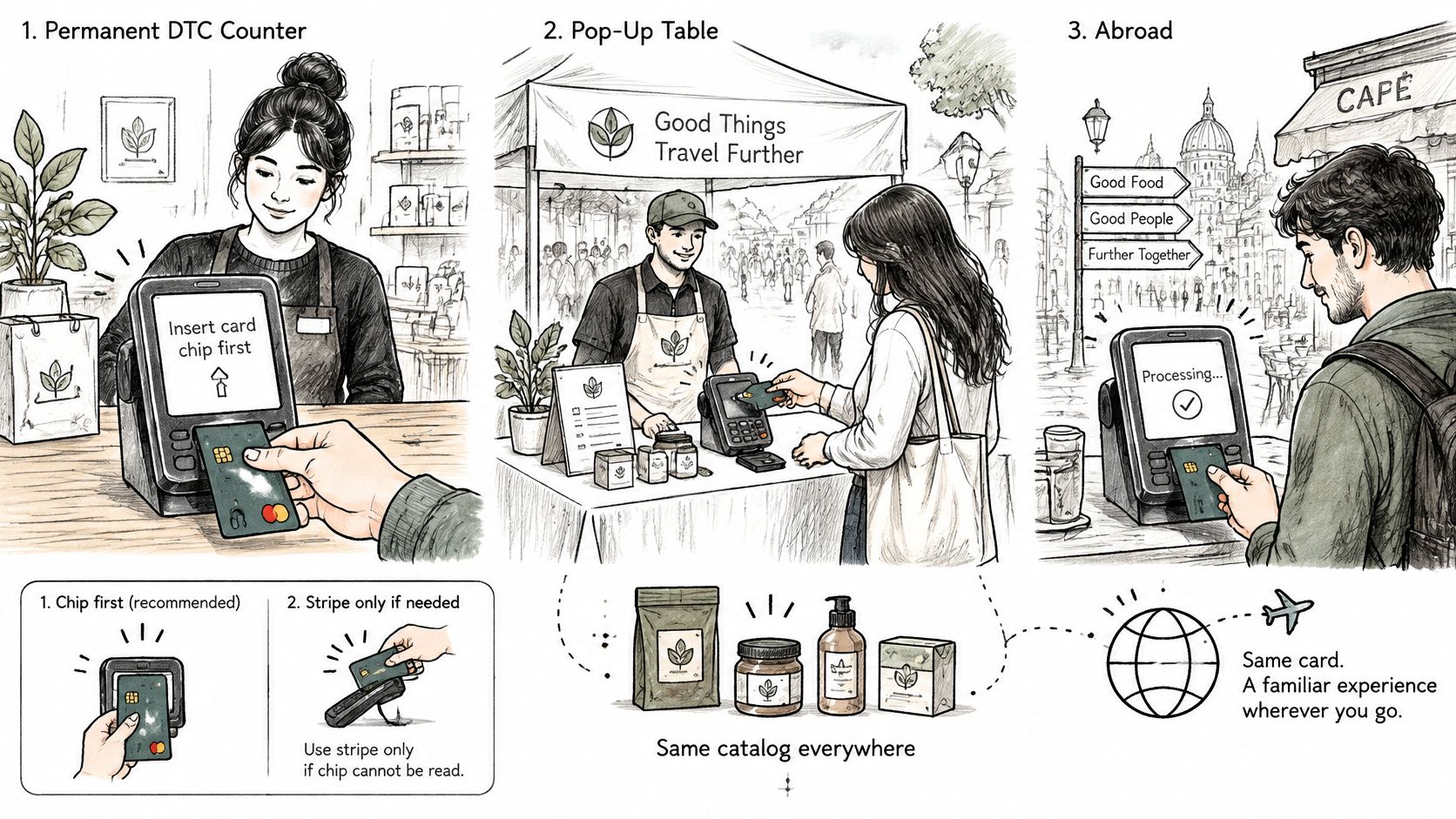
Chip acceptance depends on the terminal, the card, and the setting. A reader can accept a chip without asking for a PIN, and an offline approval still needs to reach the processor later. These three scenes show how staff can keep the process clear.
Three Scenes
A permanent DTC counter. Customers insert contact cards or tap phones and watches. Set the terminal to prompt for chip or contactless before swipe, and let staff follow that same order on every shift. Use the stripe only when the chip cannot be read, and record each fallback. A recurring fallback can point to a reader problem or a habit that needs attention. A POS cashier workflow for retail counters can help staff handle counter sales alongside online orders.
A weekend pop-up. A shared catalog and customer list can connect card-reader sales with website orders. That helps staff identify a customer when handling a return or repeat purchase. The payment method still matters: an in-person chip transaction creates a chip cryptogram, while an online reorder entered by card number does not. Chip protections at the counter do not carry over to that online sale.
A wholesale or travel counter with weak connectivity. A terminal may approve locally using offline data authentication, while the card verifies an offline PIN itself. The sale must upload when the connection returns. Before relying on this path, staff should know which verification methods the terminal supports. A foreign card may have different PIN retry limits or require a method the terminal cannot offer.
The Acceptance Checklist
- Certify the reader for contact and contactless EMV before putting it into service.
- Set chip and contactless ahead of the stripe in the terminal's prompt order.
- Restrict fallback and PIN bypass so staff do not use either by habit.
- Store entry mode and cryptogram results with each order record.
- Test an offline sale and confirm it uploads when the connection returns.
- Train staff to leave the card inserted until the terminal says to remove it.
- Review fallback regularly and address repeat entries by checking the reader and staff routine.
Give customers the same simple instruction at every counter: Dip and leave, or tap. Don't swipe a chip card.
Why a Chip Card Fails or Declines
Most counter failures have a small first check. Work through them in this order before assuming the card or the reader is broken.
1. PIN declined. Stop before you invite another attempt and check how many tries the terminal says remain. Foreign cards can allow fewer attempts than domestic debit, and each retry brings the card closer to blocking its own PIN. Ask for a different card rather than using up the last try on a guess.
2. The terminal asks for a signature where a PIN was expected. That's usually the issuer's chosen verification method, not a reader fault. US credit cards in particular often route this way. Accept it under your store policy, collect the signature properly if you collect one, and make sure the record shows which method ran.
3. An offline sale declines, or approves with an offline PIN. Confirm the terminal supports offline data authentication, and check that the card isn't configured to always go online. After any offline approval, verify the sale uploads on reconnect, because an approved offline transaction that never uploads is money you can't settle.
4. The chip won't read. Clean the reader slot, reseat the card fully, and retry the dip once. Chips with worn or dirty contacts often read on the second attempt when the card is held still. Use the stripe only if your policy allows fallback, and log it every time so the exception stays visible.
- Try a contactless tap as the alternate read before falling back to the stripe.
- Ask for another payment method when the same card fails through both chip paths.
5. An online or phone order declines. The chip isn't involved, so look elsewhere. Check that the customer entered the number correctly in the hosted card fields, review the address verification result, and look at the fraud-screen rules that scored the order. Resubmitting the same details won't change any of those.
Escalation test: If one card keeps failing across methods, hand it back and let the cardholder call the issuer. Repeated retries rarely fix anything, and they can lock the card for the customer's next purchase elsewhere.
Run a Counter and Checkout Test
Run one test pass before every store opening, market, or pop-up season. It takes a few minutes and checks the records you'll rely on in a dispute, not just whether money moves.
- Insert a test chip card and confirm the payment record shows chip entry mode with a stored cryptogram result attached to the order.
- Tap a genuine contactless card and confirm the record shows contactless, because a tap recorded as a dip hides a configuration fault.
- Force a stripe fallback on the chip card and confirm the sale is flagged for the weekly fallback review, not buried among normal transactions.
- Skip a requested PIN prompt where bypass is enabled and confirm the bypass is logged with a reason staff can explain later.
- Place one online test order through the hosted card fields and confirm the full card number isn't stored on your side. On our checkout, card details are entered into Stripe-hosted fields and never reach PlatformDTC servers, and payment processing for PlatformDTC Payments is provided by Stripe, Inc., which is described as a PCI DSS Level 1 service provider.
- Complete one offline sale with the connection down and confirm it uploads and settles when the connection returns.
The Final Check
Confirm every test lands on one order record for the customer, counter and online together. Our POS and brand-site checkout write both kinds of sale to the same record, and the checkout accepts cards, wallets, and pay-later options in one checkout, with fraud checks and dispute answers built in. That single record is what makes this one test pass cover both channels instead of two disconnected ones.
The test isn't whether the terminal beeps. It's whether each sale leaves a record that proves how the card was read and how the cardholder was checked.
If you're setting up chip acceptance across a counter, pop-ups, and your brand site, PlatformDTC runs your POS and checkout on one order record with Stripe-hosted card fields, wallets and pay-later options, and fraud checks built in. Set up chip-first terminals, keep your fallback log clean, and bring your catalog over to sell in person and online without reconciling two systems.