
A commerce cart API has evolved from a simple session helper into a durable commerce data structure that can support up to 10,000,000 carts per project. That scale changes the engineering problem: you're not just storing items, you're operating a system of record for intent, pricing, fulfillment, checkout, and recovery.
The surprising part is that the hardest cart failures rarely come from the POST /cart/items endpoint. They come from retries, stale identity, cross-device handoffs, inconsistent totals, unobservable latency, and agent actions that mutate the same basket more than once. A production cart API must protect the entire path from product selection to payment authorization, not just expose CRUD operations.
Table of Contents
- The Evolution of Commerce Cart APIs
- Cart API Operations Reference
- Implementing Idempotency for Cart Mutations
- Designing Persisted Carts for Cross-Channel Commerce
- Server-Side Versus Client-Side Cart Storage
- Reliable Checkout Handoff from Cart APIs
- Leveraging Cart APIs for Analytics and Operations
- Monitoring Cart API Performance and Latency
- Implementing Best Practices for a DTC Implementation Checklist
The Evolution of Commerce Cart APIs
Early ecommerce carts often lived in browser storage or lightweight server sessions. That model worked for a single storefront and a single device, but it broke down as brands added mobile apps, retail systems, marketplaces, headless frontends, and new checkout surfaces. A cart stopped being temporary browser state and became a shared object that multiple systems needed to read and update safely.
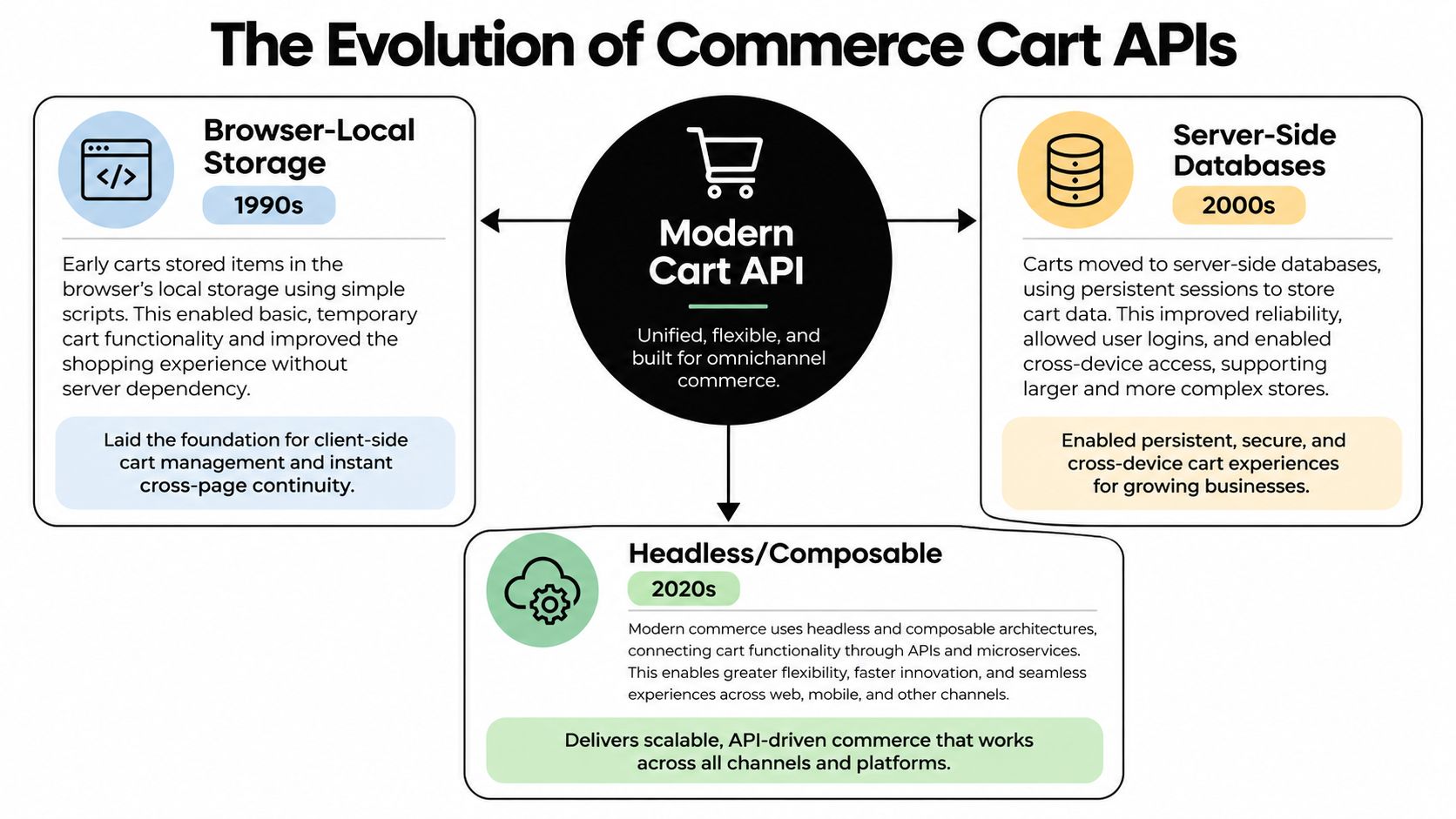
The modern commerce cart API exposes an explicit resource with an identity, lifecycle, line items, discounts, shipping context, tax calculations, and status. The commercetools Cart resource API supports cart creation, retrieval, updates, and deletion across regional endpoints, while documenting a maximum of 10,000,000 carts per project before retention cleanup applies (the commercetools Cart API specification). That isn't the shape of a disposable session helper. It's the shape of durable infrastructure.
The cart is now a shared commerce primitive
For a DTC brand, this distinction matters because the cart often sits between discovery and every downstream operation. The storefront writes to it, pricing services recalculate it, inventory systems validate it, checkout reads it, analytics records it, and recovery workflows query it later.
A well-designed API therefore needs more than familiar HTTP methods. It needs persistence, idempotent mutations, identity-aware access, version control for concurrent updates, and a clear boundary between cart state and payment state. Those capabilities let the same cart survive a browser reset, a mobile-to-desktop transition, or a handoff from an AI shopping surface.
Teams evaluating composable architecture can use these principles alongside broader guidance on API-first commerce strategies. The important question isn't whether a platform has an endpoint called “cart.” It's whether that endpoint remains trustworthy when multiple channels and services act on the same buyer intent.
Cart API Operations Reference
A useful cart contract starts with a small set of predictable operations. The exact paths vary by platform, but the responsibilities should remain clear.
| Operation | Typical method | Primary responsibility | Common use |
|---|---|---|---|
| Create | POST | Establish a cart identity | Start a guest or customer basket |
| Read | GET | Return current authoritative state | Render mini-cart or checkout summary |
| Update | PATCH or PUT | Change cart attributes or contents | Adjust quantity, address, or promotion |
| Delete | DELETE | Remove a cart or cancel its lifecycle | Privacy request or abandoned draft cleanup |
| Merge | Domain action or POST | Reconcile two cart identities | Combine guest and signed-in carts |
Creation should return a stable cart ID and the current representation, not just an empty success response. The response should establish the client's next request context, including currency, region, version, and any server-generated expiration or status fields.
Reading must be authoritative. Don't let a frontend calculate totals from cached product data and treat those figures as final. The cart service should return the line items, effective prices, discounts, shipping choices, taxes, and total it currently accepts.
Updates deserve the strictest contract. A quantity change should identify the line item, express the intended mutation, and return the recalculated cart. If two devices update the same cart, use a version, revision token, or equivalent conflict check rather than letting the last network packet win by default.
Merging is a business operation, not a naïve array concatenation. The server needs rules for duplicate products, incompatible promotions, unavailable inventory, currency differences, and customer-specific pricing. Keep the merge result explainable so support teams can see why a line changed.
For experimentation or frontend decisioning, keep cart mutations separate from test allocation and measurement. Teams that need to connect commerce behavior to testing infrastructure may find the experimentation API endpoints useful as a reference point. A deeper example of commerce resource modeling appears in PlatformDTC's Commerce Layer API guide, but the same design test applies anywhere: every operation should have a clear owner, response shape, failure mode, and retry policy.
Implementing Idempotency for Cart Mutations
A request can fail after the server has completed the mutation but before the client receives the response. The browser retries, a mobile client repeats the tap, or a webhook is delivered again. Without idempotency, one intended action can create duplicate lines, duplicate carts, duplicate captures, or duplicate orders.
Idempotency means the server recognizes repeated attempts as the same business action. The client generates a stable key for that action, sends it with the request, and reuses it for retries. The server stores the key with the result and returns the original status and body when it receives the same operation again.
Checkout.com's published payment API guidance describes this pattern, including retaining idempotency keys for 72 hours and recommending a wait of at least 30 seconds before retrying a failed request (Checkout.com's idempotency guidance). Use those values only where they fit your own risk model, but adopt the underlying discipline.
Make the key represent intent
A key should identify one business action, not one HTTP connection. For example, “add two units of SKU A to cart C” can have a client-generated action ID that survives a timeout and is reused until the server returns a terminal response. A later decision to add another two units must receive a different key.
Store at least:
- The idempotency key, scoped to the merchant and operation.
- The authenticated actor, cart ID, and relevant endpoint.
- A request fingerprint, so the same key can't be reused with a different payload.
- The original response, including validation errors where appropriate.
- A retention state, so old keys don't create unbounded storage.
Payment actions need an even tighter boundary. A cart update can often be retried safely, but authorization, capture, and order creation must share a deliberate transaction model. Don't assume a successful cart mutation proves that a downstream payment action is safe to repeat.
Practical rule: A retry should be boring. If the client can't tell whether the first request succeeded, the second request must not create a second outcome.
Test idempotency under timeouts, duplicate browser events, worker restarts, and webhook redelivery. Also test mismatched payloads using the same key. The API should reject that request rather than treating a different action as if it were the original one. POS integrations face the same failure modes, especially when terminals reconnect, so cart and retail teams should align their mutation model with the patterns described in POS integration API design.
Designing Persisted Carts for Cross-Channel Commerce
Cart identity and shopper identity must remain separate. A guest can own a durable cart without creating an account, while a signed-in customer may have different carts for regional storefronts, retail purchases, or B2B buying contexts. Combining those identities in one field creates security gaps, ambiguous ownership, and difficult merge behavior.

Keep the authoritative cart on the server. The browser should retain only a protected reference, such as a secure, HttpOnly cookie or an equivalent session mechanism. WooCommerce's Store API documentation separates a current cart associated with a visitor or member from a cart addressed directly by ID for administrative or POS workflows (WooCommerce cart API documentation). That separation gives headless implementations a useful model for customer-facing and controlled operational access.
A persisted cart also needs a lifecycle. Define expiration, recovery, archival, and deletion behavior before multiple channels begin writing to the same record. Store the channel, customer or guest context, currency, market, fulfillment location, and price version used for each mutation. Without that context, a cart restored on another device can apply the wrong inventory or commercial rules without warning.
Treat cross-channel transfer as a controlled boundary
Sign-in should trigger a reconciliation process, not an immediate overwrite. Load both carts, verify ownership, and apply an explicit merge policy. Decide how the system handles duplicate products, conflicting promotions, regional inventory, shipping-address changes, and an agent adding an item while the shopper has the cart open elsewhere. Return any resulting conflicts to the client instead of hiding them in a last-write-wins update.
Google's Universal Cart API shows a related boundary. Its CreateCart endpoint supports one-way cart population and remains separate from the Checkout API, which handles payment and the wider purchase lifecycle (Google's Universal Cart API documentation). Treat an external transfer as permission to create or populate a controlled merchant cart. Do not grant the external surface unrestricted mutation rights after the handoff.
Every read and write still requires authorization. A cart ID in a URL proves nothing about ownership. Bind access to the guest session, customer account, channel, or scoped agent credential, and record the actor and source channel for each mutation. PlatformDTC's unified commerce platform design offers a useful enterprise pattern for sharing inventory and customer records across online, retail, and B2B operations without erasing channel boundaries.
Server-Side Versus Client-Side Cart Storage
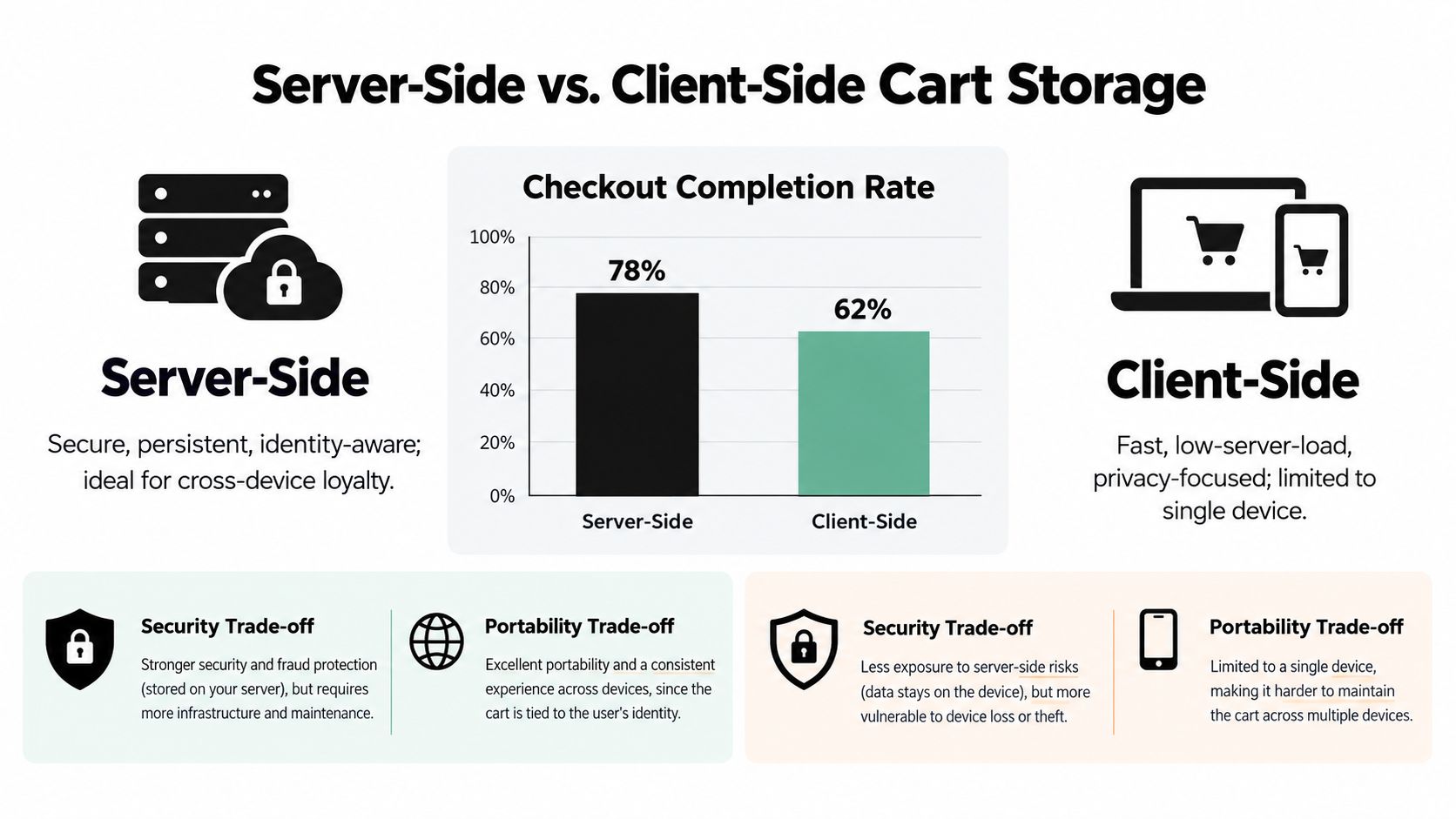
Client-side storage is attractive because it's quick to implement. A browser can keep a compact item list locally, render the cart without a round trip, and continue working when the network is unreliable. That approach fits low-risk prototypes, product configurators that don't represent an order, and experiences where the cart is intentionally limited to one device.
It becomes fragile when the cart controls money or fulfillment. Local storage can disappear, become stale, be copied between environments, or be modified by the client. It also can't reliably carry customer-specific pricing, inventory reservations, tax context, or a cross-device identity.
Choose based on authority, not convenience
| Decision factor | Server-side storage | Client-side storage |
|---|---|---|
| Price authority | Server recalculates | Client may hold stale values |
| Cross-device continuity | Natural fit with identity | Usually limited to one device |
| Offline behavior | Requires a sync strategy | Works locally until reconciliation |
| Security | Sensitive state stays controlled | Client can inspect and alter state |
| Operational visibility | Supports history and auditing | Requires extra event collection |
| Integration effort | Higher initial design cost | Fast initial implementation |
The practical compromise is a server-authoritative cart with an optimistic client cache. The frontend can render immediately from its last known representation, but every meaningful mutation goes to the API. The response replaces the cached state, and a revision mismatch triggers a refresh or conflict flow.
Never trust client totals, discount amounts, shipping quotes, or payment status. The client can suggest a quantity or promotion code, but the server must validate eligibility and calculate the accepted result. This is especially important when agents, POS terminals, and storefronts can all submit mutations.
Client-side storage still has a role. Use it for presentation preferences, unsent form drafts, or a temporary optimistic view. Don't use it as the only source of truth for a cart that can become an order.
Reliable Checkout Handoff from Cart APIs
The cart to checkout transition is where solid implementations often lose context. A shopper clicks checkout, the frontend opens a new session, and the checkout service recalculates from incomplete inputs. That is how you end up with a missing line, a different promotion, an unavailable shipping method, or a total that no longer matches what the shopper reviewed.
Treat checkout initiation as a controlled state transition. The request should carry the cart ID, the current cart revision, channel and region context, customer identity where available, and the intended checkout mode. The checkout service should validate that representation before it creates its own session.
Keep the boundary explicit
A good handoff returns a checkout identifier or a controlled continuation URL. The important part is the boundary, payment authorization stays outside the cart operation, while the checkout flow continues with a populated cart and merchant-controlled pricing, tax, shipping, and order creation. PlatformDTC's enterprise patterns follow this split because it reduces accidental drift between storefront state and the amount that gets charged.
At handoff time, validate the cart status, revision, line items, promotions, fulfillment options, and identity. The cart must still be eligible for checkout, the checkout must start from the representation the shopper saw, and the fulfillment rules still need to match the shipping context. If any of those checks fail, return a structured explanation instead of forcing the shopper into a broken payment path.
A useful production rule is simple. Never copy cart totals into a payment request as trusted values. Pass the cart or checkout reference and let the authoritative service resolve the payable amount. If the amount changes, surface the reason clearly and require the shopper or authorized agent to accept the revised state.
For agent-mediated flows, add a human approval boundary before irreversible payment actions. The agent can assemble and revise the cart, but the system should record the user's consent, the approved scope, and the final cart representation used for payment. That audit trail matters when support teams need to explain why a checkout diverged from the original cart.
Leveraging Cart APIs for Analytics and Operations
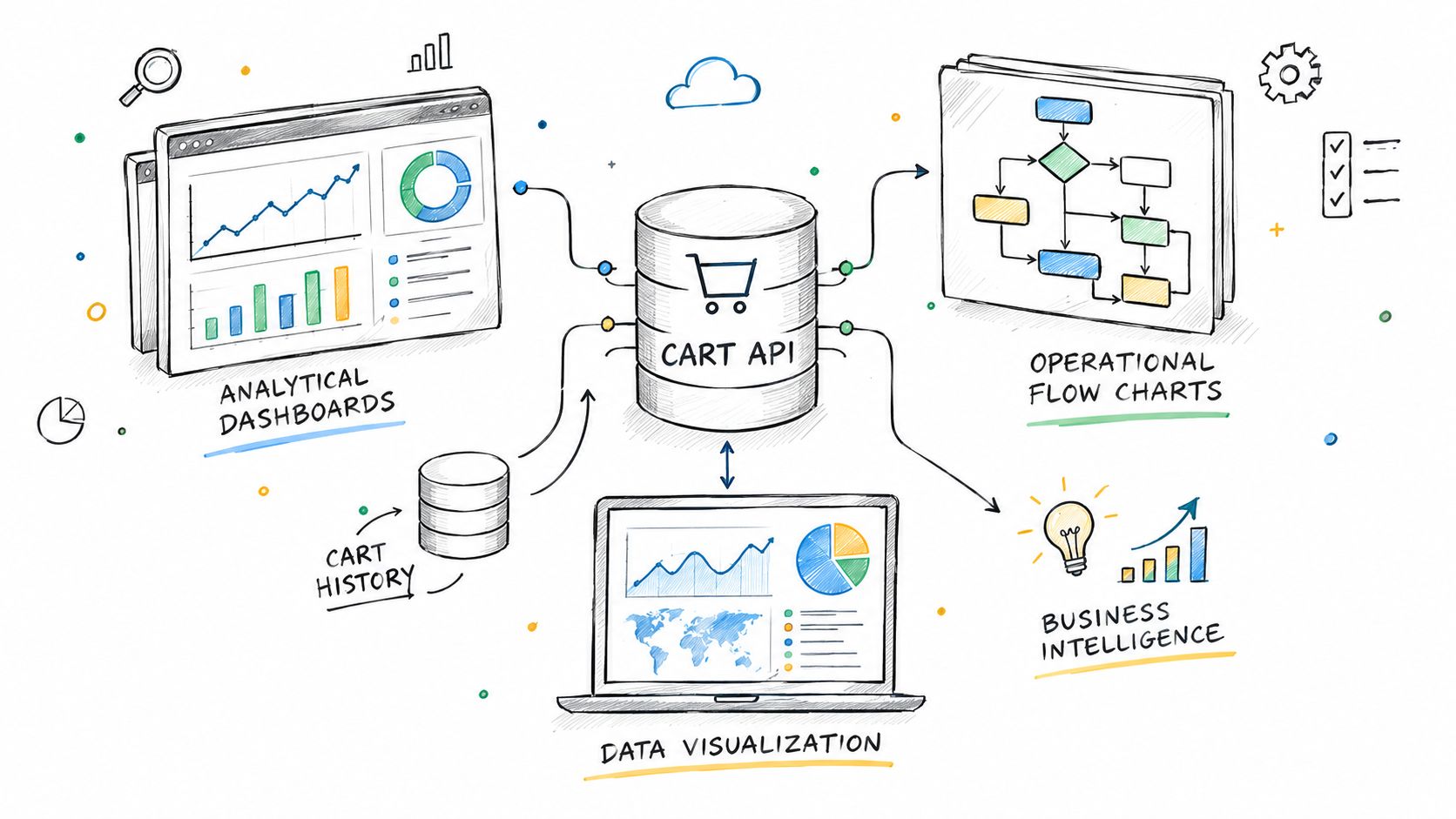
A cart API is also a behavioral data layer. It captures intent before an order exists, which makes it useful for recovery, merchandising, funnel analysis, and customer support. The operational risk is simple. If teams treat carts as disposable state, they lose the history needed to explain what happened and why.
Commerce Layer's Metrics API documents cart history beginning August 1, 2022, with queries for carts in draft or pending status (Commerce Layer's cart metrics reference). That kind of history gives operators a view into pre-order behavior instead of only completed transactions.
Build useful events, not just logs
Record cart created, line added, line removed, quantity changed, promotion applied, shipping selected, checkout started, and cart converted. Include the actor, channel, region, cart revision, and failure reason. Keep payment credentials and unnecessary personal data out of analytics payloads.
That event stream lets operations teams answer practical questions:
- Which carts are blocked by inventory rather than shopper hesitation?
- Which promotions apply cleanly but fail during checkout?
- Which channel creates the most conflicting updates?
- Which cart errors correlate with support contacts?
- Which API failures leave carts in an ambiguous state?
Recovery workflows should query cart status and last activity through a defined policy, not scan arbitrary frontend events. Merchandising teams can use recurring cart composition to identify products often considered together, while engineers can trace mutation failures back to broken integrations.
The same data supports reliability work. Request counts, response times, response-time distributions, and non-success response rates are the daily measures commerce platforms already expose for production monitoring. Treat cart telemetry as part of revenue operations, with retention, access control, and clear ownership.
Monitoring Cart API Performance and Latency
Cart performance should be measured from the shopper's point of view, not only by database throughput. Track time to first byte, end-to-end mutation time, regional latency, error rate, timeout rate, retry rate, and cache hit behavior. Separate reads from writes because a fast cart summary doesn't prove that quantity changes or checkout initiation are healthy.
Independent performance analysis notes that every 100 milliseconds of latency has historically been associated with roughly a 1% sales impact, while edge-caching commentary describes cross-continental TTFB moving from roughly 200 to 350 milliseconds to about 30 to 80 milliseconds on a cache hit (analysis of API latency and sales impact). Treat those figures as cited external observations, not as a universal forecast for your store.
Measure the path users actually take
Instrument the sequence from cart open to mutation response to checkout handoff. Slice results by geography, device, channel, cart size, authentication state, and cache outcome. A healthy average can conceal slow regions or a small group of shoppers who repeatedly retry requests.
Cache only data that can tolerate it. Product metadata and non-sensitive cart summaries may be suitable for carefully controlled edge strategies, but personalized totals, inventory decisions, discount eligibility, and payment state require authoritative validation. Always invalidate or bypass cached representations after a mutation.
Set alerts for rising p95 latency, repeated revision conflicts, idempotency-key mismatches, and checkout handoff failures. The goal isn't raw CRUD speed. It's a cart that responds quickly, reports its state clearly, and fails in a way the shopper and the operations team can recover from.
Implementing Best Practices for a DTC Implementation Checklist
A production-ready commerce cart API is less about adding endpoints and more about assigning authority at every transition. Before launch, walk through the system with engineering, support, payments, merchandising, and lifecycle teams. Each group sees a different failure mode.
Contract and identity
- Define the resource: Document cart status, ownership, region, currency, line-item identity, revisions, and retention behavior.
- Separate actors: Distinguish guest sessions, customer accounts, POS users, internal operators, and AI agents.
- Specify merges: Decide how duplicate lines, promotions, inventory, and customer pricing reconcile.
- Protect references: Treat cart IDs as identifiers, not authorization tokens.
Mutation safety
- Require idempotency: Use stable keys for retries and reject payload changes under an existing key.
- Handle concurrency: Return a conflict when the submitted revision is stale rather than overwriting another channel without notice.
- Record reasons: Store who changed the cart, what changed, and why the operation failed.
- Test interruption: Simulate timeouts, browser double-clicks, worker restarts, webhook redelivery, and terminal reconnection.
Checkout and payment
- Validate at handoff: Recheck inventory, pricing, discounts, tax, shipping, identity, and cart revision.
- Keep payment separate: A cart update must not imply authorization or capture.
- Use controlled continuation: Return a checkout reference or continuation URL that preserves the accepted cart context.
- Add approval gates: Require explicit consent before an agent performs an irreversible purchase action.
Observability and operations
- Track user-visible latency: Measure reads, writes, checkout creation, and regional behavior separately.
- Monitor stale state: Alert on revision conflicts, repeated retries, and carts stuck between lifecycle states.
- Retain useful history: Keep draft, pending, abandoned, and converted events available to authorized analytics and support workflows.
- Document recovery: Give operators a safe way to inspect, replay, cancel, or repair a failed cart action.
For teams that want these controls in one operating model, PlatformDTC provides governed commerce APIs and agent tools for creating, reading, updating, and canceling carts, with scoped access, idempotent writes, approval gates, and audit trails. Evaluate that approach against your current stack, especially if storefront, POS, inventory, checkout, and agent workflows currently maintain separate records.
The final test is simple: disconnect the client after the server receives a mutation, retry the request, sign in from another device, change the same cart from a retail channel, and initiate checkout while a promotion expires. If the resulting state is explainable, recoverable, and correctly authorized, your cart API is ready for production. If it isn't, more frontend polish won't solve the underlying risk.
Review your current cart contract against the checklist, then test retries, cross-device merges, checkout handoffs, and regional latency before adding another sales channel. PlatformDTC brings storefront, checkout, payments, POS, inventory, fulfillment, analytics, and governed agent actions into one commerce operating model, so visit PlatformDTC to assess whether it fits your implementation roadmap.