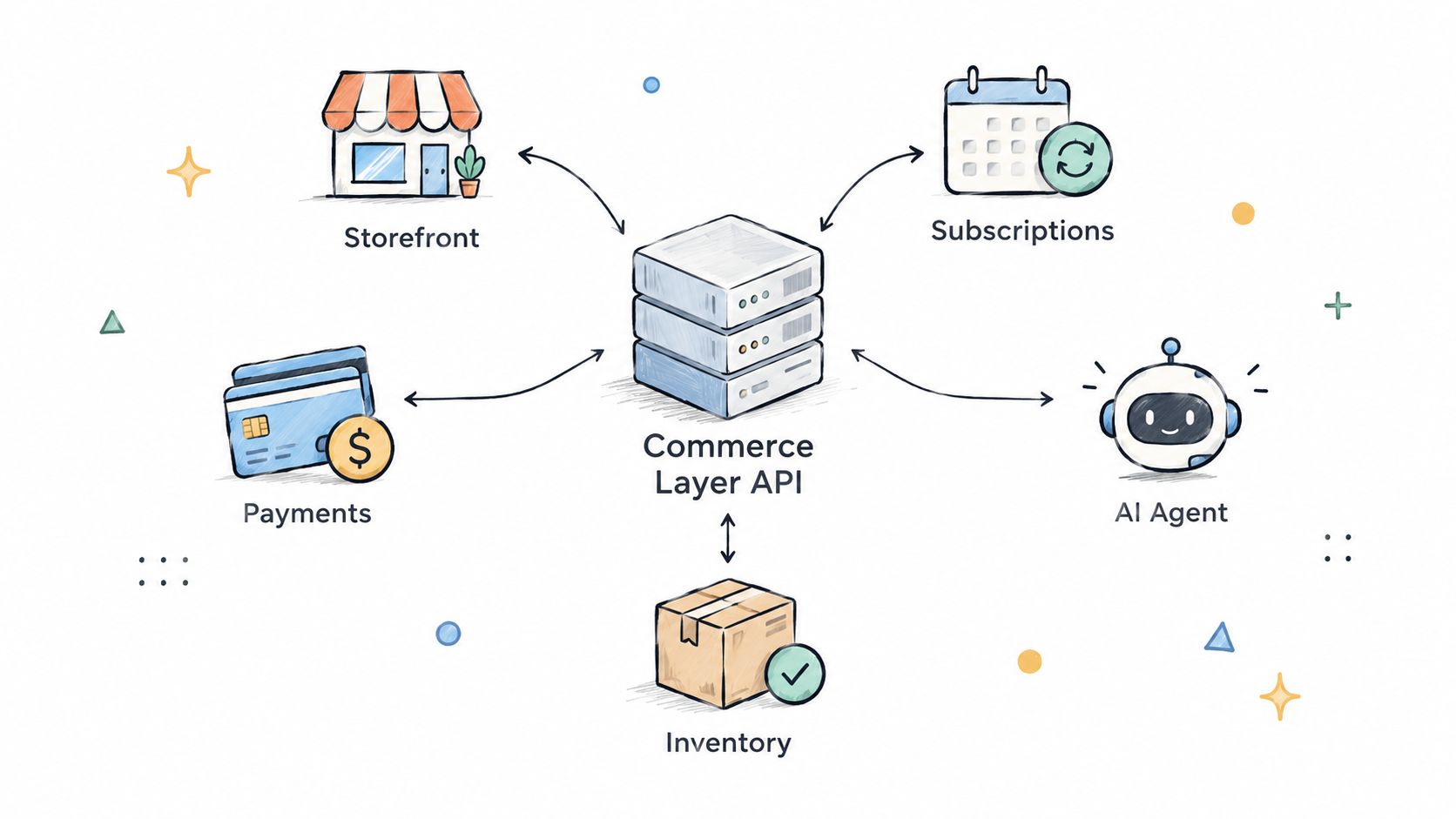
The Commerce Layer API serves as both a transactional and analytical control plane for direct-to-consumer commerce. It ties together storefronts, orders, payments, subscriptions, inventory, and reporting through governed resources, giving applications and AI agents a single operational interface they can actually rely on.
Table of Contents
- Defining the Commerce Layer API Architecture
- Use Resources as the Core Building Blocks
- Connect Architecture to Integration Choices
- Find the Right Aggregation
- Apply Metrics to Commerce Records
- Build Reliable Dashboards
- Map Each Transaction to One Lifecycle
- Prevent Drift with Controlled Writes
- Sync External Systems Safely
- Scope Access by Job
- Add Approval Gates
- Make Mutations Idempotent
- Set Practical Performance Targets
- Serve Checkout Close to Customers
- Measure What Actually Happens in Production
- Manage Subscription Renewals
- Build B2B Draft Orders
- Validate Wholesale Pricing
- Orchestrate Atomic Commerce Calls
- Prepare Data Before Importing
- Import in Safe Batches
- Run Both Systems in Parallel
- Cut Over With a Rollback
Defining the Commerce Layer API Architecture
A Commerce Layer API goes well beyond a basic set of CRUD endpoints. In a modern headless stack, it functions as the system of record for commerce events while also surfacing the metrics and controls needed to manage them day to day.
Rather than locking teams into a tightly coupled commerce suite, this architecture breaks things into modular services that share one consistent data model. A storefront creates an order, a subscription engine schedules a renewal, and an analytics dashboard queries the resulting records—no separate copies, no sync headaches.
Here are the four functional domains that carry the weight:
| Domain | Primary Role | Practical Example |
|---|---|---|
| Transactional endpoints | Create and update commerce records | Reserve inventory or authorize a payment |
| Metric queries | Return operational statistics | Calculate average order value |
| Administrative controls | Govern access and automation | Scope an agent key to catalog updates |
| Unified data model | Connect records across channels | Reconcile online and POS orders |
The real value shows up when you consider what happens without it. Fragmented app stacks tend to duplicate inventory, customer, discount, and attribution data across every tool. Each duplicate is a chance for drift. A shared API model lets every channel read from and write to the same governed record instead.
The test is straightforward: can the API handle the transaction, explain the result, and control who has permission to change it?
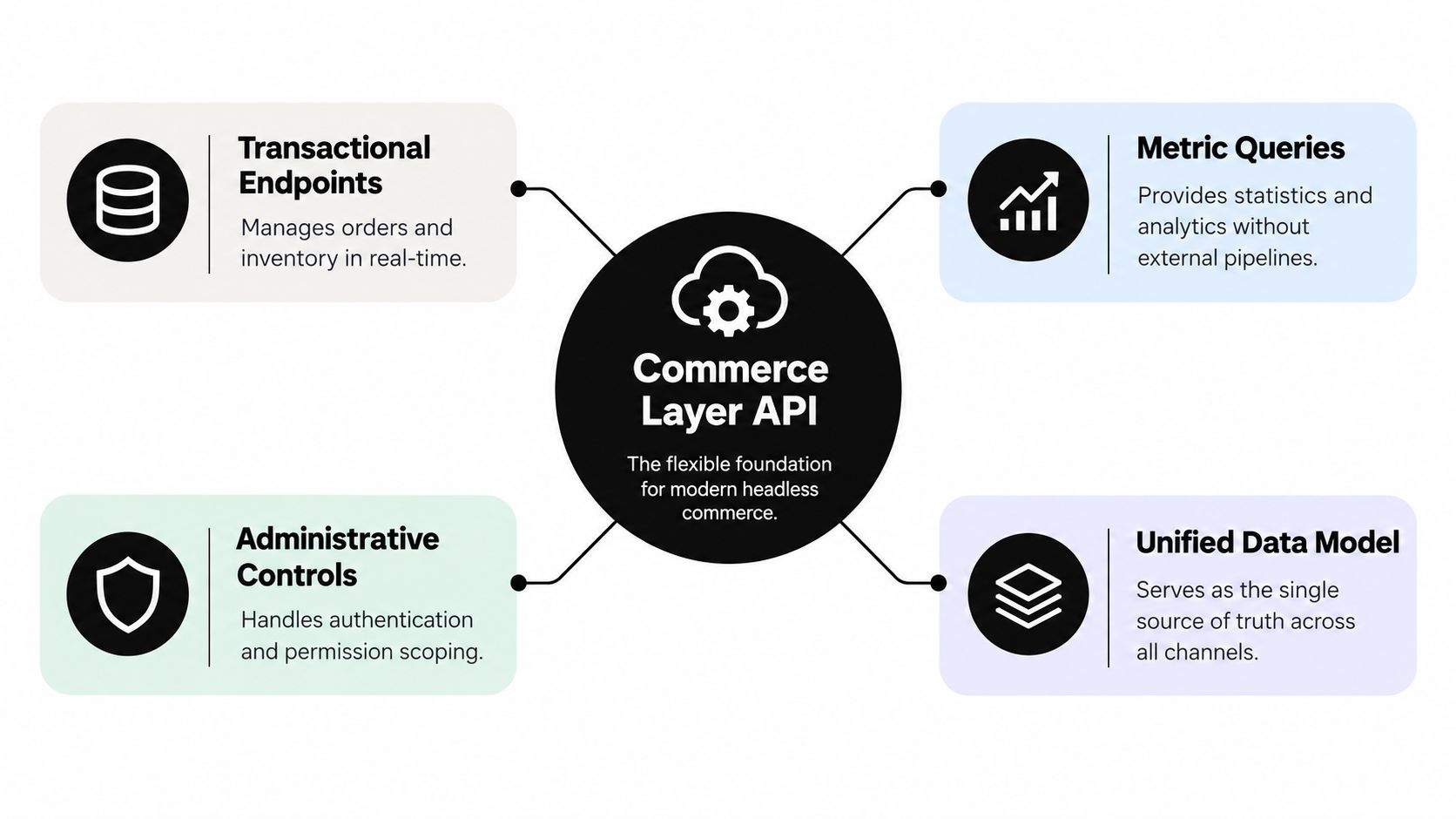
This diagram maps how transactions, metrics, administration, and the unified model connect within the Commerce Layer API.
Use Resources as the Core Building Blocks
Resources represent the actual business objects you work with: orders, line items, customers, SKUs, inventory, shipments, returns, payments, and subscriptions. Relationships between these resources preserve context, so a refund stays linked to its order and payment rather than floating around as an isolated financial event.
Walk through a typical checkout flow:
- Create or retrieve a customer record.
- Add line items to an order.
- Check inventory availability and shipping options.
- Authorize the payment.
- Submit the order and trigger fulfillment.
Every step can be audited and validated against permissions. That matters especially when an AI agent handles merchandising or operational tasks. An agent updating a product description, for instance, has no business seeing raw payment data—and the resource model enforces that boundary.
Connect Architecture to Integration Choices
The same model handles online, B2B, subscription, and in-person workflows without forcing teams to maintain separate systems. If physical retail is part of the picture, read the guide to POS integration APIs to understand how channel events connect with shared order records.
For a broader architectural reference, find the Clearcote architecture docs. In practice, the strongest commerce layer design combines transactional accuracy, measurable queries, and narrowly scoped administrative controls—letting applications evolve without spawning competing ledgers.
A Commerce Layer API should report on commerce records as directly as it creates them. Metric resources provide numeric summaries from orders, returns, customers, or line items, allowing dashboards and operational tools to query current data without maintaining a separate extraction pipeline.
Find the Right Aggregation
Most analytics requests fit four practical query families, each answering a different operational question while using the same authenticated API context as transactional calls.
- Count measures record volume, such as completed orders or approved returns.
- Minimum identifies the lowest value, useful for finding the smallest order total.
- Maximum identifies the highest value, helping teams monitor unusually large purchases.
- Average summarizes typical performance, such as average order value.
- Sum totals a numeric field, such as gross order revenue or refunded amounts.
A request might conceptually target completed orders and aggregate their totals:
GET /orders/metrics?filter[status]=completed&metric[total]=sum
The exact path and parameter names depend on the implementation, but the pattern is consistent: select a resource, apply filters, choose a field, and return a numeric result. For additional context on how metric endpoints can be structured, review the SourceLoop metrics API.
Quick rule: filter first, aggregate second. A sum across every order is rarely as useful as a sum limited to a market, date range, status, or sales channel.
Apply Metrics to Commerce Records
Order metrics are the most familiar example, but the same design works across related resources. A finance dashboard could request the sum of captured totals, while a merchandising tool could calculate the average line-item price for a collection.
For returns, count returned orders by reason, sum refund amounts, or compare maximum refund values during a selected period. Because these records share the unified model described in the architecture section, the result can align with the same order, payment, and customer relationships used by operational workflows.
| Business question | Resource | Metric pattern |
|---|---|---|
| How many orders shipped? | Orders | Count filtered by status |
| What is typical basket value? | Orders | Average of order total |
| How much was refunded? | Returns | Sum of refund amount |
| What is the largest purchase? | Orders | Maximum of order total |
Use stable filters for reproducible reporting. For example, define whether revenue means submitted, paid, captured, or fulfilled orders before comparing results across dashboards.
Build Reliable Dashboards
The main advantage of metric queries is consistent authentication and authorization. A finance service can receive permission to read order and payment summaries without gaining authority to create refunds, while an AI agent can inspect sales totals without accessing sensitive customer fields.
Cache slowly changing summaries, but request fast-moving figures close to decision time. Store the query definition, filter window, and retrieval timestamp so a dashboard user can explain why two reports differ.
For practical planning, explore our analytics guide for commerce teams, which connects operational measurement with broader reporting workflows. Also handle empty result sets explicitly, distinguish zero from missing data, and document currency and timezone assumptions.
Finally, metric APIs are useful inputs for automation. An agent might compare today's average order value with a configured threshold, recommend a merchandising change, and request approval before acting. The metric itself does not replace governance, but it gives the workflow quantitative context grounded in the same records that control commerce operations.
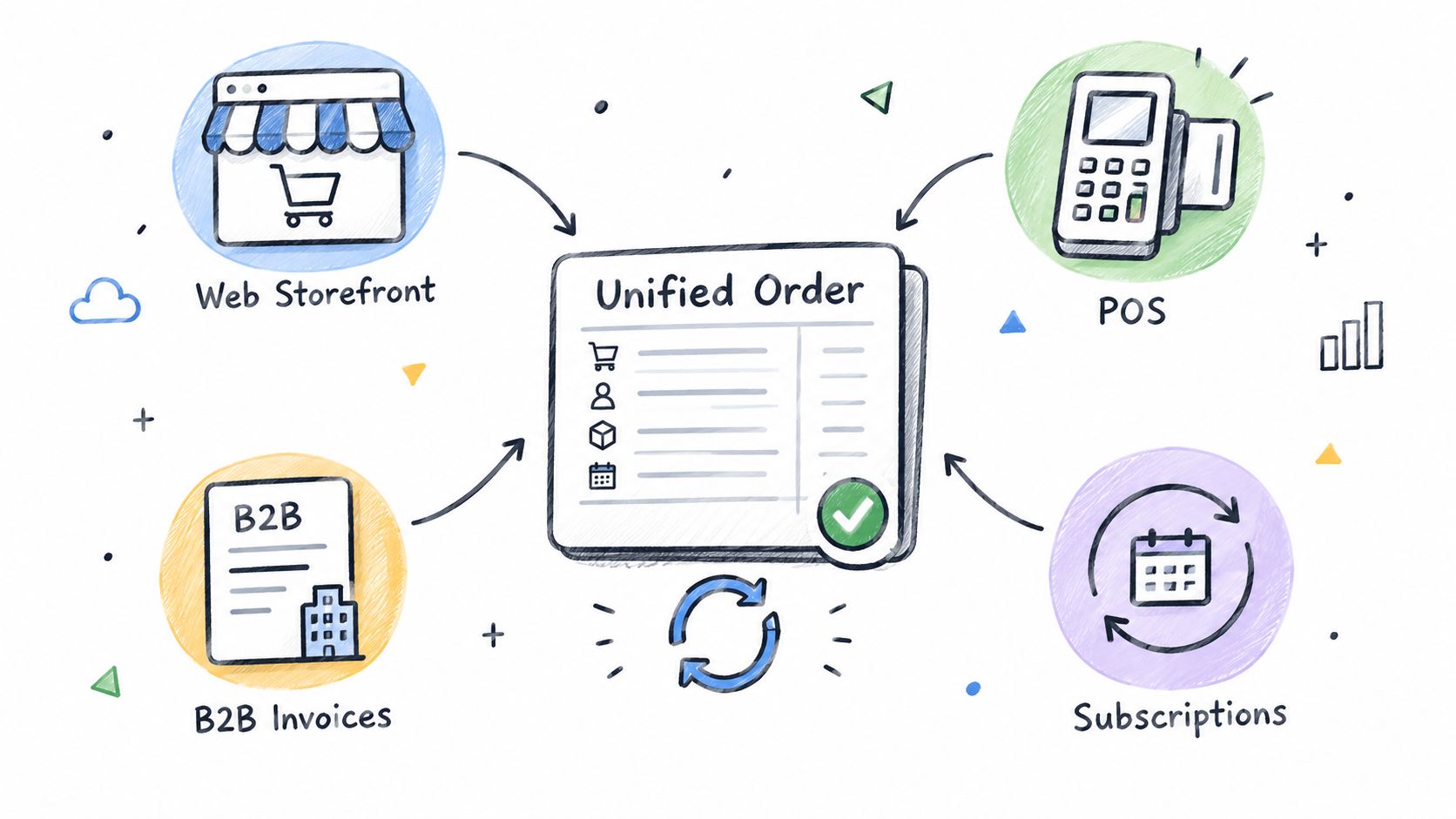
A Commerce Layer API gives every sales channel a shared order model instead of letting each application build its own version of the truth. Online checkouts, POS purchases, B2B drafts, and subscription renewals stay connected through common customer, line-item, payment, inventory, fulfillment, and return relationships.
This structure matters most when a brand operates across channels. A warehouse shouldn't see one inventory balance in the storefront and another in a retail application. The authoritative order record works as a central ledger, while connected systems consume approved events and updates.
Map Each Transaction to One Lifecycle
A unified record can start as a draft, gain line items, reserve inventory, receive payment authorization, and move toward fulfillment. A subscription renewal generates a related order without introducing a separate accounting path.
Use the same model for:
- Online purchases — checkout, payment, shipment, and returns.
- POS transactions — cash or card sales linked to customer history.
- B2B draft orders — negotiated prices, invoices, and approval steps.
- Subscription renewals — retries, captures, and recurring fulfillment.
Picture this: a customer buys a product in-store after ordering online last week. The POS application pulls the existing customer and inventory context, creates the transaction through the commerce layer, and preserves attribution — no manual record merging required afterward.
The API's modular design reflects a broader shift away from monolithic commerce suites toward API-first stacks where components can be measured and evolved independently. Commerce Layer claims more than 400 API endpoints with an average response time under 90 milliseconds, a useful benchmark that shows latency matters just as much as features. Check the Commerce Layer API benchmarks.
Prevent Drift with Controlled Writes
Consistency isn't just about shared tables. Applications need to write safely too, especially when traffic spikes or a network retry fires the same request twice.
Idempotent writes tie a client-generated key to a mutation. Submit the same create-order request twice, and the API returns the original result instead of creating a duplicate sale. Constrained permissions add another layer by restricting which service can touch inventory, prices, refunds, or customer data.
Here's a practical checkout sequence:
- Create or retrieve the customer.
- Create the order and add line items.
- Validate inventory, promotions, shipping, and payment.
- Submit the order with an idempotency key.
- Record the returned identifier for downstream processing.
Sync External Systems Safely
An ERP or CRM should typically act as a consumer of the commerce ledger, not a competing authority. Publish order events or run incremental synchronization using stable identifiers, timestamps, and version checks.
| System | Recommended Role |
|---|---|
| Commerce Layer | Authoritative order and inventory records |
| ERP | Finance, purchasing, and fulfillment execution |
| CRM | Customer profiles, service history, and segmentation |
When an ERP update fails, retry the integration without recreating the order. Store the source identifier, event status, and last successful cursor, then reconcile exceptions from a review queue. This approach keeps external tools useful without letting partial synchronization corrupt the original transaction.
Operational rule: write commerce facts once, then distribute them through traceable, repeatable integrations.
Before peak traffic hits, test duplicate requests, delayed webhooks, stock contention, and offline POS recovery. Compare order totals and inventory movements across channels, and set alerts for mismatched identifiers. That kind of preparation turns the unified model from a design principle into something that actually holds up under daily pressure.
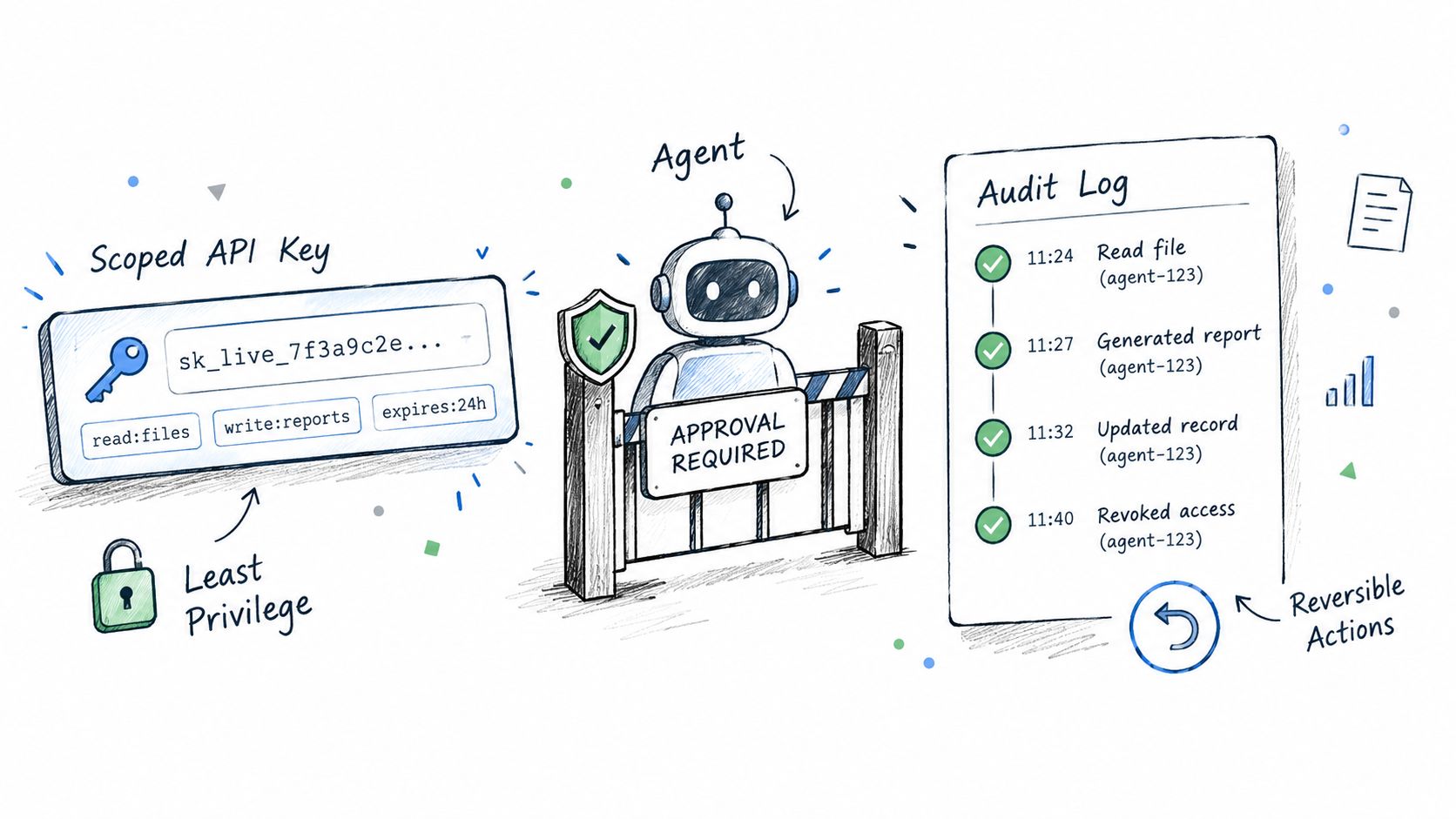
A secure Commerce Layer API treats every application, service, and AI agent as a distinct actor. Authentication proves identity, while authorization determines which resources that actor may read or change. Keeping those two decisions separate stops a merchandising agent from accidentally accessing payment details just because both functions happen to touch the same API.
Scope Access by Job
Issue short-lived tokens or narrowly scoped keys for each integration rather than handing out one permanent credential that spans the entire stack. A page-building agent probably needs catalog, content, and inventory availability permissions. It does not need to capture payments, export customer lists, or issue refunds.
Here's what a practical permission matrix might look like:
| Actor | Read Access | Write Access | Restricted Actions |
|---|---|---|---|
| Storefront | Catalog, availability | Cart and order creation | Refunds |
| Merchandising agent | Catalog, metrics | Product content, campaigns | Customer data |
| Finance service | Order summaries, payments | Reconciliation notes | Catalog changes |
| Operations agent | Orders, inventory, fulfillment | Shipment updates | Payment credentials |
This is least privilege made concrete. If an agent only needs to adjust a campaign budget, grant exactly that action and nothing wider. Review keys on a regular cadence, expire credentials that aren't being used, and rotate them without knocking other services offline.
Security rule: an automated actor should receive the minimum permission required for one defined task, not the maximum permission available.
Add Approval Gates
Permissions cover a lot of ground, but they don't solve every business risk on their own. Place human approval in front of irreversible or financially significant mutations - high-value discounts, refunds, bulk price changes, or campaign spending that crosses a defined threshold.
Picture an agent that drafts a 20% promotion and calculates its projected impact. Publishing that promotion should trigger an approved workflow rather than going live automatically. The API should capture the requester, proposed values, approver, timestamp, and the resulting resource identifier so there's always a clear paper trail.
Follow this sequence for sensitive actions:
- Agent creates a proposed change.
- Policy checks scope, amount, and affected records.
- An authorized operator approves or rejects it.
- The service executes the mutation exactly once.
- The audit record stores the complete outcome.
For a deeper dive into this pattern, read this agent gateway security model for scoped automation.
Make Mutations Idempotent
Network retries and agent loops mean requests can land more than once. Every create, capture, refund, and inventory adjustment should accept an idempotency key so the API returns the original result instead of spinning up a duplicate transaction.
Log both successful and rejected attempts. Include the key, actor, resource, policy decision, and correlation identifier in each entry. Tie those records back to the unified order record described above, so operators can trace precisely how a payment, stock movement, or fulfillment update entered the order lifecycle.
Keep logs tamper-resistant and store them separately from editable business fields. Maintain a reversible path for catalog and campaign changes, while treating captured payments and shipped orders as controlled financial facts. This combination of scoped credentials, approval gates, idempotent writes, and complete audit trails gives engineering teams a defensible security model for autonomous commerce without putting a hard brake on useful automation. Review permissions quarterly, test denial paths under realistic conditions, and alert on unusual volumes or resource access patterns before promoting agents to production.
Performance is a business requirement for any Commerce Layer API integration. A checkout that takes seconds to fetch inventory, shipping rates, or payment confirmation will lose customers even when everything technically works. Measure milliseconds at every boundary, then connect those measurements to completed purchases rather than treating infrastructure metrics as an isolated engineering concern.
Set Practical Performance Targets
Two browser metrics give you a decent starting point. Time to first byte tells you how quickly the server starts responding. Largest contentful paint tells you when the main content actually appears on screen. They measure different things, so a lightning-fast API won't save you if client-side rendering drags or assets balloon in size.
For an API-driven checkout, set targets by operation and region:
- Catalog and availability reads need to stay snappy because shoppers might fire off several before committing to an item.
- Cart mutations demand predictable latency, particularly when prices, promotions, and inventory recalculate together.
- Payment and order submission need both speed and correctness, so never strip out validation just to shave off response time.
- Webhooks and background jobs can absorb more delay, as long as their status is visible and retries are safe.
Published benchmarks are useful as a reference point, not a guarantee for your exact stack. Commerce Layer reports average response times below 90 milliseconds—you can find that documented in their public API reference. Still, test your own regions, payloads, integrations, and traffic patterns before locking in acceptance criteria.
Key takeaway: Optimize the slowest step your customer actually sees, not the fastest endpoint on your dashboard.
Serve Checkout Close to Customers
Edge delivery puts cacheable storefront content and appropriate application logic closer to your shoppers. A brand-owned, edge-served checkout cuts down on distance-dependent latency, while dynamic requests still need careful routing back to the authoritative commerce system.
Be cautious about what you cache. Customer-specific prices, payment states, inventory reservations, and order responses shouldn't sit behind a cache without explicit safeguards. Public catalog content is fair game, provided you have clear invalidation rules, and transactional writes should remain strongly consistent. For high-traffic events like Black Friday, rehearse inventory contention, payment retries, queue behavior, and rate limits before the surge hits.
PlatformDTC operates with global CDN delivery, edge checkout, and publishes TTFB and LCP measurements from Playwright runs as part of its standard operating model. Their public system status page is worth reviewing if you're evaluating delivery infrastructure and service visibility.
Measure What Actually Happens in Production
Synthetic tests give you controlled baselines. Real-user and server telemetry tells you what shoppers actually experience. Log request duration, status code, region, endpoint, payload size, cache result, and correlation ID—just leave sensitive payment data out of it.
Then tie those technical signals to commercial outcomes:
- Segment sessions by device, geography, and traffic source.
- Measure latency at catalog, cart, checkout, and payment steps.
- Join those measurements with checkout completion and error rates.
- Compare normal days against promotional peaks.
- Investigate regressions before reaching for architectural changes.
Track median and high-percentile latency, especially the 95th and 99th percentiles, because averages paper over the worst experiences. Treat uptime history, incident notes, maintenance communication, and recovery performance as product features in their own right. A Commerce Layer API that stays fast, observable, and stable under real pressure will handle growth far better than one that only shines in a quiet test environment.
Subscriptions and B2B orders demand more than a simple checkout call. A well-built Commerce Layer API ties recurring billing, negotiated pricing, approvals, inventory, fulfillment, and payments together using the same order model you'd use for one-time purchases.
That shared lifecycle cuts down on duplicated logic. A subscription renewal can generate a related order, authorize payment, reserve stock, and kick off fulfillment without your team having to maintain a separate billing engine.
Manage Subscription Renewals
Think of each renewal as a controlled commerce event rather than an isolated charge. The subscription itself holds the cadence, products, customer context, and payment preferences, while the resulting order captures what actually happened in that transaction.
Here's a renewal workflow that holds up in practice:
- Pull the active subscription along with its next billing date.
- Recalculate eligible prices, promotions, taxes, and shipping.
- Verify inventory before making any fulfillment commitments.
- Authorize or capture the payment.
- Create the renewal order using an idempotency key.
- Fire off fulfillment and customer-notification events.
Payment architecture becomes critical when renewals involve retries, partial captures, or multiple payment methods. Commerce Layer handles independent payment resources, multiple authorizations, captures, and refunds — support for the kind of real-world transaction flows covered in its Payment API overview.
Reference rule: the subscription manages the relationship and schedule, but the order is the operational record for every delivery and payment event.
If a payment fails, keep the renewal attempt and its status intact instead of spinning up a new order. Retry according to your policy, notify the customer, and let an authorized service resume the workflow cleanly.
Build B2B Draft Orders
B2B commerce typically starts with a draft, not an instant payment. A buyer might request a quote, pick negotiated SKUs, go through internal approval, and receive an invoice before the order is even ready for fulfillment.
Assign role-aware resources to each participant:
- Buyer creates drafts and submits purchase details.
- Account manager adjusts wholesale prices or approves terms.
- Finance issues invoices and reconciles payments.
- Warehouse reads fulfillment commitments and inventory status.
This approach maps directly to the authentication patterns discussed earlier. Scope your credentials by role, and require approval for discounts, credit terms, or unusually large quantities rather than giving every B2B user blanket mutation access.
Validate Wholesale Pricing
Wholesale pricing can shift based on customer group, market, SKU, order history, quantity, or contract terms. A rules engine evaluates those attributes at cart level, enabling conditional pricing and progressive discounts without spinning up a separate storefront for every account.
Say a distributor ordering 100 units gets a contract price, while a registered employee receives a temporary percentage discount. Validate the rule before submission, store the applied price on the line item, and preserve the rule version so you can audit it later.
Orchestrate Atomic Commerce Calls
For complex orders, coordinate inventory, discounts, and payment as a single guarded operation:
- Load the customer's account and permissions.
- Validate wholesale prices and promotion eligibility.
- Check inventory across requested locations.
- Create or update the draft order.
- Request payment authorization or generate an invoice.
- Submit only once every required check passes.
If any check fails, leave the draft actionable and skip partial fulfillment. Record correlation IDs and idempotency keys so retries can't double up orders, reservations, invoices, or captures.
For DTC brands layering in recurring revenue or wholesale sales, PlatformDTC combines subscriptions, B2B drafts, invoicing, payments, inventory, and fulfillment under one governed system. Explore PlatformDTC to see whether a single integration surface can replace the patchwork of separate commerce and billing workflows.
A low-risk migration treats the Commerce Layer API as a controlled bridge between the legacy platform and the new stack. Import catalogs first, then transfer order history, while keeping live checkout active until both systems produce matching results.
Prepare Data Before Importing
Create a field map between systems before writing migration code. Match product identifiers, variants, prices, tax settings, customer references, fulfillment states, payment statuses, and timestamps to the unified order model described in Unified Order Records and Data Consistency.
For each dataset, record:
- Source identifier and destination identifier
- Required transformations and default values
- Original timestamps and currency
- Validation rules and ownership
- Retry and exception handling
Import a small representative sample first. Confirm that products, inventory, customer links, and historical orders preserve their relationships before scheduling bulk operations.
Import in Safe Batches
Large imports should use batches with checkpoints rather than one uninterrupted request. An idempotency key for each logical record or batch lets a worker retry after a timeout without creating duplicate products, orders, payments, or inventory adjustments.
- Export immutable source data and calculate a checksum.
- Transform records into the new resource structure.
- Submit a bounded batch with idempotency keys.
- Store returned identifiers and processing status.
- Retry failures, then route unresolved records to review.
Keep payment data out of the migration payload unless your payment provider explicitly supports a compliant transfer. Historical orders can retain references and status values without copying sensitive credentials.
Run Both Systems in Parallel
During parallel running, send read-only comparison traffic to the new API while the legacy system remains authoritative for checkout. Compare catalog availability, prices, taxes, shipping options, order totals, and customer-visible status for identical inputs.
Migration rule: don't declare readiness just because records imported successfully. Declare it only when independently calculated outputs match within defined tolerances.
Use a verification table:
| Check | Method | Pass Condition |
|---|---|---|
| Record counts | Compare by resource and date | Exact match |
| Order totals | Recalculate line items, tax, shipping | Agreed tolerance |
| Inventory | Compare available quantities | No unexplained variance |
| Statuses | Map lifecycle states | Approved mapping |
Cut Over With a Rollback
Pick a quiet cutover window, freeze nonessential catalog changes, capture a final delta, and replay it through the new API. Switch traffic gradually, watch error rates and conversion metrics, and keep the legacy path available until reconciliation finishes.
If totals, inventory, or payment outcomes diverge, route traffic back using the saved configuration and replay only confirmed deltas. Idempotent mutations keep rollback and retry safe, while consistent identifiers simplify reconciliation across the hybrid environment.
PlatformDTC provides migration utilities, parallel-running tooling, and governed APIs for safer platform transitions. Use it to plan your cutover with measurable verification at each step.