Payment orchestration is a software layer that connects a merchant to several payment providers through one integration and decides where each transaction is sent.
If sending a payment somewhere else saves the sale, who handles the refund, the fraud risk, and the missing settlement afterward? That's the question behind a useful payment orchestration strategy. For direct-to-consumer brands, the decision isn't just about getting more payments approved. It's about controlling how money moves without leaving finance, engineering, and customer support to untangle the consequences.
Table of Contents
- Payment Orchestration Explained in Plain Terms
- Gateway Versus Orchestration and Routing Value
- The Components That Make Up an Orchestration Layer
- How a Payment Moves Through an Orchestrated Checkout
- Where Orchestration Goes Wrong and How to Avoid It
- Choosing Between Single, Multi-Provider and Platform Setups
- Confirm Your Routing Plan Before You Add a Provider
Payment Orchestration Explained in Plain Terms
Think of an orchestrator as a travel agent with access to several airlines. The agent checks your destination and preferences, chooses a suitable flight, and can arrange another route if the original service is cancelled. You deal with one booking process rather than rebuilding your itinerary with every airline.
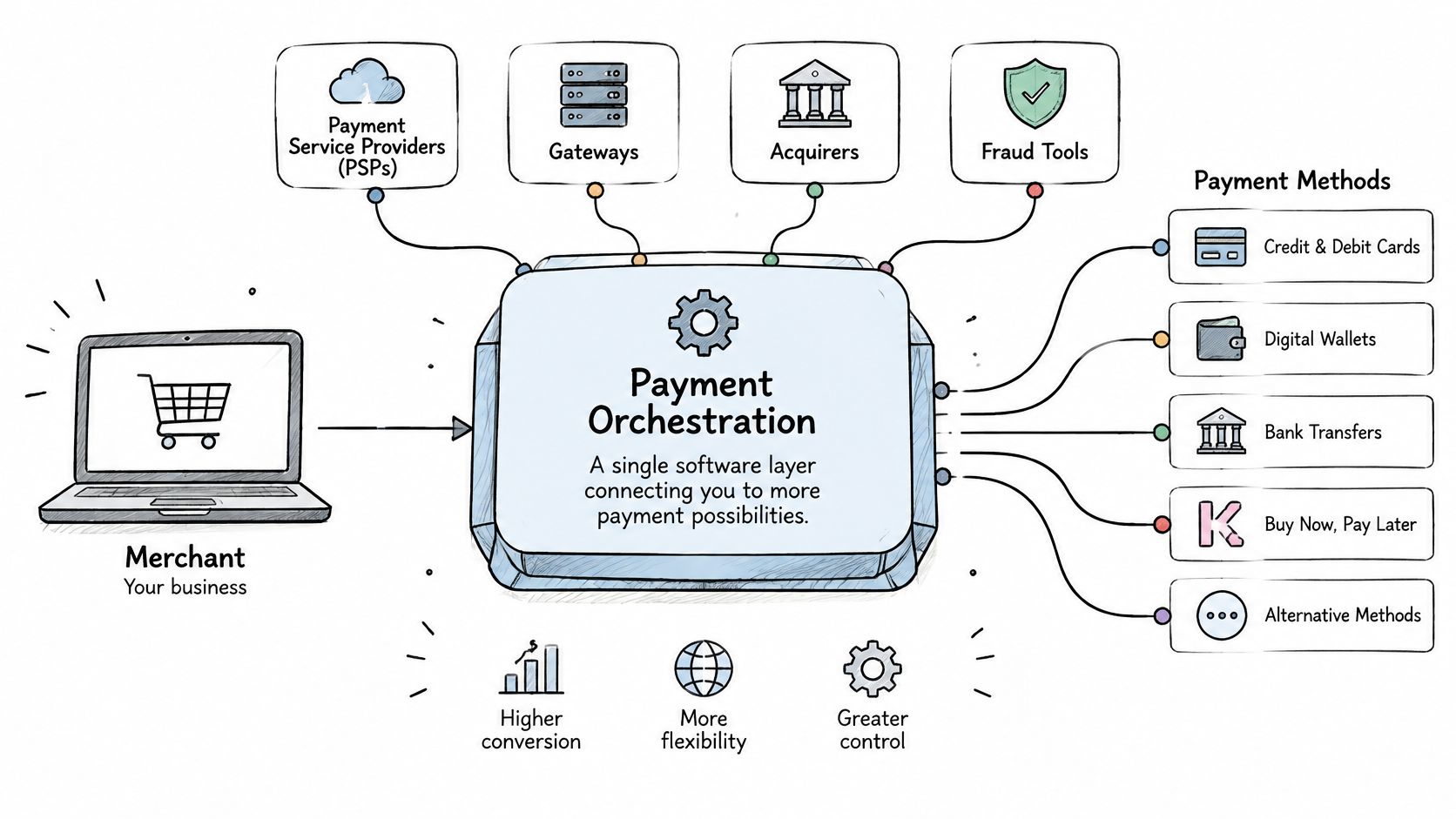
Payment orchestration does a similar job between your checkout and payment providers. Those providers include payment service providers, which help businesses accept payments, and acquirers, which handle card transactions on the merchant's side.
Say your brand sells clothing internationally. Your checkout sends a payment request to the orchestration layer, which carries out these jobs:
- Connect: Maintain access to multiple providers, gateways, fraud tools, and payment methods.
- Choose: Apply rules using the customer's country, transaction currency, and payment method.
- Recover: Send an eligible failed payment through an alternative route.
- Consolidate: Bring payment results into a shared reporting and reconciliation process.
Orchestration decides where each payment goes, while the provider still moves the money.
The diagram shows where that coordinating layer sits.
The need is familiar to online merchants: 56% of payment and technology decision-makers preferred working with multiple processors, rising to 64% among merchants generating most of their sales online, according to the Merchant Payments Trends Report 2025.
Multiple providers create choices, but also separate credentials, transaction records, and settlement reports. You have a reason to evaluate orchestration if you already use several processors, sell across countries, or can't explain why legitimate customers' payments fail. Those are investigation triggers, not an automatic reason to buy another platform.
Gateway Versus Orchestration and Routing Value
Why would the same card get declined on one route and approved on another, when the bank makes the final call? The answer is in what happens before the bank sees the request. A conventional single-provider gateway passes payment information to its processor and returns the result. An orchestration layer adds a decision before that handoff. It translates the request, selects a route, and defines what happens when an attempt fails.
That distinction is about architecture, not labels. Some products called gateways offer broader connectivity. Check the actual controls for routing, retries, and reporting rather than trusting the name.
Payment gateway versus orchestration layer
| Capability | Single gateway | Orchestration layer |
|---|---|---|
| Processors connected | One in a single-provider setup | Several through one integration |
| Routing decision | Fixed route to one processor | Dynamic rules per transaction |
| Failed payment handling | Returns decline as received | Classifies failure, then retries or reroutes eligible attempts |
| Local payment methods | Added through the processor integration | Added centrally through supported connectors without rebuilding checkout |
| Reporting | Separate per processor | Consolidated across connected providers |
| Authorization uplift potential | Baseline for comparison | Approximately 1–4% from dynamic routing, with 10–15% approval lifts reported in other routing benchmarks, according to Beast Insights' payment-decline overview |
| Main trade-off | Simpler, but dependent on one processing route | More control with added operational complexity |
Read those uplift ranges as benchmarks to test, not guaranteed outcomes. They reflect different reported results. Your starting approval rate and transaction mix shape what extra routing can add.
Connection work comes first. Our guide to payment gateway infrastructure choices explains how that link between checkout and processor is built. Samba's guide to connecting tour payments with Samba offers a sector-specific integration example, useful for separating the work of connecting checkout from the work of choosing payment routes.
Why a different route can perform better
The customer's issuer, meaning their card-issuing bank, makes the authorization decision. The path used to reach that issuer can still change the result.
Outcomes vary by card brand, issuer country, currency, local acquiring relationship, and BIN range, the identifying portion of a card number associated with its issuer. Provider outages and slow responses add another variable.
A skincare brand selling into an overseas market sees recoverable processing failures cluster there. A local acquiring route may present the transaction in a form the regional issuers accept more readily. Chasing the lowest advertised fee on every transaction will not solve that mismatch. Routing moves money, and each move shifts fraud exposure and who owns the failure.
Routing needs guardrails before sophistication:
- Provider health: Stop assigning traffic to a route that fails your availability or response-time criteria.
- Failure classification: Separate transient problems, such as timeouts, from hard declines such as invalid credentials or suspected fraud.
- Retry limits: Cap attempts so the system does not keep submitting an unsuitable payment.
- Duplicate prevention: Use idempotency keys, identifiers that let a system recognize a repeated operation, alongside shared payment-state controls.
Timeouts deserve extra care. The provider might have accepted the payment even though its response never reached you. An idempotency key alone does not automatically coordinate independent processors, so a blind retry can create a duplicate charge.
Judge the result on incremental approved gross merchandise value after additional fees, fraud losses, latency, and operating costs. A higher approval rate is not a win if the recovered margin goes to dispute handling.
The Components That Make Up an Orchestration Layer
A useful mental model is a hub with spokes. The central layer translates and decides; the spokes connect to providers and supporting services. The hub shouldn't force every component to share the same failure boundary.
This diagram maps those connections.
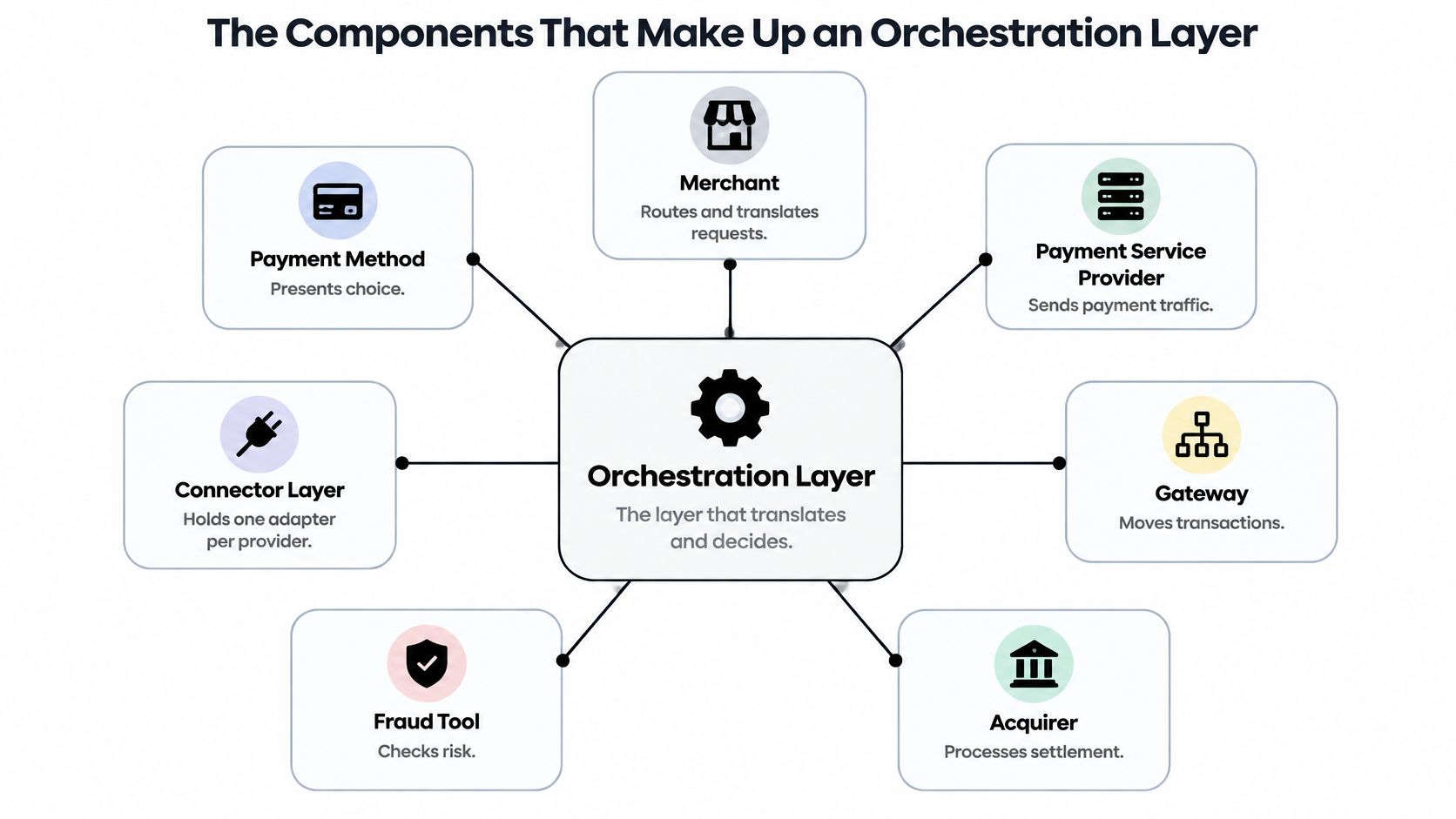
The CloudFintech technical architecture explainer describes the core sequence as normalizing a request, evaluating routing rules, invoking a provider connector, and translating its response into a consistent internal status.
Core components of a payment orchestration layer
| Component | Function | Key check for merchants |
|---|---|---|
| Connector layer | Adapts each provider's application programming interface, or API | Supports your target markets and payment methods |
| Normalization service | Converts requests into a canonical, shared format | Handles provider response types consistently |
| Routing engine | Evaluates geography, currency, card attributes, health, cost, latency, and authorization history | Allows controlled custom rule configuration |
| Token vault | Stores tokens used instead of raw card details | Limits raw-data handling without assuming compliance obligations disappear |
| Retry and recovery | Manages eligible failover attempts | Enforces retry caps and duplicate-prevention controls |
| Fraud hooks | Connect risk scoring and customer authentication tools | Supports additional identity checks when needed |
| Reconciliation service | Matches settlements and fees to orders | Identifies exceptions and supports their resolution |
Normalization means your order system doesn't need to interpret every provider's vocabulary. An approval, hard decline, timeout, or soft decline should map to a defined internal status, while retaining the original response for investigation.
A soft decline may require another action, such as authentication, rather than an immediate reroute. Flattening every unsuccessful response into “failed” removes the information needed to make that distinction.
Our explanation of payment tokenization covers how replacement credentials reduce exposure to raw card details. Don't assume a token created for one provider can automatically be used with another.
For a visual walkthrough of the concept, use the accompanying video.
Architecture check: A broken provider connector should be isolated, not allowed to corrupt routing decisions, order states, or settlement records.
Ask vendors to demonstrate that separation, including how they recover when a component stops responding.
How a Payment Moves Through an Orchestrated Checkout
Follow a hypothetical card purchase from a customer buying a subscription. The checkout should submit the purchase intent without embedding provider-selection logic throughout the storefront.
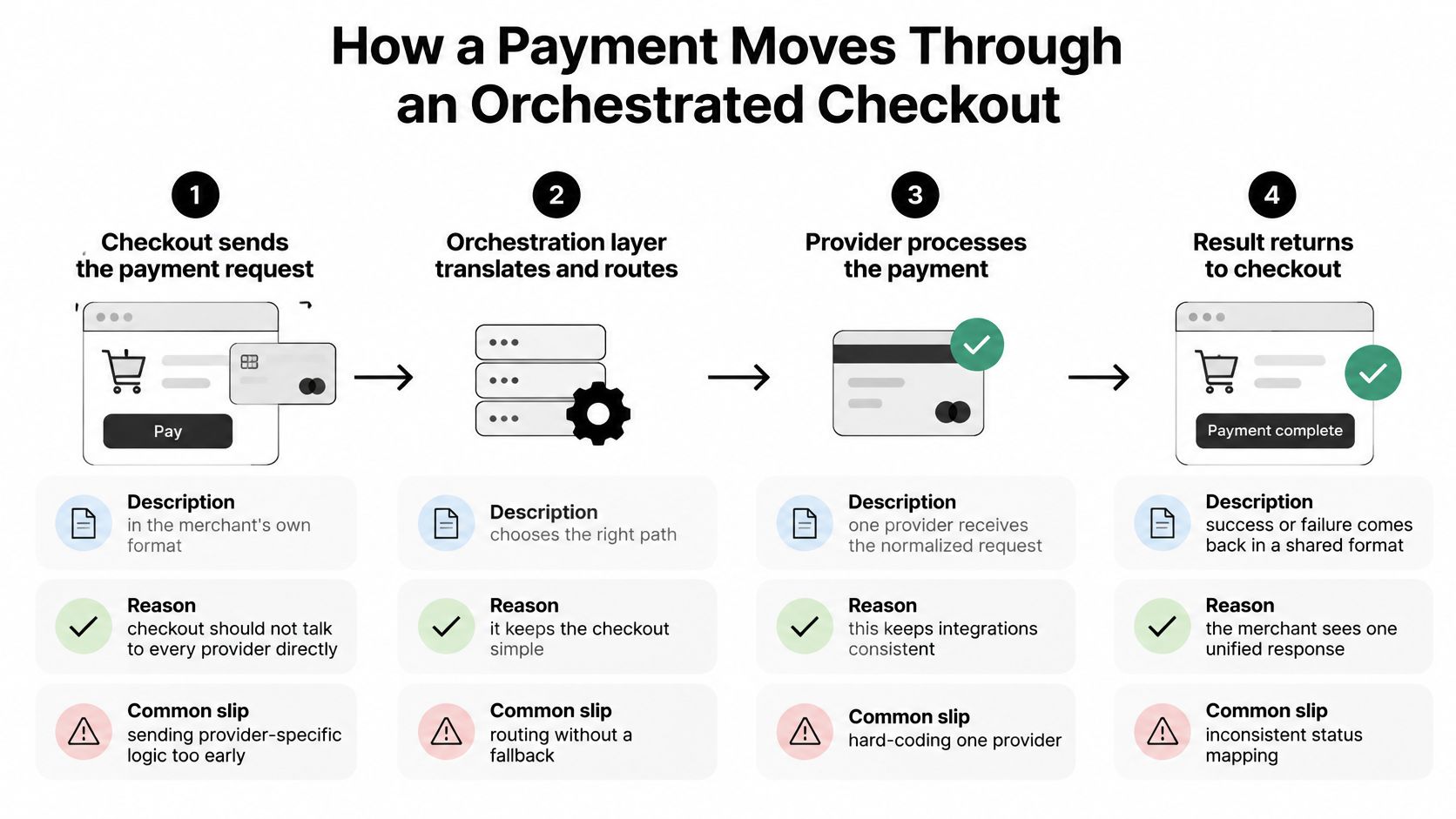
The simplified flow looks like this.
From purchase request to order record
-
Checkout submits the payment request. It sends the order reference, amount, currency, payment credential reference, and relevant customer context. Keeping this request provider-neutral prevents checkout from becoming a collection of processor-specific branches.
-
The layer validates and normalizes it. The system converts the request into its shared format before choosing a route. Missing country or currency fields should trigger validation, not a guess that sends the payment down the wrong path.
-
Routing rules select an eligible provider. The engine checks market, method, currency, and current provider health against your policy. A fallback list without health criteria can redirect customers from one failing service to another.
-
The connector submits the request. It translates the shared instruction into the selected provider's required format. Preserve identifiers linking this attempt to the original purchase.
-
The response becomes a consistent status. Approval, hard decline, timeout, and soft decline lead to distinct next actions. Don't label an authorization as settled money or an unanswered request as a confirmed failure.
-
Recovery follows the failure classification. An eligible transient failure may trigger another route; a hard decline stops the automatic flow. Preserve the logical payment's idempotency key, reconcile uncertain outcomes, and enforce cross-provider duplicate controls before submitting another attempt.
-
The result stays attached to the order. Store the final outcome and send the relevant records to reporting and reconciliation. Avoid creating a new order because the payment used a different provider.
A healthy record links the order to every attempt, with its route, status, timestamp, and provider reference. Support can then answer what happened without reconstructing the purchase across dashboards.
The same record discipline applies beyond routing. A coherent DTC payment system must connect purchase attempts to subscription renewals, refunds, and financial reporting.
Where Orchestration Goes Wrong and How to Avoid It
A recovered sale can still lose money when it creates a second charge. The customer contacts support, asks for a refund, or files a dispute while your team searches two dashboards to learn which provider moved the money. Rerouting changes ownership of funds, evidence, and follow up, not only the chance of approval.
Orchestration also changes your fraud exposure, because each added provider route needs its own identity, device, and authentication controls, and each one must be reviewed for risk.
The benefits and operational dependencies belong in the same evaluation.
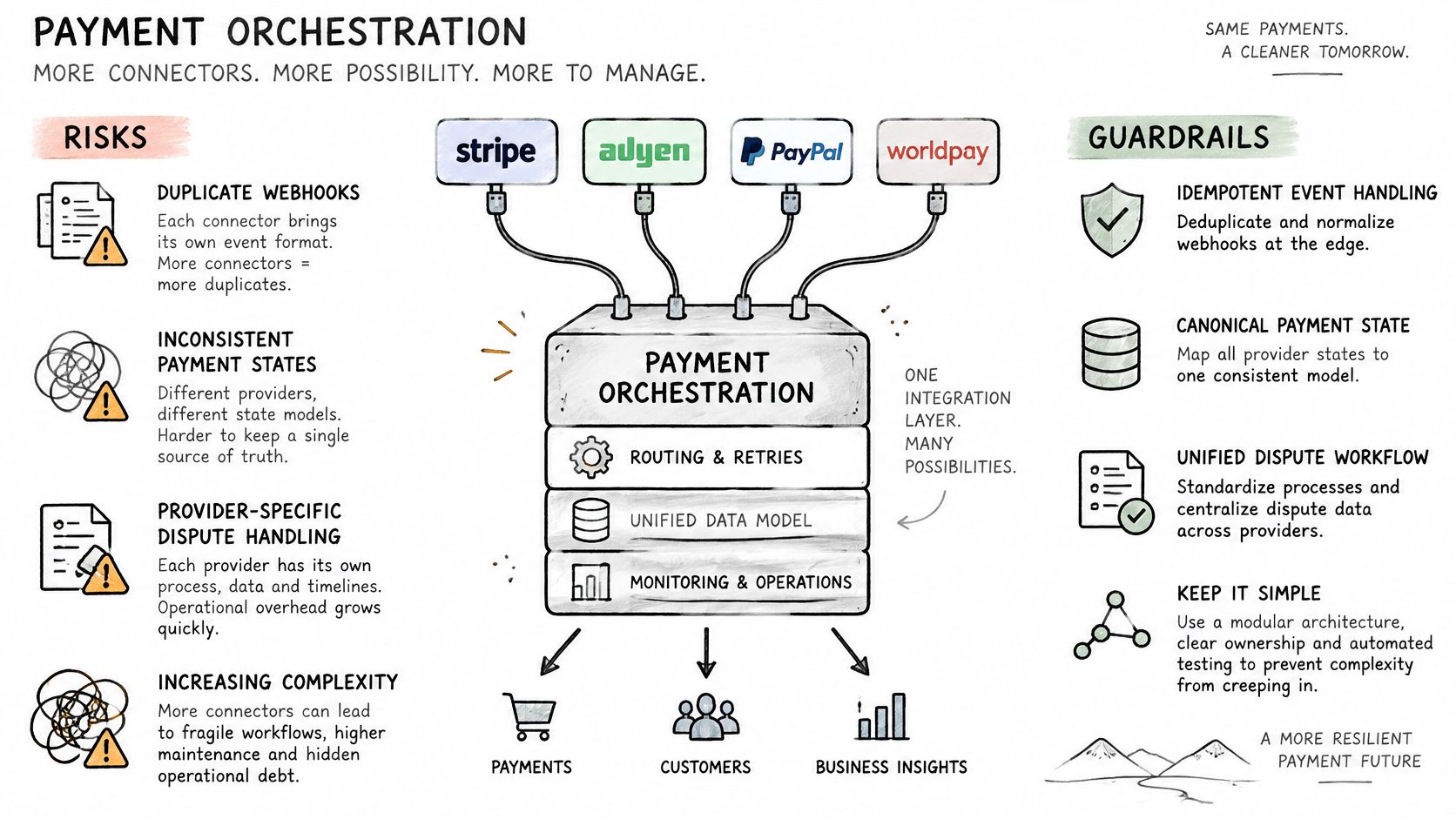
Pair each failure point with an owner
Duplicate captures and renewals show the money movement risk most clearly. Test delayed responses, repeated submissions, and failover in a sandbox. Confirm that the order service blocks another capture or subscription renewal when a previous attempt is still unresolved.
Blind retries raise fraud and decline costs together. A failure can reflect insufficient funds, issuer controls, misconfiguration, stolen credentials, or account takeover. Combine response codes with device, identity, transaction velocity, subscription history, and consent signals before you retry, authenticate, or stop.
Hidden operational debt grows with every connector. Each one brings provider-specific events and workflows. Deduplicate webhooks, which are provider notifications, document status mappings, and assign an owner to settlement exceptions.
Unclear responsibility leaves refunds stuck between teams. Identify who submits refunds, handles chargebacks, and replies to customers for each route. A consolidated dashboard does not transfer those duties to the orchestrator by itself.
Card-data exposure stays with you. Document where card information is collected, stored, and transmitted. Payment orchestration does not remove obligations under the Payment Card Industry Data Security Standard, or PCI DSS.
Orchestrator dependency is a single point of failure. Monitor the coordinating layer itself. Multiple healthy processors will not help if checkout cannot reach the system that selects them.
For our payment flow, card details are entered into Stripe-hosted fields and never reach our servers. That narrows the raw card-data handling within our infrastructure, but brands still need to understand their own integration and compliance responsibilities.
Before launch, require clear answers to these questions:
- What happens after an ambiguous timeout? Request a demonstration of how the system checks whether money was already authorized.
- Who owns the customer's problem? Name the team responsible for refunds, disputes, and incident communication.
- What proves the change helped? Review net revenue alongside fraud, false declines, support contacts, and settlement exceptions.
Choosing Between Single, Multi-Provider and Platform Setups
Payment providers have incorporated orchestration into their infrastructure through acquisitions, including Checkout.com's acquisition of ProcessOut, as described in Forbes' payment-orchestration market analysis. The category now commonly covers vaulting, routing, reporting, fraud optimization, and failed-payment recovery, reflecting a move toward managed multi-provider architectures.
That doesn't mean every brand needs every capability. Choose the smallest setup that addresses a measurable operating problem.
Three setup models compared by fit and trade-off
| Setup | Best for | Main trade-off |
|---|---|---|
| Single provider | A brand serving one market with low payment complexity | A provider outage can interrupt all sales on that route |
| In-house orchestration | Multi-market brands with dedicated engineering teams | Your team maintains connectors, routing controls, and reconciliation |
| Platform orchestration | Brands needing unified order records across channels. PlatformDTC combines own-domain checkout, storefront, subscriptions, payments, and POS on a shared order record, with Stripe-hosted card entry | Provider and market coverage constrain available routes; unified orders alone don't establish dynamic failover capabilities |
Stay single when your current provider covers your market and methods reliably, and you haven't identified a problem that another route would solve. Improve your existing integration before adding infrastructure.
Build or adopt multi-provider routing when specific market gaps, outages, or recoverable failures justify the maintenance. BroLabel's explanation of payment routing across acquirers provides useful context for evaluating that architecture.
Choose a managed platform when your team needs coordinated commerce records without maintaining every connection itself. Separate provider selection from transaction-level automation: a setting that switches the active checkout provider isn't the same as automatic rerouting during a payment attempt.
A unified order record is valuable only if every payment route keeps it accurate.
Before committing, document supported providers, merchant onboarding countries, currencies, token compatibility, refund behavior, and settlement exports. At our platform, selling availability follows where the payment processor can onboard your business, and the country on a payments account can't be changed once set.
Finish with a cost question: What does each successful payment cost, including engineering time? Include connector maintenance, monitoring, support, and financial exception handling, not just the transaction fee.
Confirm Your Routing Plan Before You Add a Provider
Add a provider only after you can name the payment problem it should solve and the evidence that would justify keeping it.
- Map your current setup. List providers, markets, currencies, and payment methods. Record which team owns each connection and its downstream financial workflow.
- Establish a baseline. Pull approval rate, first-attempt success, fraud rate, disputes, and cost per successful payment by market. Keep purchase-level outcomes separate from attempt-level metrics so retries don't distort the comparison.
- Choose a limited change. Start with a fallback route for a selected market. Write its health requirements, retry cap, failure eligibility, idempotency policy, and rollback conditions before enabling it.
- Test, then measure. Simulate failover in a sandbox and confirm that no duplicate capture or renewal appears. After a controlled launch, compare incremental approved revenue against added fees, disputes, and operational work before expanding.
Our payments setup happens within the platform, and businesses can start for free. To accept payments, create an account and complete Stripe Connected Account onboarding.
Apply the baseline to our setup just as you would to any provider. A successful integration is the starting point; the decision should rest on reliable payment outcomes and manageable operating costs.
PlatformDTC brings storefront, checkout, subscriptions, payments, and POS into a shared order lifecycle, helping your team keep payment outcomes connected to the purchase. Visit PlatformDTC to evaluate the platform against your provider requirements and build a payment setup with clear ownership from checkout through settlement.