You've done the hard work. The shopper found the product, trusted the brand, and reached checkout with buying intent intact. Then the payment page asks for a card number, expiration date, billing address, and security code. The mobile keyboard appears. The wallet button is missing. A few seconds later, the shopper closes the tab, and your analytics labels the session as an abandoned cart.
That moment is why a DTC payment system deserves more attention than a gateway logo in an architecture diagram. It determines how quickly a customer can pay, which methods they can use, where the money settles, how refunds are tracked, and whether your finance team can match a payout to the original order without assembling data from several disconnected apps.
A useful way to understand the system is to follow one order from start to finish. The shopper taps a wallet or enters payment details. The processor checks and captures the payment. Funds move through the selected settlement path. The order, refund, subscription renewal, fee, and payout then need to remain connected in your records.
This guide follows that complete lifecycle in plain language. You'll learn how payment authorization differs from settlement, why wallet-first checkout has become important, how direct settlement affects control, and why reconciliation belongs in the same conversation as conversion. You'll also see how online orders, retail payments, subscriptions, and B2B invoices can share one operational record instead of creating separate versions of the truth. For a practical look at how a brand-owned checkout fits into this flow, explore PlatformDTC's checkout capabilities.
Table of Contents
- How a DTC Payment System Actually Moves Money
- Wallets Cards and Buy Now Pay Later at DTC Checkout
- Settlement Models and Where Your Money Lands
- Payouts Reconciliation and Keeping Your Books Accurate
- Unifying Online POS Subscriptions and B2B Payments
- Choosing and Operating Your DTC Payment System With Confidence
How a DTC Payment System Actually Moves Money
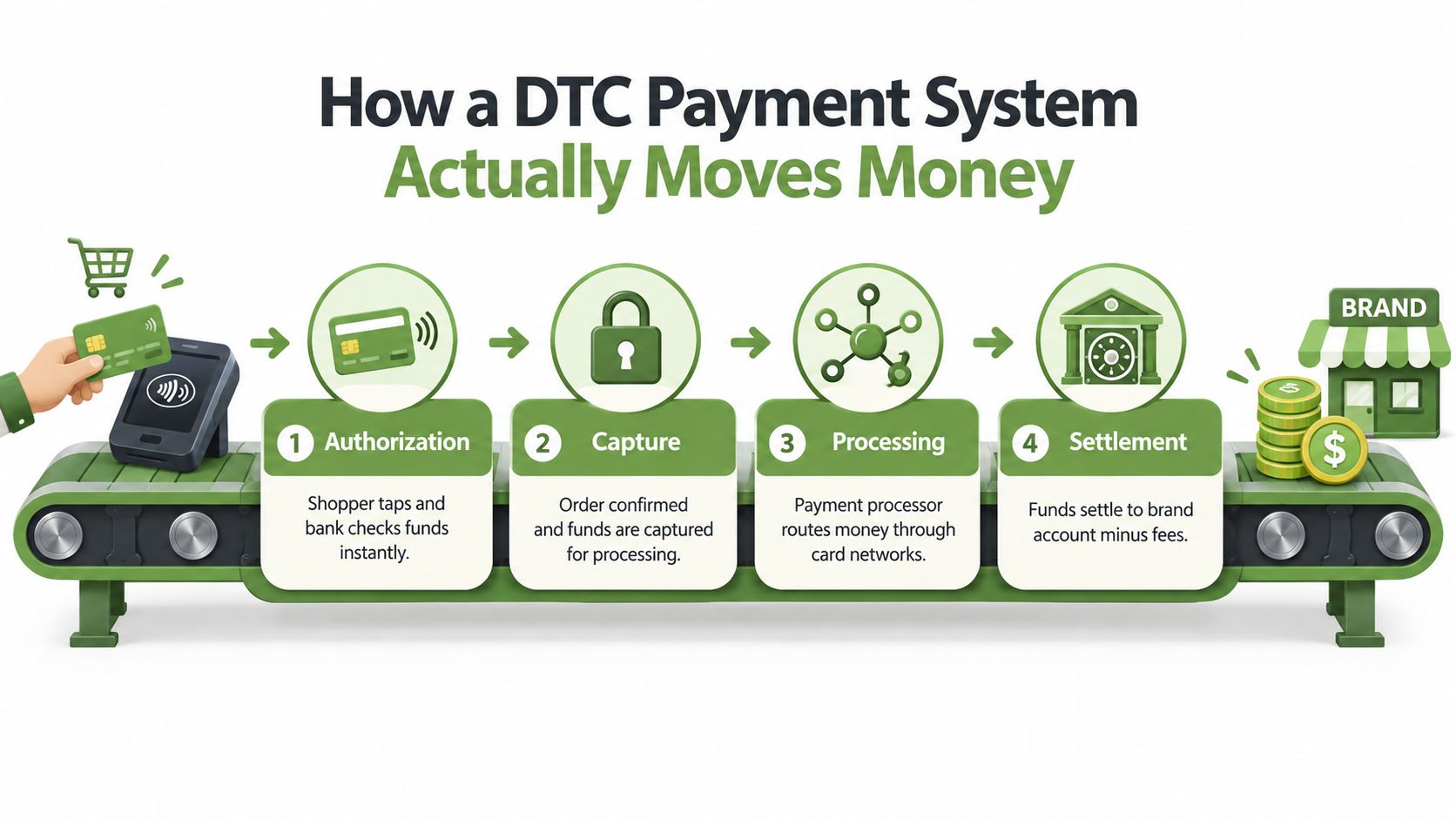
Think of checkout as a conveyor belt rather than a button. The shopper starts the belt with a tap. Several systems perform checks and handoffs. The brand receives the payout only after the payment has moved through the entire process.
The four handoffs behind one payment
Authorization happens first. The shopper selects Apple Pay, Google Pay, PayPal, a card, or another method. The payment provider sends a request to the relevant bank or network, which checks whether the transaction can proceed. Authorization isn't the same as money arriving in your bank account. It's permission to continue.
Capture records the decision to take the funds. A merchant may authorize and capture immediately for a normal product order, or authorize first and capture later when inventory ships. The correct choice depends on the brand's fulfillment process and the payment provider's configuration.
Processing routes the transaction through the necessary payment infrastructure. The storefront, checkout interface, processor, card networks, wallet provider, and issuing bank each have a role. A good checkout hides this complexity from the shopper, while the operator still gets a reliable event trail behind the scenes.
Settlement is the point at which funds become available through the chosen payout arrangement, after applicable deductions and adjustments. The customer sees a completed purchase well before the brand sees a payout, so the order record must preserve that connection.
The core idea: A DTC payment system isn't just the page where a customer enters payment details. It's the complete lifecycle from payment attempt to captured order, settlement, refund, chargeback, and reconciliation.
The distinction between acceptance and settlement prevents a common mistake. A checkout can accept a card successfully while the brand still has questions about payout timing, fee deductions, reserves, or ownership of the processor relationship. Choosing among DTC payment gateways is therefore only one part of the design.
Performance matters at the first handoff. An edge-served checkout can deliver the payment interface closer to the shopper, reducing the distance and work required before wallet buttons or payment fields appear. That technical detail matters because a customer doesn't experience your payment architecture as a diagram. They experience loading, form entry, authentication, approval, and confirmation as one continuous moment.
The scale makes these decisions operationally important. One 2026 report estimated total ecommerce transaction value across 42 markets at more than $7.6 trillion in 2025, as summarized in payment processing market data. For a growing brand, the lesson isn't that every payment flow must look identical. It's that the payment layer has become core commerce infrastructure, not an afterthought attached to the storefront.
Wallets Cards and Buy Now Pay Later at DTC Checkout
A modern checkout shouldn't force every shopper through the same path. A mobile customer with a saved wallet credential has a different expectation from a wholesale buyer paying an invoice. A returning desktop customer may prefer PayPal, while another shopper wants to use a card with additional verification.
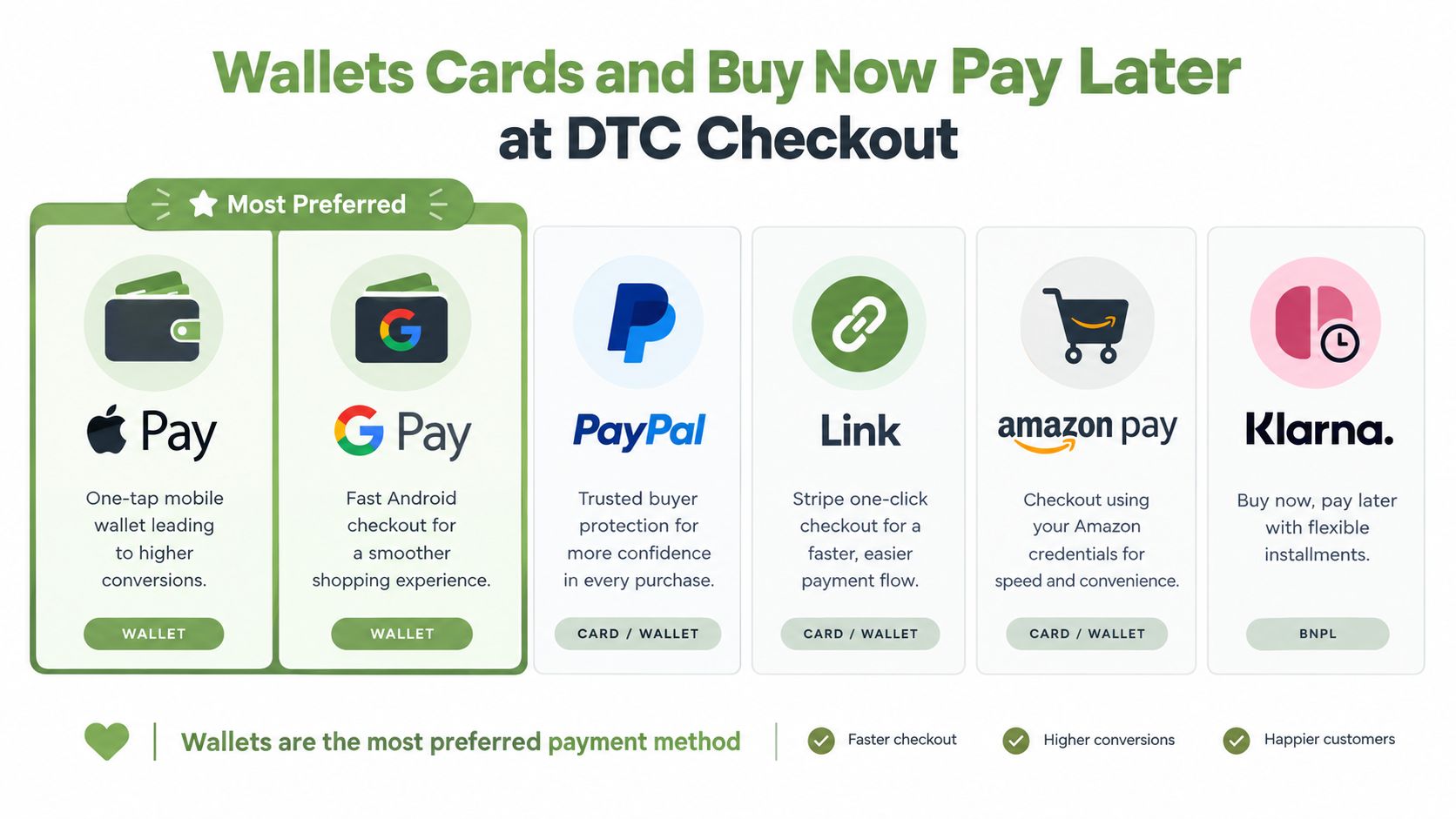
The practical shift is from card-first fallback to wallet-first orchestration. The system should identify eligible methods, display useful buttons in the right context, and keep the manual card form available without making it the default for everyone.
The change reflects how shoppers fund online purchases. One industry summary reported that digital wallets represented about 50% of worldwide online transaction value in 2023, compared with around 22% for credit cards, 12% for debit cards, 7% for account-to-account transfers, and 5% for buy now pay later, according to global online payment method data. Those figures describe a broad market, not a guarantee for an individual brand, but they explain why wallet buttons now belong near the beginning of the checkout path.
Compare the payment paths
| Payment Method | Shopper Friction | Best Fit for DTC |
|---|---|---|
| Apple Pay | Low on compatible Apple devices, especially when credentials and address details are already available | Mobile shoppers and returning customers |
| Google Pay | Low for shoppers with saved credentials in supported Google environments | Android and Chrome-heavy audiences |
| PayPal | Low for account holders, with a separate account decision before approval | Shoppers who value a familiar account-based flow |
| Link | Low for returning users with saved payment information | Repeat buyers in supported checkout environments |
| Amazon Pay | Low for shoppers comfortable using Amazon credentials | Customers who prefer an established account flow |
| Klarna | Moderate, because shoppers review an installment or deferred-payment choice | Eligible customers seeking buy now pay later options |
| Card form | Higher, because shoppers manually enter details and may complete extra verification | Universal fallback and customers without an available wallet |
A wallet-first design doesn't mean removing cards. It means preserving cards as a dependable route while reducing unnecessary typing for shoppers who already have a tokenized credential. It also means rendering methods dynamically rather than displaying a long, static list that makes the customer decide which options apply.
Wallet coverage still needs regional judgment. The strongest method in one market may not be the preferred method in another, so operators should review payment-method usage by device, country, customer segment, and order type. The goal isn't to collect every possible button. It's to support the methods that reduce friction for the audiences you serve.
Buy now pay later deserves separate treatment. Klarna and similar methods can support a different affordability preference, but the merchant still needs clear controls for eligibility, refunds, order status, and reconciliation. A payment method that increases choice without preserving the order record can create more operational work than expected.
Settlement Models and Where Your Money Lands
The checkout tells you whether a purchase was accepted. Settlement tells you where the money goes afterward. That distinction becomes important as soon as a brand operates across multiple channels, payment providers, currencies, or legal entities.
There are two broad models. In an aggregated arrangement, a platform collects customer payments into an account it controls and later pays the brand. In a direct arrangement, the payment lands in the merchant's own Stripe or PayPal account, subject to that provider's rules and payout process.
Aggregated settlement
Aggregated settlement can simplify initial setup because the platform handles more of the payment relationship. The brand may receive a consolidated payout, while the platform manages portions of routing, reporting, and account administration.
That convenience comes with a visibility tradeoff. The brand must understand how the platform calculates fees, handles refunds, records reserves, and communicates chargebacks. If the platform's payout report and the merchant's order report use different identifiers, finance staff may need manual mapping before they can close the books.
Direct settlement
Direct settlement keeps the merchant's processor relationship and funds in the merchant's own accounts. The platform can still provide the checkout experience, but the payment provider remains the destination for settlement, reporting, refunds, and dispute workflows.
This model can give the brand clearer ownership and a closer connection between processor activity and accounting records. It also leaves the merchant responsible for configuring provider accounts, reviewing payout behavior, and maintaining the controls needed for refunds and disputes.
The payment fields themselves don't need to expose sensitive card details to the commerce platform. A setup using processor-hosted fields can keep payment data within the provider's handling environment while the storefront receives the result needed to create or update the order. The architecture should make it clear which system owns the payment credential, which system owns the order, and which account receives the funds.
Wallets strengthen the case for treating settlement as part of the whole lifecycle. One 2026 industry summary reported wallets at 53% of global ecommerce purchases in 2024, while other 2026 market reporting placed them at roughly 52.5% of global ecommerce transaction value in 2025 and projected 61% by 2027, as reported in digital wallet adoption analysis. A merchant needs more than wallet buttons. It needs a consistent record showing which method funded the order and how that order later reached settlement.
Payouts Reconciliation and Keeping Your Books Accurate
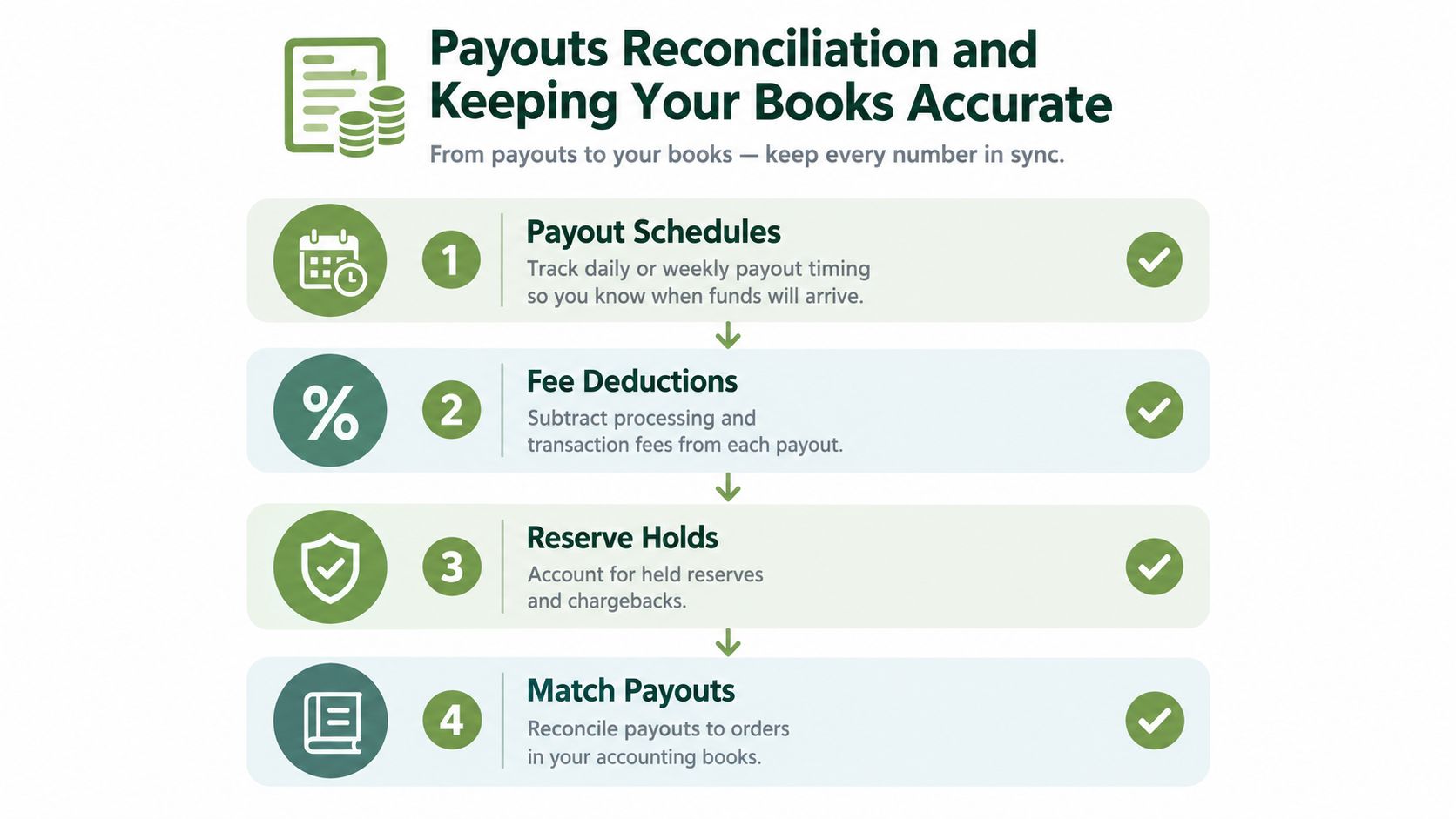
A payout is not a single clean copy of your order total. It may reflect captured sales, refunds, processing fees, adjustments, reserves, disputes, and timing differences. Reconciliation turns that messy bank activity into a reliable accounting trail.
Start with the order record. Each payment should connect to the customer, items, discounts, taxes where applicable, fulfillment status, refund history, and processor transaction identifier. When a payout arrives, finance should be able to trace the net amount back to the contributing transactions without searching through unrelated exports.
A repeatable close process
-
Confirm the payout schedule. Record when each provider initiates and releases payouts. A sale may appear in the order system before it appears in the bank, so timing should be treated as a normal state difference rather than an unexplained variance.
-
Separate gross and net activity. Keep the customer charge, processing fee, refund, and final payout visible as distinct entries. Posting only the bank deposit hides the economics of the transaction and makes later investigation harder.
-
Account for reserves and disputes. A provider may hold funds or remove money after a chargeback or adjustment. Those movements need their own status and reference, not a silent reduction in sales.
-
Match the ledger. Compare the provider payout report with orders, refunds, and the accounting system. Investigate unmatched items by transaction identifier, date, amount, currency, and payment status.
Practical rule: Reconcile the payment event, not just the bank deposit. The deposit is the final result of several events that may have happened on different dates.
Fragmented app stacks create drift in ordinary places. A discount may be calculated in the storefront but omitted from a reporting export. A subscription renewal may create a payment record without matching the original customer profile. A refund may be visible in the processor but missing from the fulfillment system.
Checkout speed belongs in this operational picture because faster payment completion affects the quality of the sales funnel, not only the customer experience. One 2026 checkout performance article reported that merchants displaying Apple Pay, Google Pay, and Shop Pay saw conversion rates increase by 43%, cart abandonment fall from 69% to 41%, and purchase completion time drop to under 15 seconds, compared with a traditional 2 to 3 minute flow, as described in checkout performance reporting. Finance and growth teams should therefore review order counts, payment statuses, refunds, and checkout performance from connected records.
Unifying Online POS Subscriptions and B2B Payments
A DTC payment system becomes more useful when it treats payment as an attribute of an order lifecycle rather than a feature limited to a web cart. The same customer may buy online, renew a subscription, pay at a retail counter, and place a wholesale order. Those transactions shouldn't create disconnected customer identities and competing inventory counts.
Retail counter payments
A shopper buys online, then visits a physical store. The associate accepts a card or cash through POS. If the POS shares the catalog and customer record with ecommerce, the brand can preserve product, inventory, and purchase history in one place. A return can then reference the original transaction instead of relying on a handwritten note or a separate lookup.
Subscription renewals
Subscriptions add time to the lifecycle. The initial order establishes the product, customer, payment method, delivery cadence, and consent context. A later renewal needs to connect to that history while still producing its own payment event, fulfillment instruction, refund path, and accounting entry.
A subscriptions system such as PlatformDTC's subscription feature can keep renewals alongside one-time purchases in the same order model. That structure helps lifecycle teams understand what the customer bought and finance teams identify which renewal produced a particular payout.
B2B draft orders and invoices
Wholesale buyers often need a draft order, negotiated pricing, an invoice, or a payment term rather than a standard consumer checkout. The payment system still needs to connect the buyer, account, products, discounts, fulfillment status, and eventual payment to the same commercial record.
This is also where localized and cross-border payment solutions from Zaro can provide useful background for brands serving buyers across markets. The operational requirement remains consistent, the brand needs to know which method was used, which entity recorded the sale, and how the funds reconcile.
A unified model doesn't mean every channel has identical screens or approval rules. Retail, subscriptions, and B2B each need different experiences. The shared layer is the catalog, customer identity, order status, payment event, refund history, inventory effect, and payout reference.
The market direction supports this multi-method approach. A 2025 global payments report identifies digital wallets as the top online choice, while 2026 industry reporting states that wallets represented 56% of global ecommerce value in 2025 and merchants accepted roughly four to five payment methods on average, as summarized in the Worldpay Global Payments Report. Brands should therefore design for choice without allowing each payment method or channel to create a separate operational universe.
Choosing and Operating Your DTC Payment System With Confidence
The right payment system should answer five practical questions.
Can shoppers pay quickly? Test the checkout on real mobile devices and desktop browsers. Check whether eligible wallet buttons appear promptly, whether the card form remains usable, and whether authentication or errors return the customer to a clear next step.
Does the system fit your markets? Review wallets, cards, bank methods, and buy now pay later options by region and customer type. A method is valuable when it serves a real buying pattern, not because the provider offers it.
Who controls the money? Understand whether funds settle through an aggregated platform account or directly to your own processor accounts. Document who handles refunds, disputes, reserves, fees, and payout reporting.
Can finance reconcile without detective work? Ask for a complete event trail from order creation through capture, refund, dispute, and payout. Check whether the identifiers remain consistent across the storefront, processor, accounting system, POS, and subscription engine.
Can your team operate it safely? For AI-assisted commerce, review scoped permissions, approval gates, idempotent writes, audit trails, and reversible actions. For engineering teams, inspect API documentation, status transparency, migration support, and performance reporting. Teams evaluating broader booking workflows may also find this online booking and payment system guide useful for comparing payment steps with operational records.
PlatformDTC is one example of a commerce platform that combines brand-owned checkout, wallet methods, subscriptions, POS, B2B workflows, direct settlement to merchant Stripe and PayPal accounts, unified records, governed APIs, migration utilities, analytics, and a public service status page. The important evaluation standard isn't the product list. It's whether the system keeps the customer's payment journey and the operator's financial workflow connected.
Audit your current flow by placing a test order, completing a refund, reviewing the processor event, and tracing the resulting payout into your ledger. Then compare the time and effort required with a unified lifecycle that keeps checkout, payment, fulfillment, and reconciliation on linked records.
PlatformDTC brings storefront, edge-served checkout, wallets, subscriptions, POS, B2B payments, fulfillment, and analytics into one commerce operating system with direct settlement options and governed APIs. Visit PlatformDTC to see how you can reduce checkout friction while keeping payment ownership and payout visibility under your control.