
A customer says they paused their subscription, but the warehouse has already shipped the next box. Another customer wants to stay, yet their renewal failed after a card replacement. Your dashboard counts both as churn, and support has to search billing records, order history and emails to explain what happened.
A subscription management platform should make those situations distinguishable and manageable. The practical test isn't whether it can charge a card again. It's whether your team can explain every renewal, recover the right payment failures and respect a customer's decision to stop.
Table of Contents
- What a Subscription Management Platform Covers
- How Billing, Proration and Lifecycle States Work
- Recovering Failed Payments Through Dunning
- Pause, Skip and Swap Controls That Protect Renewals
- Subscription Metrics That Show Real Health
- Choosing a Platform by Renewal Capability
- Integration With Storefront, Tax and Fulfilment Systems
- How to Migrate Subscriptions Without Breaking Renewals
- Confirm Your Requirements Before You Shortlist Vendors
What a Subscription Management Platform Covers
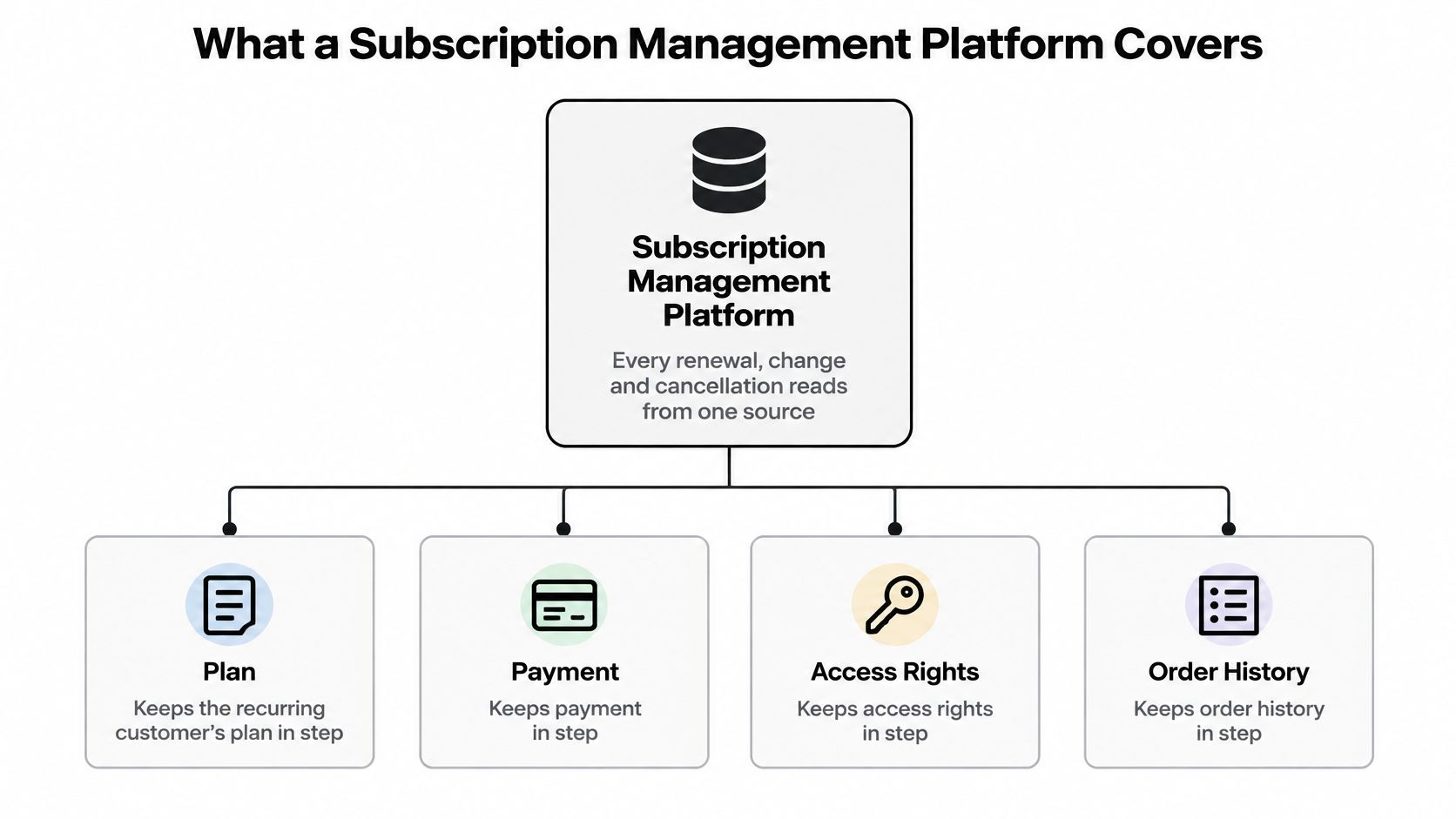
A subscription management platform keeps a recurring customer's plan, payment, access rights and order history in step, so every renewal, change and cancellation reads from one record. Think of it as a building's management office, keeping leases, invoices and maintenance history together instead of scattered across spreadsheets.
A billing script charges cards. A platform also maintains the customer and order lifecycle that your storefront, support team and reporting tools use. For subscription-based ecommerce, that means coordinating recurring orders with the rest of the shopping relationship.
Core capabilities of a subscription management platform
| Capability | What it handles | What breaks without it |
|---|---|---|
| Recurring billing | Charges on each cycle date, with the right amount | Missed or duplicate charges |
| Proration | Credits and charges for mid-cycle plan changes | Customers overcharged for unused days |
| Dunning | Retries and notices after a failed payment | Silent involuntary churn |
| Lifecycle states | Trial, active, past due, paused, cancelled, reactivated | Wrong access and unclear customer status |
| Customer self-service | Skip, swap, pause and cancel without support | Support tickets for routine changes |
| Revenue analytics | MRR, churn, recovery and revenue at risk | Blind spots in retention |
The shared record is the important part. A customer changing a plan shouldn't leave support looking at the old price while fulfilment prepares the old product.
The 2025 Zuora Subscription Economy Index covered more than 600 subscription businesses and reported 16.5% revenue growth among the companies tracked in its latest reported year. That scale helps explain why recurring commerce needs specialized operational tooling rather than a scheduled payment alone.
Start by marking which capabilities your current stack handles automatically and which require spreadsheets or support tickets. The manual work is your first requirements list, especially where staff must reconcile conflicting records before answering a customer.
How Billing, Proration and Lifecycle States Work
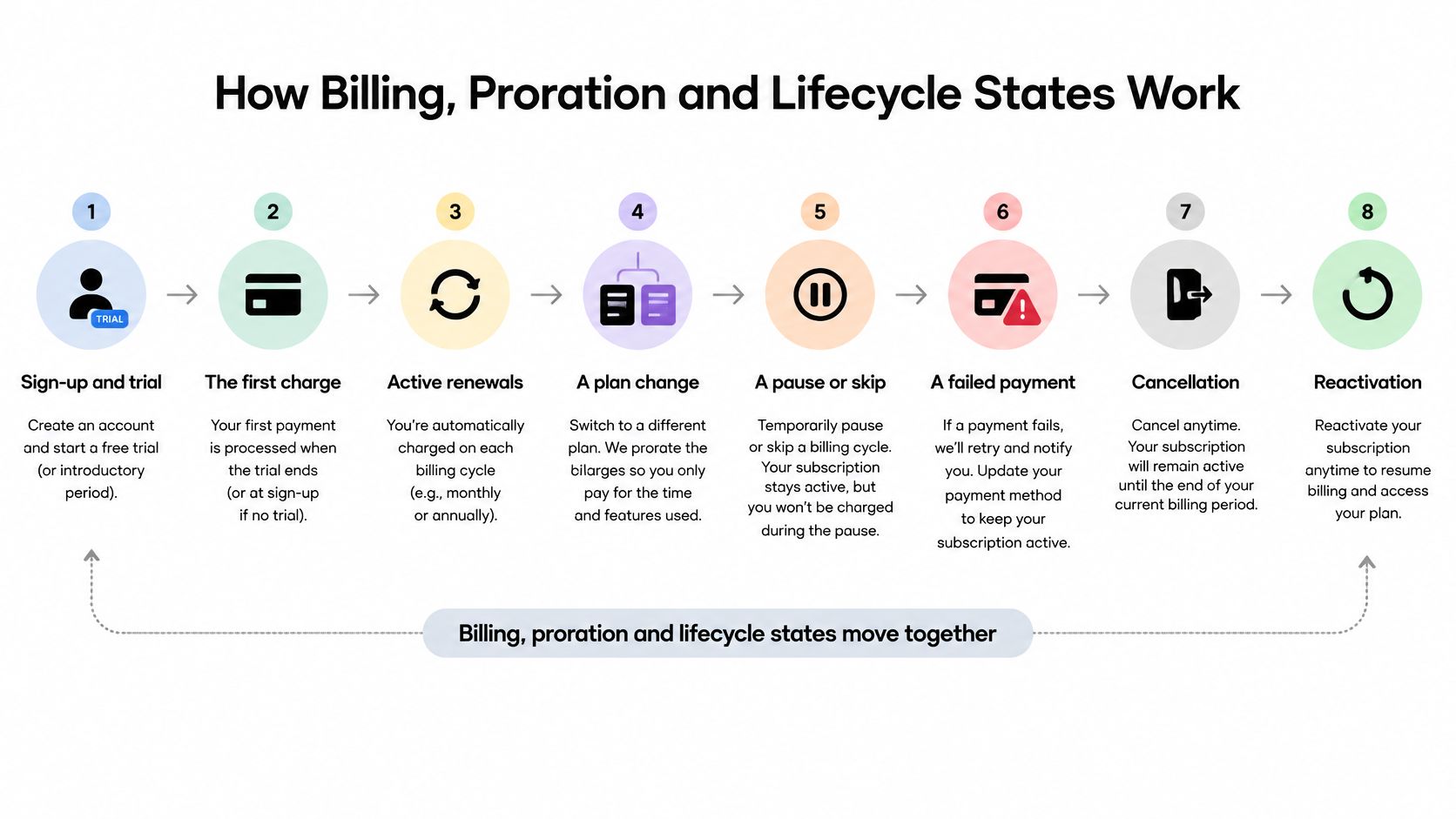
Follow a hypothetical customer from trial to return. At sign-up, the subscription enters trial; when the trial ends and the first payment succeeds, it becomes active. Charges fall on the configured cycle start date, and access normally continues through the paid period.
A successful renewal keeps the subscription active. A failed renewal moves it to past due, while a confirmed pause moves it to paused. A completed cancellation makes it cancelled; an agreed return creates a reactivated event before normal active renewals resume.
These aren't mandatory stops in a straight line. A customer can cancel directly from active, and a past-due subscription can return to active when payment succeeds.
A worked proration example
Suppose a customer has a $60 plan on a 30-day cycle and upgrades to a $90 plan after 10 days have elapsed. Assume day-based proration, an unchanged renewal date, and no tax or discount adjustments.
- Unused old plan: $60 ÷ 30 × 20 remaining days = $40 credit.
- Remaining new plan: $90 ÷ 30 × 20 remaining days = $60 charge.
- Net adjustment: $60 charge − $40 credit = $20 due now.
The next full cycle starts at the new plan price. Specify the day-count convention and rounding rule before implementation, otherwise equally plausible calculations can produce different invoices.
Keep the return history
In Deloitte's 2025 Digital Media Trends survey, 24% of consumers had cancelled and later renewed the same paid streaming service within six months. That's a reason to retain cancellation history rather than delete the subscription record.
A return should preserve the historical record while confirming current terms and payment authorization. Check that every state change writes a timestamped entry linked to the order record, including who requested it and when it takes effect.
Recovering Failed Payments Through Dunning
Involuntary churn happens when customers lose their subscription because payment failed, not because they chose to leave. Dunning is the process of resolving that failure through payment updates, permitted retries and clear customer communication.
A failed payment needs investigation before it becomes a cancellation.
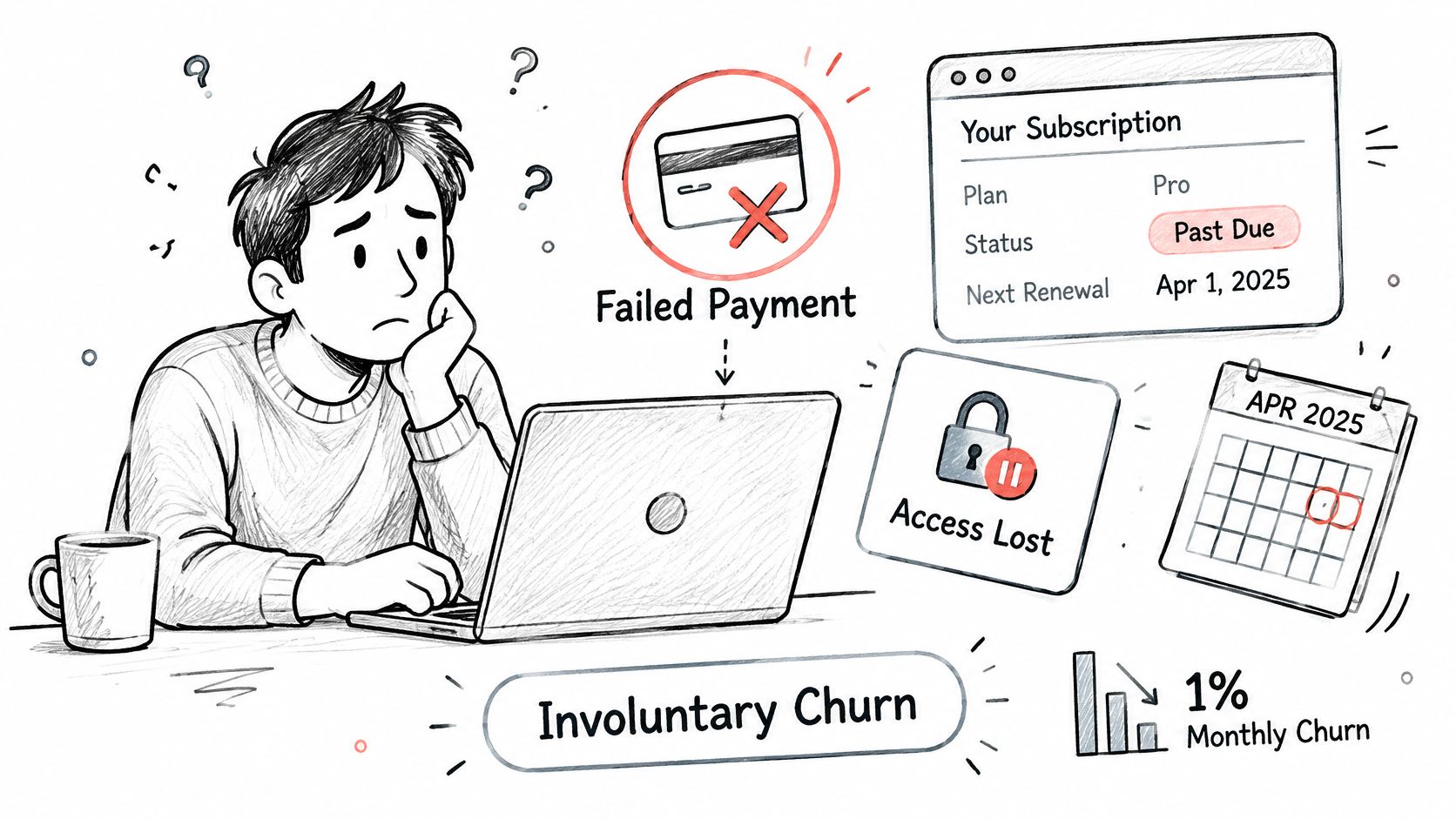
The MarketSplash compilation of subscription churn statistics describes a dataset of more than 1,000 subscription companies, with monthly involuntary churn of approximately 1% and insufficient funds accounting for 42.3% of declined payments. Those are different operational problems from a customer deciding the product isn't worth buying.
Follow the decline, not a fixed calendar
- Classify the response. Keep the processor's decline code and distinguish a recoverable failure from a payment method that must be replaced.
- Schedule permitted retries. Follow issuer, network and processor guidance rather than retrying every failure on the same calendar.
- Refresh credentials. Use account-updater services and network-token mechanisms where supported.
- Notify the customer. Explain what failed, how to update payment and when service may stop.
- End recovery deliberately. Cancel for nonpayment only when the permitted recovery process is exhausted, and record that reason separately from voluntary cancellation.
For a plain-language explanation of the workflow, see what dunning involves. The operational distinction is that a past-due invoice remains a recovery task, not evidence that the customer wanted to leave.
| Decline type | Typical cause | Recovery action |
|---|---|---|
| Insufficient funds | Balance too low on the charge date | Adaptive retry timed to issuer guidance |
| Expired or replaced card | Card reissued or past its expiry date | Account updater and network token refresh, then retry |
| Generic issuer decline | Issuer declined without a clear reason | A permitted retry following guidance, then notify the customer |
| Suspected fraud or closed account | Card blocked or reported | No automatic retry; ask for a new payment method |
Use the payment workflow as a discussion aid when reviewing your recovery setup.
Suppose a $49 box renewal fails because the card expired. The customer updates it through a secure payment form before the next permitted attempt, payment succeeds, and the subscription continues without a cancellation notice.
Pause, Skip and Swap Controls That Protect Renewals
Offering a pause isn't the same as earning a useful pause. A customer who wants to cancel may not want another decision, and a customer who accepts a break may forget when billing restarts.
The Mastercard and FT Strategies subscription economy report says more than two-thirds of surveyed U.S. businesses offered a pause option in 2025, while cancellation-session data showed pause acceptance of about 19%. It also associates longer pauses with greater odds of disputes or immediate cancellation when billing resumes.
Give each control a clear meaning
- Skip the next order. The plan continues, but the skipped cycle creates no charge or shipment. Show the next actual billing and delivery dates, and explain whether existing credits remain available.
- Swap the product. Apply the selection at the stated renewal, subject to the fulfilment cutoff. Display the replacement item, quantity, price and any effect on discounts before confirmation.
- Change frequency. Show the new cycle date and delivery cadence before saving. Explain how the change affects prepaid orders, credits and any order already being prepared.
- Pause. Stop scheduled billing and fulfilment until a visible restart date. Send a reminder before reactivation and let the customer extend the pause or cancel before the next charge.
Don't use an ambiguous success message such as “Your subscription has been updated.” Confirm the actual result: which order won't ship, what the next charge covers and when it will occur.
Separate preference changes from payment recovery
A pause is a customer instruction. A past-due state is a payment problem. If a customer pauses while an invoice is outstanding, record both facts and explain whether the existing balance remains payable.
Apply the change to the warehouse release schedule as well as the billing schedule. Otherwise, support may confirm a pause after fulfilment has already committed inventory.
A retained subscription isn't a successful outcome if the customer didn't understand that billing would resume.
The objective isn't maximum pause acceptance. A transparent pause can mean less short-term revenue, but it gives the customer a genuine choice and makes a later return more meaningful.
Subscription Metrics That Show Real Health
A single churn number hides separate causes and separate remedies. Customers who choose to leave need a different response from customers whose payment method stopped working.
Churnkey's 2025 State of Retention analysis places failed payments at 20–40% of total churn and reports that standard email notices with basic retry rules recovered only about 15% of failed payments. Treat those findings as context, not a target for your own catalogue or payment mix.
Subscription KPIs, formulas and what each signals
| Metric | Calculation | What it signals |
|---|---|---|
| Monthly recurring revenue | Sum of active subscription fees normalized per month | Size and direction of the recurring base |
| Voluntary churn rate | Customers who chose to cancel ÷ customers at start of period | Possible product, price or preference problems |
| Involuntary churn rate | Customers lost to failed payments ÷ customers at start of period | Payment-infrastructure leakage |
| Renewal-invoice-paid rate | Renewal invoices paid on first attempt ÷ renewal invoices issued | Health of the initial renewal attempt |
| Recovery rate by decline code | Recovered failed invoices ÷ failed invoices, per decline code | Which failures respond to remediation |
| Retry-attempt conversion | Successful retries ÷ total retries, per attempt number | Whether retry timing is working |
| Revenue at risk | Recurring revenue from subscriptions currently past due | Value of the recovery queue |
Define the reporting period and unit before comparing results. Customer churn and subscription churn aren't interchangeable when a shopper holds several subscriptions, and a cancellation request isn't always an immediately ended subscription.
Your subscription churn benchmark comparison is only useful when the denominator, cancellation timing and treatment of pauses match. Also distinguish customers who returned from customers who never left.
Segment before changing the workflow
Break recovery down by payment method, country, issuer response, renewal age and decline code. Add wallet usage, credential updates and customer value when those fields are available.
A low overall recovery rate doesn't tell an engineer what to fix. A concentration of failures among replaced cards suggests a credential-maintenance issue; poor results on generic issuer declines call for a different investigation.
Reporting rule: Count recovered revenue only after payment settles. Keep delayed cancellation and pending retries outside that total.
Pair recovery reporting with disputes, duplicate-charge incidents and complaints. A team shouldn't claim better retention merely because it postponed cancellation or kept sending payment attempts after the customer asked to stop.
Choosing a Platform by Renewal Capability
If you're comparing vendors, ask them to demonstrate renewal handling rather than present a feature checklist. The useful comparison is what happens after a plan changes, a card fails or an event arrives twice.
Selection criteria for renewal handling
| Criterion | What to verify | Red flag |
|---|---|---|
| Renewal and proration logic | Mid-cycle changes credit and charge the correct days | Proration done by hand or not at all |
| Decline-aware dunning | Retries follow decline codes and issuer guidance | One fixed retry schedule for every failure |
| Network tokens and account updater | Renewals use tokens and refreshed card details | Raw card numbers stored or re-keyed in operational workflows |
| Merchant-initiated flags | Renewals sent with the correct transaction indicators | Renewals treated as new customer payments |
| Unified order record | Renewals share the record used by storefront, inventory and returns | Subscriptions held separately without reliable reconciliation |
| Self-service controls | Customers can skip, swap, pause and cancel | Cancellation requires a support ticket |
| Event logging | Every state change and retry is logged and auditable | Only the final status is stored |
Inspect payment credentials and order architecture
Network tokenization uses a credential maintained by the card network, which can remain usable when underlying card details change. Paysight's explanation of network tokens cites VisaNet comparisons for global card-not-present transactions during October–December 2022, reporting a 4.6% higher authorization rate for tokenized payments than for raw card numbers.
That comparison isn't a promised subscription uplift. Ask how the platform exposes token coverage and authorization results by issuer, country and payment type.
Check that the initial transaction receives appropriate customer-initiated authentication and that subsequent renewals carry the correct merchant-initiated transaction indicators. A vaulted processor reference and a network token are not necessarily the same thing, so request an explanation of what the implementation uses.
The other easily missed criterion is the order model. When subscription billing sits apart from commerce, teams must reconcile discounts, stock commitments and returns across separate objects.
Our PlatformDTC subscriptions engine manages renewals within the same order lifecycle as one-time purchases, using Stripe-hosted payment fields. Our decline-aware dunning reads issuer responses, and Insights tracks subscription revenue; assess those capabilities against the same acceptance criteria rather than assuming a unified platform automatically fits your workflows.
Finish the vendor demonstration with a concrete request: show a sample event log for a renewal that declines, retries and changes state. It should connect the invoice, payment attempt, customer notice and order outcome without requiring staff to reconstruct the sequence.
Integration With Storefront, Tax and Fulfilment Systems
A renewal touches more than the processor. Verify the connections using a transaction you can trace from checkout through fulfilment and refund.
| Connection | What to prove |
|---|---|
| Storefront checkout | Sign-up creates the subscription and links its initial order |
| Inventory and fulfilment | A payable renewal creates linked order lines and follows stock and release rules |
| Tax and discounts | Each renewal evaluates the applicable address, products, promotion terms and tax treatment |
| Returns and refunds | Adjustments reference the original renewal order and payment |
Don't freeze tax or discount outcomes at sign-up. Evaluate them at renewal using the current applicable rules, while preserving any contractual price or promotion commitments.
Test event delivery, not just connectivity
Downstream systems need events for relevant state changes and renewal outcomes. Check that webhook receivers acknowledge accepted events, failed deliveries retry, and consumers tolerate duplicate or out-of-order notifications.
Use idempotency keys for charge and order-creation requests. Repeating the same logical request must return the existing outcome rather than create another charge.
Run this sandbox test before enabling production renewals:
- Create a subscription through the storefront and locate its linked order.
- Force a renewal decline using the processor's supported test tools.
- Complete recovery and confirm the order, inventory and tax records each update only as intended.
- Issue a refund and verify that it references the original order and payment.
Acceptance check: A webhook delivery retry must never be mistaken for a new customer purchase.
Keep the resulting identifiers and event timestamps in the test evidence. A successful API response alone doesn't prove the warehouse, tax service and support view agree.
How to Migrate Subscriptions Without Breaking Renewals
Treat migration as a controlled transfer of billing responsibility, not a customer-list import. Before moving records, name the person who can stop charging and the person who can approve each cohort's release.
Prepare and reconcile before charging
-
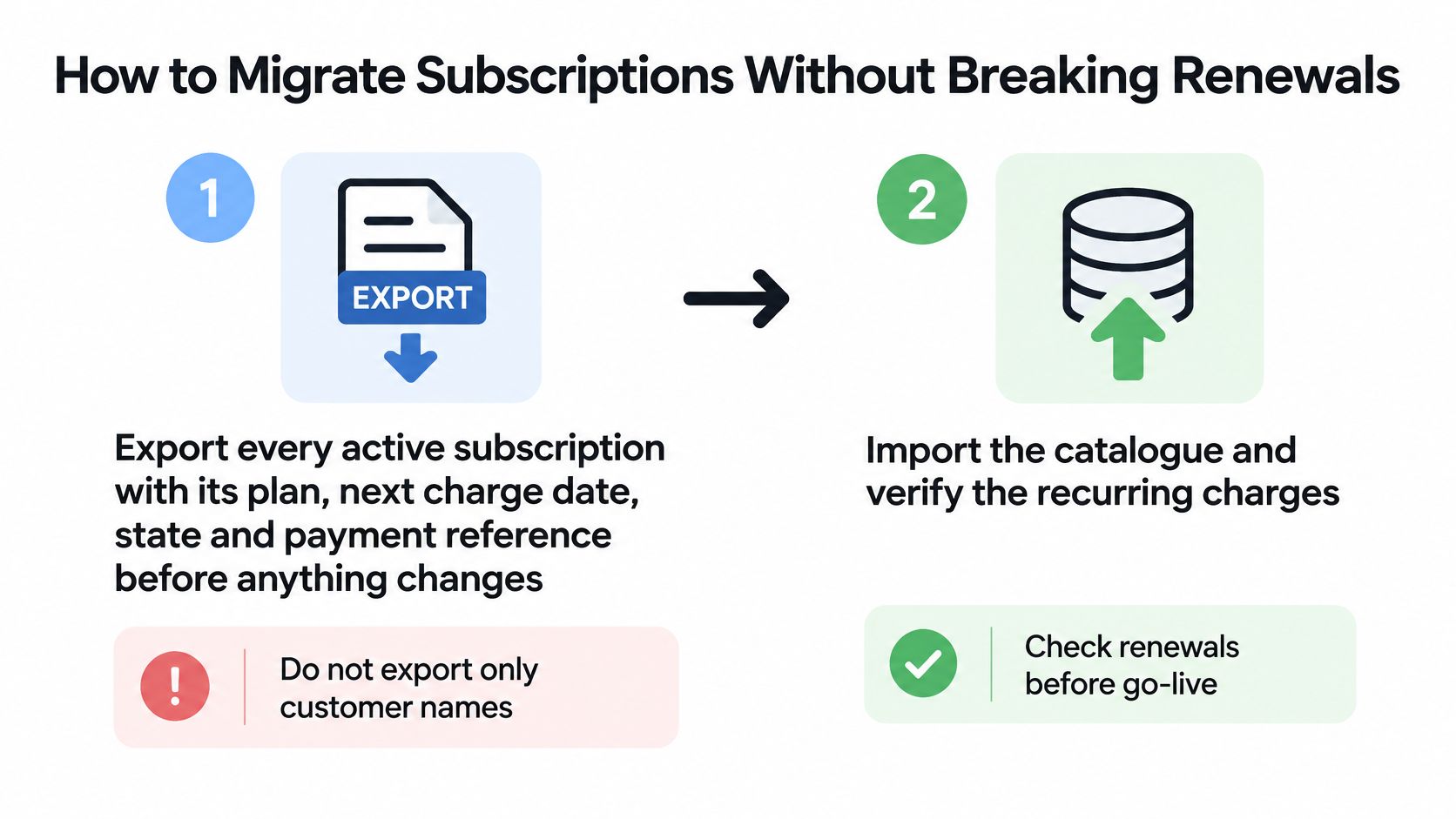
Export the operational record. Include each active subscription's plan, next charge date, state and payment reference. Retain relevant paused and past-due records, discounts, credits and cancellation instructions too; exporting customer names alone loses the billing obligations.
-
Map the catalogue and billing rules. Match old plans to new products, prices and cycles. Check time zones, renewal anchors and prepaid entitlements, because a correct product mapping can still produce the wrong next charge.
-
Run a shadow comparison. Let the old system remain the sole charging authority while the new stack calculates expected renewals through a complete billing cycle. Don't enable live charging in both systems just to compare their outputs.
-
Reconcile expected renewals. Compare amount, date, status and payment-reference mapping. Resolve mismatches before release, then disable old-system billing for the cohort before enabling the replacement.
Transfer responsibility in controlled cohorts
-
Move payment references securely. Use the processors' supported transfer process, or ask customers to re-enter their payment method through a secure form. Never copy raw card numbers into exports, tickets or spreadsheets, and don't assume existing tokens are portable.
-
Notify customers before cutover. As an operational baseline, communicate a full billing cycle ahead where feasible, allowing more time when applicable obligations require it. State any change in price, charge date, statement descriptor or customer action; a vague platform-update email isn't enough.
-
Release a small cohort first. Start with a manageable plan group and confirm that its initial live renewals settle correctly. Expand only after checking payments, order creation, customer notices and warehouse outcomes against the migration manifest.
-
Retain historical access safely. Keep the old system read-only for a defined period aligned with your record-retention obligations. Preserve invoice and dispute evidence without leaving scheduled jobs capable of charging customers.
Keep a rollback decision separate from the technical ability to switch systems. Before restarting an old scheduler, reconcile any payments already accepted by the new processor, including attempts whose responses timed out.
A successful cutover has the expected renewal count, no duplicate charges, and a traceable explanation for every changed state. Unresolved exceptions should remain assigned to an owner rather than disappear into an aggregate migration-success figure.
Confirm Your Requirements Before You Shortlist Vendors
Write your requirements before reading vendor pages. Start with the operational questions that determine whether a platform fits your business.
- Which losses matter most? Separate revenue lost through voluntary cancellation from revenue lost after failed payments. Prioritize the workflow that addresses your actual failure pattern.
- Which customer controls are necessary? Decide whether your catalogue needs skips, swaps, pauses and frequency changes, and specify when each change takes effect.
- Which systems must agree? Name the storefront, inventory, tax, returns and support records that must share the renewal outcome.
Turn those answers into acceptance tests using the selection criteria and integration checks. Assign an owner to each test so a sales demonstration doesn't become a substitute for operational sign-off.
PlatformDTC is an option to assess against that list, not a reason to change it. Request a trial renewal run and inspect the event log yourself, including the failure path rather than only a successful charge.
Choose your leading KPIs before implementation so you'll know whether the change helped. Then write a requirements document containing the core capabilities, your top three KPIs and the migration plan for existing subscriptions before opening another vendor page.
PlatformDTC combines subscription checkout, automatic renewals, failed-payment retries and subscriber self-service with recurring-revenue reporting. Visit PlatformDTC to evaluate those capabilities against your requirements and bring a renewal scenario with a decline, recovery and customer-requested change to the discussion.