Most subscription based ecommerce advice starts with a familiar target: remove every possible obstacle between a visitor and a trial. Preselected options, vague renewal language, and one-click enrollment can make an acquisition dashboard look healthy, but they often shift the cost into payment failures, support work, disputes, cancellations, and compliance exposure. A subscription isn't successful when the first charge goes through. It's successful when the customer understands the agreement, receives continuing value, and renews without operational surprises.
That requires a different operating model. Subscription commerce connects acquisition, consent, payments, orders, inventory, fulfillment, customer accounts, analytics, and retention workflows. If those records live in disconnected applications, the brand can lose customers even when the product is sound. The durable advantage comes from clear subscription design and unified infrastructure, not from making cancellation difficult or hiding the recurring commitment.
Table of Contents
- The Hidden Costs of Frictionless Subscription Growth
- Core Subscription Models and Retention Realities
- Retention Mechanics and Billing Orchestration
- Designing Subscriptions for Compliance and Trust
- Metrics That Actually Measure Subscription Health
- Unified Commerce vs Fragmented App Stacks
- Migrating to a Unified Subscription Infrastructure
The Hidden Costs of Frictionless Subscription Growth
The obsession with frictionless conversion assumes that every completed trial is valuable. That assumption breaks down when the customer didn't understand the renewal, couldn't find the cancellation control, or entered a payment method that later failed. A trial can inflate acquisition performance while creating a queue of future support tickets and disputed charges.
Transparent checkout adds useful friction. The customer should see the billing frequency, renewal timing, recurring amount, trial conditions, and cancellation method before consenting. A clearly labeled checkbox is less aggressive than a preselected option, but it produces a stronger commercial record and gives the buyer a fair chance to decide whether the subscription fits.
Practical rule: Optimize for informed enrollment, not maximum enrollment.
The cost of poor enrollment appears across the business:
- Payment operations: Expired cards, failed authentication, and bank declines interrupt renewal even when the customer still wants the product.
- Customer support: Unclear terms turn ordinary billing questions into cancellation disputes.
- Finance: Refunds, chargebacks, and reconciliation work reduce the value of recurring revenue.
- Brand trust: Customers who feel trapped may cancel every relationship with the brand, not only the subscription.
- Compliance: A flow that performs well in one market may create risk in another if consent and cancellation requirements differ.
The regulatory direction matters. Authorities are increasingly targeting subscription traps and difficult cancellation flows. In 2025, the U.S. Federal Trade Commission, 21 states, and the District of Columbia brought an amended complaint concerning alleged Uber One enrollment and cancellation practices, as described in this review of involuntary churn and subscription enforcement. The allegation itself isn't a finding that every subscription business uses deceptive practices, but it shows why growth teams can't treat checkout mechanics as a purely creative or conversion question.
A small amount of candor can improve economics over the full customer lifecycle. It filters out people who don't want a recurring commitment, reduces ambiguity at renewal, and gives the support team a defensible record of what the buyer accepted. The objective isn't to make checkout slow. It's to make the relationship understandable enough that a customer can say yes with confidence.
Core Subscription Models and Retention Realities
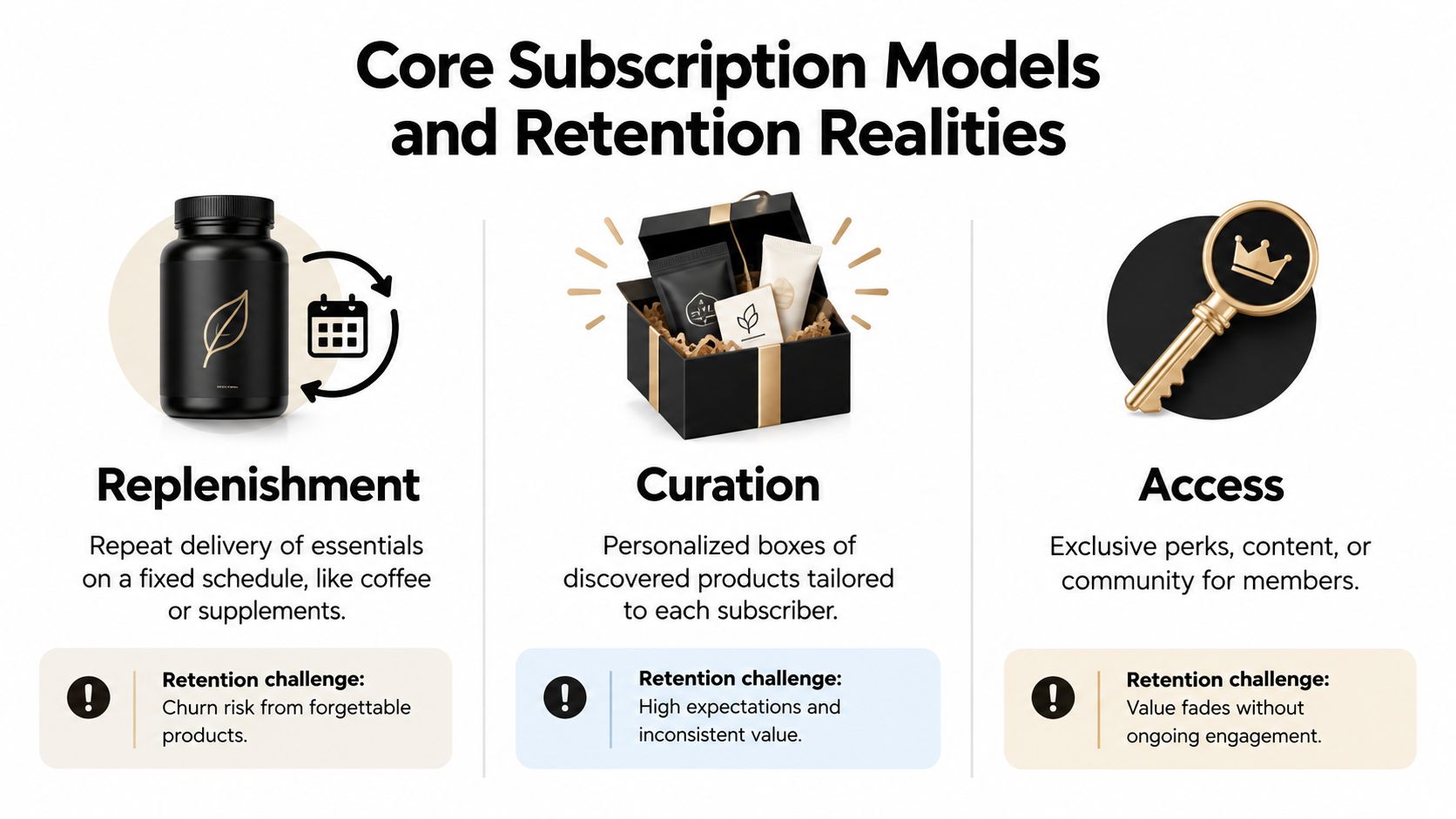
A subscription only works when the customer has a credible reason to repeat the relationship. McKinsey separates subscription ecommerce into replenishment, curation, and access, and its research provides a useful warning for operators chasing novelty. In 2018, McKinsey reported that 15% of online shoppers had subscribed to one or more recurring product services, while the subscription ecommerce market had grown by more than 100% annually over the preceding five years. These figures come from McKinsey's research on subscription-box consumers.
Replenishment solves a predictable problem
Replenishment sends products the customer already expects to use, such as coffee, supplements, pet supplies, or household essentials. Convenience drives the decision. The customer isn't paying primarily for surprise, but for continuity and fewer decisions.
McKinsey found that 45% of replenishment subscribers had remained subscribed for at least one year, approximately 10 percentage points higher than the comparable level for curation or access services. That doesn't mean every replenishment offer will retain well. Consumption timing, product quality, price changes, and delivery control still matter. It does show why predictable utility often creates a stronger retention foundation than novelty alone.
Curation sells discovery, not simply delivery
Curation assembles a selected range of products, often in beauty, food, apparel, or lifestyle categories. Its promise is expertise, personalization, and discovery. The operator must keep the experience fresh while avoiding products that feel irrelevant, repetitive, or difficult to use.
Curation needs strong preference data and a clear explanation of how selections are made. If customers don't understand the value of the editorial layer, they may compare the box with individual products and conclude that the recurring fee lacks justification.
Access must keep earning its place
Access subscriptions provide discounts, exclusive products, content, community, or other member benefits. They can work well when the customer repeatedly uses the benefit, but membership alone isn't a retention strategy. The operator must maintain the underlying experience and make the benefit visible before the renewal event.
Nearly 40% of ecommerce subscribers had canceled a subscription, according to the same McKinsey research. Use that finding as a planning constraint, not as a universal forecast. Model cancellation by subscription type, acquisition source, product usage, and tenure. A useful subscription service website guide should communicate the model's value in plain language before asking for payment.
The model also determines the customer experience. Replenishment needs flexible cadence and inventory reliability. Curation needs preference management and a compelling unboxing or discovery experience. Access needs dependable entitlements and visible benefits. Treating all three as the same recurring billing problem is a fast route to weak retention.
Retention Mechanics and Billing Orchestration
Retention work begins after acquisition, but the most preventable losses often occur during billing. A customer can remain interested in the product while a renewal fails because a card expired, a bank declined the transaction, or an authentication step wasn't completed. That is involuntary churn, and it needs a different response from a customer who consciously cancels because the value no longer fits.
The first design decision is to place subscription renewals inside the same order lifecycle as one-time purchases. The renewal should create an order, apply current pricing and promotions according to the subscription rules, reserve or allocate inventory, trigger fulfillment, record payment status, and update the customer record through one governed process. When a separate subscription app, payment tool, and fulfillment system each maintain their own version of the event, data drift becomes a customer-facing problem.
Build the recovery path before the failure
A sound billing sequence distinguishes recoverable payment problems from deliberate cancellation. The practical flow looks like this:
- Record the renewal event: Create the order and preserve the subscription, customer, payment, and fulfillment references.
- Classify the failure: Use the decline response and account state to distinguish a temporary issue, an expired method, authentication failure, or a customer decision.
- Retry intelligently: Apply retry logic that avoids blindly repeating charges while giving the customer a clear opportunity to update payment details.
- Use a defined grace period: Keep account status, fulfillment eligibility, and access rules consistent while the payment issue is being resolved.
- Close the loop: Notify the customer, record every attempt, and end or pause the subscription according to disclosed terms.
A customer portal should support pause, skip, swap, cadence changes, payment updates, and cancellation without requiring an agent to intervene. These controls don't merely reduce support volume. They give customers alternatives when the core issue is timing, inventory at home, or a temporary budget constraint.
A failed renewal is an operational event, not just a payment error.
The same logic should govern inventory. If the payment succeeds but the subscription system doesn't communicate with fulfillment, the brand can charge for an order it can't ship. If inventory changes after the renewal is scheduled, the customer should receive an approved substitution, delay, or refund path rather than an unexplained failure.
Teams evaluating the visibility and discoverability of their subscription operations can also review AI visibility with Wispra as a separate resource. The broader lesson is simple: retention depends on reliable events, clear ownership, and consistent records. A dunning sequence can't repair an architecture that loses the renewal state before the message is sent.
Designing Subscriptions for Compliance and Trust
Compliance-first UX isn't a tax on conversion. It is a way to ensure that the revenue in the dashboard represents customers who understood the commitment. A clear offer can still be persuasive, but it shouldn't depend on hiding the recurring charge or making the exit path obscure.
The U.S. Restore Online Shoppers' Confidence Act, European consumer-protection rules, and related auto-renewal frameworks create a practical design brief for subscription operators. Requirements vary by market and offer, so legal review remains necessary. Across jurisdictions, the recurring themes include transparent material terms, express consent, accessible cancellation, renewal communication where required, and records that show what the customer accepted.
Make consent specific and auditable
The checkout should state what will happen after the trial or initial purchase. Show the billing frequency, amount, renewal condition, and relevant delivery or access terms beside the decision control. Don't bury the recurring commitment in a separate terms page that the customer is unlikely to open.
Store an audit trail containing the version of the offer, consent timestamp, market or locale, displayed terms, and relevant customer action. The record should be retrievable by support, finance, and legal teams. If the checkout changes, preserve the earlier version rather than overwriting it.
Give cancellation equal dignity
Cancellation parity means the customer shouldn't need to contact support, explain a reason, or work through a maze that didn't exist during enrollment. Offer an online cancellation path that is at least as understandable as the signup path. You can ask for feedback, but don't make the survey a gate.
Renewal reminders, refund rules, localized disclosures, and payment notices should follow the requirements that apply to the customer's market and product. A global brand needs a rules layer, not a single universal flow translated into several languages.
Trust is a retention mechanism. Customers stay longer when the business makes the commercial relationship easy to understand and easy to control.
Transparent friction also protects the unit economics. It can prevent disputes before they reach the payment provider, reduce cancellation conversations caused by surprise charges, and help support agents resolve questions with a reliable record. The operator may lose some low-intent trials, but that isn't necessarily a loss. A smaller base of informed subscribers is easier to serve and more credible to forecast.
Authorities are increasingly scrutinizing subscription traps and hard-to-cancel experiences, including the alleged Uber One practices referenced earlier. That environment makes compliance a product requirement. Growth, legal, finance, and engineering should approve the same enrollment and cancellation flows rather than treating disclosure as a final copy review.
Metrics That Actually Measure Subscription Health
Monthly recurring revenue is useful for understanding the size of the subscription business, but it doesn't explain whether that revenue is durable. A growing MRR figure can conceal failed renewals, heavy discounts, weak cohorts, or acquisition costs that take too long to recover. Operators need to connect revenue with customer behavior and the cost of delivering repeated value.
Start with cohort analysis. Group subscribers by model, acquisition channel, offer, geography, product, and enrollment period. Compare replenishment, curation, and access separately because each has a different reason to renew. A single blended churn figure can make a weak curation cohort look acceptable beside a strong replenishment cohort.
Use a metric set, not a dashboard trophy
| Metric | Definition | Why It Matters |
|---|---|---|
| Net Revenue Retention | Recurring revenue retained from an existing subscriber cohort, including expansion, contraction, and cancellations | Shows whether the existing base is becoming more or less valuable |
| Subscriber CAC payback | The time required for subscriber contribution margin to recover acquisition cost | Tests whether acquisition spending matches the renewal pattern |
| Customer lifetime value | The expected contribution from a customer across the relationship, after relevant costs | Connects retention, pricing, discounting, and fulfillment economics |
| Involuntary churn rate | Subscribers lost through failed or unrecovered payments rather than an intentional cancellation | Separates billing operations from product or value problems |
| Voluntary cancellation rate | Subscribers who actively end the relationship | Points toward offer, experience, price, or product issues |
| Renewal success rate | The share of scheduled renewals that complete successfully | Measures billing continuity and dunning effectiveness |
| Cohort contribution margin | Revenue less product, fulfillment, payment, discount, support, and recovery costs for a cohort | Reveals whether retained revenue is profitable |
Discounts deserve their own analysis. A discount can reduce the initial barrier, but it may also attract customers whose willingness to pay is lower than the standard price. Compare discounted and full-price cohorts on renewal behavior, support needs, product returns, and contribution margin. Don't call a campaign successful because it produced subscribers if those subscribers fail to recover CAC or generate usable margin.
Measure the relationship, not only the invoice.
Unified customer and order records improve attribution because the business can connect the original campaign, subscription plan, renewal outcome, payment status, fulfillment cost, and cancellation reason. Fragmented systems often force analysts to reconcile identities manually, which makes channel comparisons less trustworthy. The practical question isn't only which campaign acquired the subscriber. It's which campaign acquired subscribers who renewed profitably and required manageable operational support.
Unified Commerce vs Fragmented App Stacks
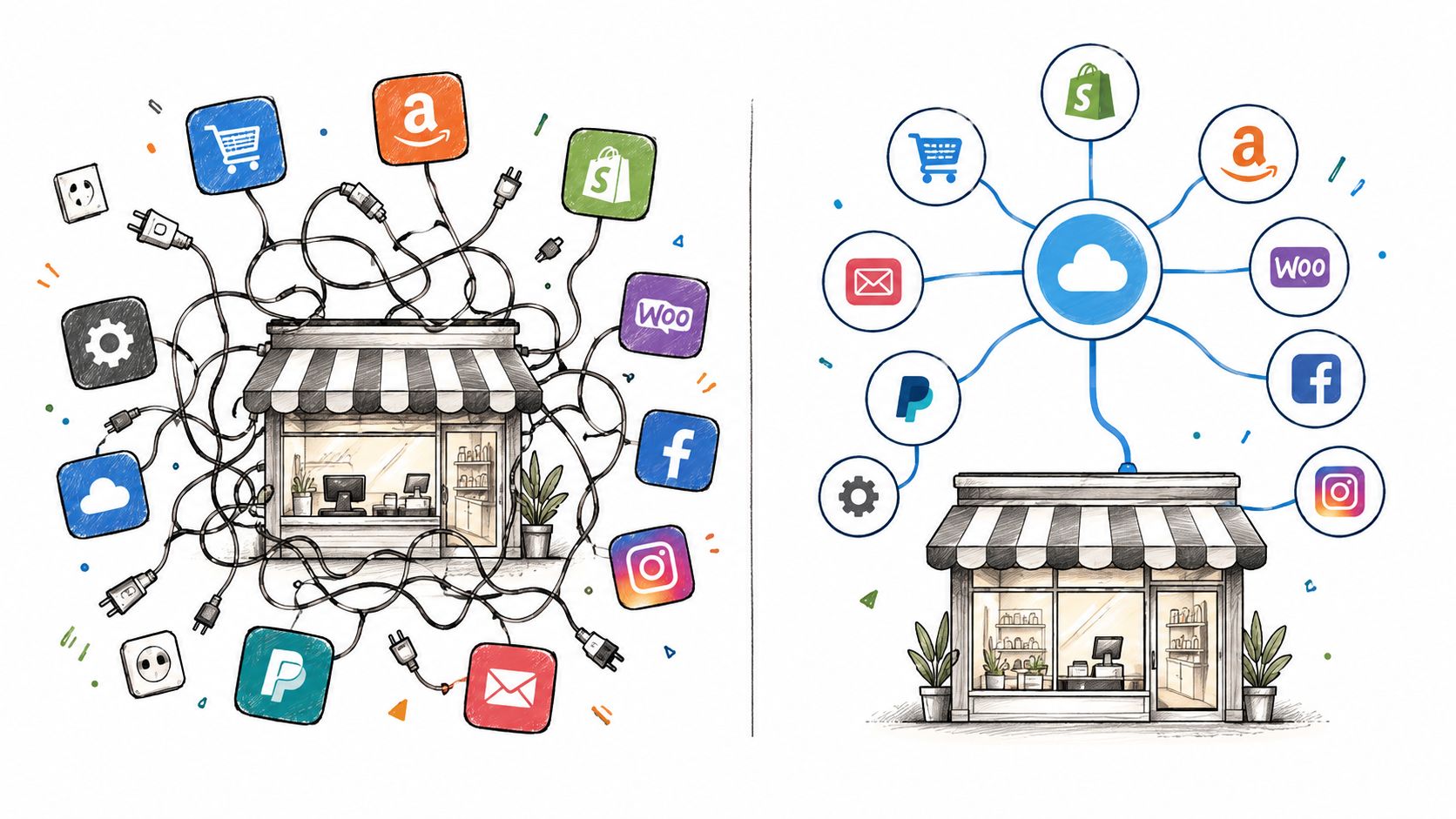
A fragmented app stack can launch a subscription offer quickly. One application manages the storefront, another owns recurring billing, another handles discounts, and separate tools track fulfillment, support, and attribution. Each tool may perform its assigned task correctly while the overall customer record becomes inconsistent.
Where fragmentation creates risk
The recurring order may use an outdated product price. The discount engine may recognize a promotion that the subscription service can't apply. Inventory may be reserved in one system but decremented in another. A cancellation may reach marketing automation while the billing record remains active. These failures aren't theoretical edge cases once a brand has multiple markets, sales channels, and plan variations.
Fragmented architecture also makes diagnosis slow. When a subscriber reports a missing shipment or unexpected renewal, support must inspect several dashboards and infer which record is authoritative. Engineering teams then maintain brittle integrations instead of improving the customer experience.
What a unified model changes
A unified platform stores storefront, subscription, payment, inventory, fulfillment, returns, and customer activity against a shared order model. The renewal remains connected to the original agreement, but it still follows the same controlled lifecycle as a one-time order. That arrangement makes status changes easier to trace and gives operations one place to inspect the customer relationship.
| Operating concern | Fragmented stack | Unified commerce model |
|---|---|---|
| Renewal state | Duplicated across billing and order systems | Managed through one lifecycle |
| Inventory | Synced through integration jobs | Available to the same order and fulfillment record |
| Discounts | Rules may differ between apps | Governed by a shared promotion engine |
| Attribution | Identity matching across tools | Connected to the customer and order record |
| Automation | Broad permissions and hidden dependencies | APIs can expose scoped actions and audit trails |
A unified commerce approach doesn't eliminate the need for specialist services or careful governance. It reduces the number of places where a subscription state can diverge. For brands assessing the architecture, this overview of unified commerce platforms can help frame the difference between adding another app and consolidating the underlying record model.
AI agents add another reason to govern the system carefully. An agent that changes a product, applies a discount, or modifies an order should operate through scoped permissions, approval gates, idempotent actions, and an audit trail. Automation is safer when it can work with the same records and lifecycle rules as human operators.
Migrating to a Unified Subscription Infrastructure
Migration is where subscription strategy meets revenue protection. A platform change can preserve the customer experience, or it can create accidental cancellations if plans, renewal dates, payment tokens, and fulfillment rules don't map cleanly. Treat the move as a controlled lifecycle migration, not a storefront redesign.
Establish the migration inventory
Begin by exporting a complete operational inventory. Include active and paused subscriptions, plan versions, products, prices, cadence, next renewal date, customer identity, shipping details, payment-token references, discounts, cancellation status, failed-payment state, and fulfillment history. Reconcile the export against finance and customer support records before importing anything.
Next, map every legacy rule to the target subscription engine. Document exceptions rather than forcing them into a generic plan. A product with seasonal cadence, a customer-specific price, or a prepaid arrangement needs an explicit treatment and an owner.
Run the new and old systems in parallel
Import the catalog and representative subscription cohorts first. Then run parallel verification against renewal calculations, order creation, payment status, inventory allocation, fulfillment triggers, customer portal actions, refunds, and cancellation behavior. Compare events rather than relying only on final totals. A successful test order doesn't prove that a failed renewal or skipped delivery will behave correctly.
A practical cutover checklist includes:
- Preserve payment references: Confirm that the target processor can use the stored payment tokens through an approved migration process. Never ask customers to re-enter payment details casually.
- Protect renewal dates: Validate the next charge and delivery date for every migrated record.
- Reconcile totals: Compare active subscriptions, expected renewals, failed payments, pauses, and cancellations between systems.
- Test recovery paths: Simulate an expired payment method, a declined charge, a refund, a skipped order, and a cancellation.
- Notify subscribers clearly: Explain what is changing, what remains the same, and how customers can manage the relationship.
- Monitor after cutover: Assign owners to payment failures, support contacts, fulfillment exceptions, and reconciliation until the new lifecycle is stable.
A carefully managed ecommerce platform migration process protects more than technical continuity. It preserves the customer's expectation about what will be charged, when it will arrive, and how the subscription can be changed. Make the cutover reversible where possible, keep an audit trail, and don't declare success until billing, fulfillment, support, and finance agree on the same records.
PlatformDTC consolidates storefront, checkout, subscriptions, payments, inventory, fulfillment, messaging, and analytics into one commerce system, with subscription renewals managed in the same order lifecycle as one-time purchases. Visit PlatformDTC to evaluate a unified infrastructure for recurring revenue, governed operations, and safer migration from fragmented app stacks.