
You've got repeat buyers, but every month starts at zero. The coffee, supplements or skincare they already reorder could arrive on schedule, if the price, renewal and cancellation experience work as one system. Get one part wrong and revenue looks predictable for a quarter, then leaks through failed cards, surprise charges and quiet cancellations.
Table of Contents
- What Subscription Based Pricing Really Means
- Tiered, Usage and Hybrid Models Side by Side
- Which Products Suit a Subscription for DTC Brands
- Revenue and Retention Metrics Worth Tracking
- Pros and Cons for Brands and Customers
- Billing and Churn Mechanics That Protect Revenue
- Compliance and Tax Rules for Recurring Charges
- Confirm Your Pricing Model Before You Launch
What Subscription Based Pricing Really Means
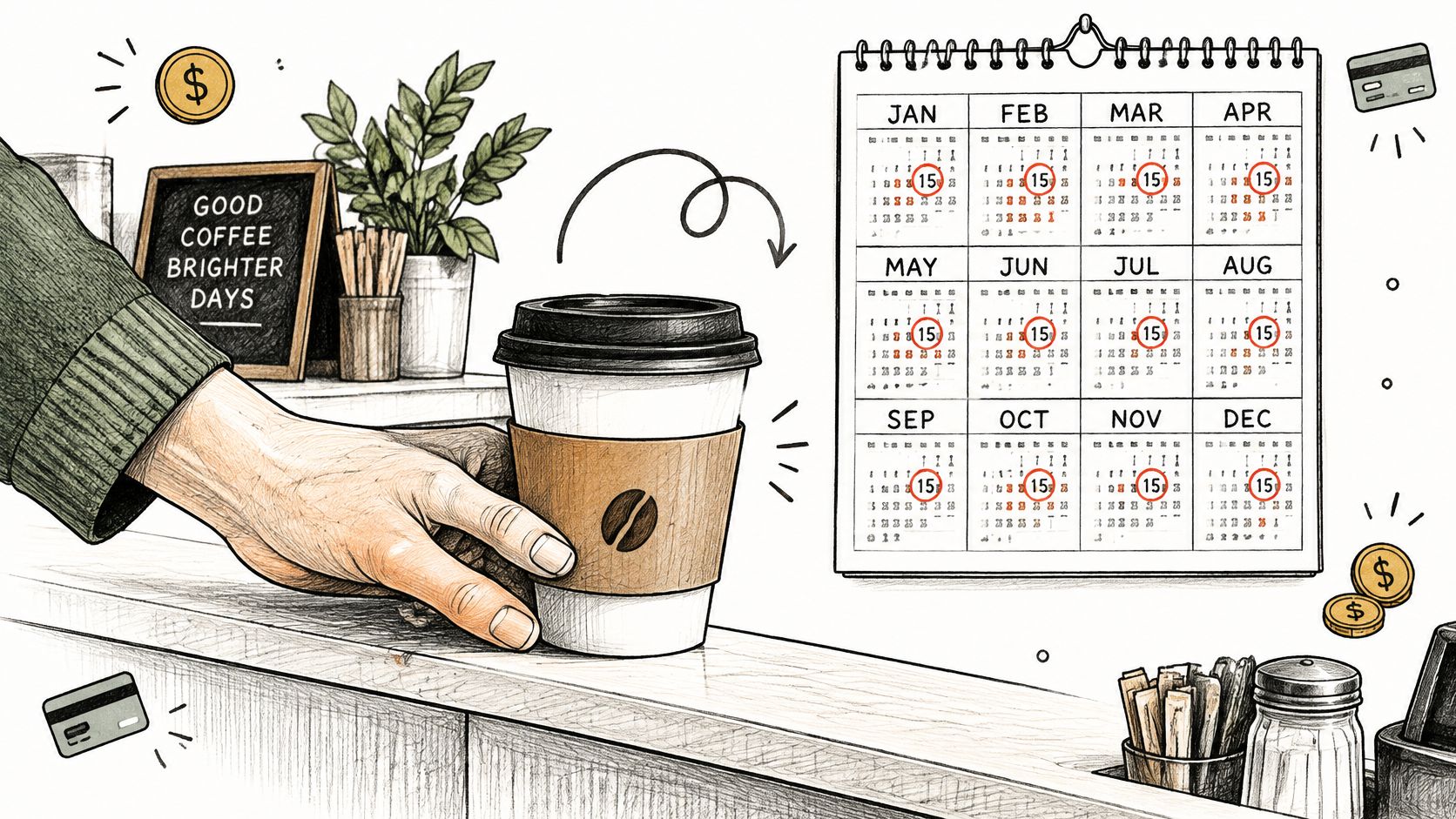
A regular at a bakery leaves a standing order for a loaf every Saturday. She doesn't decide again each week, and the baker bakes with a known order in hand. That's the core of subscription based pricing.
The customer pays a fixed fee at a set interval for ongoing access, a delivery or a service, instead of paying per transaction. A monthly coffee order works the same way, arriving without a fresh checkout decision.
Three common forms
- Membership access: Customers pay for member pricing, free shipping, exclusive products or other ongoing perks.
- Replenishment: A consumable ships on a predictable cycle, such as coffee every 30 days.
- Software style access: Customers pay to keep using a service, account or digital entitlement.
Say a box costs $34 as a one-off purchase and $30 a month on subscription. The customer saves $4 and skips reordering. You trade some margin on each order for a revenue line you can forecast before the month begins.
Don't confuse the price structure with the operation behind it. The structure sets what's charged and how often. The operation handles renewals, payment retries, pauses and cancellations. A good price attached to weak billing still loses subscribers.
Four terms cover most decisions. The billing interval is the gap between charges, a renewal is each new charge and period, a trial is a limited introductory period, and monthly recurring revenue is the subscription revenue expected in a month.
The model has commercial weight behind it. The Zuora Subscription Economy Index release reported that, from January 1, 2012, through June 30, 2019, subscription businesses represented in the index grew revenue by more than 350%, with an 18.2% compound annual growth rate compared with 3.6% for S&P 500 companies. That doesn't guarantee your outcome.
Use one test first. Does the customer need the product again on a predictable schedule? If not, you're building billing complexity around a purchase that doesn't naturally repeat.
Tiered, Usage and Hybrid Models Side by Side
| Model | How the customer pays | Revenue predictability | Main risk |
|---|---|---|---|
| Tiered | Fixed fee per plan each period | High | Customers settle on the cheapest tier |
| Usage-based (metered) | Charged per unit consumed | Low to medium | Bills vary and customers cut usage |
| Hybrid | Base fee plus usage or overage | Medium to high | Harder to explain at checkout |
| Replenishment | Fixed delivery on a set cycle with a subscriber discount | High | Skips, pauses and early cancellations |
| Per-seat | Fee per user per period | Medium | Seat counts fall between renewals |
Tiered pricing
Tiered plans present fixed choices, for example Basic at $29, Pro at $79 and Business at $199 a month. Good, better, best anchoring makes the middle plan feel reasonable, while feature gates give customers a reason to upgrade. Keep the differences obvious at checkout. If buyers can't explain why Pro costs more in one sentence, most will choose Basic.
Metered pricing charges for what's consumed, such as $0.02 per SMS after 500 included messages. Revenue rises with value delivered, and light users aren't forced into a large flat fee. The trade-off is bill uncertainty. Customers who fear an unexpected total may ration usage or avoid starting.
Hybrid and replenishment models
A hybrid combines a base fee with overage, such as $49 including 200 orders, then $0.40 per extra order. You get a predictable floor and still capture heavier use. Show the included amount, the overage rate and a worked example before payment, or the model will create support tickets.
Replenishment is simpler for physical consumables. The product arrives on a set cycle, often with a 10% to 15% subscriber discount in an illustrative offer. It works when consumption is regular enough that customers don't accumulate unused stock.
Per-seat pricing charges per user per period. It suits team software because value usually rises with headcount, but seat counts can fall before renewal. Track active seats at each renewal date and decide before launch whether removed seats stop billing immediately, at period end, or only on the annual anniversary.
Practical rule: Test the access fee and usage fee separately, because customers don't react to them in the same way.
An ACM study of a subscription market found that increasing the access price had a substantially stronger effect on customer retention than on usage, while increasing usage prices reduced consumption and affected retention more moderately, and analyses based only on observed usage underestimated price sensitivity by approximately 45% because they ignored customers who churned. Track a full renewal cycle before calling a price test successful.
A pricing model isn't just a billing setting. It tells customers what behaviour you reward, what costs you'll absorb and when they'll reconsider the relationship.
Which Products Suit a Subscription for DTC Brands
| Product type | Typical repurchase cycle | Subscription fit | Main reason |
|---|---|---|---|
| Coffee, tea and supplements | 30 to 60 days | Strong | Regular consumption and habit forming |
| Skincare and personal care | 45 to 90 days | Strong | Replenishment tied to product running out |
| Pet food and litter | 30 days | Strong | Recurring need with low price sensitivity |
| Curated boxes | 30 days | Moderate | Value depends on novelty and rotating content |
| Apparel basics | 6 to 12 months | Moderate | Works for replacement and size changes |
| Furniture and gifts | Irregular or multi-year | Weak | Long gaps between purchases |
Say a coffee brand has 1,000 active subscribers paying $30 a month. That's $30,000 in monthly recurring revenue before refunds, failed payments and one-time add-ons.
At an illustrative 5% monthly churn, it loses 50 subscribers a month. It must add 50 new subscribers just to stay flat, before any growth target enters the conversation. That replacement burden is why retention matters more than a strong launch weekend.
Run the margin check
A 15% subscriber discount on a $30 order leaves $25.50 before product cost, packaging, fulfilment, shipping and payment fees. Check contribution margin per renewal, not whether the headline price looks competitive. A subscription that needs perfect retention to repay its discount is fragile from day one.
Pet products illustrate the fit well because consumption is visible in the home and running out has immediate consequences. If you're evaluating that category, you can compare dog supplement delivery options to see how delivery cadence and product format are presented to buyers.
Apply three screening tests before pricing work begins:
- Interval test: Does the customer normally repurchase within 60 days?
- Behaviour test: Do customers already reorder without a promotion or reminder campaign doing all the work?
- Margin test: Does each renewal stay contribution positive after the subscriber discount and fulfilment?
Curated boxes need extra care. Novelty can carry the first two deliveries, but customers cancel when contents start feeling repetitive or irrelevant. Apparel basics can work as scheduled replacement, yet sizing changes and long gaps make a rigid monthly plan a poor fit.
You don't have to convert the whole store. I would add subscription as an option beside one-time purchase, learn which customers self-select into it, and expand only where renewal behaviour proves the need is real.
Revenue and Retention Metrics Worth Tracking
| Metric | Formula in plain words | Pricing question it answers |
|---|---|---|
| Monthly recurring revenue | Sum of active subscription fees in the month | Is the base growing or shrinking? |
| Average revenue per account | Recurring revenue divided by active subscribers | Are tiers or upsells lifting spend? |
| Voluntary churn | Customers who cancel divided by subscribers at period start | Is the offer or price losing customers? |
| Involuntary churn | Subscribers lost to failed payments divided by period-start subscribers | Is billing recovery working? |
| Net revenue retention | Revenue from existing subscribers now divided by their revenue before | Do expansions outweigh losses? |
| Customer lifetime value | Monthly contribution times average lifespan in months | Can we afford the acquisition cost? |
| Reactivation rate | Former subscribers who resubscribe divided by all former subscribers | Do win-back offers pay back? |
| Payment recovery rate | Failed renewals later collected divided by all failed renewals | Are retry and update flows effective? |
Read the metrics together. Rising monthly recurring revenue beside falling net revenue retention can mean new sales or price increases are masking weakness in the existing base. Higher average revenue per account isn't automatically good if voluntary churn rises among lower spending customers who were profitable.
Use contribution, not revenue, for lifetime value. Say a subscriber pays $30 a month, contribution margin is 40%, and average lifespan is eight months. That's $12 a month times eight, or about $96 in contribution. Acquisition, onboarding and any introductory subsidy must fit inside that $96.
Use cohorts, not blended averages
Group subscribers by signup month, acquisition channel, first product and starting discount. A blended churn rate can look stable while a recent paid-social cohort cancels twice as fast as an organic cohort. Cohort views show whether a pricing change altered who joins, who stays, or both.
For a fuller operating view, use the guide to subscription metrics worth tracking alongside your own cohort reports. Keep external benchmarks as context only. Your trend, split by cause, is the number you can act on.
A churn number that mixes deliberate cancellations with failed cards can't tell you whether to fix the offer or fix billing.
Review new subscriber quality after every discount or channel test. Revenue acquired through a deep first-order offer isn't equivalent to revenue from customers who joined at the normal price and renewed without intervention.
Pros and Cons for Brands and Customers
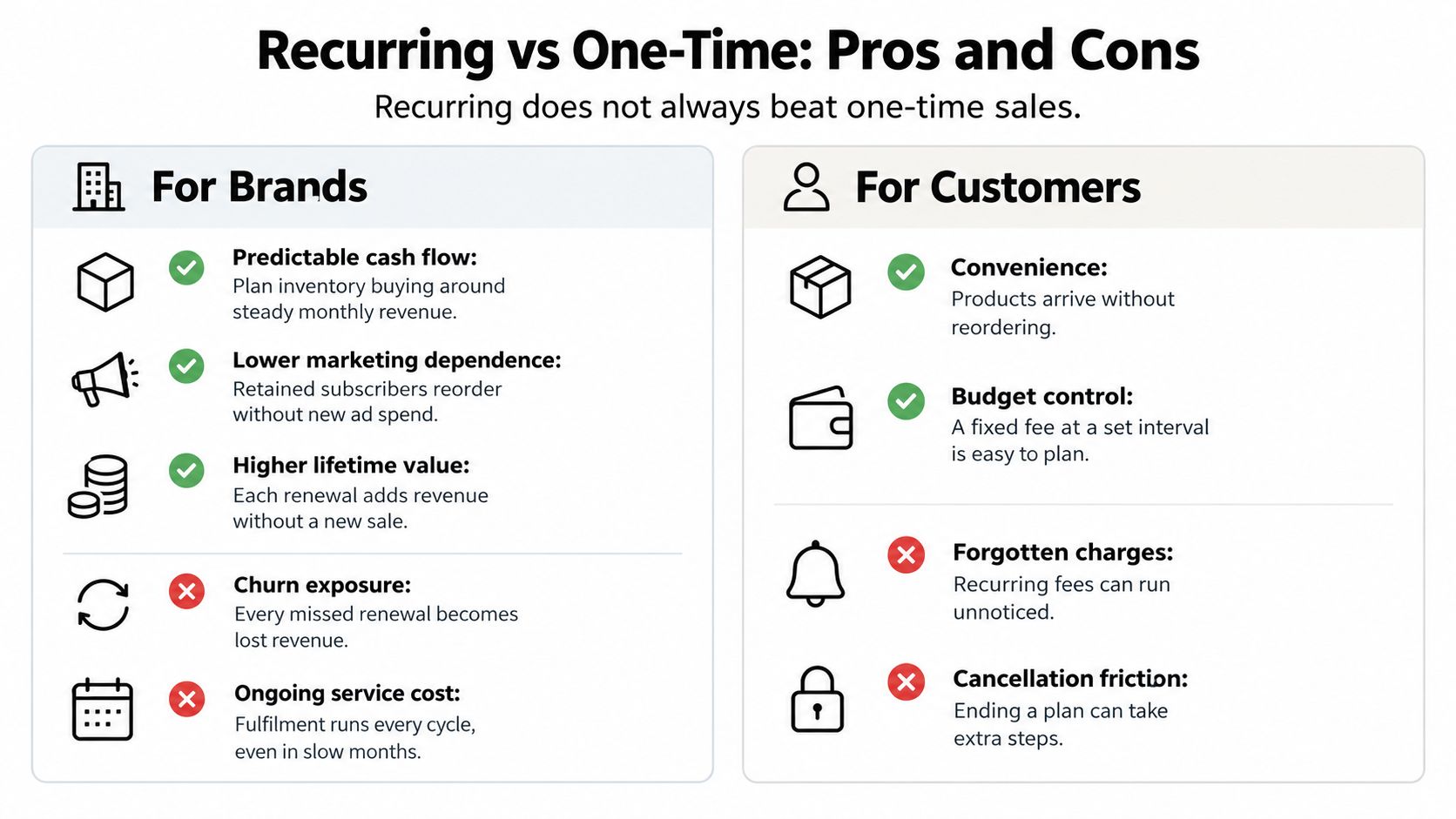
Recurring revenue doesn't always beat a clean one-time sale. A subscription adds obligations every cycle, and customers judge you again at every renewal.
For brands
- Predictable cash flow: Known renewals make inventory buying and staffing less speculative.
- Lower marketing dependence: Retained subscribers reorder without another paid click.
- Higher lifetime value: Each renewal adds revenue from an existing relationship.
- Useful first-party data: Skips, pauses and product swaps reveal real consumption patterns.
The drawbacks are equally concrete. Churn compounds unnoticed, price rises provoke cancellations, billing exceptions generate support work, and recurring charges carry more compliance exposure than a single transaction. Fulfilment also continues in slow months, whether demand elsewhere falls or not.
For customers
Customers gain convenience, a steady discount and fewer stockouts. Pause and skip controls let them match deliveries to actual use. The downside is forgotten charges, fatigue from managing many subscriptions and frustration when leaving takes longer than joining.
Refillable household products show the customer's calculation clearly, because the benefit depends on use rate and storage space as much as price. The discussion around choosing a Fillaree refill routine is useful context for how buyers weigh commitment against convenience.
There's room to earn renewals on value. The Zuora Subscription Economy Index 2025 release reported that, in 2025, 84% of surveyed U.S. consumers said their subscriptions delivered either the same value or greater value than the previous year, based on a Harris Poll of 3,087 adults.
If you're mapping the customer-facing experience, this overview of a subscription service website shows the account and offer elements that need to work together.
Subscriptions reward products that earn repeat use. They penalise brands that depend on customers forgetting.
Billing and Churn Mechanics That Protect Revenue
A card expires on renewal morning. The charge fails, no order is created, and the box never ships. The customer did not cancel, but the revenue is lost unless your recovery process catches the failure.
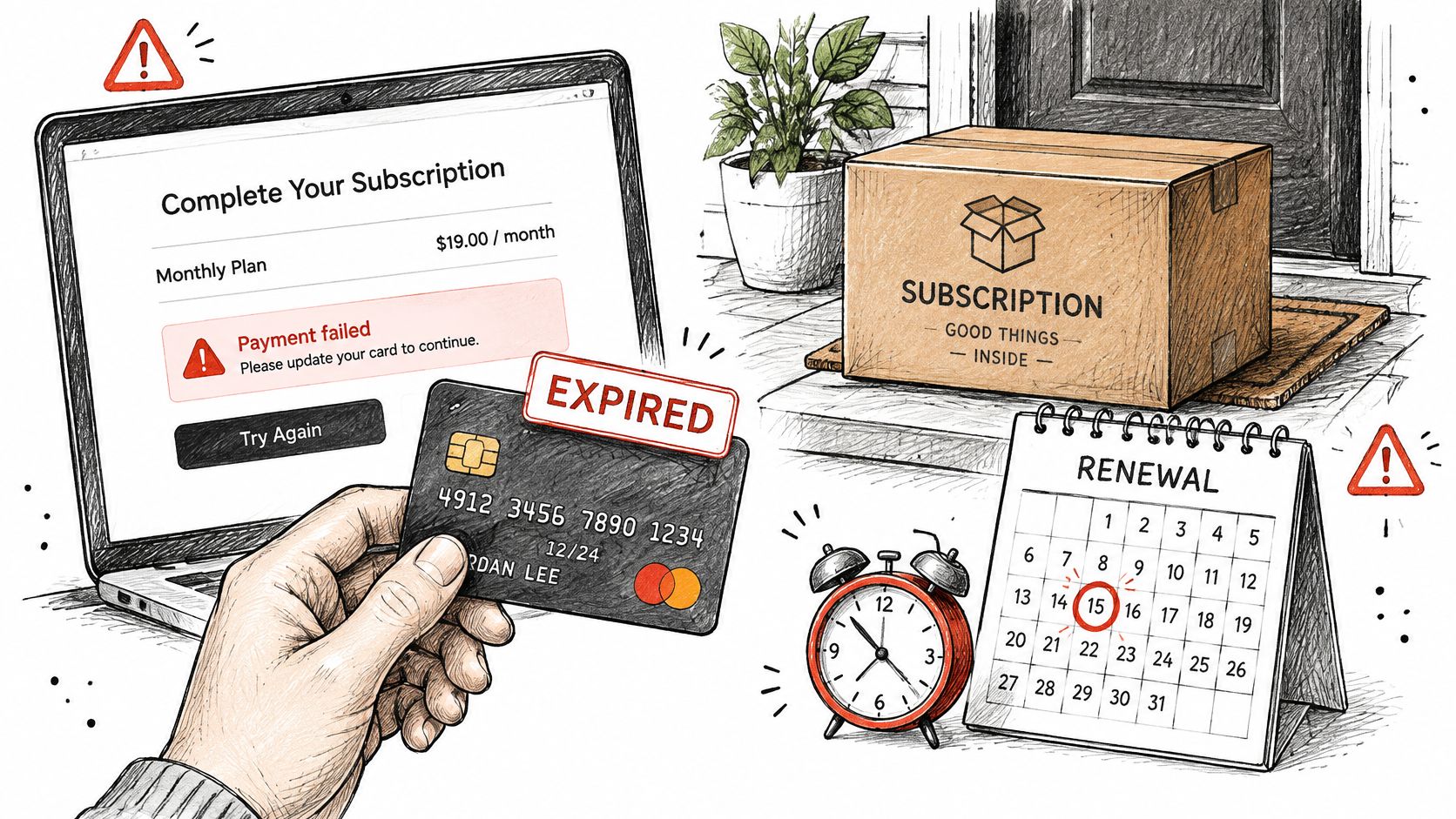
Set four mechanics before launch: the billing interval and anchor date, trial length and conversion terms, proration for mid-cycle plan changes, and how renewals connect to order fulfilment. Keeping renewals in the same order lifecycle as one-time purchases helps prevent duplicate shipments. PlatformDTC manages subscription renewals within that shared lifecycle. This review of subscription billing software options can help compare how billing systems handle these mechanics.
Separate failed payments from cancellations
The Recurly-based involuntary churn benchmark summary reports average subscription churn of about 3.27%, with roughly 2.41% voluntary churn and 0.86% involuntary churn. Payment failures therefore account for close to one quarter of total churn in that benchmark. Handle them differently from deliberate cancellations.
Build a recovery sequence:
- Run a card account updater before renewal: Replaced cards can interrupt a subscription the customer still wants.
- Retry by decline type: Space out retries for temporary failures and avoid repeated attempts on hard declines.
- Set a grace period: Pause fulfilment if needed while preserving the subscription during payment recovery.
- Send a direct update link: Explain the failed charge and take the customer straight to payment details.
- Give a final notice: State when the subscription will end before closing it.
Retries that are too aggressive can create issuer problems and customer complaints. Immediate termination can turn a fixable card issue into lost revenue. The right sequence gives the customer a clear chance to update payment without shipping an unpaid order.
The walkthrough below shows how renewal and recovery states can appear to the customer.
Pause and skip options give customers an alternative to cancelling outright. A Mastercard subscription economy report reports that 31% of consumers frequently cancel and resubscribe. That pattern makes flexible controls part of retention, not just account settings. The price a customer sees, the renewal they experience and the ease of pausing or cancelling work as one system: a surprise charge or a difficult exit can make otherwise useful pricing feel fragile.
Give clear notice and a plain explanation before raising prices. The Zuora 2025 Subscription Economy Index resource reports that among U.S. consumers who cancelled a subscription in 2024, 47% cited a price increase, based on Harris Poll research. Advance notice gives subscribers a chance to assess the new price against the value they receive.
Compliance and Tax Rules for Recurring Charges
A customer should see the price before subscribing, understand what happens at renewal, and be able to end the plan without friction. If any part of that system is unclear, the result can be complaints, chargebacks and regulatory exposure. Set the disclosures and cancellation process alongside the pricing model.
United States renewal rules
US state automatic renewal laws generally require clear terms before purchase, consent to recurring charges and a reasonably simple cancellation route. Details vary by state, product and offer, including trial conversion terms and whether renewal reminders are required. Make the checkout and account flow match the rules in each state you serve.
The federal negative option rule has faced court challenges. Existing consumer protection laws and state requirements still apply, so a challenge to one rule is not permission to obscure renewal terms or make cancellation difficult. Confirm the current requirements before launch and when the rules or your offer change.
Treat refund terms with the same clarity. If you offer a guarantee, explain when it starts, who qualifies and what return conditions apply at the point of purchase. The article on understanding the 30-day refund window illustrates how to make those conditions clear to customers.
Europe, the UK and total price disclosure
EU and UK rules emphasize pre-contract information, withdrawal rights and clear recurring terms. Online withdrawal requirements are being phased in, so confirm the current rules for each country you serve and make sure the online cancellation process meets them.
Show the total payable price where the price first appears. Include recurring fees and known add-ons, and explain how tax is treated. South Korea offers a useful example of why this matters: a BKL summary of South Korea's subscription policy changes reported that 34.0% of consumers experienced unexpected additional charges at payment and 31.0% encountered insufficient transaction-information disclosure. The policy response taking effect in February 2025 requires the total payable price to appear on the initial screen where pricing is first shown.
If the customer needs the payment screen to discover the real recurring total, the pricing page hasn't done its job.
Taxes can change what customers pay even when the base price stays the same. VAT or GST may apply to recurring physical and digital supplies. In the US, sales tax obligations depend on state nexus rules and product taxability. Decide whether displayed prices include tax in each market, then check the amount customers will be charged in practice by location.
Keep records that let your team reconstruct the full subscription agreement and its changes:
- Consent record: Customer, offer, timestamp and accepted terms.
- Price history: Version, effective date and any grandfathering rule.
- Communications: Renewal reminders, price-change notices and cancellation confirmations.
- Action log: Pauses, skips, payment updates and reactivations.
Have qualified legal and tax advisers review the rules in each jurisdiction before launch, and again before material changes to price or terms. The price customers see, the renewal they experience and the way they can leave all need to work together.
Confirm Your Pricing Model Before You Launch
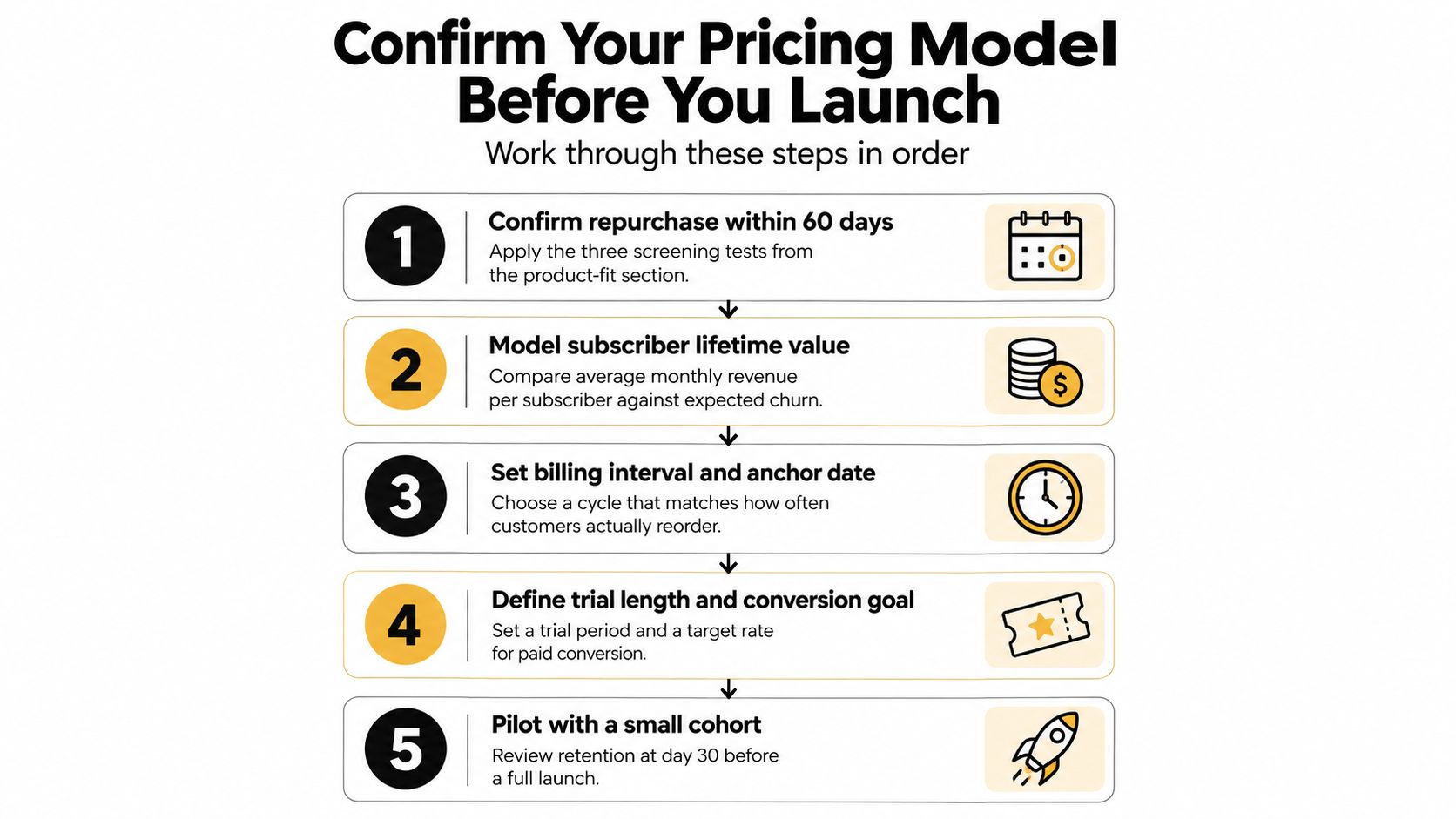
- Confirm repurchase within 60 days using the interval, behaviour and margin tests.
- Pick one primary model and add a hybrid element only if you already have reliable usage or overage data.
- Set the subscriber discount and verify contribution stays positive after fulfilment and payment fees.
- Publish the total price, tax treatment and renewal terms on the first screen, then test cancellation end to end.
- Configure dunning, pause and skip before the first subscriber joins.
- Run a pilot with a holdout group, measure one full renewal cycle, and segment by channel, geography and tenure.
If you're migrating, run the new subscription stack in parallel with the old one and verify customer, order and renewal records before cutover. Don't discover missing payment tokens on renewal day.
Launch one product line, measure one full cycle, then expand.
PlatformDTC brings subscriptions, checkout, payments, inventory, fulfilment and analytics into one system, so renewals run in the same order lifecycle as one-time purchases. If you're building subscription based pricing without stitching together separate billing and storefront tools, visit PlatformDTC to see how the platform handles the full workflow.