
A subscription service website doesn't fail because the landing page was weak. It usually fails later, when the second or third renewal hits a stale card, the billing cadence doesn't match usage, or the customer can't easily skip without canceling. That's the key reframing.
The strongest data point on that shift isn't a conversion benchmark. It's scale. One independent 2026 market summary estimates the subscription economy at about $330 billion in 2026, growing around 12% annually, while another report projects subscription e-commerce to rise from USD 180.48 billion in 2025 to USD 206.26 billion in 2026 and reach USD 402.2 billion by 2031 at a 14.28% CAGR. Those are projections, but they make the point clearly. Subscription service websites now sit at the center of real retail infrastructure, not a niche add-on to checkout (subscription commerce projections for 2026 and beyond).
After migrating three brands off fragmented app stacks, the pattern was consistent. Teams spent too much time debating PDP layout and too little time on renewal reliability, card recovery, annual plan design, and cohort reporting. The brands that held revenue past month six treated the lifecycle as the product. The ones that struggled treated subscriptions like a theme customization.
Table of Contents
- Why a Subscription Service Website Is a Lifecycle Problem
- Choosing the Right Subscription Product Model
- Designing Storefront, Checkout, and Payments for Repeat Buyers
- Setting Up Billing Cycles That Match Customer Behavior
- Building a Dunning System That Recovers Failed Payments
- Tracking the Subscription Analytics That Actually Matter
- Consolidating the Stack and Shipping Your Subscription Site
Why a Subscription Service Website Is a Lifecycle Problem
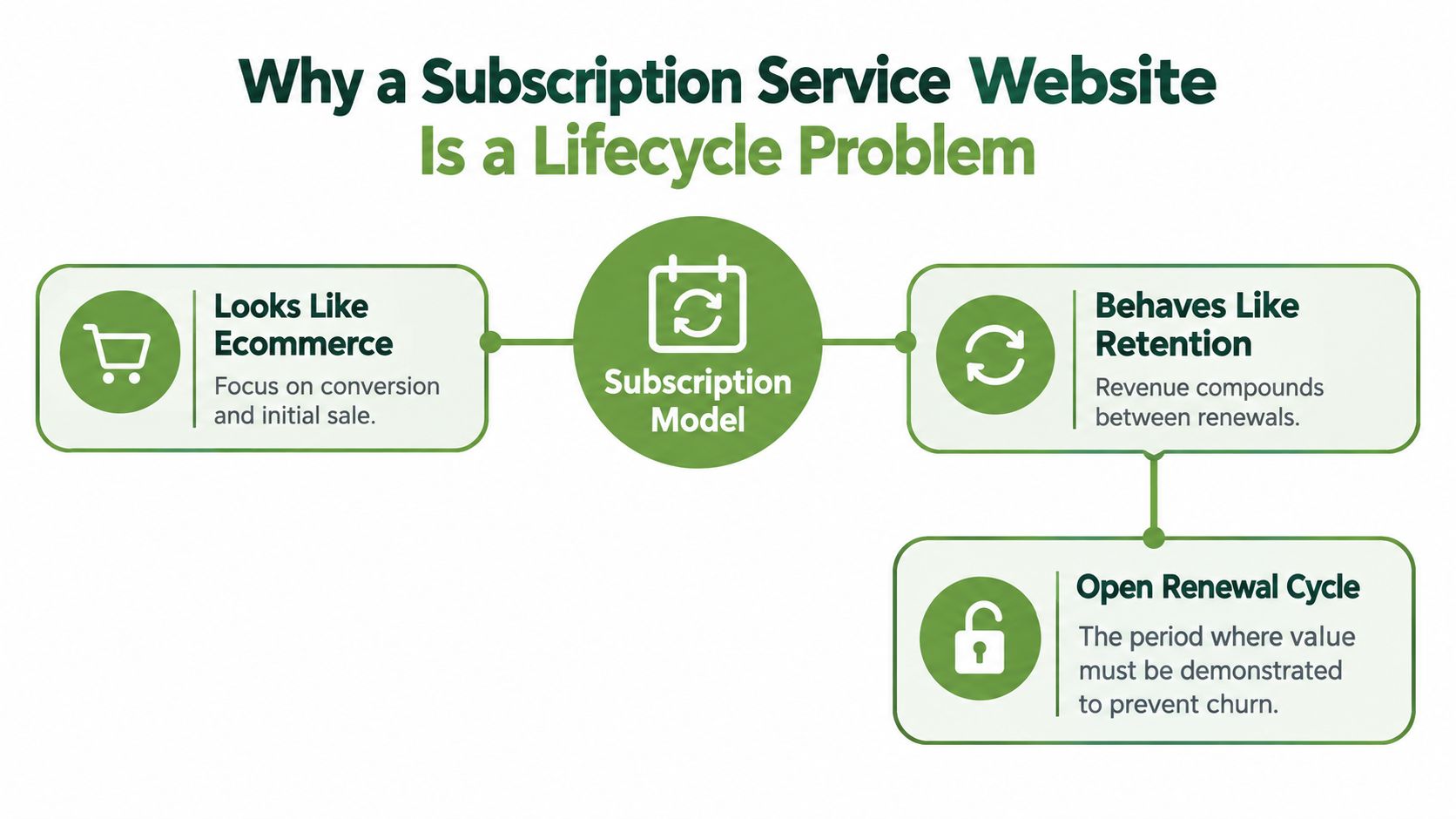
A subscription service website looks like ecommerce on the surface. There's a product page, an offer, a checkout, and a first order. But once the first transaction clears, the economics stop behaving like ordinary retail.
A one-time store can survive on merchandising and acquisition bursts. A subscription business can't. It has to earn the next charge repeatedly, and it has to collect that charge reliably. That changes what matters operationally. Billing success, trial conversion, customer self-service, second-order behavior, and cancellation friction all become product decisions.
The website is only the front door
Recent industry reporting shows subscription businesses stabilizing at roughly 3% acquisition rates and about 12.6% overall subscription growth, while a separate 2026 benchmark report cites average churn around 3.60%, with 2.34% voluntary churn and 1.25% involuntary churn (Recurly state of subscriptions benchmarks). I care less about the exact benchmark than what it tells operators. This is now a measurable operating system.
That means a subscription service website should be built around a few inputs and outputs:
- Inputs that operators can influence: activation, billing cadence, payment method quality, dunning logic, plan mix, skip behavior
- Outputs that reveal real health: MRR composition, renewal success, cohort retention, contraction, and churn
- Behavior that links the two: what the customer does between signup and the next invoice
Practical rule: If your team only reviews conversion rate and first-order AOV, you're not managing a subscription business yet.
What usually breaks first
In practice, the failure points show up in a predictable order:
- Wrong plan structure: the product doesn't fit the cadence being sold.
- Clumsy first checkout: the customer starts on subscription but hits unnecessary friction.
- Weak billing design: renewals happen on dates that don't match use or shipment timing.
- No recovery layer: failed charges turn into churn.
- Blurred reporting: one-time and recurring orders live in different systems, so nobody trusts the numbers.
Operators often treat these as separate tools or app categories. They aren't. They're connected parts of the same lifecycle. If cadence is wrong, dunning gets noisier. If self-service is weak, support load rises. If analytics are stitched together, you don't know whether retention is improving or just being masked by new signups.
Choosing the Right Subscription Product Model
Most subscription mistakes start before platform selection. They start when the founder hasn't decided what kind of subscription they're selling. The model drives everything downstream, including catalog structure, account logic, checkout copy, and cancellation pressure.
Four models that behave differently
| Subscription Product Model Comparison | What It Sells | Primary Churn Risk | Catalog Implication | Checkout Must-Have |
|---|---|---|---|---|
| Replenishment | Predictable repeat consumption | Overstock, underuse, mistimed renewals | Stable SKU mapping and delivery intervals | Clear delivery frequency selector |
| Curation | Surprise and discovery | Perceived value drop when boxes feel repetitive | Rotating assortments and preference data | Skip, swap, and gift controls |
| Access | Digital entitlement or gated utility | Low ongoing usage or unclear value | Account permissions matter more than SKU depth | Login creation and entitlement clarity |
| Member model | Paid relationship, status, or wholesale access | Weak member benefits or poor onboarding | Membership tiers and benefit rules | Eligibility, renewal terms, and account visibility |
Replenishment is the cleanest model operationally. Think supplements, razors, coffee, pet food, or household staples. Customers understand why they're being charged again because the use case is obvious. The hard part is matching refill timing to actual consumption, not just pushing the shortest interval.
Curation is harder than many teams admit. You're asking the customer to renew before they know exactly what they'll get next. That means your site has to support preference collection, skip windows, and enough control to keep surprise from becoming frustration.
Match the model to the system
Access businesses, like memberships, software, digital media, and premium content, don't sell a box at all. They sell access rights. In those builds, account state is more important than fulfillment logic. The checkout has to make the entitlement clear, and the post-purchase flow has to get the customer into the product fast.
Member models sit in between commerce and community. These need approval rules, segmented benefits, or special pricing that isn't visible to everyone. If you're evaluating tooling for that kind of setup, it helps to look at what a platform exposes at the subscription layer, not just the storefront layer. Platform feature sets like subscription functionality for DTC brands are useful here because they show whether the subscription object can support the commercial model you're running.
Curation brands usually overinvest in homepage polish and underinvest in account controls. Replenishment brands often do the reverse.
A good litmus test is simple. If you removed the word “subscription” from the site, would the product still make sense? If yes, you probably have a replenishment or curation offer. If no, you're likely selling access or membership, and the account experience should lead the build.
Designing Storefront, Checkout, and Payments for Repeat Buyers
Repeat buyers don't shop like first-time browsers. They aren't there for exploration. They're there for reduced effort. A good subscription service website respects that from the product page forward.
Put the recurring choice on the product page
The most common mistake is hiding the subscription option behind a separate explainer page or inside checkout. That adds uncertainty right where the customer wants confidence. Show the one-time purchase and the subscribe-and-save option on the PDP itself. Make the billing interval visible. Make the savings visible. Make the delivery expectation visible.
The toggle matters because it frames the decision correctly. The customer isn't choosing between two unrelated offers. They're choosing whether convenience and pricing justify an ongoing commitment.
A strong PDP for subscriptions usually includes:
- A clear one-time versus subscription selector: no modal, no redirect, no buried widget
- Cadence controls near the buy button: monthly, quarterly, or annual where relevant
- Policy clarity: pause, skip, swap, and cancel access linked from the purchase area
- Account expectation: whether the customer can manage future orders themselves
Optimize for stored payment quality
The first order is also the setup step for future renewals. That's why saved payment methods matter so much. If checkout supports express wallets and tokenized card storage cleanly, future renewals inherit that quality.
Useful options in practice include Apple Pay, Google Pay, PayPal, Link, Amazon Pay, and Klarna, depending on market and customer profile. The point isn't to stuff the page with logos. The point is to let the buyer choose a payment instrument they're likely to keep active.
Here's the practical setup I'd choose most of the time:
- Use a short checkout path: fewer screens, fewer drop-offs
- Enable address autocomplete: less friction at first purchase
- Support wallet payments: especially on mobile
- Store the payment method for renewals: with clear consent and policy language
- Handle authentication cleanly: especially where strong customer authentication or 3DS can interrupt the flow
A renewal should feel invisible when things are working. The customer notices the product arriving, not the charge processing.
One caution. Don't design the checkout purely for initial conversion if the payment method mix creates weaker downstream renewals. Sometimes the highest-converting first-order method isn't the most durable one for recurring billing. Operators should test that trade-off, not assume the first-order winner is also the best subscription instrument.
Setting Up Billing Cycles That Match Customer Behavior
Billing cadence isn't a formatting choice on the pricing page. It controls when the customer feels friction, when inventory gets committed, and how much room your team has to prove value before the next decision point.
Monthly isn't the default just because it's common
The strongest benchmark on cadence is the retention gap between annual and monthly plans. One benchmark synthesis reports annual prepay subscribers retain at roughly 2.5x the rate of monthly subscribers over 12 months, with 28% versus 11% retention, and estimates monthly-equivalent churn of 0.5% to 1.5% for annual plans versus 5% to 8% monthly churn for comparable monthly plans (annual versus monthly subscription churn benchmarks).
That doesn't mean annual is always better. It means annual removes repeated renewal decisions. If the product delivers clear value, that matters a lot. If the product is unproven, annual can create buyer hesitation up front.
| Billing Cadence Trade-Offs | Cash Flow Impact | Typical Churn Risk | Best Fit Product | Pricing Page Treatment |
|---|---|---|---|---|
| Monthly | Frequent revenue collection, less upfront commitment | Highest exposure to repeated renewal decisions | Entry-level access, low-risk trials, flexible replenishment | Keep visible as the easy entry option |
| Quarterly | Balanced cash collection and reduced payment frequency | Moderate risk when usage aligns to cycle | Replenishment with longer consumption windows | Present as the practical default when usage supports it |
| Annual | Pulls revenue forward and reduces renewal frequency | Lower ongoing decision pressure if value is proven | Access products, memberships, strong repeat behavior | Highlight savings clearly without hiding monthly |
The right cadence depends on what the customer consumes
Quarterly is underrated for physical goods. If customers don't use the product every month, a monthly plan can manufacture churn by charging too soon. Teams often misread that as weak demand when it's really poor cadence design.
For pricing presentation, keep the structure simple:
- Lead with the plan logic, not the discount math: “delivers every 90 days” is clearer than a savings banner alone
- Show the economic difference transparently: the customer should understand why one option costs less over time
- Avoid burying monthly: forcing annual too aggressively can hurt trust
- Tie the billing date to the ship date: silent drift between those two creates support tickets fast
Billing engine details that matter more than teams expect
Operators should configure proration rules before launch, not after the first support wave. The same goes for pause versus skip behavior. Pause works well when the customer needs a temporary stop. Skip works better when they still want the subscription relationship but need to push one cycle.
Gift-style prepaids need their own reporting treatment. If they're mixed into normal recurring cohorts, retention reads get distorted. So do staggered anchor dates when migrations bring in customers with inherited billing schedules.
The strongest subscription setups keep one operational rule in place. The date you bill and the date you ship shouldn't diverge unless the product model requires it and the customer understands why.
Building a Dunning System That Recovers Failed Payments
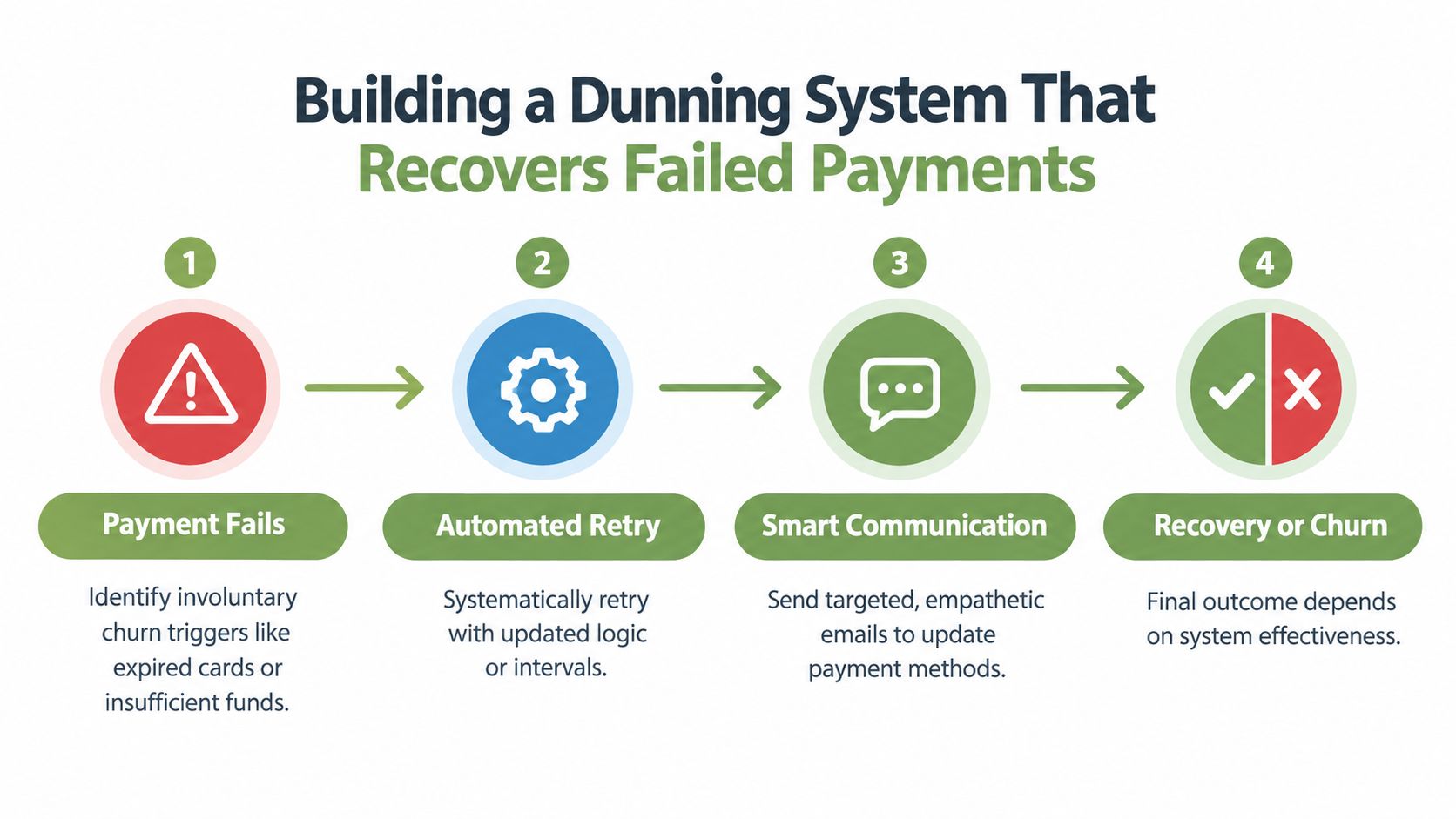
Most subscription teams focus on cancellation prevention and ignore the more solvable problem. Failed payments. That's a mistake because involuntary churn is often less about customer intent and more about billing mechanics.
One industry analysis says 68% of all churn is involuntary from payment failures, while another benchmark notes 7.2% of subscribers may be lost each month to involuntary churn if decline management isn't deployed (subscription retention and failed payment benchmarks). Another benchmark summary says involuntary churn can account for 20% to 40% of total subscription churn, with failed-payment churn at 0.86% of monthly churn across 1,500+ subscription sites, and again notes that about 7.2% of subscribers can be lost each month from declines if no decline-management strategy is used (involuntary churn benchmarks for subscription businesses). If you've ever watched a “healthy” subscription brand leak renewals while paid acquisition still looks fine, this is usually why.
Build recovery before you need it
A useful dunning system has four parts.
-
Pre-renewal prevention Run card checks before the renewal date where your payment stack allows it. Expiring cards and stale payment methods are easier to fix before a charge fails than after an order is blocked.
-
Retry logic Don't fire repeated attempts at random times. Space retries with purpose. Soft declines often recover. Hard declines often require a new payment method.
-
Card updater support If the gateway supports automatic card updates, enable it. It's one of the few retention levers customers barely notice and operators feel immediately.
-
Segmented communication A generic “payment failed” email is too blunt. “Your bank declined the charge” and “your card expired” are different problems and should trigger different instructions.
For teams that need a simple reference, this explanation of dunning in ecommerce subscriptions is the right conceptual frame. Dunning isn't just reminder messaging. It's the full recovery workflow around failed recurring charges.
Message by decline type, not by template
The communication layer should stay calm and direct. No guilt language. No fake urgency on the first touch. Give the customer one clear action.
A practical pattern looks like this:
- First touch: email soon after the failed payment with a direct update link
- Second touch: another attempt after a short delay, with alternate payment options if supported
- Third touch: SMS if consent exists and the account still hasn't been updated
- Final state: cancel only after the system has exhausted recoverable paths
The fastest way to lose recoverable revenue is to send the same message to every decline reason.
I'm opinionated here. Dunning should sit close to the billing engine, not as a disconnected messaging hack. If retries, order state, and communication events live in separate systems, support sees one story, finance sees another, and the customer gets both.
Tracking the Subscription Analytics That Actually Matter
Most dashboards for subscriptions are too busy and too shallow at the same time. They show sessions, conversion rate, top products, and campaign clicks, but they don't explain whether the subscription base is strengthening or hollowing out.
Watch four metrics first
The four metrics I'd instrument first are the ones that answer operational questions, not just growth questions.
| Subscription Metrics That Predict Health | What It Measures | Healthy Benchmark | How to Read It |
|---|---|---|---|
| MRR waterfall | Change in recurring revenue from new, expansion, contraction, and churn | No universal benchmark | The mix matters more than the headline total |
| Cohort retention by signup month | Whether each intake month stays active over time | No single benchmark | Compare curves, not just current subscriber count |
| Involuntary churn rate | Revenue loss from failed payments rather than cancellation intent | See earlier benchmarks tied to your billing setup | If this rises, audit decline reasons and recovery flow |
| Payment recovery rate | How much failed recurring revenue is recovered | No universal benchmark | Read it alongside retry timing and card updater usage |
MRR should never be a single number on its own. Break it into new, expansion, contraction, and churn. That tells you whether growth is real or whether annual prepaids are flattering the month.
Cohort retention is the report I trust most. It shows whether customers who joined in one month behave better or worse than those from another month. If a new offer increases signup volume but weakens the shape of future retention curves, you didn't improve the business. You bought a louder first month.
Tie every event back to one customer record
Involuntary churn rate is only useful when it's linked to charge attempts and decline outcomes. Payment recovery rate is only useful when it's linked to the retries and messages that created it. That sounds obvious, but many teams still measure “recoveries” in a tool that doesn't own the final order state.
A strong instrumentation setup should capture:
- Every recurring charge attempt
- Every failure reason that the payment stack exposes
- Every retry event
- Every customer update to payment method
- Every skip, pause, cancel, and reactivation
- Every communication touch tied to the same timeline
If you need a simple operating checklist, these subscription metrics to track are the right starting categories. What matters is less the dashboard vendor and more whether finance, lifecycle, support, and operations are all reading the same underlying record.
Healthy subscription reporting answers “why did revenue move?” not just “did revenue move?”
Consolidating the Stack and Shipping Your Subscription Site
Fragmented stacks create fake clarity. Each app has a dashboard. Each dashboard says something useful. None of them fully agree. That's how teams end up debating churn with three versions of the same customer.
Why consolidation changes execution
After migrations, the biggest win usually isn't visual. It's operational. One order record, one subscription record, one customer timeline. When orders, renewals, retries, messaging, and analytics all point at the same object, decisions get faster and support gets cleaner.
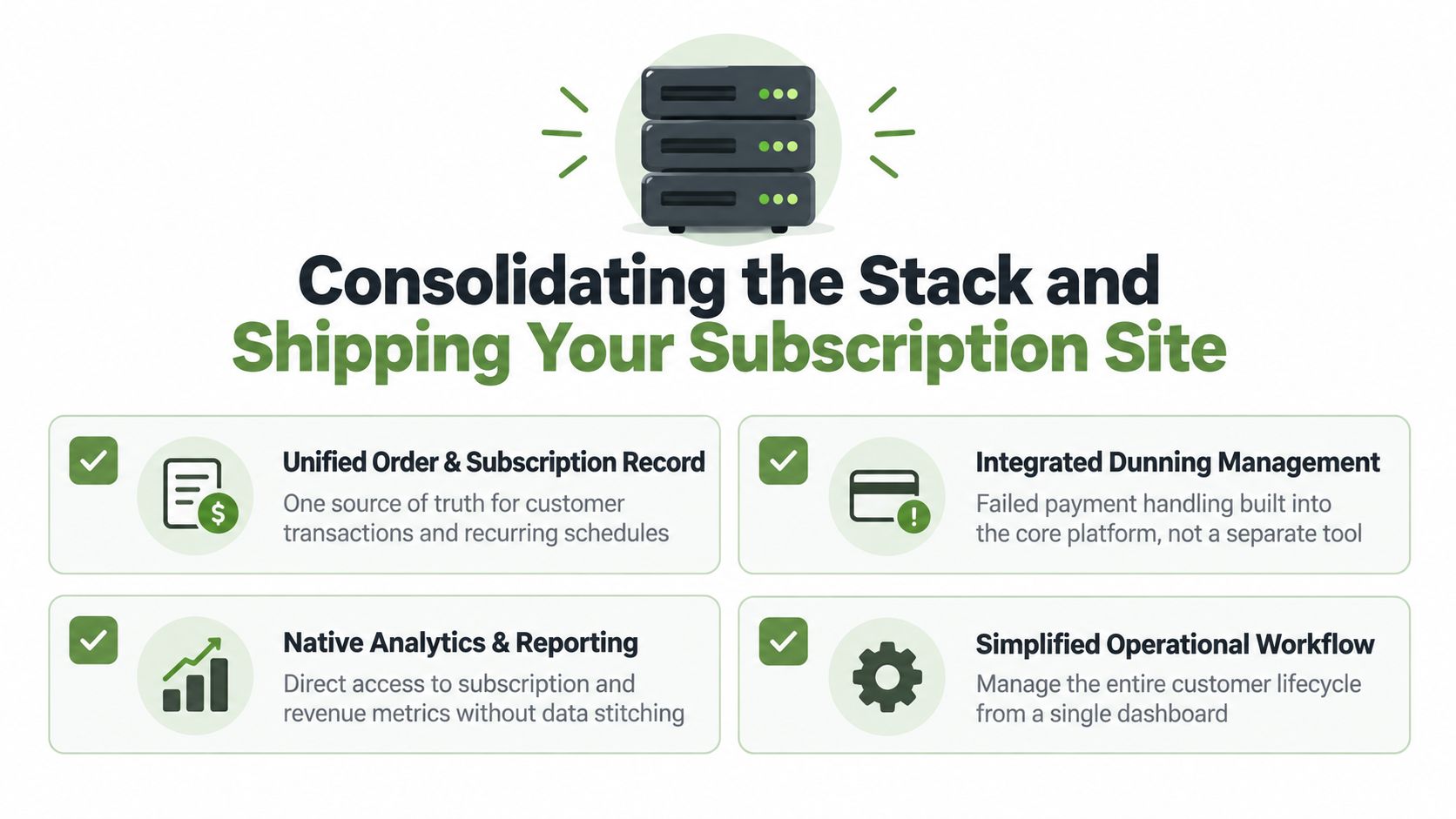
The alternative is familiar. A checkout app creates the order. A subscription plugin owns future billing dates. A dunning tool runs retry emails. A CRM logs some but not all events. An analytics layer tries to reconcile the mess afterward. That stack can work for a while, but it gets brittle once volume rises or the business adds complexity like B2B, retail, or mixed carts.
One practical option in this category is PlatformDTC, which combines storefront, checkout, subscriptions, payments, messaging, and analytics in one system. The relevant point isn't the brand name. It's the architecture. A subscription service website gets easier to operate when renewals live in the same order lifecycle as one-time purchases.
The pre-launch checklist that actually matters
Before shipping, I'd verify these decisions are settled:
- Product model is locked: replenishment, curation, access, or member model, with account logic to match
- PDP and checkout are live: subscription selection is visible, and wallet options are enabled where appropriate
- Billing cadence is tested: monthly, quarterly, and annual plans behave correctly in billing and fulfillment
- Self-service exists: skip, pause, swap, or cancel paths are accessible without support intervention
- Dunning is enabled: retries, updater logic, and segmented communication are in place
- Analytics are instrumented: recurring revenue movement, cohorts, payment failures, and recoveries all trace to one customer history
This walkthrough is useful before final QA:
The final decision is simple. Don't launch a subscription site because the checkout works. Launch it when the renewal system works, the recovery system works, and the reporting tells the truth.
PlatformDTC gives DTC brands one system for storefront, checkout, subscriptions, payments, messaging, and analytics, which is exactly what operators need when the lifecycle matters more than the first conversion. If you're reworking a subscription service website and want fewer handoffs between billing, retention, and reporting, visit PlatformDTC.
Created with Outrank tool