You're scaling the brand, the ad spend is climbing, and the stack that felt sharp a year ago now looks like a row of duct-taped tools. Checkout latency shows up in campaign results, customer service is chasing order statuses in one system while finance reconciles payments in another, and someone in ops is asking whether the new AI assistant can touch pricing or just read it. That's the point where enterprise ecommerce platforms stop being a feature debate and become an operating model decision.
| Decision area | Unified platform | Composable stack | What to verify |
|---|---|---|---|
| Order lifecycle | One record across storefront, payments, inventory, returns, fulfillment | Multiple services stitched together | Can one order be traced end to end without manual reconciliation? |
| Checkout control | Centralized, domain-owned checkout | Often split across services or hosted components | Who owns latency, wallet flows, and payment failure recovery? |
| Agent governance | Scoped tools, approvals, audit logs | Depends on custom policy layer | Can you prove what an agent changed and reverse it? |
| Cross-border returns | Built into the order model | Usually assembled from add-ons | Are duties, refund timing, and return addresses visible before checkout? |
| Integration burden | Lower if core functions are consolidated | Higher because services must stay in sync | How many handoffs fail when catalog, pricing, and fulfillment change? |
Table of Contents
- Why Enterprise Commerce Choices Are Harder Now
- What Makes a Platform Truly Enterprise Grade
- How Leading Architectures Compare on Substance
- Total Cost of Ownership Without the Blind Spots
- Performance Benchmarks and Low Risk Migration Paths
- Which Platform Fits Different DTC and B2B Scenarios
- Final Recommendation and How to Shortlist Confidently
Why Enterprise Commerce Choices Are Harder Now
A DTC team can grow fast on a patchwork of apps, until the patchwork becomes the product risk. One team owns promotions in one place, subscriptions in another, and returns somewhere else, while engineers spend their time keeping records aligned instead of improving the buying experience. That's not just untidy, it's operational exposure.
Global commerce has also reached a scale that changes the conversation. In 2024, businesses in 46 developed and developing economies recorded nearly $28 trillion in e-commerce sales, a figure that covers a large share of world commerce and shows why enterprise architecture matters (UNCTAD). In the U.S., retail e-commerce reached $1.2337 trillion in 2025, with $316.1 billion in the fourth quarter alone, and e-commerce represented 16.6% of all retail sales in that quarter (U.S. Census Bureau).
The real job is reducing operational drift
The buyer's problem isn't “Which platform has the longest feature list?” It's “Which platform keeps money, orders, customers, and changes in one controlled system when the business is moving quickly?” That means unified order handling, governed APIs, and checkout performance matter more than a shiny front end.
Practical rule: if your team can't answer who owns order truth, pricing truth, and approval truth, the platform isn't enterprise-grade yet.
This is also where vendor due diligence gets more serious. Before buying, teams should know how to run security reviews and ask for evidence instead of promises. A useful external primer on that process is how to pass vendor security reviews, because the right questions often surface architecture gaps faster than a sales demo.
What Makes a Platform Truly Enterprise Grade
Enterprise-grade doesn't mean “has a lot of features.” It means the platform acts as an operating layer that keeps commercial data and workflows consistent across channels. The storefront matters, but it's only one surface of a much larger system. Catalog, inventory, checkout, order management, and integrations all have to move together.
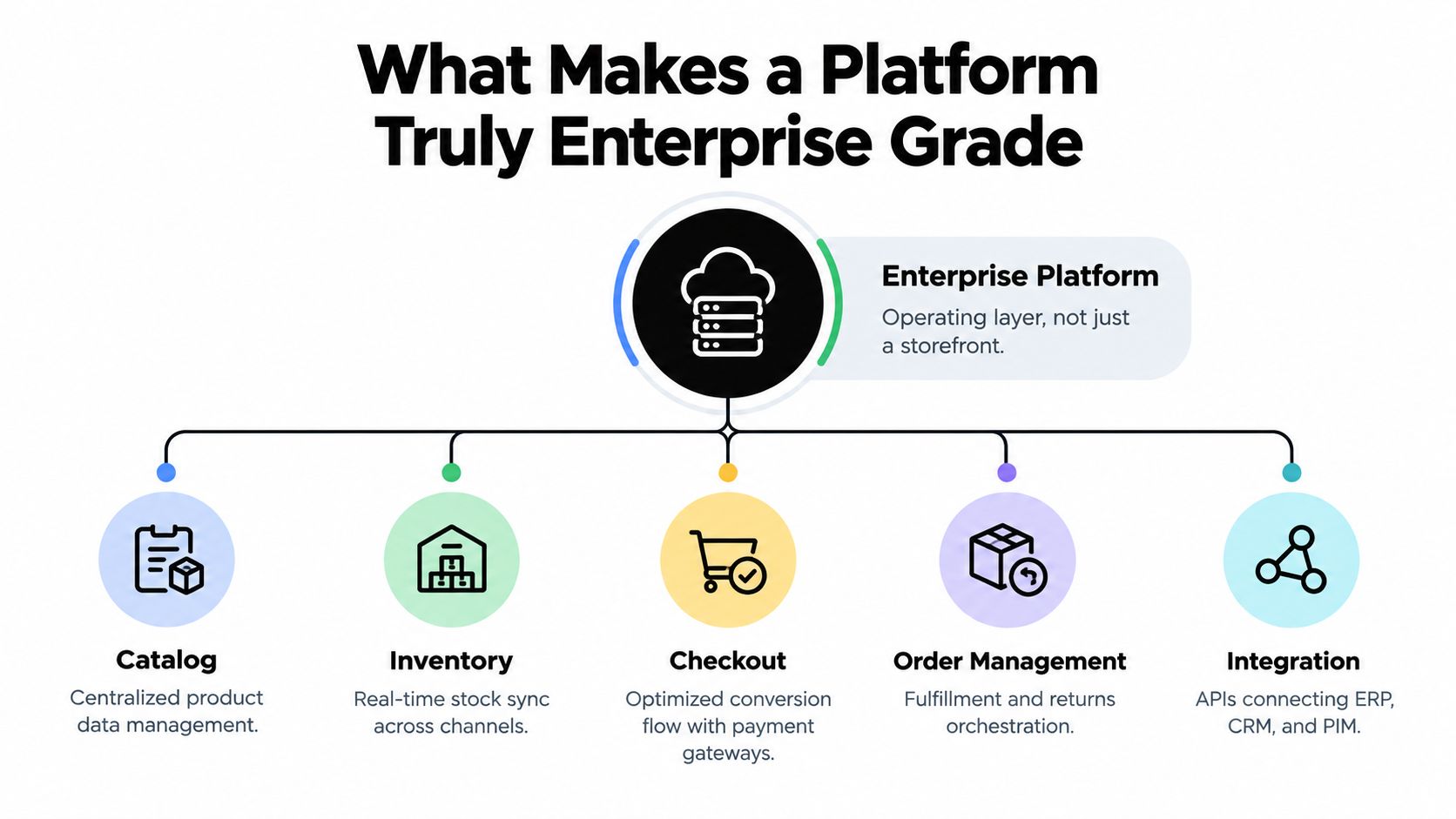
The market scale makes that architecture essential. If the platform can't keep catalog data, inventory state, and order history aligned, the business pays in support tickets, refund errors, and campaign waste. The right comparison should therefore focus on whether the platform can maintain one commercial record across DTC, wholesale, and physical retail, not whether it can render a homepage quickly.
The core operating layer
A real enterprise stack needs to do more than present products. It has to support order processing, payments, fulfillment, analytics, subscriptions, and cross-channel coordination inside a single model. That's why a platform with one order record is often easier to govern than a stack where each subsystem keeps its own version of the truth.
For mixed B2B and B2C operators, the capability boundary matters as much as the feature list. If the same platform can run invoicing, draft orders, retail counters, and ecommerce without duplicating customers or products, it reduces the chance of reconciliation errors later. PlatformDTC's B2B-oriented workflow documentation shows how those concerns map into practice, especially for brands comparing storefront-led systems with more unified models, and the overview at PlatformDTC's B2B ecommerce solutions is a useful reference point for that comparison.
Governed agents, not just AI features
AI is now part of the enterprise ecommerce conversation, but the key issue is governance. A platform can have agents that build pages or manage campaigns, but enterprise teams need scoped permissions, audit trails, approval gates, and idempotent writes. Without those controls, an agent becomes a privileged actor with too much blast radius.
That's why the strongest platforms separate read access from write access and make actions reversible. A less autonomous agent with tight controls can be more valuable than a broader agent that makes faster mistakes. Enterprise buyers should ask which tasks an agent is allowed to do, who approved them, and how every change is logged.
How Leading Architectures Compare on Substance
The difference between unified and composable is not philosophical, it's operational. Unified systems reduce the number of moving parts you have to reconcile, while composable systems give teams more freedom to replace components and tune the stack. Either can work, but they fail in different places.
A composite stack can be powerful when the organization has mature engineering, integration discipline, and a clear ownership model. A unified platform is stronger when the team wants one order lifecycle, one pricing model, and fewer handoffs across commerce, support, and fulfillment. If your internal architecture review already feels like a chain of “it depends,” the question is probably less about elegance and more about survivability.
| Criterion | Unified platform | Composable stack | What to verify |
|---|---|---|---|
| Data consistency | One shared order and customer model | Data has to be synchronized across services | Can discounts, returns, and subscriptions stay aligned under load? |
| Checkout ownership | One controlled checkout path | May rely on multiple services and embedded components | Who owns wallet support, payment recovery, and edge latency? |
| Subscription lifecycle | Managed in the same lifecycle as one-time orders | Often split into a separate service | Can renewals, cancellations, and refunds stay in one audit trail? |
| POS and B2B unification | Easier when one record spans channels | Usually needs more middleware and integration work | Are wholesale, retail, and ecommerce reading the same customer and inventory state? |
| API governance | Central policy and access control | Depends on how each service is secured | Are permissions, rate limits, and logs enforced consistently? |
| Observability | Easier to trace across fewer systems | Requires distributed tracing discipline | Can you see failure points before they affect revenue? |
Unified commerce reduces the number of places where a pricing or inventory error can hide.
For teams evaluating integration-heavy stacks, the hidden cost is never just the connector itself. It's the maintenance chain around it. A practical integration framework like Loopfour's enterprise application integration guide for finance is worth reading because it helps separate clean interfaces from fragile glue.
Where best-of-breed still wins
There are cases where a composable approach is the right call. If a brand has an unusual content operation, a specialized PIM, or a mature engineering org that wants to own the stack, modularity can pay off. But that only works when the business is willing to own the orchestration cost that comes with freedom.
The caution is simple. Many teams adopt composable architecture for flexibility and end up paying for coordination overhead instead. The architecture is still valid, but the operating burden shifts to the merchant.
Total Cost of Ownership Without the Blind Spots
TCO conversations go wrong when finance sees the license line and ops sees the implementation line, but nobody totals the work around them. The expensive part is often the indirect maintenance, the app sprawl, the integration drift, and the manual reconciliation tasks that keep showing up month after month. That is where the true cost of a fragmented stack lives.
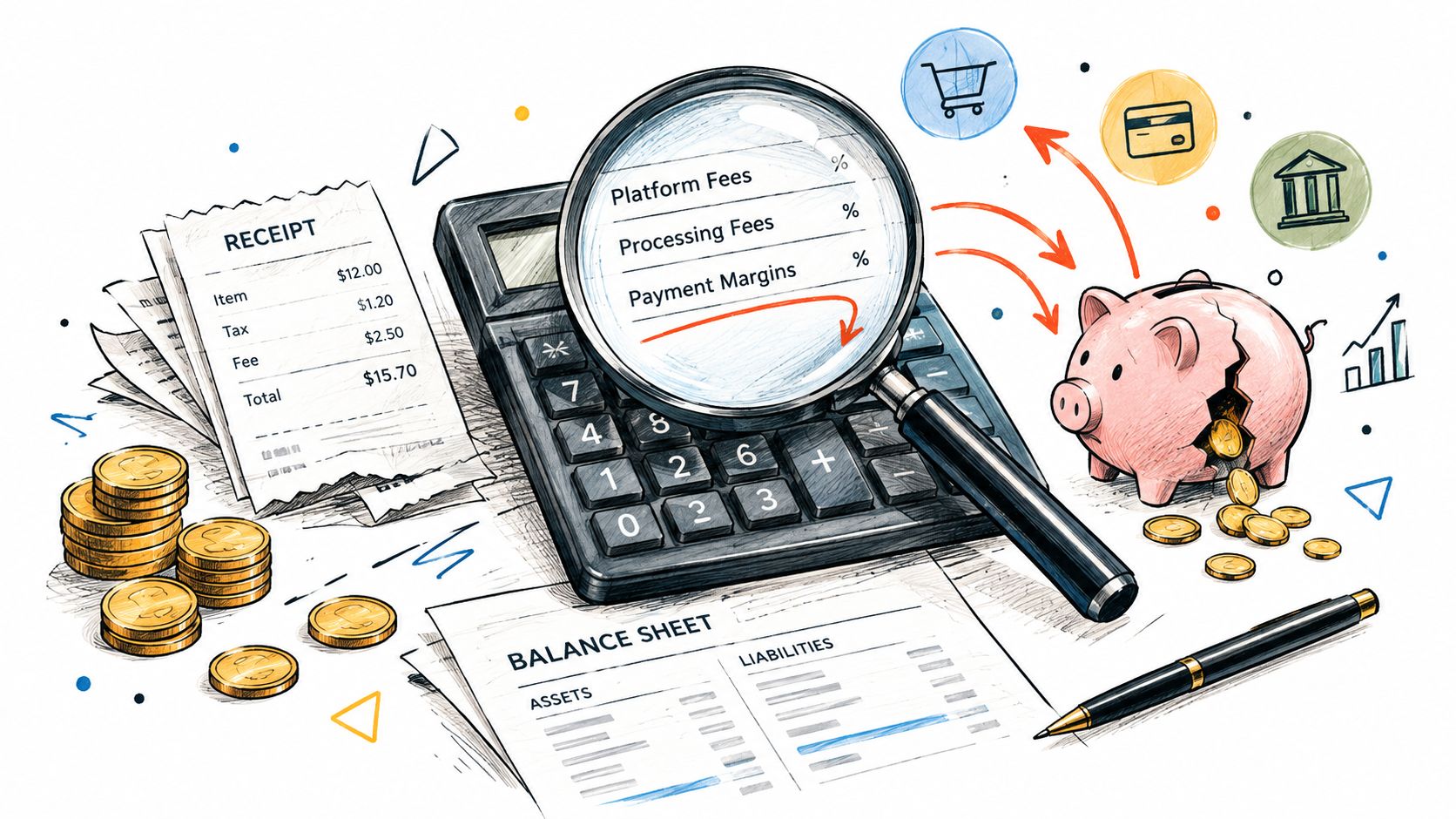
The cleanest way to model TCO is to separate what you buy from what you keep paying to operate. Platform fees matter, but they're only the start. Payments, app replacement, engineering overhead, campaign operations, and support handoffs all belong in the same spreadsheet if the goal is a real comparison.
Build the cost model around operating friction
A unified platform changes costs in ways a license sheet won't show. If one discount engine and one customer record replace several overlapping tools, teams spend less time reconciling campaign outcomes, inventory mismatches, and service tickets. That's not a theoretical savings claim, it's a structural difference in how many systems need to agree before an order is correct.
The same logic applies to campaign operations. If email, SMS, ads, and checkout all read from different data sources, attribution gets noisy and lifecycle teams spend time cleaning lists instead of improving performance. The more disconnected the stack, the more hidden labor appears in analytics, support, and merchandising.
For buyers comparing public pricing, PlatformDTC's own pricing explanation at pricing and plans is useful because it frames fees alongside operational scope rather than treating software cost as the whole story.
Financial test: if a new platform removes a recurring reconciliation task, quantify the labor saved and the error risk avoided, not just the subscription delta.
Don't undercount integration maintenance
Integration burden is easy to ignore early and expensive to ignore later. Every app that needs to stay in sync with inventory, promotions, or customer data adds future maintenance, testing, and release coordination. Once teams start patching drift manually, the platform has already become more expensive than it looked in procurement.
A solid TCO review should also include the cost of support handoffs. When a buyer asks why a discount failed, or why an order state looks wrong, the answer shouldn't require three tools and two Slack threads. The cleaner the order lifecycle, the less expensive support becomes to run.
Performance Benchmarks and Low Risk Migration Paths
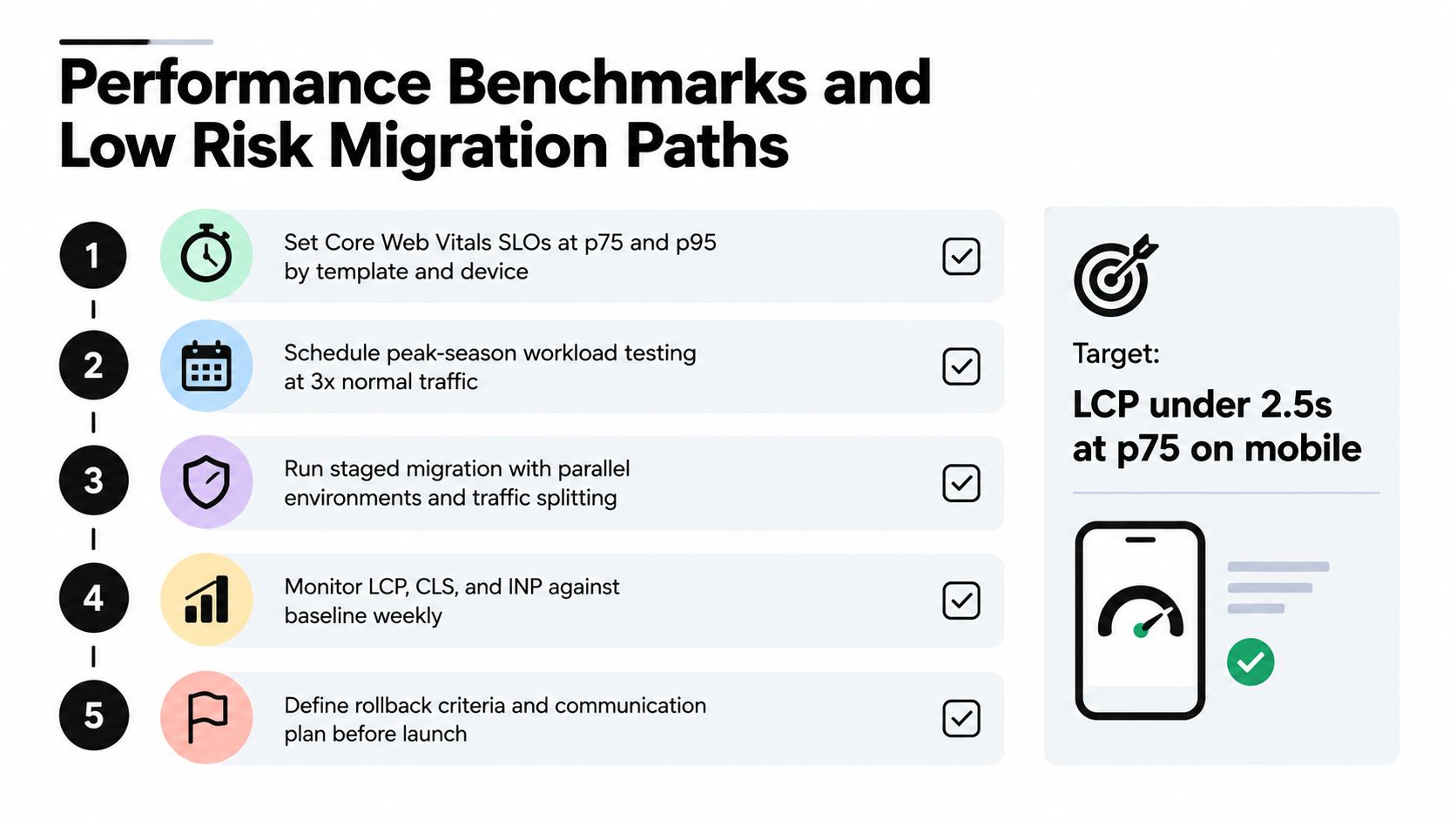
Performance needs to be treated as an operating target, not a design preference. Google's thresholds for “good” Core Web Vitals at the 75th percentile are LCP no more than 2.5 seconds, INP no more than 200 milliseconds, and CLS no more than 0.10 (Google Enterprise Commerce performance guidance). Those are practical service-level targets for any platform that expects to handle serious revenue volume.
That's also why controlled migration matters. A replatform is not just a technical project, it's a revenue-risk event. If the new stack can't run in parallel, prove it can ingest the catalog, and show that checkout works under real workloads, the cutover is too risky.
Benchmark the right pages under real traffic
A homepage score doesn't tell you much. PDPs, PLPs, cart, and checkout should be measured separately, on mobile and desktop, because each template loads different scripts and behaves differently under pressure. The actual test is whether your platform keeps speed stable when catalog size, discounts, and wallet flows get more complex.
A practical validation cycle should look at real-user monitoring and compare p75 and p95 by geography, device, payment method, and traffic source. That matters because a fast median can hide slow checkout tails during campaigns. If you can't see the tail, you can't control revenue risk.
Run migration before you cut over
The safer path is to import the catalog, run the new system in parallel, and verify order behavior before you switch traffic. That lets you catch data drift while the old stack is still available. It's especially useful for stores with subscriptions, inventory logic, and multiple payment methods.
Here's a simple migration checklist:
- Load the catalog early, then verify products, variants, and pricing rules against the source system.
- Run the new stack in parallel, so operations can compare orders, refunds, and inventory movements.
- Split traffic carefully, starting with low-risk flows before moving checkout volume.
- Measure failure rates and traces, not just page speed, so payment and fulfillment issues show up fast.
- Define rollback criteria upfront, because the time to decide is before launch, not during a revenue event.
The practical readout is simple. If the platform can't prove performance on your domain, under your workload, and with your real payment stack, it's not ready.
For implementation teams, the migration playbook at PlatformDTC's ecommerce platform migration guide is a useful parallel reference because it focuses on catalog import and cutover discipline rather than abstract migration talk.
Which Platform Fits Different DTC and B2B Scenarios
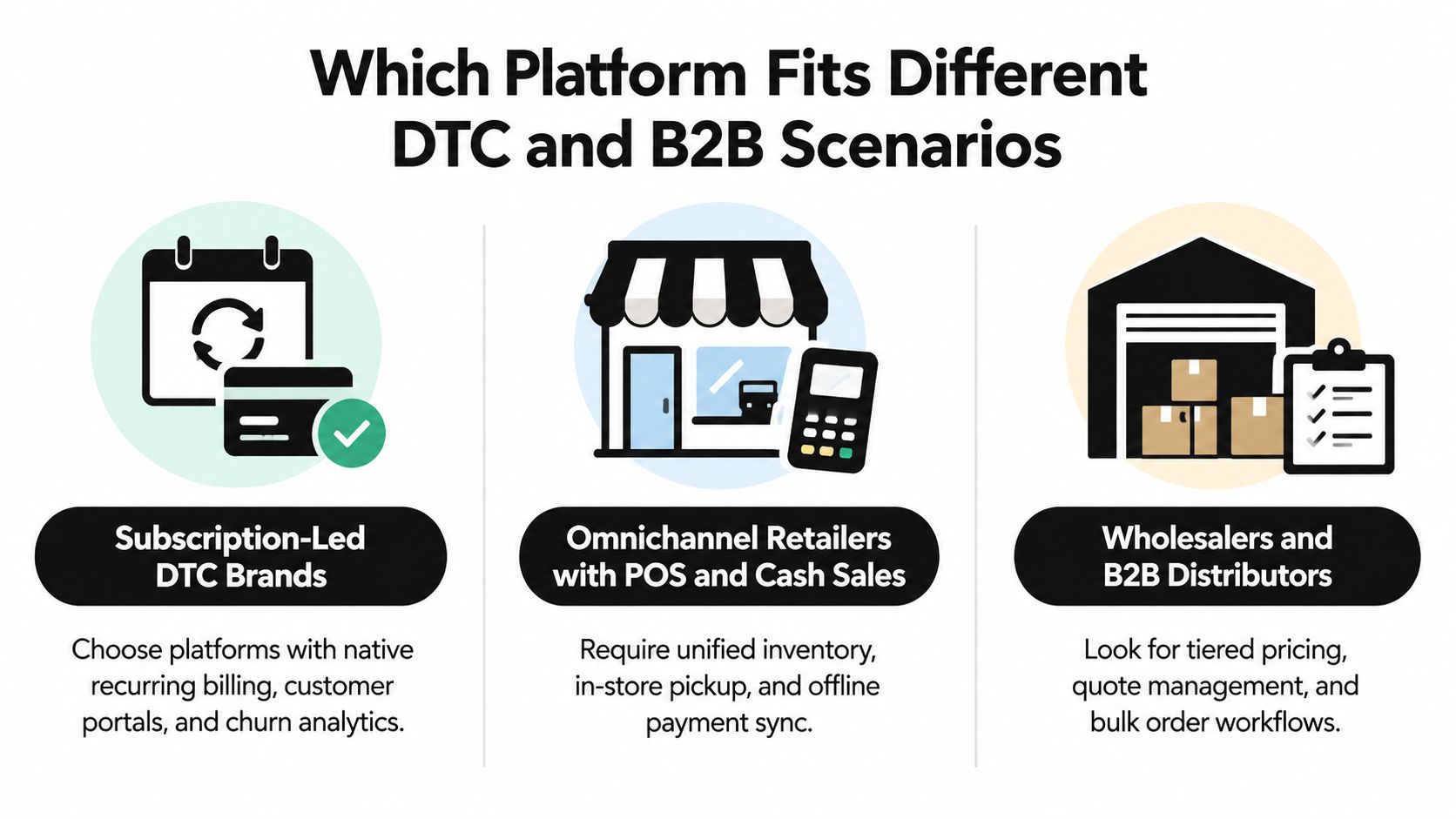
A subscription-led DTC brand does not need the same architecture as a wholesale distributor, and a global retailer with POS doesn't have the same risk profile as an AI-heavy merchandising team. The best choice depends on which failure you can't afford. That might be checkout latency, fragmented customer records, cross-border returns, or an agent that can change too much without approval.
Different operating models need different controls
Subscription-led brands need a platform where renewals live inside the same order lifecycle as one-time purchases. That makes churn analysis, payment recovery, and customer service easier to coordinate. Omnichannel retailers need unified inventory and in-store payment sync, because store sales, pickup, and online orders all affect the same stock pool.
Wholesalers and distributors need quote management, draft orders, and invoicing more than they need flashy merchandising. Their buyers care about repeatable procurement, not browsing theatrics. A platform that treats wholesale as a bolt-on often creates more manual work than it removes.
For teams improving product discovery across channels, Google Shopping feed optimization tips can help sharpen merchandising execution, especially when feed quality affects how well products surface in paid and shopping environments.
AI governance changes the shortlist
If your team wants agents to handle merchandising, page builds, or operational tasks, the key question is not whether the platform has AI. It's whether it can enforce permissions, approvals, and auditability. A less autonomous agent with stronger controls is often the better enterprise choice, because it lowers the chance of pricing errors, compliance problems, or unauthorized changes.
The same logic applies to international commerce. DHL's 2025 shopper survey found that 33% of shoppers won't buy internationally because of return costs, and that B2B sellers cite expensive delivery, return costs, and customs complexity as barriers in 44%, 37%, and 32% of cases respectively (DHL). That means return logic and landed-cost visibility are not back-office details, they're conversion constraints.
Final Recommendation and How to Shortlist Confidently
If you're a DTC brand with one main channel and a relatively simple catalog, a SaaS-first platform can still be the fastest path. If you're carrying subscriptions, POS, B2B, and returns in one business, unified order lifecycle matters more than app count. If your team is AI-forward, the platform has to prove governance before it proves automation.
The shortlist should be built around three proof requests, not broad marketing claims. Ask vendors to show Playwright or equivalent performance evidence, payment success under realistic checkout conditions, and agent audit logs with approval and rollback details. If they can't show those three things, the risk usually lands on your team after go-live.
For many operators, the practical split is this, pick consolidation when the business keeps paying integration tax, and pick composability when your engineering team can own the complexity. PlatformDTC fits the first case well because it ties storefront, checkout, subscriptions, payments, inventory, fulfillment, B2B workflows, and governed APIs into one order model. That gives DTC teams a way to reduce drift without rebuilding the whole stack.
PlatformDTC brings storefront, checkout, subscriptions, payments, inventory, fulfillment, messaging, analytics, POS, and governed AI tools into one order lifecycle for brands that want fewer moving parts. If your team is comparing enterprise ecommerce platforms and needs to see how unified commerce, agent controls, and migration support fit together, visit PlatformDTC and review how the platform maps to your own stack.