The most popular advice about commerce pricing is also the least useful: compare the monthly subscription fee, pick the plan that fits today, and upgrade when sales grow. That approach treats your platform like rent. In reality, it behaves more like a variable operating cost attached to every order, payment, channel, and integration.
A platform with a low headline fee can become expensive once transaction charges, payment processing, app subscriptions, implementation work, and operational errors enter the picture. A higher monthly plan can also be cheaper overall if it removes duplicate tools and keeps orders, inventory, subscriptions, and customer data in one system.
The right question isn't “How much does this plan cost?” It's “What will this platform cost to operate at my actual volume and complexity?” That is the foundation for evaluating pricing and plans in modern DTC commerce.
Table of Contents
- The Hidden Reality of Commerce Platform Costs
- Anatomy of Modern Subscription Tier Structures
- Calculating the Blended Take Rate and Margin Impact
- Consolidation Economics and App Replacement Savings
- Adapting Plans for Subscriptions, B2B, and POS Channels
- Designing a Transparent and High-Converting Pricing Page
- Aligning Pricing Architecture with Long-Term Brand Value
The Hidden Reality of Commerce Platform Costs
The headline monthly fee is only the visible part of a commerce platform's cost. Founders who compare plans by subscription price alone often miss the charges that scale with success, including transaction fees, payment margins, app subscriptions, support requirements, and the engineering work needed to keep separate systems synchronized.
The useful measure is total cost of ownership, or TCO. TCO combines the platform subscription with the costs required to sell, collect payment, manage customers, run operations, and maintain the surrounding technology stack. A cheap plan isn't cheap if it forces you into costly add-ons or takes a larger percentage of every sale.
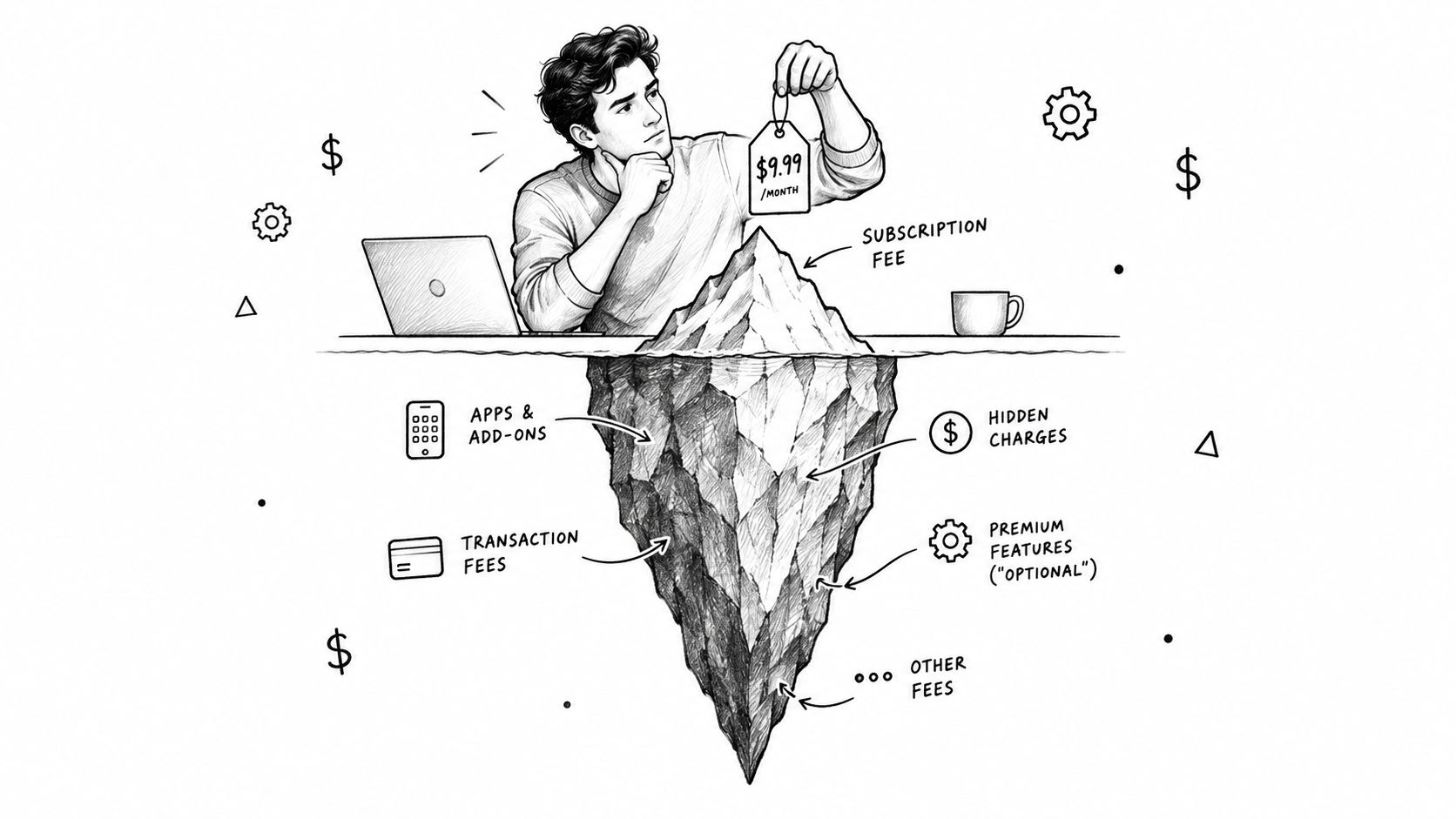
Look below the subscription line
Commerce pricing still relies heavily on monthly or annual subscription tiers. A global Statista survey of subscription commerce merchants found that flat-rate pricing was the most popular model in 2023, followed by good-better-best tiering. That structure gives operators a predictable starting point, but it doesn't make the total bill predictable by itself.
Recent platform comparisons place common standard plans around $29 to $39 per month, mid-tier plans around $79 to $105 per month, and enterprise plans at $1,499 per month or more, with some large-scale offerings reaching into the thousands. Those ranges establish the subscription baseline, not the final cost. You still need to model payment fees, platform commissions, premium features, implementation, and the tools you'll retain outside the platform.
A useful pricing review should separate costs into three layers:
- Fixed platform costs: The monthly or annual subscription, required seats, support packages, and contracted services.
- Variable commerce costs: Transaction fees, payment processing, currency conversion, shipping-related services, and usage-based charges.
- Stack and operating costs: Apps, integrations, data reconciliation, developer maintenance, migration work, and internal support.
Practical rule: Never approve a plan until you can calculate its cost as a percentage of revenue at your current scale and at your next realistic operating milestone.
The same discipline applies outside ecommerce. Teams comparing software subscriptions, including pricing for academic users, also need to understand which features, usage limits, and service obligations sit behind the advertised fee. The principle is identical: the price card is an entry point, not a TCO model.
Anatomy of Modern Subscription Tier Structures
Most commerce platforms use a familiar good-better-best structure. The entry tier handles core selling, the middle tier adds capabilities that growing merchants need, and the top tier bundles control, support, scale, and customization. This architecture works because it lets a platform serve different operational maturity levels without creating a separate product for every merchant.
Flat-rate subscription remains the base layer. The market has added more usage and outcome-based components, but it hasn't abandoned plans. Chargebee's recurring-revenue benchmarks report that 70% of businesses raised prices in 2024, while 40% failed to align those increases with perceived customer value. The lesson isn't that price increases are bad. It's that buyers resist a plan when the extra cost doesn't correspond to a capability they understand and value. (Chargebee provides the benchmark context.)
What each tier should signal
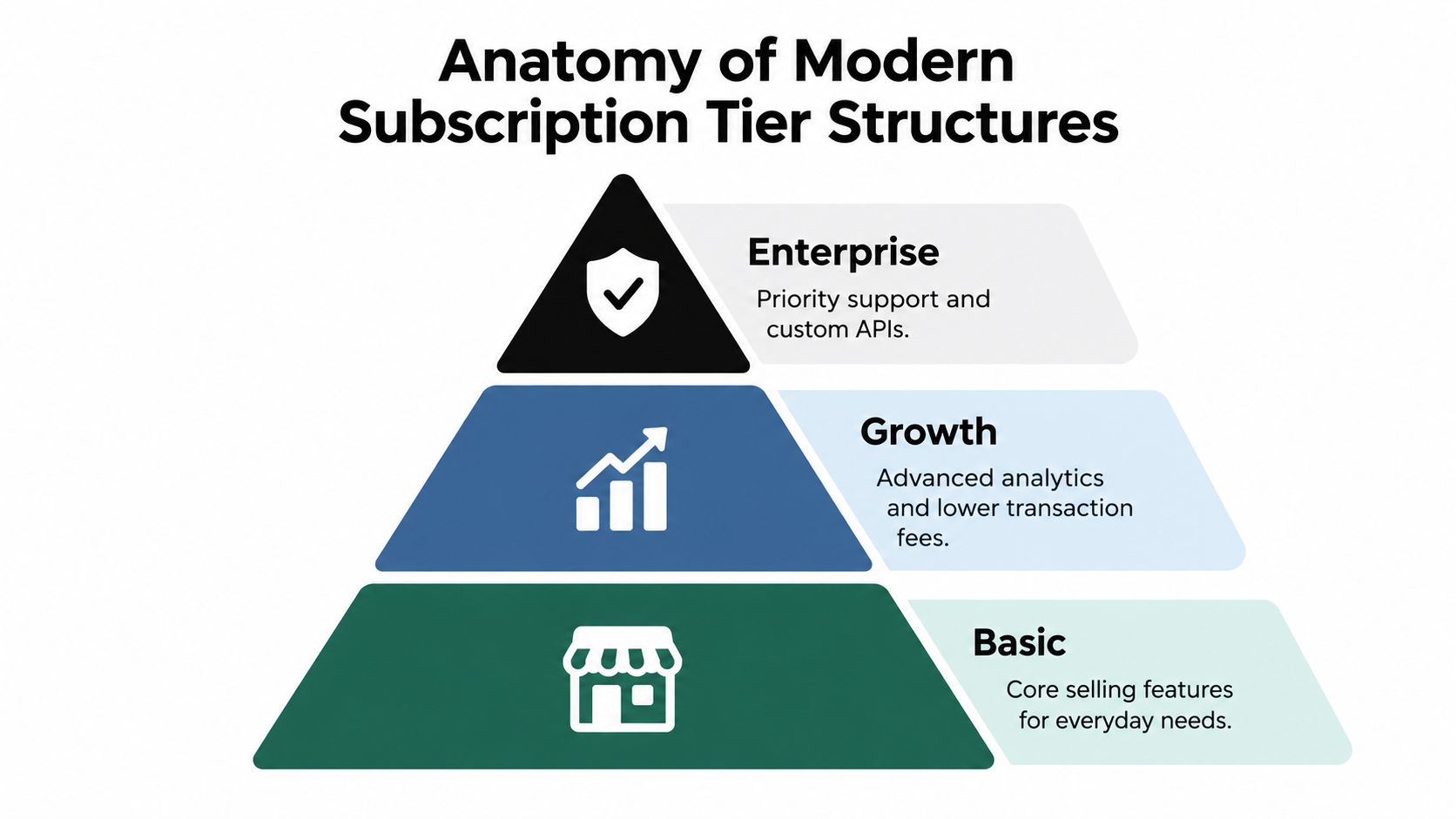
Basic should support a merchant that needs a dependable storefront, checkout, catalog, order management, and essential reporting. It shouldn't hide a core part of the selling process behind an upgrade.
Growth should solve operational problems, not merely raise limits. Better analytics, lower variable fees, automation, customer segmentation, and more capable campaign tools justify a move when the merchant is actively managing complexity.
Enterprise should address governance and coordination. Wholesale workflows, advanced permissions, custom APIs, priority support, multi-market operations, and negotiated economics belong here when they require deeper platform involvement.
Feature gating matters more than raw usage caps. A plan that technically supports more orders but withholds critical checkout controls, automation, or reporting can create a forced upgrade before the merchant reaches a meaningful volume threshold.
Why hybrid pricing is expanding
A 2026 Chargebee dataset reports that 51% of recurring-revenue companies combine subscription pricing with usage or outcome-based pricing, while 75% still retain a subscription element. The fixed plan pays for the platform foundation. Variable charges then reflect payment volume, advanced consumption, or a higher-value service layer.
That combination can be sensible for ecommerce, but only when the variable component is easy to forecast. A plan that combines a subscription, transaction commission, payment fee, app charges, and negotiated usage rules creates an accounting problem if the buyer can't model it from the pricing page.
Choose a tier by asking what will become structurally important to the business. If subscriptions, B2B orders, POS, international currencies, or unified customer records are already part of the operating model, don't select a plan that treats them as optional extras.
Calculating the Blended Take Rate and Margin Impact
A commerce platform's economics become clear when you convert every charge into one blended take rate. This rate shows how much of your sales revenue goes toward the platform subscription, platform transaction fees, and payment processing.
Use this formula:
Blended take rate = platform fees plus payment processing costs plus the monthly plan fee, divided by monthly revenue.
The calculation has three parts:
-
Start with the base subscription. Add the monthly plan fee to your cost model. WooCommerce's pricing guidance illustrates the broader market structure, where entry-level SMB economics can sit around $25 to $30 per month, with additional costs determined by the services and payment setup a merchant chooses. (WooCommerce pricing explains the layered structure.)
-
Add the platform transaction fee. A platform charge of 0.5% to 2% per sale can materially affect a high-volume DTC brand, particularly when the merchant also pays card processing separately. Use the exact rate for each plan, not the lowest advertised rate.
-
Add payment processing. Card processing commonly runs around 2.5% to 3.0% plus a fixed per-transaction fee, depending on the payment provider and arrangement. For a working model, the table below uses the requested 1% platform fee and 2.9% processing rate as variables, not as a universal industry quote.
A simple cost model
| Monthly Revenue | Base Plan Fee | Platform Fee (1%) | Processing (2.9%) | Total Platform Cost |
|---|---|---|---|---|
| R | $25 to $30 | 1% of R | 2.9% of R | $25 to $30 + 3.9% of R |
The table makes the problem visible. The fixed plan fee stays constant, but the percentage charges expand with every sale. At higher revenue, the subscription can become a relatively small part of the bill while the blended variable rate determines the margin impact.
For a complete model, add fixed per-transaction charges separately. They affect low-value orders more heavily because the fixed amount represents a larger share of each transaction. Also separate payment provider fees from platform fees so you can compare payment flexibility accurately.
Margin check: Model the platform cost against gross margin, not revenue alone. A fee that looks small as a percentage of sales can consume a meaningful share of contribution margin after product, shipping, returns, and marketing costs.
Run the calculation at several revenue levels using your own sales forecast. Include one-time purchases, recurring orders, refunds, discounts, international payments, and any payment methods with different economics. The DTC payment system guide is a useful reference when reviewing how payment architecture fits into the wider commerce stack.
A good plan should become more efficient as the brand grows, or at least make the additional cost easy to justify through capabilities that would otherwise require separate tools. If the platform takes more from every successful sale without reducing another cost, it deserves close scrutiny.
Consolidation Economics and App Replacement Savings
A platform's subscription price should never be evaluated in isolation from the software it replaces. Many DTC brands pay separately for email, SMS, subscriptions, reviews, loyalty, analytics, POS, promotions, and customer service. Each tool may look affordable on its own. Together, they create both a recurring bill and a coordination burden.
The financial comparison is straightforward:
Net platform cost = new platform cost minus the recurring cost of replaced tools, plus or minus the change in payment and transaction fees.
That formula changes the decision. A platform with a higher base fee can lower TCO if it removes enough duplicate subscriptions and reduces the engineering work required to connect them.
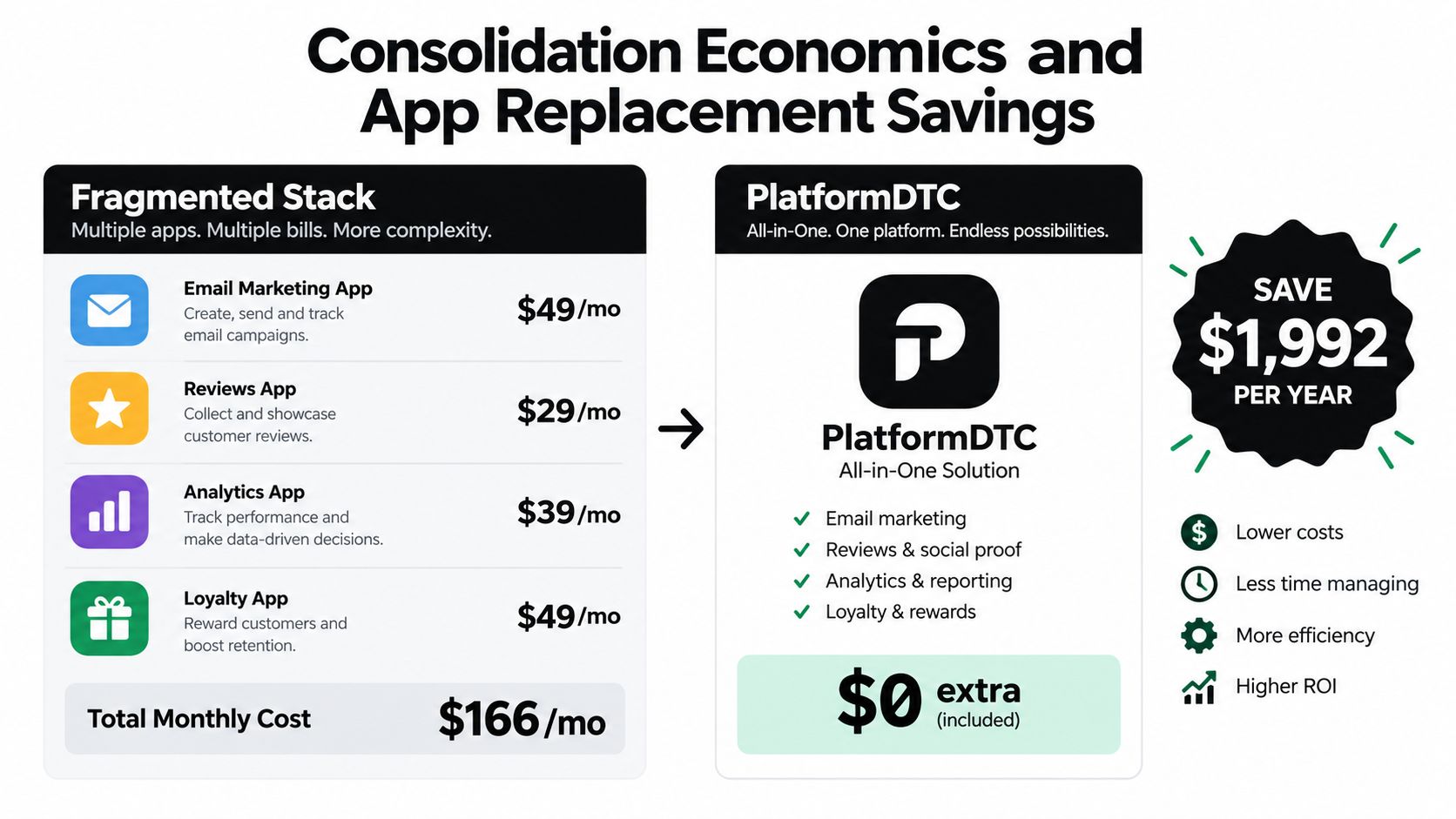
Audit the stack, not just the invoices
Start with a complete inventory of every commerce-related tool. Include the subscription invoice, implementation cost, integration maintenance, data exports, agency retainers, and internal time spent resolving discrepancies.
Then classify each system by the record it owns:
- Customer record: Email, SMS, loyalty, reviews, and support tools may each maintain overlapping customer profiles.
- Order record: The storefront, subscription system, POS, fulfillment tool, and accounting system can disagree about status, refunds, or cancellations.
- Product record: Catalog, inventory, promotions, and wholesale pricing often live in separate administrative interfaces.
- Attribution record: Analytics and advertising platforms may receive different events, producing conflicting reports.
The hidden cost is data drift. When a customer changes an address, cancels a subscription, uses a promotion, or returns an item, several systems may need the same update. If one integration fails, an operator spends time investigating the discrepancy, and the business may make a decision from incomplete data.
Measure replacement value carefully
Don't count an app as replaced just because the new platform has a similarly named feature. Confirm that the consolidated capability covers the workflow your team genuinely uses, including automation, permissions, reporting, exports, and customer communication.
The commerce platform migration guide can help structure this review around catalog imports, parallel operation, verification, and cutover risk. Migration planning belongs in the TCO model because a low recurring fee doesn't compensate for a poorly controlled transition that interrupts revenue or corrupts customer data.
Use a replacement worksheet with four columns: current tool, monthly cost, business workflow, and replacement coverage. Add a fifth column for what happens if the capability disappears. That last question exposes dependencies that an invoice review misses.
Operator's view: Consolidation creates value only when the unified system owns the workflow, not merely when it places several app icons behind one login.
A unified order lifecycle can reduce reconciliation work, but it can also create concentration risk if the platform lacks export tools, APIs, audit history, or a credible migration path. Savings and resilience must be assessed together.
Adapting Plans for Subscriptions, B2B, and POS Channels
A basic one-time DTC sale is the easiest commerce workflow to price. The customer visits a storefront, pays, receives an order, and may return later. Subscriptions, wholesale, and physical retail introduce different records, permissions, payment events, and service expectations.
Pricing and plans should reflect those differences without turning every new channel into a collection of punitive add-ons.
Subscriptions need lifecycle economics
Subscription billing isn't just recurring payment capture. The platform must manage renewals, failed payments, skips, pauses, cancellations, address changes, discounts, inventory, and customer service within the same order lifecycle as one-time purchases.
A plan that offers subscriptions through a separate app may create duplicated customer records and conflicting discount logic. Ask whether subscription renewals use the same catalog, inventory, promotion, fulfillment, and reporting systems as ordinary orders.
Billing cadence also matters. Research on global subscription retailers found that 80% of plans used monthly billing, while 20% used yearly billing, and 77% of plans were priced in USD. Only 20% of standard subscription programs offered multiple plans, according to the same market analysis from FreightAmigo. Those figures point to a practical gap: merchants often need more flexibility than the standard plan structure provides.
B2B needs controlled complexity
Wholesale buyers don't behave like individual shoppers. They may require draft orders, invoicing, account-specific catalogs, negotiated prices, purchase approvals, and payment terms. A plan that treats B2B as a storefront theme or a simple customer tag won't support a serious wholesale operation.
Evaluate whether the platform includes:
- Account-specific pricing: Buyers should see the right catalog and terms without manual intervention.
- Draft order workflows: Sales teams need to create and revise orders before final payment.
- Invoice support: B2B payment terms should be visible in the order record and reporting.
- Unified inventory: Wholesale commitments shouldn't remain disconnected from DTC availability.
- Permission controls: Teams need different access for sales, finance, operations, and customer service.
POS must share the same truth
POS adds cash payments, card terminals, store locations, staff permissions, returns, and in-person customer identification. The right plan connects those events to online orders, inventory, promotions, and customer profiles. Otherwise, operators aren't running omnichannel commerce. They're reconciling separate businesses.
International operators should also test currency support and billing cadence by market. A one-size-fits-all monthly USD plan can work for a narrow audience, but it may create conversion friction and retention problems when customers expect local currency, annual options, or a different subscription structure.
Designing a Transparent and High-Converting Pricing Page
A pricing page should let a serious buyer calculate the likely bill without first speaking to sales. Hiding every meaningful cost behind “Contact Sales” creates friction, especially for operators comparing several platforms under time pressure.
Research from the 2025 SaaS pricing report found that product-led growth companies are nearly 3x more likely to publish pricing and 4.6x more likely to show complete pricing details than sales-led companies. A separate 2025 buyer survey found that 49% of software buyers identified a lack of transparent pricing as the single biggest change they wanted from vendors. (The 2025 State of SaaS Pricing report.pdf) provides that buyer and company comparison.)
Put the commercial model on the page
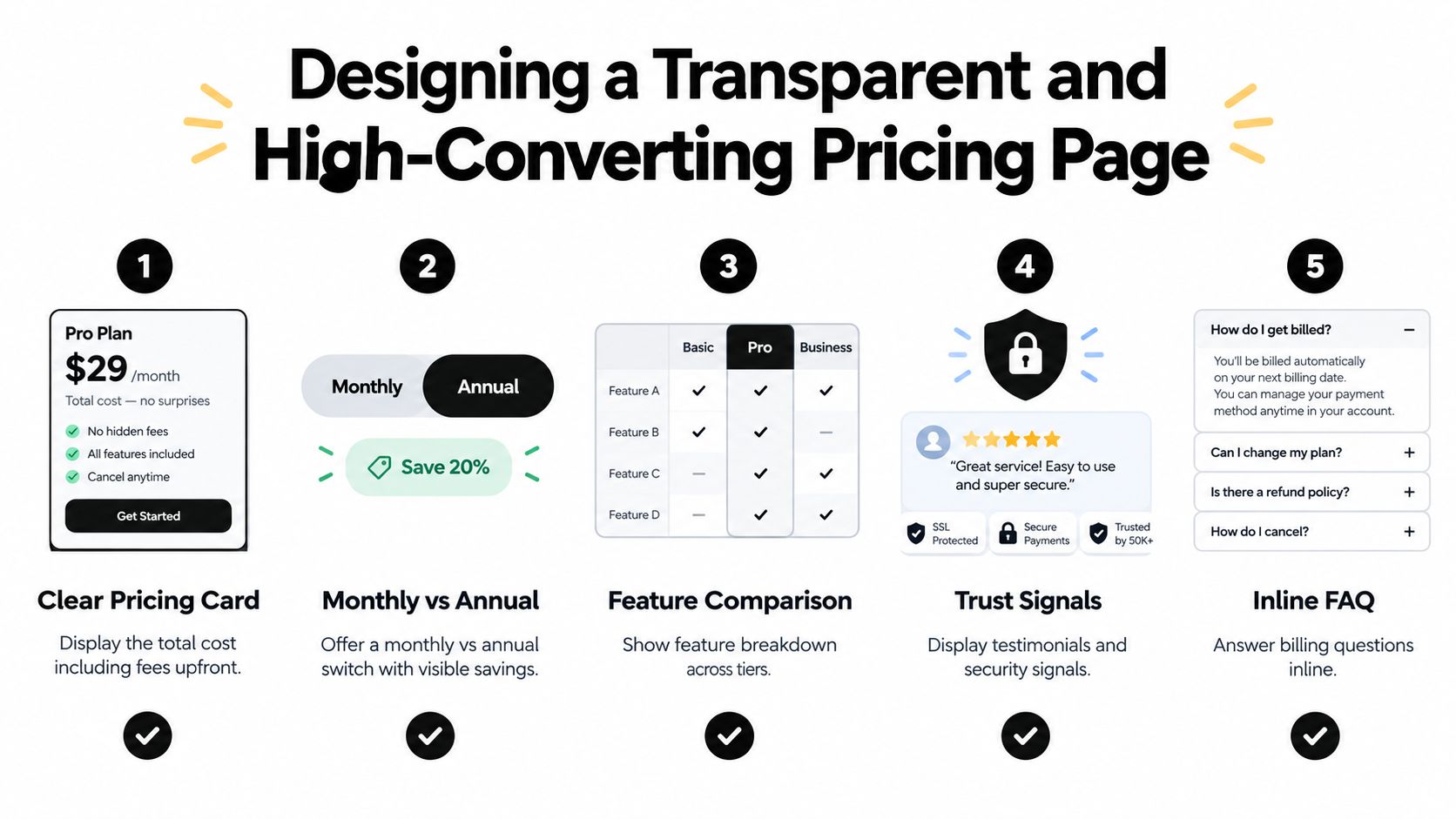
A credible pricing page should answer five questions before a buyer submits a form:
- What is fixed? Show the subscription fee, billing cadence, included stores, and any required seats.
- What scales with sales? Display transaction fees, payment processing rates, fixed transaction charges, and relevant currency costs.
- What changes by tier? Use a comparison grid that identifies feature gates, not just vague labels such as “advanced” or “custom.”
- What does the platform replace? List bundled capabilities such as subscriptions, POS, messaging, analytics, promotions, and B2B workflows.
- What happens during migration? Explain imports, parallel running, verification, support, data access, and cancellation terms.
A calculator is more useful than a promotional savings badge. Let buyers enter monthly revenue, average order value, payment mix, order frequency, subscriptions, and tools they plan to retire. The output should separate fixed platform cost, variable platform cost, payment cost, and estimated replacement value.
Make trust part of the conversion path
The page should also show support boundaries, service status, API availability, security information, refund treatment, and the process for resolving payment disputes. A buyer evaluating payment risk may also find it useful to see pricing for disputes as part of a broader review of dispute-management costs.
Don't use “enterprise” as a substitute for information. Enterprise buyers still need to understand what is standard, what is negotiable, and which charges require a commercial conversation. A clear explanation of the negotiation boundary builds more trust than a blank price card.
The PlatformDTC pricing page should follow this principle by making plan fees, payment economics, and included capabilities easy to compare. Buyers don't need every contract term published. They do need enough information to decide whether a conversation is worth having.
Buyer expectation: If a platform knows how it charges, it should be able to explain the model before asking a merchant to disclose revenue or book a demo.
Aligning Pricing Architecture with Long-Term Brand Value
The right pricing model rewards a platform for creating durable operating value, not merely for collecting more as the merchant grows. That means founders should evaluate pricing and plans against lifetime value, gross margin, operational complexity, and the cost of switching later.
Good-better-best packaging can help buyers self-select and can give a platform room to serve different merchant profiles. Research summaries report that three-tier packaging can capture about 60% more revenue per customer cohort than a single-tier plan, largely because the middle tier acts as an anchor and the premium tier captures higher-lifetime-value buyers. The same summaries describe typical subscription discounts of 10% to 25%, with annual prepayment often receiving the larger discount. (Digital Applied's subscription commerce guide covers those findings.)
Protect margin while improving commitment
Discounting annual prepayment can improve cash collection and reduce renewal friction, but it also reduces the revenue available to cover support, payment costs, and service delivery. The cited research describes a case where a 65% baseline gross margin can fall to about 50% after a 15% subscriber discount, before added support and management costs.
That isn't an argument against annual plans. It's an argument for modeling the full economics. Compare the discount with incremental lifetime value, reduced churn, payment timing, servicing effort, and the cost of acquiring another customer. A discount that improves retention can be rational. A discount offered only to make the pricing card look attractive is margin leakage.
Price changes need the same discipline. Chargebee's benchmark shows that many businesses raised prices, but a substantial portion did not connect the increase to perceived customer value. Customers accept a higher bill more readily when the platform explains the capability, reliability, time savings, or operating efficiency they receive in exchange.
Select for mutual growth
Use this evaluation framework before committing:
- Model the blended take rate: Include subscription, transaction, payment, currency, and fixed transaction costs.
- Audit replacement value: Identify which apps, integrations, and internal processes the platform will remove.
- Test channel expansion: Confirm that subscriptions, B2B, POS, and international commerce use a coherent order and customer model.
- Review governance: Require permissions, approval controls, audit history, reversible actions, and clear API boundaries before allowing automation or AI agents to affect commerce operations.
- Check the exit path: Verify data export, migration support, parallel testing, documentation, and contract terms.
A platform should make growth easier to finance, operate, and govern. Transparent pricing reduces buyer friction because the merchant can understand the commercial model before implementation. A clear migration path reduces risk because the merchant isn't forced to treat switching as an irreversible bet.
The best plan isn't the one with the lowest monthly fee. It's the one whose fixed and variable costs remain understandable, whose capabilities reduce stack complexity, and whose economics improve as the brand builds durable customer value.
PlatformDTC offers a unified commerce system for storefront, checkout, subscriptions, payments, inventory, fulfillment, messaging, analytics, POS, and B2B workflows, with governed APIs for controlled AI agent operations. Visit PlatformDTC to compare its pricing and plans, model total cost of ownership, and evaluate a migration path built for scalable DTC commerce.