
The popular advice is to choose a B2B commerce platform with the fastest checkout, the largest catalog, and the most polished storefront. That advice imports the wrong evaluation criteria from consumer retail. In wholesale commerce, a beautiful interface can't compensate for contract pricing that disappears at checkout, stock that isn't available, or an order that requires a sales representative to repair it manually.
The better question is whether your B2B e-commerce solution can keep commercial and operational truth intact across discovery, pricing, approval, fulfillment, invoicing, and support. The storefront matters, but it sits on top of a much larger system. Buyers need accurate account context, repeatable workflows, and reliable promises more than they need another layer of visual polish.
Table of Contents
- Redefining B2B E-Commerce Solutions Beyond Retail
- Designing the Modern Rep-Free Buyer Journey
- Solving the Real-Time Inventory Trust Problem
- Evaluating Governed AI Automation in Commerce
- Unifying Channels with a Single Source of Truth
- Executing a Risk-Free Platform Migration
- Building a Resilient B2B Commerce Operation
Redefining B2B E-Commerce Solutions Beyond Retail
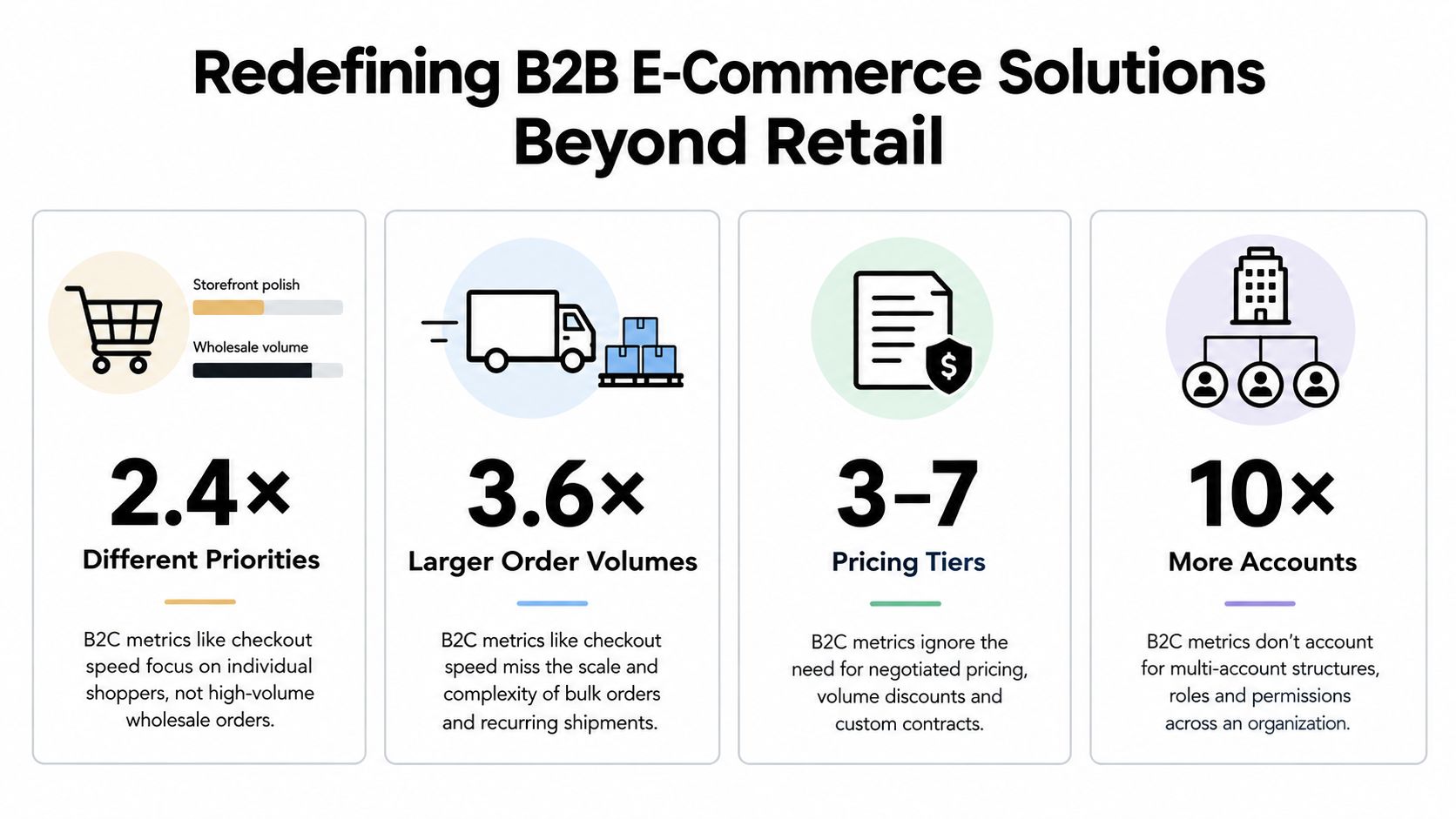
Plenty of teams still judge a B2B platform the way they would judge a retail site: storefront quality, search polish, and checkout speed. Those things matter, but they are not the operating core of wholesale commerce. B2B buyers place orders inside account structures shaped by negotiated terms, approval policies, tax rules, ship-to complexity, and invoicing workflows. If the underlying data is wrong, a polished storefront only helps the customer reach the wrong answer faster.
The scale of the market explains why that distinction matters. UNCTAD estimates that businesses in 43 economies generated nearly US$25 trillion in e-commerce sales in 2021, and that business e-commerce reached almost US$27 trillion in 2022. Across the economies studied, e-commerce represented anywhere from less than 1% to as much as 30% of business turnover, while most business e-commerce sales were made to other businesses or organizations. In most markets, B2C transactions accounted for less than one-quarter of business e-commerce sales.
Japan shows the same pattern clearly. The UNCTAD dataset reports B2B e-commerce transactions exceeding ¥370 trillion in Japan in 2021, compared with almost ¥21 trillion in B2C and approximately ¥2.2 trillion in C2C. B2B value was roughly 17.6 times B2C value and about 168 times C2C value. That gap is why platform selection should start with commercial control and operational continuity, not with merchandising alone.
The infrastructure buyers actually depend on
A credible B2B e-commerce solution has to model the business relationship itself. That includes account hierarchies, user permissions, customer-specific catalogs, negotiated prices, payment terms, minimum order rules, approval routing, quotes, reorders, invoices, and live connections to inventory and fulfillment systems. In practice, these functions decide whether buyers trust self-service across web, sales-assisted, and service-led channels.
I usually separate retail convenience features from transaction integrity. Fast pages and low-friction checkout still improve conversion. But if a buyer sees one price in the catalog, another in the cart, and a third on the invoice, the problem is not design. It is unreliable commercial data, and it forces reps or support teams to repair orders by hand.
Practical rule: Evaluate the platform as a transaction system first and a storefront second.
The OECD reports that, on average, nearly 30% of businesses across OECD countries received orders over computer networks in 2022 in its Handbook on Measuring Digital Trade. That includes structured electronic ordering and enterprise systems, not just conventional web checkout. A serious evaluation should test whether the platform can preserve one operational truth across channels and apply AI only where data, permissions, and audit controls are in place.
Designing the Modern Rep-Free Buyer Journey
A rep-free journey doesn't remove sales from B2B commerce. It removes unnecessary dependency on sales for routine work while preserving human help when the buyer needs judgment, negotiation, or technical context.
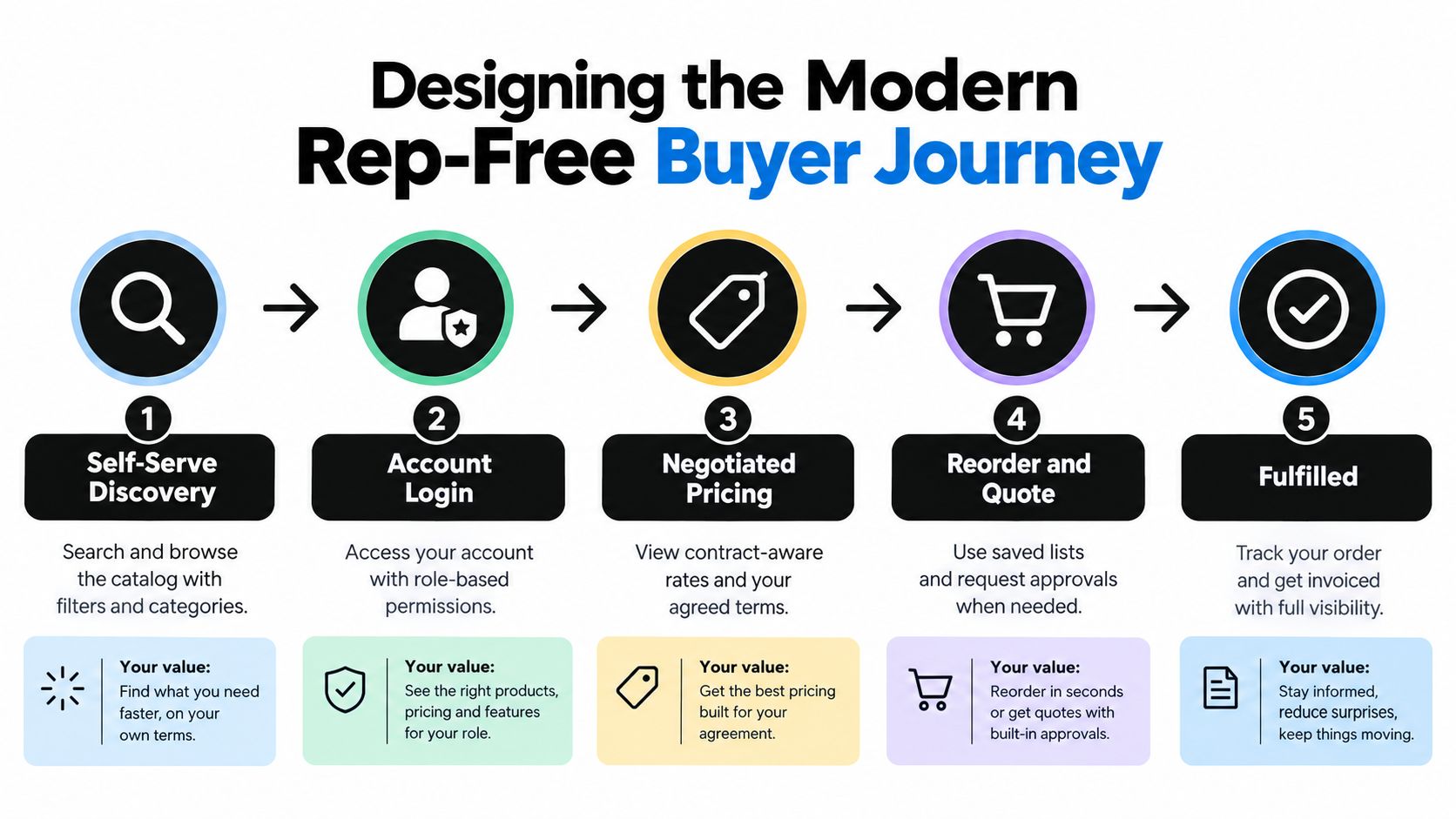
Gartner research found that 61% of B2B buyers prefer an overall rep-free buying experience. The same research found that 69% reported inconsistencies between information on a supplier's website and information provided by sellers. Those two findings belong together. Buyers want independence, but contradictory information makes self-service unsafe.
Make account context available before checkout
A buyer should see the right commercial reality as soon as they authenticate. Product eligibility, pricing, minimum quantities, delivery options, tax treatment, credit status, and approval requirements should derive from governed account data, not from a front-end assumption.
Use a canonical model for:
- Identity and permissions: Connect every user to an account, location, role, and purchasing authority.
- Commercial terms: Apply negotiated prices, discounts, currencies, payment terms, and effective dates consistently.
- Product eligibility: Prevent restricted or unavailable products from appearing as purchasable options for the wrong account.
- Order state: Preserve carts, drafts, quotes, approvals, and submitted orders across portal and sales-assisted interactions.
The buyer journey should support discovery, account login, negotiated pricing, reorder or quote creation, approval, invoicing, and tracking without forcing a restart. A draft-order API is especially useful here. It lets a buyer begin independently, then invite a representative to adjust quantities or terms while retaining the same account, cart, and order context.
Keep the human handoff resumable
Guided selling works when it adds context instead of replacing self-service. A representative should be able to open the buyer's draft, explain a substitute, add a commercial note, or route an approval without copying details into another system.
The portal and seller tools should read from the same versioned product and commercial records. Add automated checks that compare displayed prices, specifications, delivery estimates, and eligibility rules against the source of truth. At order submission, revalidate those rules because a browser session may contain stale data.
The result isn't a choice between self-service and assisted selling. It's a controlled journey where buyers can move between them without data loss.
Solving the Real-Time Inventory Trust Problem
“Real-time inventory” sounds like a checkbox. In production, it's a trust contract between the buyer and the operation. If a portal says an item is available, the buyer reasonably expects the supplier to reserve, ship, or clearly explain why that promise changed.
Recent buyer research found that 40% of professional buyers identify insufficient transparency about stock and delivery dates as their top frustration. The same source reports that 33% of online B2B orders contained errors. More recommendations and a larger catalog won't repair the relationship after an unavailable item appears as confirmed.
Define authority before building the integration
Warehouse management, ERP, marketplace, and storefront systems may each hold a quantity. They don't all represent the same thing. One may show physical stock, another available-to-promise stock, and another inventory after allocations, safety buffers, or location restrictions.
Document the rules before selecting middleware or APIs:
- Choose the authority by data type. The ERP may own customer-specific availability, while a warehouse system owns pickable quantities. The platform must know which value to display and why.
- Separate physical stock from promiseable stock. Allocated, inbound, quarantined, and location-specific inventory need distinct states.
- Attach freshness to the value. A quantity without a timestamp or synchronization status invites false confidence.
- Revalidate at commitment. Checkout should confirm availability, price, delivery method, and account permissions before creating the final order.
- Make exceptions explicit. Substitutions, partial shipments, backorders, cancellations, and split fulfillment need visible business rules.
The useful metrics are operational, not decorative. Track inventory freshness, promise-date accuracy, order-error rate, cancellation reasons, exception volume, and the percentage of orders requiring manual intervention.
Communicate uncertainty honestly
A reliable promise date is more valuable than an optimistic one. If stock is inbound, show the expected availability with the relevant conditions. If a location-specific quantity can't support the requested delivery, explain the alternative rather than silently accepting an order that operations can't fulfill.
Teams also need an audit trail. When a buyer challenges an order, staff should be able to see what stock, allocation, price, and delivery calculation the system used at the time of submission. That record turns an argument into a resolvable operational event.
For teams building monitoring or content pipelines around commerce data, tools that convert pages to LLM-ready Markdown can help standardize messy documentation and supplier information before it enters a governed workflow. The tool doesn't make an inventory system authoritative, but it can make the surrounding information easier to inspect and process consistently.
Evaluating Governed AI Automation in Commerce
AI can improve search, merchandising, content preparation, and support. It can also amplify an inaccurate catalog, expose a restricted price, or create an unauthorized financial commitment. The difference isn't the marketing label. It's the boundary around the action.
A 2025 industry survey found that 89% of practitioners identified AI and machine learning for digital customer experience as a major trend, while 67% cited system compatibility and 63% cited data consistency as major implementation challenges. Those constraints should shape the rollout order. Governance and data quality come before autonomy.
Start with reversible assistance
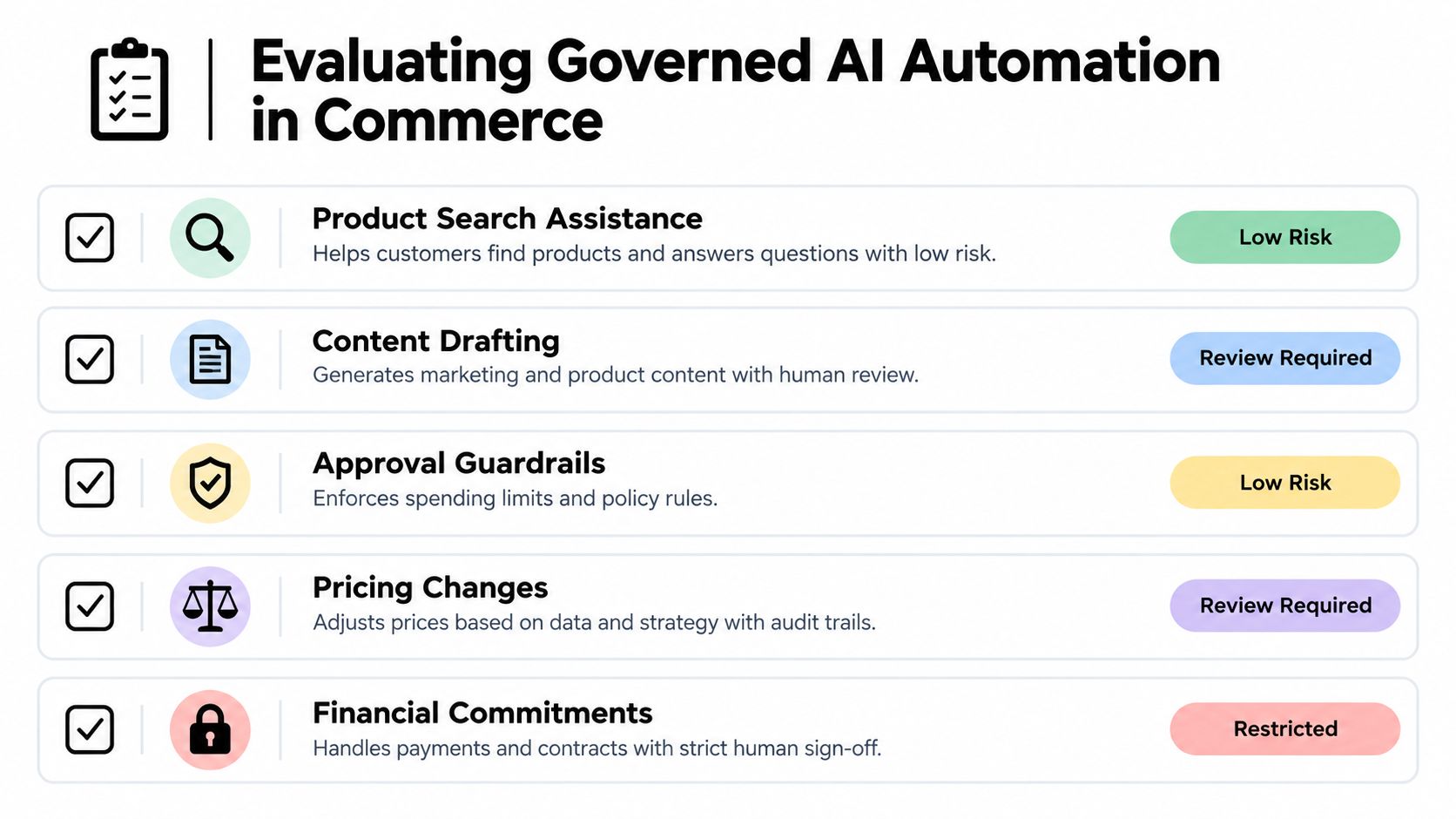
Low-risk use cases can provide value without giving an agent authority to change the commercial record:
- Product search assistance: Interpret natural-language requests, synonyms, and part numbers, then return results for buyer confirmation.
- Content drafting: Prepare product descriptions, buying guides, and support replies for human review.
- Merchandising suggestions: Recommend related products while applying existing eligibility and account rules.
- Order summarization: Explain order history or shipment status without changing it.
These actions still need access controls and source attribution, but a human can review the result before it affects a customer.
Higher-risk actions require a different control plane:
- Pricing changes need approval thresholds, effective dates, and an audit record.
- Credits and refunds need financial permissions and clear reason codes.
- Replenishment orders need limits, idempotent writes, and a rollback or cancellation path.
- Customer-term changes should require explicit human sign-off because they alter the commercial relationship.
When you compare ecommerce AI platforms, inspect the control model rather than counting assistants. Ask whether the system supports scoped keys, approval gates, idempotent mutations, full action logs, and monitoring for failed or repeated requests. Agentic workflows are useful only when the surrounding commerce system can constrain them, a principle also explored in what is agentic commerce.
Calculate the real cost
An AI feature's cost includes integration maintenance, data preparation, exception handling, model monitoring, review time, and change management. Measure incremental margin, prevented manual work, order accuracy, and approved task completion. Clicks and generated text aren't sufficient evidence of commercial value.
Unifying Channels with a Single Source of Truth
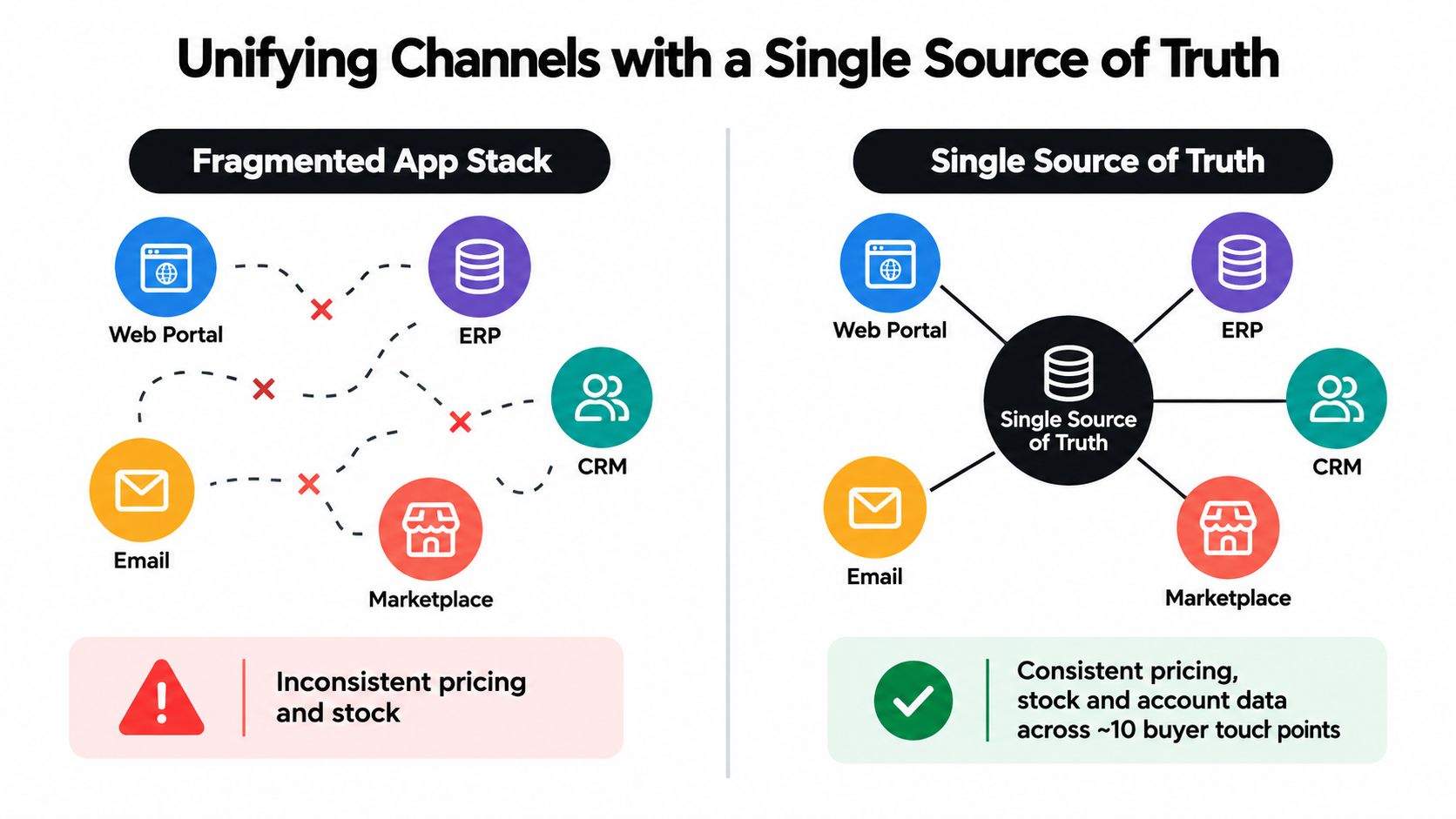
B2B buyers don't experience your architecture as separate applications. They experience one supplier. If the web portal shows one price, a sales representative quotes another, and a physical location sees a third inventory position, the buyer sees a broken relationship.
A McKinsey B2B Pulse Survey found that buyers use an average of 10 interaction channels, up from five in 2016, and that more than half expect smooth movement between channels. The operational answer isn't necessarily one interface. It's one consistent record model behind the interfaces.
Fragmentation creates reconciliation work
A fragmented stack often gives each channel its own customer, cart, discount, and order representation. Integrations then copy data between systems, sometimes on schedules and sometimes through custom event logic. Every copy creates an opportunity for drift.
The common symptoms are familiar:
| Fragmented model | Unified model |
|---|---|
| Separate carts for portal and sales | One cart or draft-order state |
| Channel-specific pricing logic | Central contract and pricing rules |
| Different inventory snapshots | Explicit availability authority |
| Manually reconciled order status | One canonical order lifecycle |
| Independent customer records | Shared account and permission model |
A unified architecture doesn't eliminate every integration. It clarifies ownership. The platform should expose canonical customer, catalog, price, inventory, quote, and order objects through governed APIs, with clear consistency rules for each channel.
Measure continuity, not just uptime
Storefront uptime tells you whether a page responded. It doesn't tell you whether a buyer successfully moved from research to quote, from quote to approval, or from representative-assisted work to online payment.
Track:
- Channel-switch completion: Did the buyer continue without restarting?
- Pricing-consistency defects: How often did channels show conflicting commercial terms?
- Inventory synchronization lag: How long did a committed change take to reach every channel?
- Manual intervention rate: Which orders required staff to correct or re-enter data?
- Order-state integrity: Did every channel display the same fulfillment and invoice status?
For operators assessing architecture options, a detailed explanation of a unified commerce platform is useful because it frames the problem around shared records and processes rather than just adding more sales channels.
Executing a Risk-Free Platform Migration
A platform migration is a revenue exercise disguised as a technology project. The dangerous assumption is that a successful product import means the migration is ready. B2B commerce fails at the edges, where account pricing, order approvals, invoice terms, fulfillment rules, and historical customer context meet.
Start by mapping the existing operation. Inventory every catalog field, variant relationship, customer account, user role, price list, discount, payment term, tax rule, delivery option, draft-order process, invoice state, and integration dependency. Mark each item as authoritative, derived, or obsolete. This prevents the new platform from inheriting ambiguous ownership.
Build a verification path
Import utilities reduce engineering overhead, but imported data still needs business validation. Use representative accounts and products rather than testing only the simplest public catalog path.
Test at least these scenarios:
- Account-specific pricing: Log in as accounts with different terms and confirm prices, discounts, currencies, and minimums.
- Organizational permissions: Verify that buyers can create, save, submit, approve, and view orders only within their assigned authority.
- Draft orders and invoices: Create a sales-assisted order, send it for payment or invoice handling, and confirm that the final order retains its original context.
- Inventory and fulfillment: Place orders against different availability states, including partial shipment, backorder, and location-specific stock.
- Payments and callbacks: Validate successful, declined, interrupted, and duplicate payment events.
- Notifications and service: Confirm that customers and staff receive the right order, invoice, shipment, and exception messages.
The ecommerce platform migration guidance is most useful when treated as an operational checklist, not a launch-day recipe.
Run both systems before cutover
Parallel running gives the team a chance to compare outcomes without immediately abandoning the legacy workflow. Route controlled traffic or selected accounts through the new stack, then reconcile prices, taxes, inventory reservations, order status, payment results, and fulfillment events against the existing system.
Define cutover criteria in advance. Don't switch because the calendar says launch day. Switch when critical workflows pass, unresolved discrepancies have owners, rollback is tested, customer support has scripts, and staff know which system owns each record during the transition.
Keep the old system available long enough to investigate historical orders and customer questions. A migration is complete when the operation can support buyers confidently, not when the new storefront first opens.
Building a Resilient B2B Commerce Operation
The strongest B2B e-commerce solutions make operational truth easy to access and difficult to corrupt. They connect buyer identity to account permissions, apply commercial rules consistently, expose reliable availability, preserve order state across channels, and treat automation as controlled execution rather than a novelty layer.
A vendor evaluation should begin with the records that carry revenue:
- Catalog and product data: Can the platform manage variants, technical attributes, eligibility, and effective dates without duplicated ownership?
- Pricing and terms: Can it apply account-specific prices and approvals at display time and revalidate them at submission?
- Inventory and promises: Can it distinguish physical, allocated, inbound, and promiseable stock?
- Order lifecycle: Can a draft, quote, approval, invoice, payment, shipment, return, and credit remain connected?
- Channel continuity: Can buyers and sales teams resume the same work across portal, assisted sales, and physical channels?
- Automation governance: Are permissions scoped, financial actions approved, writes idempotent, and every action logged?
- Migration and support: Can the provider import data, run systems in parallel, document APIs, publish status information, and connect operators to engineers?
Choose measurable reliability over feature volume
Catalog size is easy to demonstrate in a sales presentation. Data reliability requires harder questions. Ask vendors to show the timestamp and source behind an inventory value, the rule that selects an account price, the audit record for an automated action, and the behavior when a payment or fulfillment event repeats.
Cost transparency matters too. Include platform fees, payment margins, integration maintenance, app replacement, monitoring, exception handling, and internal change-management work in the total-cost model. A lower license price can become expensive when staff must reconcile orders or engineers maintain fragile synchronization.
PlatformDTC is one example of a unified commerce approach. It supports online, B2B, and in-person sales through a shared catalog and order record, with draft orders, invoicing workflows, migration utilities, parallel running, governed APIs, scoped agent permissions, approval gates, idempotent writes, and audit trails.
The strategic decision is simple, even if the implementation isn't. Choose infrastructure that makes accurate buying the default, makes exceptions visible, and gives people control over consequential automation. Storefront polish should support that foundation, not distract from its absence.
PlatformDTC brings storefront, checkout, payments, inventory, fulfillment, POS, analytics, and B2B workflows into a unified commerce system with governed APIs for safe automation. Visit PlatformDTC to evaluate a migration path that protects order continuity while giving your team a clearer operational source of truth.