You can feel the gap by mid-morning. The paid traffic looks healthy, the product pages are getting visits, and the campaign report is full of clicks, but the margin view tells a different story. The question in e commerce for fashion isn't whether the storefront looks premium, it's whether it converts, protects contribution margin, and keeps the return pile from eating the month.
That's why the operator's job is so unforgiving. Fashion sits inside a nearly trillion-dollar digital category, with online revenue at approximately $897.8 billion in 2024 and projections reaching $2.33 trillion by 2034 according to Market.us fashion e-commerce market estimates. But the money doesn't flow cleanly from awareness to profit. It moves through merchandising, fit confidence, search quality, fulfillment, and channel coordination, and any weak link shows up later as a refund, a support ticket, or a customer who doesn't come back.
A useful way to think about the stack is simple. Your storefront has to do five jobs at once, merchandising, fit and returns, search and discovery, omnichannel unification, and visual storytelling. The brands that execute well don't treat those as creative departments. They treat them as measurable operating systems.
For teams comparing their setups with broader B2B and DTC workflows, Polish's B2B e-commerce examples are useful as a contrast point, because they show how structured buying journeys differ from fashion's more image-led, return-prone flow. And if you're trying to understand how a unified DTC stack changes the work across storefront, checkout, and operations, the DTC benefits overview gives helpful context.
Table of Contents
- The Operator's Reality in Fashion Ecommerce
- Fashion Ecommerce in 2026: Scale, Regions, and Channel Mix
- Merchandising Decisions That Move Contribution Margin
- Fit Uncertainty and the Returns Problem
- Search, Discovery, and the AI Question That Matters
- Unifying Online, POS, and B2B Without Data Drift
- Visual Storytelling That Reduces Returns
- A 90-Day Operator Checklist
The Operator's Reality in Fashion Ecommerce
The day usually starts with a dashboard, and the dashboard usually lies by omission. Traffic is up, maybe conversion is steady, maybe the email campaign outperformed last week, but the margin column is soft because size issues, discount stacking, and return exposure have already started working against you. A fashion storefront can look polished and still behave like a leaky bucket.
That's the trap. The site is not a portfolio piece. It's a decision environment that has to translate attention into an order that survives fulfillment, exchange, and repeat purchase. If the team can't answer whether a PDP improved assisted conversion, whether a promo lifted net contribution margin, or whether a sizing change lowered avoidable returns, then the brand is optimizing appearances instead of outcomes.
What the site has to prove
Every change should answer a commercial question. Did this reduce support contacts? Did it improve checkout completion without increasing refund cost? Did it give first-time shoppers enough confidence to buy without bracketing three sizes?
That mindset matters because fashion ecommerce operates with structural friction. Online sales make up only a minority of total fashion revenue globally, with roughly one-quarter of worldwide fashion-retail revenue coming through e-commerce and about three-quarters still happening offline, according to Statista's fashion e-commerce overview. The storefront has to persuade, but it also has to work with stores, inventory, and customer records that don't stop at the browser.
Practical rule: if a change can't be tied to return rate, contribution margin per session, checkout latency, or assisted conversion, it's probably decoration.
That's why good operators care less about “brand elevation” language and more about the mechanics of buying. The right build supports measurement, merchandising discipline, and a clean order lifecycle. The wrong build adds friction, duplicates logic, and buries the data you need to make decisions next week.
Fashion Ecommerce in 2026: Scale, Regions, and Channel Mix
The market is large enough that small mistakes turn into real money fast. Fashion e-commerce revenue was estimated at approximately $897.8 billion in 2024, apparel and clothing represented 52% of market revenue in that same year, and business-to-consumer transactions accounted for about 80% of the market in 2025, according to Market.us. Asia-Pacific led the category in 2024 with about $341.1 billion in revenue and more than 38% of global fashion e-commerce revenue. That is not a niche planning detail. It is a signal that regional execution, payment preferences, and fulfillment rules can shape margin.
At that scale, the stack has to do more than list products and take payment. It has to support international demand, multiple currencies, and channel coordination without creating clean-up work for the team behind the scenes.
The channel mix still matters
Fashion ecommerce has matured, but it has not swallowed the category. Online still represents only a minority of total fashion sales globally, which is why unified commerce keeps coming up in operator conversations. If most revenue still happens offline, storefront decisions cannot live apart from store inventory, POS behavior, or customer identity.
The regional split makes the operating challenge sharper. Asia is the largest fashion e-commerce market, with online fashion revenue projected to exceed $467 billion by 2030 in the Statista topic page, while North American revenue is expected to be roughly one and a half times smaller in that year. That gap does more than signal growth. It shows that a catalog, promo calendar, and fulfillment setup that works in one region can fail in another if the rules are too rigid.
Teams that treat fashion ecommerce as a single-market website usually end up rebuilding it later for inventory, localization, and payment support.
The operator question is simple. Can inventory be trusted across channels? Can promotions be governed consistently? Can fulfillment and customer data support international volume without manual clean-up? If those answers are fuzzy, the business is already paying for it somewhere else.
Merchandising Decisions That Move Contribution Margin
Merchandising works when it reduces uncertainty, not when it adds more visual noise. The product page has to answer the shopper's practical questions fast enough that they don't bounce to search or support. That means cleaner variant labels, better size context, stronger fabric notes, and a taxonomy that helps people find the right thing without playing category roulette.
Build PDPs for decisions, not applause
A useful PDP does four jobs. It shows the item clearly, it explains fit and fabric behavior, it makes variant choice obvious, and it gives the shopper enough confidence to move forward without opening three tabs. If a product has high sensitivity to seasonality or inventory risk, seasonal SKU allocation tactics can help teams think more carefully about what gets displayed, promoted, and held back.
That discipline matters because fashion buyers often shop with a specific intent, but the site serves them a generic grid. If a dress is shown without context for stretch, lining, opacity, or model size, the customer fills in the gaps themselves. That gap often becomes a return.
- Clarify the variant language. “Stone,” “sand,” and “oat” might sound brand-led, but they're only useful if the shopper can distinguish them from the thumbnail and the swatch.
- Normalize sizing cues. Don't bury whether a style runs short, fitted, or relaxed behind vague copy.
- Expose fabric behavior. Material content alone doesn't tell a customer whether the piece drapes, clings, or wrinkles easily.
- Keep filter logic honest. If the catalog filters are noisy or incomplete, shoppers abandon search and you lose intent.
The same logic applies to bundles and outfit logic. If a set increases average order value but drives higher returns because one piece is the anchor and the rest are speculative add-ons, the bundle is not a win. It's borrowed conversion.
Discount logic deserves the same scrutiny. Overlapping apps can create a mess where one shopper gets stacked promos, another sees conflicting prices, and a B2B buyer accidentally receives a consumer code. A single order lifecycle, with one discount engine and one source of truth, keeps that from turning into margin leakage.
A strong merchandising stack is boring in the best way. It makes the right product easy to buy and the wrong discount impossible to stack.
Fit Uncertainty and the Returns Problem
Returns are a structural cost of the fashion business model, and published research puts overall return rates around 25% to 40%, with some categories or brands reaching 75%. The core issue is fit uncertainty, because shoppers cannot reliably infer garment dimensions, fabric behavior, or size equivalence from photos alone.
That makes return data a signal worth using, not just a line item to absorb. If a specific SKU, silhouette, or brand repeatedly produces the same size-related outcome, that pattern should shape catalog copy, fit guidance, and checkout flow, not sit only in post-purchase reporting.
Turn return records into fit intelligence
The practical model is straightforward. Return reasons, exchange behavior, and size-related complaints should flow back into the product record. If an item tends to run small, that should not live in a spreadsheet nobody opens. It should inform the PDP, the recommendation layer, and the customer's next sizing decision.
SizeFlags research paper uses weakly labeled return records in a probabilistic Bayesian model to estimate whether an item has a size-related issue. In production across 14 countries, the approach reportedly reduced the average number of size-related returns by 17% and the return rate by 40%. That is the kind of result operators care about because it connects model output to margin, not just to a technical demo.
A separate multi-country dataset covering 75,707 customers found that approximately 37.5% of ordered items were returned, while shoppers used a size finder on only about 7.3% of orders, according to the Journal of Innovation and Knowledge study. The same study found that size-finder users were 0.65% more likely to return an item, which is why raw group comparisons can mislead. The people using fit tools are often the ones with the most uncertainty to begin with.
Measure the tool against a holdout, not against the average shopper. Selection bias will make weak tools look better than they are, and strong tools look worse than they should.
The measurement stack should include size-guide exposure, variant selection, checkout, exchange, return reason, refund cost, and repeat purchase. The outcome you want is net contribution margin per session, lower avoidable return rate, and healthier size-exchange behavior. If the catalog and order layers cannot connect those dots, fit uncertainty will keep draining cash in silence.
For teams that want a practical visual aid at the PDP level, Robosize's fit visualization tips are a useful reference point for how shoppers read size information before they commit.
Search, Discovery, and the AI Question That Matters
A shopper lands on your site looking for “wedding guest dress for hot weather,” and the search bar has to turn that into a usable shortlist fast. Fashion search is still mostly an intent problem. McKinsey and The Business of Fashion report that 69% of online fashion shoppers go straight to a retailer's search bar, yet 80% are dissatisfied with the experience and leave, while 41% cite irrelevant results as a major barrier to purchase, according to their 2025 State of Fashion report. This is a relevance problem.
The core job is to translate messy human intent into ranked products. Occasion, fit constraints, budget, color, and availability all matter. If the engine cannot understand why the shopper is there, it cannot serve the right result.
What good discovery needs to do
The common mistake is to add AI on top of weak product data and call it innovation. If attributes are incomplete, inconsistent, or loosely governed, AI only scales the confusion. The better move is to make the catalog explicit first, then let search and recommendation use that structure.
Adobe reported in February 2025 that 39% of surveyed consumers were already using AI for online shopping, with 14% expecting to adopt it soon, and clothing was one of the leading categories for AI shopping assistance at 41%. For the surrounding market context, see the AI shopping adoption discussion from PlatformDTC. That raises the bar for guardrails, because shoppers will accept some automation, but they will not forgive bad ranking or obvious manipulation.
Before a brand ships AI-driven discovery, four questions matter:
- What intent signals are you using? If the model only looks at clicks, it is probably learning popularity, not shopper intent.
- How do you measure commercial usefulness? Assisted conversion, return rate, and margin matter more than CTR.
- How do you prevent paid placement from masquerading as recommendation? Shoppers can spot that trick quickly.
- How do you audit the model? If merchandising cannot trace why a product was shown, trust erodes.
How AI assistants choose products to recommend is worth reading if you are pressure-testing whether your search and recommendation layer is helping people buy or just helping them browse longer.
Unifying Online, POS, and B2B Without Data Drift
Fashion brands usually don't run one channel. They run a website, one or more stores, maybe wholesale, maybe subscriptions, maybe pop-ups, and often a messy set of tools trying to pretend all of that is separate. That separation creates inventory drift, attribution confusion, and customer-service headaches the first time someone asks why the site sold what the store already promised to another buyer.
The fix is a unified order and inventory record. A single SKU should mean the same thing online and in-store. A shopper should be recognized whether they arrived from Instagram, bought at a retail counter, or opened a B2B draft order. And discount logic has to be governed once, not rewritten in each channel.
What unified commerce actually changes
With a shared catalog and order model, a team can stop reconciling the same stock pool in three places. Real-time inventory visibility keeps the site from overselling items that the flagship store already moved. It also makes customer history more useful because size, return, and purchase patterns travel with the person instead of living inside one channel.
That matters for migration, too. Switching platforms mid-season is one of the riskiest moments in the business, so the operational value of catalog import tools, parallel running, and verification before cutover is hard to overstate. The goal is not just a prettier frontend. It's avoiding a revenue interruption while the stack changes underneath it.
If a platform can't prove that online, POS, and B2B all read from the same order logic, it's not unified commerce. It's three systems with polite branding.
A system like PlatformDTC's unified commerce platform is one example of how brands can connect storefront, payments, subscriptions, inventory, POS, and B2B workflows inside a single record model. The point isn't the vendor name. The point is that the order lifecycle, discount engine, and inventory truth need to survive contact with multiple channels.
The questions to ask are blunt. Can the same catalog support DTC and wholesale without duplicate maintenance? Can inventory updates flow across storefront and POS quickly enough to prevent selling the same unit twice? Can customer records and promotions stay consistent when the buyer moves between channels? If the answer is no, the brand is still paying an integration tax.
Visual Storytelling That Reduces Returns
Fashion still needs visuals, but the useful ones do more than make a PDP look polished. They help the shopper judge fit, drape, color, and proportion before checkout. That is the line between imagery that decorates the page and imagery that changes buying behavior.
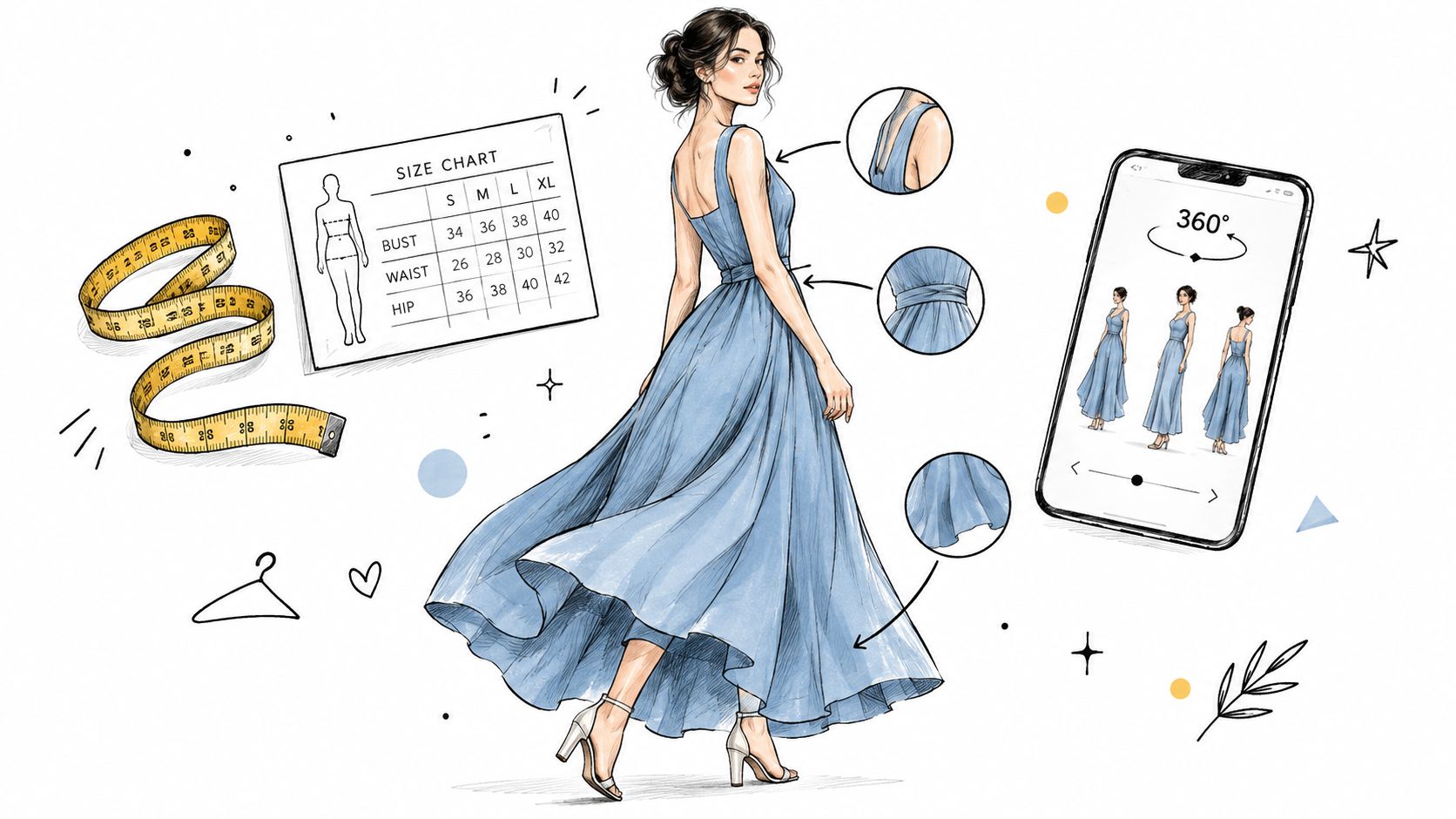
Model photography works best when it shows how the garment behaves on a real body. Fit video helps because motion exposes details static images miss. Flat lays with measurements can feel plain and still do the job because they answer the questions that stall a purchase.
Use AI where it helps, not where it misleads
AI-generated imagery can help with background replacement, lifestyle compositions, or scaling on-model visualization across large catalogs. It becomes a problem when it hides true fabric drape, actual color, or how a garment behaves across body types. If the image improves click appeal but makes the item less truthful, the store may win attention and lose margin through returns.
User-generated content matters for the same reason. Shoppers trust other shoppers when the photos show real variation in fit. That evidence narrows the gap between expectation and reality, especially in categories where body shape and size perception matter more than a polished campaign shot.
A practical PDP checklist keeps the story honest:
- Mandatory visuals: front, back, close-up fabric detail, and at least one fit reference that shows scale.
- Strongly recommended visuals: motion video, size-on-body comparison, and a measurement callout.
- Optional visuals: lifestyle compositions, editorial crops, and AI-assisted background treatments when they do not distort the item.
- Retire these fast: unclear swatches, overly retouched imagery, and any visual that makes color or drape harder to judge.
The best visual stack answers the same question three ways, then makes sure those answers agree.
If a category carries a high return risk, the PDP cannot rely on taste alone. It needs enough visual evidence to support the buying decision, and enough consistency that the customer does not feel tricked when the package arrives.
A 90-Day Operator Checklist
Month one is about measurement. Instrument return reason data, checkout latency, assisted conversion, and size-guide exposure across the categories that matter most. Then identify the three SKUs with the highest avoidable return rate and put them under a microscope, because those items are already telling you where the system is failing.
Month two is about merchandising and discovery. Tighten PDP visuals, test size guidance with a real holdout group, and audit discount logic for overlap or drift. If search relevance is weak, fix product data before blaming AI, and if the product story is muddy, don't expect the recommendation engine to save it.
Month three is about unification. Connect online and POS inventory, verify that B2B draft orders use the same catalog and pricing logic, and run the storefront in parallel with the legacy stack before cutover. The purpose is to remove data drift before it shows up as reconciliation work later.
By day 90, the operator should be able to answer yes to five questions: can we see return reasons by SKU, can we measure assisted conversion by category, can we trust inventory across channels, can we explain why a product was recommended, and can we tell whether a fit change improved margin rather than just clicks? If those answers are still no, the stack needs more than a cosmetic refresh.
If you're ready to treat fashion ecommerce as an operating system instead of a marketing surface, visit PlatformDTC and see how a unified storefront, payments, inventory, subscriptions, POS, and B2B stack can support the same measurements this article uses. For teams that need cleaner data, safer migrations, and less drift across channels, that's where the work becomes much easier to manage.