
A returning visitor can represent a smaller share of sessions while generating a much larger share of revenue. In a benchmark of 33 DTC store properties and approximately 24.7 million sessions, returning visitors represented a median 16.8% of sessions but produced 38.5% of revenue, according to DTC ecommerce benchmarks. That gap captures the promise of direct-to-consumer commerce: not just selling without a retailer, but building an operating system that makes repeat purchasing, customer intelligence, and controlled execution economically useful.
Table of Contents
- What Makes DTC a Different Commerce Model
- The Margin Story Behind Selling Direct
- First-Party Customer Data as a Working Asset
- Lifetime Value Built on Relationships, Not Transactions
- Checkout as a Conversion Engine
- Unified Commerce and Operational Visibility
- When DTC Actually Wins on the P&L
- Putting the DTC Benefits Into an Operating Plan
What Makes DTC a Different Commerce Model
DTC moved from a niche model to a major retail route during the late 2010s and early 2020s. U.S. DTC ecommerce sales were forecast at $17.75 billion in 2020, a 24.3% increase from 2019, while earlier estimates found that DTC ecommerce grew at roughly three to six times the rate of overall ecommerce between 2016 and 2019. The pandemic accelerated that trajectory, with U.S. digital DTC sales estimated to rise 45.5% from 2019 to 2020. These figures come from Payability's overview of direct-to-consumer statistics.
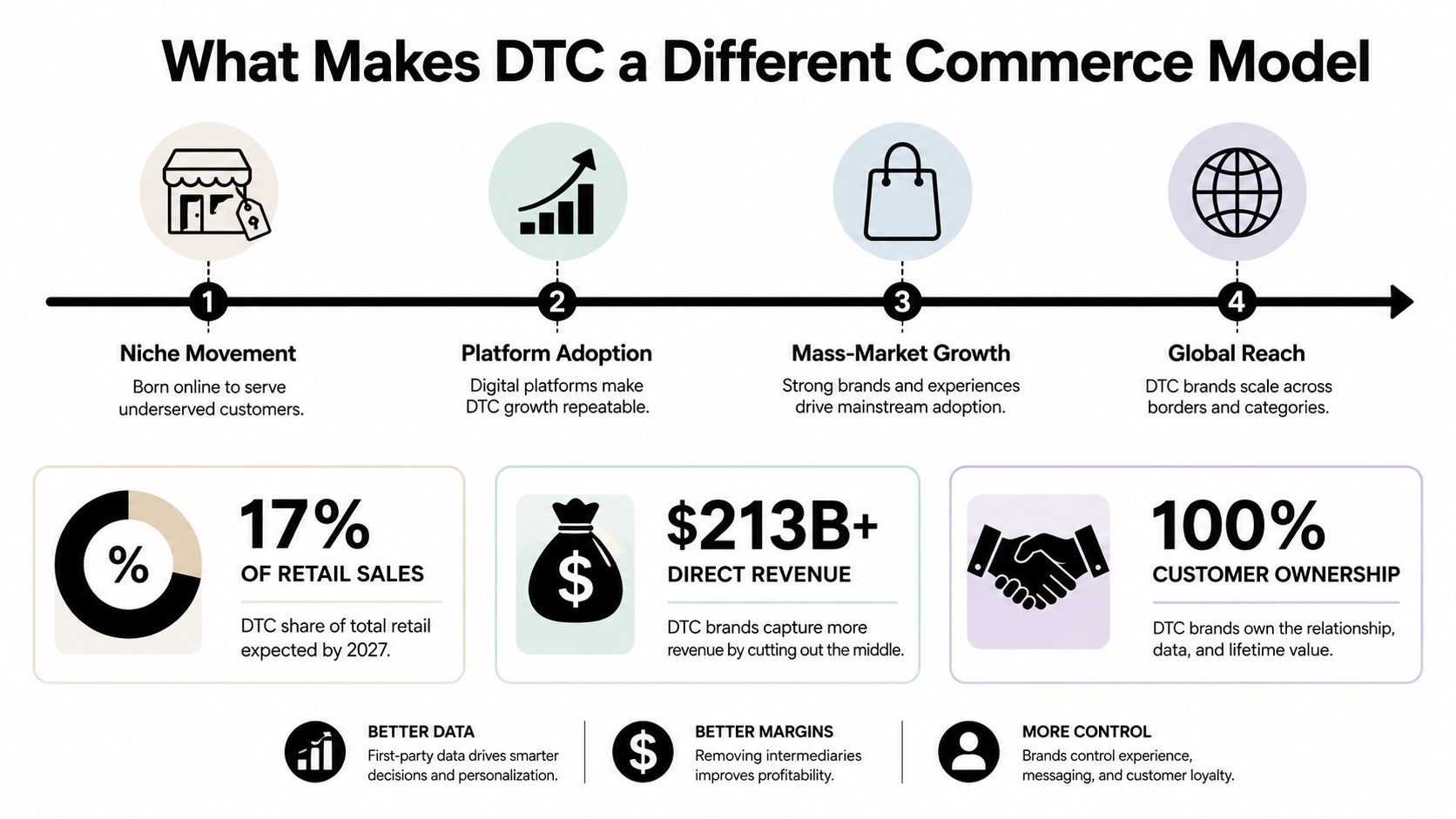
DTC means a brand sells through an owned digital channel rather than relying entirely on department stores, wholesalers, or marketplace operators. The distinction matters because the brand controls more than the checkout. It controls presentation, pricing, customer communication, product-launch timing, and the records created by each transaction.
That control doesn't automatically create profit. It creates the possibility of profit, provided the company can connect storefront behavior to inventory, fulfillment, payments, retention, and reporting. A fast storefront with poor returns data is still an expensive storefront. A large customer database that lacks consent or usable identity resolution is not a strategic asset.
Analyst's rule: Treat DTC as a bundle of operating capabilities, not as a sales channel with a guaranteed margin premium.
The strongest DTC benefits appear through four lenses. Margin improves only when fulfillment, payment, service, discounts, and returns remain under control. Customer data becomes valuable when it connects browsing, orders, subscriptions, and support. Lifetime value grows when that information powers relevant retention programs. Unified commerce makes the whole system measurable and governable across online, in-person, and wholesale activity.
The Margin Story Behind Selling Direct
Selling direct can keep economics inside the brand that would otherwise be shared with intermediaries. Whether that improves the business depends on a narrower question, which channel leaves more contribution after the brand has generated, fulfilled, supported, and, when necessary, refunded the order?
That distinction matters because gross margin is only the starting point. Contribution margin is what remains after the costs that move with demand: payment processing, fulfillment, packaging, shipping subsidies, discounts, customer support, acquisition spend, and expected returns. A DTC order may show a stronger gross margin than a wholesale order while producing weaker contribution once paid acquisition and reverse logistics are counted.
Use a simple SKU-level formula:
Contribution margin = net revenue minus product cost, payment fees, fulfillment, shipping, discounts, support, returns, and attributable acquisition cost.
The useful comparison sits below the company average. Review it by product, channel, customer cohort, and order type. A replenishable product with strong second-order behavior can support a very different CAC and fulfillment profile than a one-time purchase with high return risk, even if both sit in the same blended margin report.
| Cost Line | Own DTC Site | Wholesale or Marketplace |
|---|---|---|
| Price control | Brand sets consumer price, promotions, and bundles | Retail or marketplace terms constrain pricing and promotional flexibility |
| Customer acquisition | Brand funds acquisition and retention directly | Partner may provide discovery, but the brand gives up customer visibility |
| Fulfillment | Brand carries parcel-level handling, delivery, and return costs | Retailer or marketplace may absorb parts of fulfillment, depending on terms |
| Customer relationship | Brand can build permissioned lifecycle communication | Customer access and behavioral detail may be limited |
| Contribution drivers | Repeat orders, subscriptions, bundles, and owned demand can improve contribution | Volume and retail discovery can offset lower per-unit economics |
The better question is: which channel produces the stronger contribution after the work required to generate and serve the order? For some categories, the answer will not always be DTC. Products that benefit from shelf discovery, physical trial, or marketplace intent can acquire customers more efficiently through partners, with the owned site capturing later demand where retention economics justify it.
Measure that with channel-level contribution margin and payback period. If the first order runs negative, the retention system has to earn back acquisition cost through repeat purchasing, higher reorder rates, stronger mix, or lower support intensity over time. If that repeat behavior never appears, the margin story is straightforward. The channel is buying revenue rather than building profitable demand.
First-Party Customer Data as a Working Asset
Returning visitors generated 38.5% of revenue from 16.8% of sessions and converted at 2.72 times the rate of new visitors, based on the benchmark cited earlier. That gap explains why first-party data matters commercially. The advantage is not more event volume. It is the ability to connect identifiable customer behavior to margin, retention, and service outcomes at the order level.
A direct checkout can tie consented contact details to products purchased, order value, payment status, subscription state, delivery events, support interactions, and later replenishment behavior. Retail and marketplace partners may share sell-through reporting, but they rarely expose the same customer-level sequence. Without that sequence, brands can see demand. They cannot easily diagnose why a customer repeated, returned, churned, or generated avoidable support cost.
That only works if records resolve to a stable identity. A usable customer profile separates a first order from a renewal, treats a return as a reversal rather than fresh demand, and preserves channel and preference history across devices. Teams building that foundation can use this guide on how to build a customer profile to structure identity, behavioral, and relationship data.
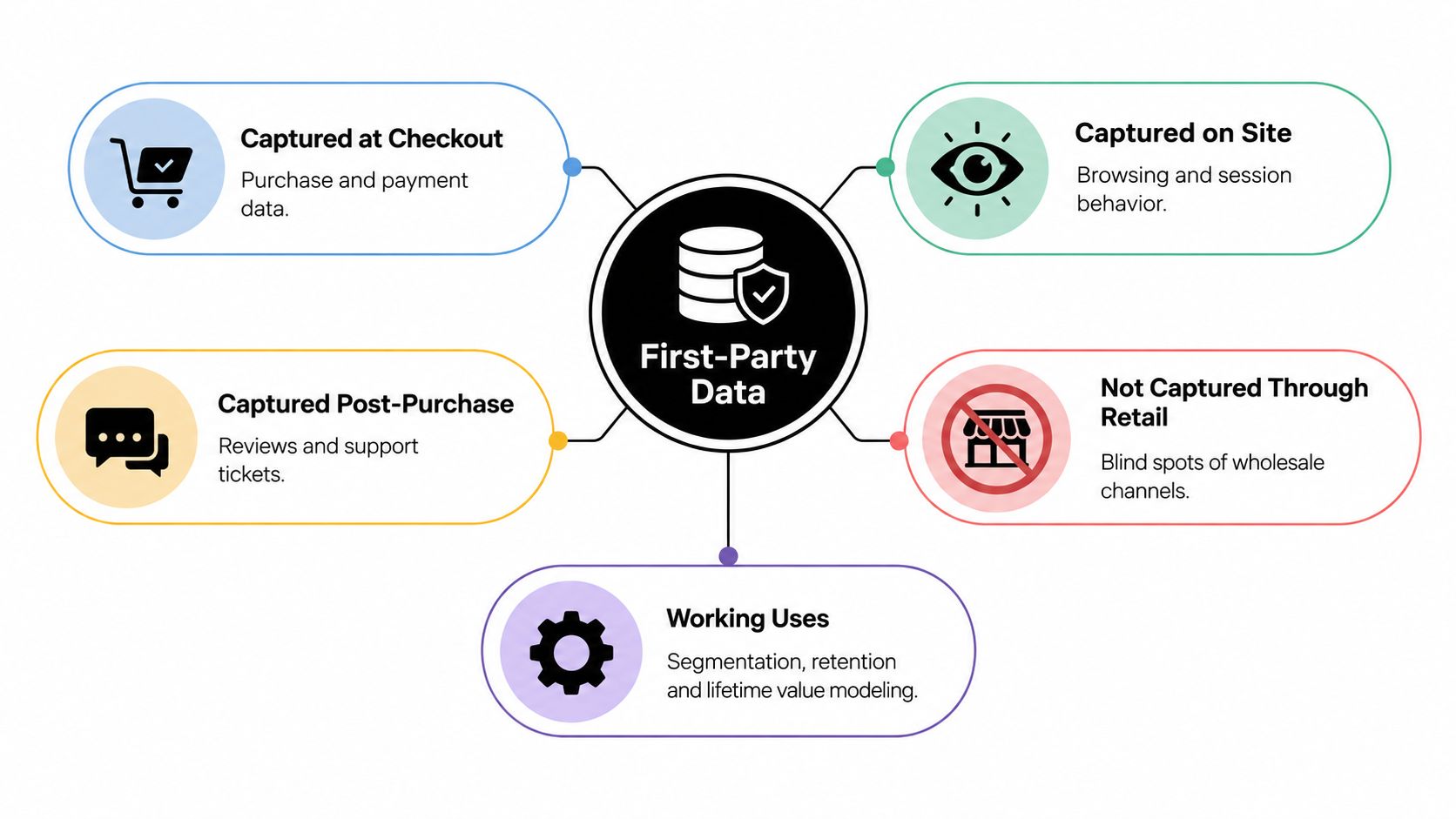
The operational payoff comes from system design, not from collecting more fields. Store browsing and product-view events in one environment, connect them to orders, attach subscriptions to the same customer record, and make email, SMS, and support tools read from current purchase state. That setup supports segmentation by recency, replenishment timing, loyalty status, return behavior, and support intensity. For a working definition, see this explanation of first-party data.
Permission has to be part of the architecture. Brands should record why data was collected, what value the customer received in exchange, where the data can be used, and how access or deletion requests are handled. Data quality also matters. If consent is unclear, identities are duplicated, or lifecycle status is stale, the brand does not gain a working asset. It gets a noisy database that makes targeting worse and trust harder to keep.
Lifetime Value Built on Relationships, Not Transactions
DTC retention economics challenge the instinct to treat every growth problem as an acquisition problem. Existing customers typically convert at 60% to 70%, compared with 5% to 20% for new prospects, according to the benchmark cited by Top Growth Marketing. That difference doesn't mean every existing customer will buy again. It means the business should design the second purchase deliberately rather than hoping it appears.
The first intervention is relevance. A replenishment reminder should reflect actual product usage, not an arbitrary calendar. A subscription renewal should account for pauses, failed payments, inventory availability, and customer preferences. A win-back message should recognize prior behavior without pretending that every customer has the same reason for leaving.
Retention programs commonly combine:
- Subscriptions: Convert predictable replenishment into a managed renewal lifecycle with pause, skip, and cancellation controls.
- Post-purchase messaging: Set expectations, explain use, request feedback, and surface a logical next product.
- Loyalty treatment: Reward meaningful behavior, such as repeat purchasing or referrals, rather than indiscriminate discounting.
- Support recovery: Use service interactions to resolve friction before a dissatisfied customer becomes a silent churn event.
The data layer determines whether these programs help or annoy. Messaging needs current order status, accurate consent, deliverability controls, and identity resolution across email, SMS, storefront, and support. Reporting should separate new-customer revenue from repeat revenue and distinguish a voluntary cancellation from a failed renewal.
Trust is the harder requirement. A May 2025 survey of 2,208 U.S. adults found that consumers were comparatively willing to share information with DTC brands, while business AI adoption and changing regulation were among the developments most likely to damage trust. Respondents also preferred receiving convenience or cost benefits in exchange for personal data, according to Morning Consult's consumer trust, privacy, and AI research.
That finding changes the retention playbook. A brand shouldn't ask for data because it might become useful later. It should explain the benefit now, document consent, and set human approval rules for automated personalization. A smaller dataset with clear permission can support stronger relationships than a larger dataset collected without a credible value exchange.
Checkout as a Conversion Engine
Checkout is where the DTC promise becomes a completed transaction or disappears. Baymard's longitudinal research found that 17% of online shoppers abandoned an order because the checkout process was difficult or overly complicated. The same research identified extra costs such as shipping, tax, and fees as an abandonment driver for 48% of shoppers, while 9% cited insufficient payment methods. See Baymard's checkout UX statistics for the underlying research.
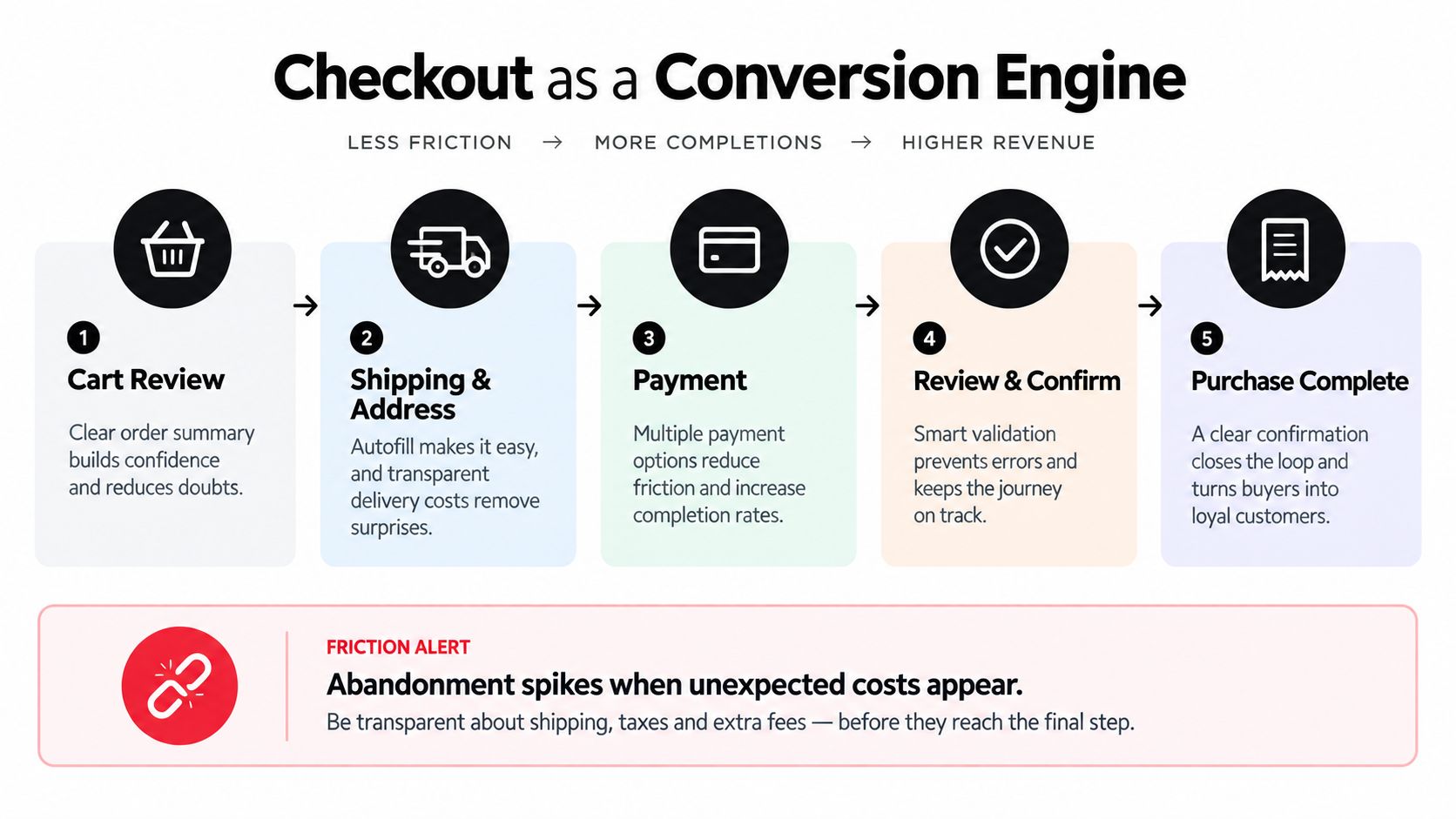
The remedy isn't a visual redesign alone. It's a sequence of operational decisions:
- Show the payable total early. Customers should see shipping, tax, fees, discounts, and the final amount before payment submission. Surprise costs create doubt at the point where intent is highest.
- Offer guest checkout. Requiring account creation adds a task unrelated to payment. Let customers complete the purchase, then invite them to save details afterward.
- Reduce manual entry. Address autocomplete, wallet tokenization, and remembered preferences shorten the path without forcing customers to create an account.
- Support relevant payment rails. Cards, digital wallets, PayPal, and locally preferred methods give customers a way to pay that matches their market and device.
- Measure each transition. Track cart review to shipping, shipping to payment, payment errors, and confirmation completion rather than relying on one blended conversion figure.
An edge-served checkout can reduce avoidable latency, but speed won't compensate for missing wallets or unclear charges. Report completion by device, country, payment method, and new versus returning customer. An aggregate rate can hide a serious mobile or cross-border failure.
Product presentation also influences checkout confidence. Teams selling apparel or appearance-led products can study approaches such as AI model outfit ecommerce when improving visual merchandising before the customer reaches payment. The relevant principle is consistency: product expectations, price, delivery promise, and payment outcome should agree.
A useful checkout feature framework should therefore be judged by measurable friction reduction, not by the number of options on a feature list.
Unified Commerce and Operational Visibility
Unified commerce is an architectural choice. A fragmented stack stores customers, orders, subscriptions, payments, inventory, and fulfillment states in separate systems, then asks integrations and analysts to reconcile the differences. A unified model gives each order one lifecycle and lets downstream rules act on the same current state.
That distinction matters during exceptions. A failed renewal should pause fulfillment. A return should update inventory and refund status. A discount rule should recognize prior use across channels. A POS purchase should appear in the same customer history as an online order. When each event creates a new copy instead, teams spend time resolving mismatched timestamps, identifiers, and definitions.
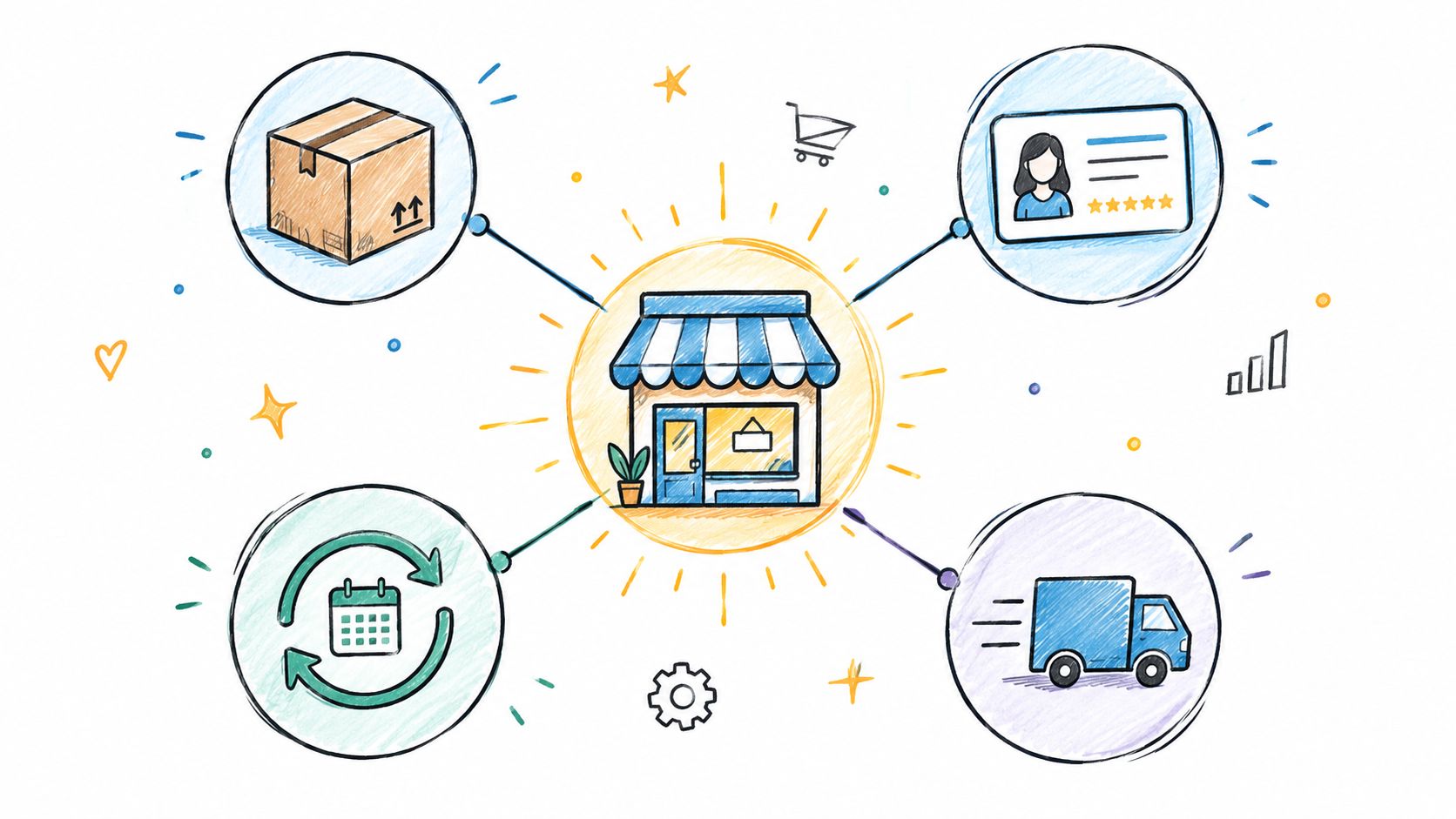
The test isn't whether a platform has fewer applications. The test is whether the business can answer operational questions without stitching exports together.
- Inventory: Can the team see sellable, reserved, returned, and allocated stock from one consistent state?
- Customer identity: Can online, POS, subscription, and support activity resolve to the same customer?
- Measurement: Can campaign attribution, repeat purchase, churn, refund rate, and contribution margin use common identifiers?
- Exceptions: Can a failed payment, promotion conflict, or address issue trigger a defined action rather than a manual investigation?
AI agents make governance part of commerce architecture. Scoped credentials limit what an agent can change. Idempotent mutations prevent a retry from creating duplicate orders or repeated refunds. Approval gates control high-risk spending, while audit logs make automated actions reviewable.
Practical control: An automated action should be constrained by permission, safe to retry, subject to approval where risk is high, and visible in an audit trail.
The resulting metrics are practical: exception volume, inventory mismatch frequency, incident diagnosis time, refund accuracy, and the share of automated actions completed without human correction. A deeper architectural reference is available in this guide to a unified commerce platform.
When DTC Actually Wins on the P&L
DTC wins when the owned relationship creates more contribution than the cost of acquiring, serving, and retaining that customer. It loses when the brand mistakes gross-margin retention for profit retention.
Recent industry analysis estimates that customer-acquisition costs have risen 25% to 40%, depending on channel, according to Deloitte's Q1 2025 retail and consumer trends. That range weakens the simplistic claim that removing the retailer automatically makes a brand more profitable. The brand may retain more selling price while paying more to create demand.
Evaluate channels with a cohort contribution model:
- Start with net revenue. Remove discounts, refunds, and cancelled orders.
- Subtract variable service costs. Include product cost, payment fees, fulfillment, delivery support, and returns.
- Allocate acquisition cost by cohort. Avoid treating all paid media or creator spend as equally productive.
- Measure payback over the customer lifecycle. Include repeat purchases, subscriptions, and retention costs.
- Compare alternatives. Test the owned site against wholesale and marketplace economics for the same product and customer segment.
The result may favor a blended strategy. Retail and marketplaces can provide discovery, convenience, or category credibility. The owned site can capture subscriptions, service relationships, richer consented data, and higher-frequency replenishment. Omnichannel inventory lets the business decide where an order should be fulfilled rather than forcing every customer into one route.
A second benchmark supports restraint about digital-channel dominance. A 2025 online-retail review described ecommerce as approximately 23.5% of U.S. retail sales and projected that it may reach a ceiling near 30% by decade's end, as summarized in the Deloitte source above. The implication isn't that DTC is small. It's that physical retail and partner channels remain part of the demand environment. DTC should complement those routes when they improve the blended economics.
Measurement discipline matters. Teams assessing channel efficiency can use a practical resource on measuring marketing ROI, then extend the analysis beyond media returns to include fulfillment, returns, support, and repeat-purchase contribution. Revenue dashboards that omit those costs reward unprofitable growth.
The trust counterweight is equally important. Consumers may share data with a DTC brand when the exchange is clear, but AI adoption and changing regulation can weaken confidence. A brand that collects every possible event and uses automated agents to infer sensitive preferences may create more risk than value.
Governance should be operational, not aspirational:
- Localize consent: Reflect the customer's market and the permissions required there.
- Define retention: Keep each data class only as long as the business has a documented reason.
- Support access and deletion: Give customers a workable route to inspect or remove their information.
- Require human approval: Review high-impact profiling, discounts, and automated messaging before release.
- Maintain audit trails: Record which agent or user acted, what changed, and whether the action was approved.
The headline benefit of first-party data becomes more nuanced at this point. Data ownership has no value on its own. Permissioned, transparent, and auditable customer intelligence is valuable. A smaller trusted dataset can outperform a larger one harvested without a clear customer benefit because customers remain willing to engage with it and operators can use it with less governance risk.
Putting the DTC Benefits Into an Operating Plan
DTC benefits become durable when the brand converts them into operating metrics and accountable owners. The useful plan is not “sell more directly.” It is a controlled sequence that links channel economics, customer relationships, checkout performance, and data governance.
Start with a baseline by channel, product, and cohort. Then review:
- Contribution margin: Measure net revenue after product, payment, fulfillment, support, discounts, returns, and acquisition costs.
- Repeat purchase: Separate new-customer revenue from returning-customer revenue and track the time between purchases.
- Refund and return rate: Segment by product, reason, channel, and fulfillment route.
- Subscription churn: Distinguish failed renewals, voluntary cancellations, pauses, and skips.
- Checkout completion: Report each step by device, country, payment method, and customer status.
- Data trust: Monitor consent opt-in, access requests, deletion requests, and automated-message approvals.
- Operational exceptions: Count inventory mismatches, duplicate mutations, payment failures, and actions requiring correction.
Don't pursue every improvement simultaneously. A brand with unreliable inventory shouldn't scale personalized promotions. A company with high acquisition costs shouldn't assume subscriptions will fix the P&L without checking renewal behavior. A team that can't explain where customer data came from shouldn't give an AI agent broad authority over messaging.
The strongest DTC operating plan makes trade-offs visible. It preserves the benefits of direct distribution while allowing wholesale, marketplace, POS, and B2B channels to contribute where they create efficient demand or useful customer access. The objective is not channel purity. It's a measurable, trusted commerce system that improves contribution and repeat behavior without hiding operational costs.
PlatformDTC brings storefront, edge-served checkout, subscriptions, payments, inventory, fulfillment, messaging, POS, B2B workflows, and analytics into one governed commerce system. If you're evaluating DTC benefits through contribution margin, retention, checkout performance, and safe AI operations, visit PlatformDTC to assess the platform and its migration options.