
You can get a Commerce.js integration to look healthy in staging and still have it fall apart the first time payments, webhooks, and retries start colliding in production. The common failure isn't the frontend call itself, it's the assumption that a commerce API behaves like a synchronous CRUD service. In practice, the hard part is keeping object ownership, payment state, and replay handling aligned when real customers refresh pages, retry checkouts, or trigger delayed webhook events.
Commerce JS API work gets easier when you stop thinking in endpoints and start thinking in state transitions. Commerce.js emerged in 2016 as an early developer-focused, API-first commerce platform, with public launch milestones recorded in January and November of that year, and that history matters because it pushed storefront control away from a fixed presentation layer and toward composable front ends backed by managed commerce infrastructure Product Hunt's launch record for Commerce.js by Chec. That pattern is still the right mental model, because the main production failures are almost always authorization drift, webhook ambiguity, and event replay.
Table of Contents
- Why Commerce.js API Patterns Matter in Production
- How the Commerce.js SDK Is Structured
- Core Endpoints for Catalog, Cart, Checkout, and Customers
- Payment, Subscription, and Webhook Flows as a State Machine
- Building a Replay-Safe Event Consistency Layer
- Object-Level and Property-Level Authorization
- Endpoint Inventory and Versioning Discipline
- Unified Order Records and Governed Agent Access
- Rate Limits, Caching, and Throughput Tuning
- Commerce.js API Quick Reference
Why Commerce.js API Patterns Matter in Production
A storefront can look healthy in staging and still fail as soon as retries, delayed webhooks, and duplicate clicks start colliding in production. A product list renders, the cart updates, checkout opens, and the system appears stable until one customer submits twice and another payment confirmation lands late.
Commerce.js was built around API-level control over commerce behavior, not a monolithic storefront, so production work starts with distributed-systems thinking rather than a UI tour the platform's launch history. The practical question for a production integration is what failure each call prevents and what failure it creates if you trust it too early.
Practical rule: treat every commerce mutation as if it can be retried, duplicated, reordered, or denied after the browser says it succeeded.
Three failure modes show up repeatedly. Authorization drift happens when a client sends an object ID and the server never checks whether that object belongs to the current tenant. Webhook ambiguity appears when the browser redirect looks final, but payment confirmation still depends on asynchronous provider delivery. Event replay shows up when a retry creates a second order, a second reservation, or a second refund because the write path was not idempotent.
The integration gets easier once every endpoint is treated as part of an event-consistency surface. That changes code review, test cases, and incident response. It also keeps teams from treating checkout as a one-shot request, which is where many Commerce.js deployments break under real traffic.
How the Commerce.js SDK Is Structured
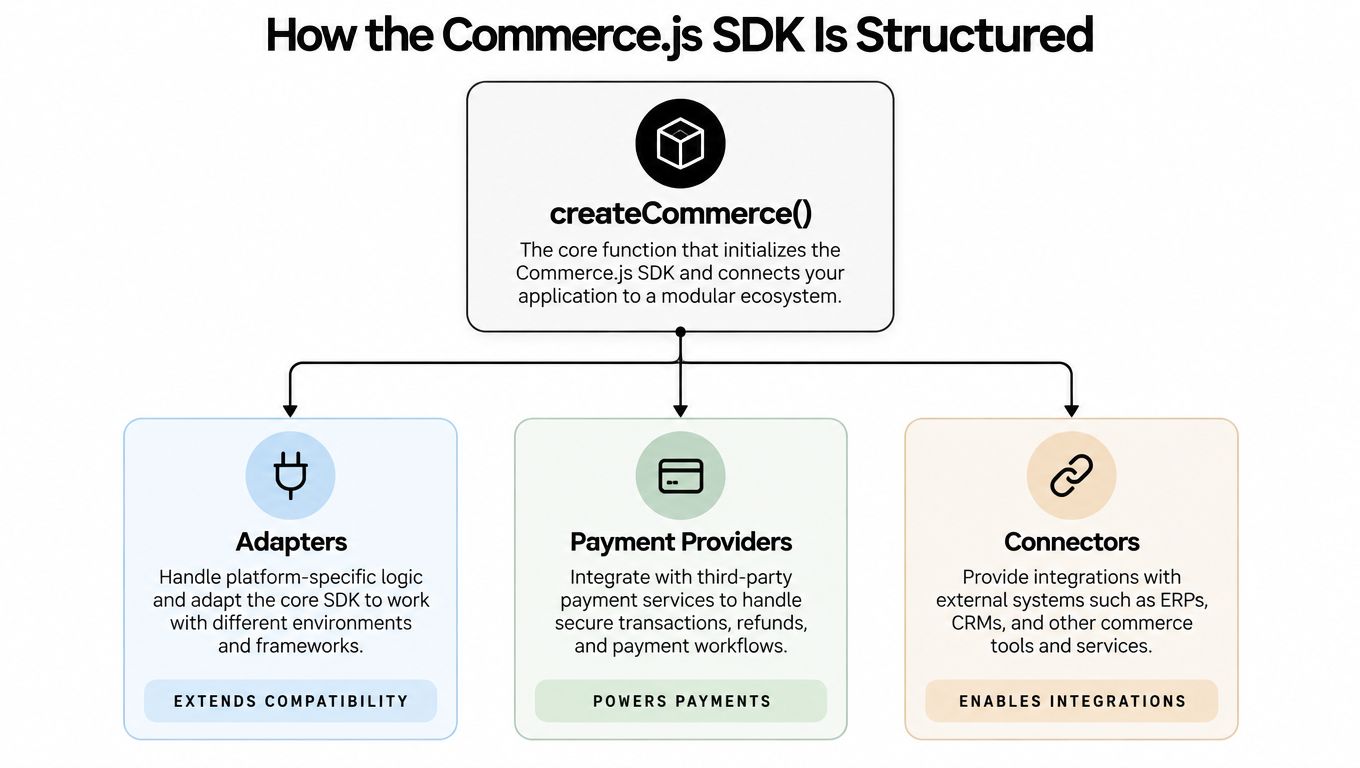
A production Commerce.js integration starts with the SDK boundary, not the storefront. The official core package centers createCommerce(), which wires adapters, payment providers, notifications, analytics, events, and webhooks as separate capabilities Commerce.js core package documentation. That separation matters because each piece can fail on its own, and the failure mode changes how the app should recover.
What the core owns
The core package acts as the orchestration layer. It does not try to become a storefront, and it does not flatten every concern into one request object. It gives the application a controlled way to connect commerce capabilities to the rest of the stack, which makes dependency injection and test isolation much easier. Payment behavior can change without forcing a rewrite of product or cart logic, and notification logic can be swapped without touching checkout flow.
The package history also shows a useful compatibility milestone. Commerce.js 2.4.0 supported API version 2021-03-31 for adding products with variants to carts. That detail matters because variant handling is where many storefronts drift out of sync. If size, color, material, or region is added too late, the cart can look valid while the order path charges the wrong item.
What to look for in code
A codebase that scales usually splits the SDK into a few clear layers:
- Adapters connect the client code to the commerce backend.
- Payment providers isolate gateway-specific behavior.
- Events and webhooks carry asynchronous truth back into the app.
- Notifications and analytics sit beside the transaction path, not inside it.
That structure prevents several production failures. Tightly coupled adapters make upgrades risky. Mixed payment logic makes retries hard to reason about. Webhook handling buried inside UI code turns late confirmations into support incidents. Clean separation keeps each failure contained, and it gives the team a place to test how the system behaves when a call is repeated, delayed, or rejected.
Core Endpoints for Catalog, Cart, Checkout, and Customers
The daily integration work in a Commerce.js API usually falls into four buckets. Catalog reads answer what can be sold. Cart writes answer what the shopper intends to buy. Checkout answers how the order will complete. Customer endpoints answer who owns the state and where the receipt, address, or profile should live.
Where the variant data must flow
Variant handling is the part that gets under-specified in too many implementations. A real catalog doesn't just contain a product. It contains a product plus the options that affect inventory and pricing, such as size, color, material, or regional availability. If that metadata drops out between catalog read and cart write, the frontend can show one thing while the order service charges for another.
The safest pattern is to thread variant identifiers through every call, not just the initial product fetch. Cart items should preserve the exact variant selection, checkout should validate it again, and customer-facing summaries should surface the same option set so support teams can reconcile the order later.
| Endpoint Family | Primary Resource | Key Parameter |
|---|---|---|
| Catalog | Products and variants | Product or variant ID |
| Cart | Line items | Variant ID |
| Checkout | Checkout session | Cart ID |
| Customers | Customer profile and addresses | Customer ID |
If you need a broader implementation pattern for cart orchestration, the Commerce cart API reference is useful as a structural comparison point.
The frontend should never “remember” a variant selection on its own. The API has to confirm it at each state change.
For production code, the question isn't whether a call succeeds. It's whether the returned payload still matches the shopper's original intent after pricing, availability, and address validation are applied. That's where cart, checkout, and customer records become a single chain, not four separate screens.
Payment, Subscription, and Webhook Flows as a State Machine
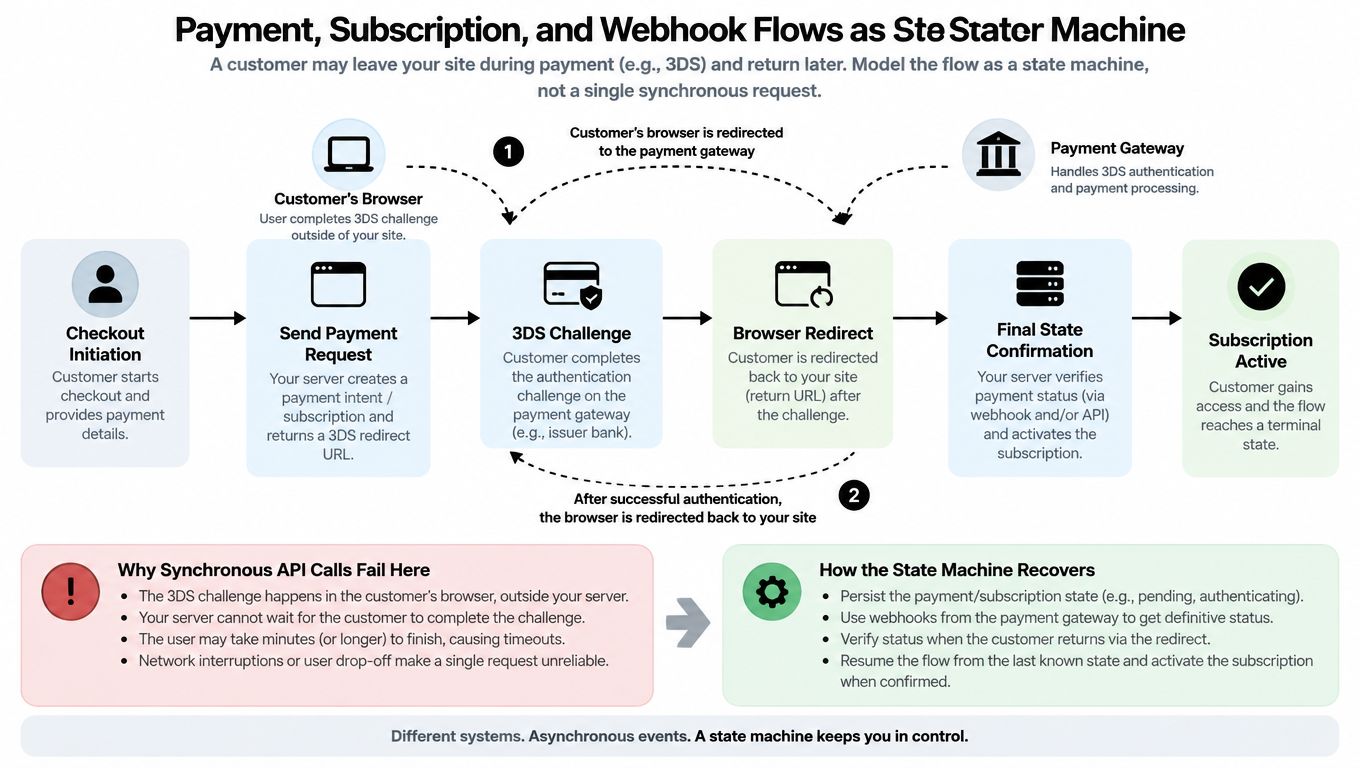
A card flow that requires 3DS is not a simple request-response exchange. The browser may redirect to a provider page, the shopper may complete authentication, and the final status still arrives later through webhook delivery. That's why a successful redirect is only a clue, not a settlement event.
The difference between a browser callback and a durable payment state is the reason production systems need a provider-neutral state machine. The meaningful states are pending, authorized, captured, failed, refunded, and unknown. If the integration only models “success” and “failure,” it can't explain delayed webhooks, duplicated notifications, or a retry that shows up before the original event is processed.
For a clean conceptual contrast between synchronous calls and asynchronous delivery, the Refact guide on webhook vs API explained is worth having open while designing the flow.
What usually breaks first
CommerceJS provider toolkits can use different verification strategies, and webhook delivery may include unique delivery IDs, retries, and HMAC signing. That means the implementation must preserve the raw request body for signature checks, validate the event timestamp, and reject anything that lands outside the replay window.
A durable payment model also needs reconciliation. If the provider says an order is captured and your local system still says pending, the local state is wrong until the discrepancy is resolved. The reverse is also true. Production reliability comes from the reconciliation loop, not from the hope that every event arrives once and in order.
For a deeper operational treatment of payment handling in a commerce stack, the DTC payment system reference is a useful companion.
Reliable rule: a webhook should update state, not invent it.
That distinction keeps the checkout flow honest under load, especially when subscriptions renew, cards require extra authentication, or the shopper retries before the first event returns.
Building a Replay-Safe Event Consistency Layer
The fix for async commerce isn't more endpoint calls. It's a write path that assumes duplicates, delays, and partial failure from the start. Every mutation that changes business state should carry an idempotency key, including cart updates, order creation, payment confirmation, inventory reservation, refunds, and subscription renewals.
The control set that actually holds up
The first control is raw-body preservation. If the JSON parser runs before signature validation, you've already weakened the webhook path. The second is timestamp checking, because old events should fail fast instead of being treated like current truth. The third is replay resistance, usually implemented through event IDs or idempotency records that mark a delivery as already handled.
You also need a dead-letter queue for poison events. Some payloads are malformed, some arrive with missing context, and some will never validate cleanly. Pushing those cases to a queue that operators can inspect is a lot safer than letting them loop forever in the main consumer.
The same pattern works across the whole commerce surface:
- Cart updates: store the idempotency key with the resulting cart snapshot.
- Order creation: persist the key with the order record so a retry returns the same outcome.
- Payment confirmation: treat the webhook as the source of truth, then reconcile local state.
- Inventory reservation: record reservation attempts so duplicate decrements don't slip through.
- Refunds and renewals: log the mutation result before any downstream side effect is exposed again.
A practical operator checklist
A runbook-grade integration usually includes the following fields and decisions:
- Header values: request ID, signature, timestamp, and idempotency key.
- Persistence keys: tenant ID, object ID, event ID, and mutation hash.
- Retry policy: exponential backoff for transient failures, no blind retries for validated duplicates.
- Reconciliation cadence: a scheduled job that compares local order and payment state against the provider source of truth.
The e-commerce API integration guide is a useful reference if you're formalizing these patterns into engineering standards rather than leaving them scattered across handlers.
When teams get this right, the integration stops double-charging, stops double-reserving inventory, and stops drifting away from the provider's actual payment state. That's the difference between a storefront that looks reliable and one that really is.
Object-Level and Property-Level Authorization
Most Commerce.js integrations start with endpoint checks and stop there. That's not enough. Authorization needs to be a resource-level decision, which means the server must verify that the authenticated principal is allowed to access the specific object named in the request, not just the route.
OWASP classifies this as Broken Object Level Authorization, or API1:2023, and the risk is straightforward. If the server accepts a client-supplied cart, order, customer, subscription, inventory, or payment ID without checking tenant, merchant, user, or agent ownership, the integration has already lost control of the object boundary OWASP API Top 10 2023.
Why field-level control matters too
Property-level authorization matters just as much. AI agents and careless frontends shouldn't be able to mass-assign protected fields like payment status, fulfillment state, discount totals, settlement account, or audit metadata. Those fields belong behind explicit allowlists and server-side rules, not direct request binding.
The controls are practical, not theoretical:
- Tenant-bound API keys ensure credentials only operate inside the correct merchant boundary.
- Scoped capabilities like
catalog:readororder:refundlimit what a token can do. - Server-side ownership checks confirm the caller can touch the exact object in the request.
- Deny-by-default behavior prevents accidental privilege expansion.
- Structured audit logs capture principal, agent identity, object ID, action, result, and correlation ID for every sensitive change.
If you're rolling out those permissions in a mature system, Vision's guide on safely rolling out access changes is a useful companion.
If the request body can rewrite business-critical fields directly, the API isn't enforcing authorization, it's trusting the client.
That's a bad trade in commerce, where one mistaken refund, one changed settlement destination, or one unauthorized discount can turn into real financial loss.
Endpoint Inventory and Versioning Discipline
A production Commerce.js API needs a machine-readable map of everything it exposes. That includes public hosts, endpoints, webhooks, API versions, deprecated routes, and internal routes that still exist in production. OWASP calls the risk Improper Inventory Management, or API6:2023, and the failure mode is familiar, forgotten debug routes, stale versions, and security rules that apply to one path but not its duplicate OWASP API Security Top 10 release notes and OWASP API Security Top 10 API6:2023.
What a real inventory stack looks like
A solid implementation usually has an OpenAPI contract per version, generated endpoint inventories in CI, ownership metadata for every route, and automated checks that compare deployed surfaces against the documented contract. That combination catches shadow routes before they become long-term liabilities.
A deprecation policy should also be visible inside the engineering organization. Sunset dates, migration notes, and owner names reduce the chance that an old webhook or cart endpoint survives because nobody wanted to break a dependent app.
For webhooks, the inventory rules are stricter because inbound traffic can mutate state. Signatures should be verified, timestamps checked, event schemas validated, replay attempts rejected by event ID or idempotency record, and processing moved to an async worker with retries plus dead-letter handling.
Monday morning checklist
- Maintain one contract per version.
- List every deployed route, including internal ones.
- Assign an owner to each endpoint and webhook.
- Compare the live deployment to the documented inventory in CI.
- Publish a deprecation schedule with explicit cutoff dates.
Teams that do this stop finding security gaps through incident response. It also makes audits and upgrade work easier, because nobody has to guess which endpoints still exist or what version they belong to.
Unified Order Records and Governed Agent Access
The strongest commerce systems are starting to converge on a single order record that spans storefront activity, subscriptions, payments, inventory, returns, and fulfillment. That model lines up with the modular Commerce.js approach, but it goes further by making the order itself the durable business object instead of scattering truth across multiple services.
That matters even more when AI agents can act on behalf of teams. Scoped keys per agent, approval gates on spend, idempotent writes, and immutable audit trails are the natural extension of the authorization and replay controls already discussed. They turn commerce operations into governed actions instead of free-form API access.
PlatformDTC applies that pattern with unified order records and scoped dtc_* tools for agent operations. The point isn't to replace the composable model, it's to add stronger control boundaries when automation starts writing into real revenue flows.
The next layer of commerce APIs won't just expose more endpoints. It'll expose better permissioning around the same business objects.
That's the direction the market is moving in, whether the caller is a storefront, an ops dashboard, or an AI agent coordinating merchandising and fulfillment. The winning design keeps one source of truth, one order lifecycle, and one audit trail, then constrains who can change it and under what conditions.
Rate Limits, Caching, and Throughput Tuning
Throughput problems in commerce are co-design problems. Rate limits need to be set by tenant, credential, IP, and sensitive business flow, not by one global ceiling. That is the control pattern that keeps a busy storefront from turning catalog reads, cart edits, webhook retries, and checkout spikes into one shared failure mode.
A practical integration caches product and category reads, uses conditional requests with ETags where supported, batches cart updates, and coalesces server-side requests for hot SKUs so a burst of shoppers does not create identical upstream calls. Checkout, search, and webhook ingestion usually need the tightest controls, while catalog and content reads can usually tolerate more reuse.
For gateway routing and backpressure patterns, the GoReplay guide on API gateway security and routing is a useful reference. The OWASP API4:2023 guidance on unrestricted resource consumption also maps cleanly to this problem class.
What the backoff logic should key off
Use the Retry-After header when the API sends it. If the gateway says to wait, the client should wait. If the call is a duplicate mutation, the idempotency key should return the original outcome instead of forcing another write.
Good throughput posture usually includes:
- Response caching for product and category data.
- Conditional reads to avoid refetching unchanged resources.
- Batched cart writes when the UI makes several changes in quick succession.
- Request coalescing for hot items that many shoppers open at once.
- Backoff discipline that respects server guidance instead of hammering retries.
That setup keeps the integration responsive without redesigning the whole stack around limits. It also avoids the common failure where retries meant to improve reliability create their own traffic spike.
Commerce.js API Quick Reference
A Commerce.js integration stays healthy when every write, callback, and retry follows the same rules. The failure modes are predictable. A duplicate mutation creates extra side effects, a stale read leaves order status behind provider truth, and an unchecked webhook can replay the same event twice.
Core resource families
- Catalog: products, variants, categories.
- Cart: line items, totals, discounts.
- Checkout: checkout sessions, payment state, order creation.
- Customers: profiles, addresses, saved context.
- Webhooks: inbound event delivery from payment and order systems.
Headers and mutation controls
- Idempotency key: required on commerce writes that can be retried.
- Signature header: required for webhook authenticity checks.
- Timestamp header: validate it before accepting an event.
- Request ID or correlation ID: log it with the object ID and action.
Webhook handling
- Verify the raw body before parsing.
- Reject replayed event IDs.
- Process asynchronously.
- Move poison events to a dead-letter queue.
Versioning
- Use explicit API versions.
- Keep one contract per version.
- Document deprecations with a sunset date.
Common failure classes
- Unauthorized object access: client ID accepted without ownership check.
- Duplicate mutation: retry creates a second side effect.
- Stale state: local order status no longer matches provider truth.
- Undocumented route: endpoint exists outside the contract.
Keep the getting-started quick start open while wiring these pieces together. It is the fastest way to confirm the request shape, header handling, and webhook flow before code reaches production.