
Most Shopify alternatives guides obsess over the wrong number. They compare the monthly plan, then act like the cheaper sticker price is the smarter move. That's how brands end up paying more in app sprawl, integration maintenance, migration risk, and broken data than they ever would have on a cleaner stack.
The right question is simpler and more brutal. Which platform reduces your five-year total cost of ownership, keeps AI agents under control, and avoids data fragmentation as your order volume, channels, and team complexity grow? On that scorecard, the usual “cheapest” option often loses fast.
| Platform | Consolidation | TCO profile | Migration risk | Checkout performance | Agent governance |
|---|---|---|---|---|---|
| BigCommerce | Stronger than Shopify for native consolidation, especially when you want fewer moving parts | Usually cleaner than a plugin-heavy stack if you stay within native features | Moderate, because you still have to map apps and flows | Good if the implementation is disciplined and the checkout path stays lean | Basic, unless your implementation partner builds the controls |
| WooCommerce | Fragmented by design unless you assemble a tight WordPress stack | Can look cheap upfront, then drift upward as hosting, plugins, and maintenance pile on | Higher, because the migration often involves rebuilding what plugins used to cover | Highly variable, depending on hosting, theme, caching, and extensions | Weak by default, because governance lives in the plugin and custom code layer |
| Adobe Commerce | Strong for enterprises that need one commerce brain across complex operations | High implementation cost, but often defensible when the business needs deep control | High, because the scope is rarely simple | Can be strong, but only when the build and hosting are tuned properly | Better than most if your team implements approval and audit discipline |
| Shopware | Good for mid-market teams that need more structure than Shopify-lite tools | Balanced if the fit is right, less efficient if you force enterprise complexity onto it | Moderate, with implementation effort tied to scope | Usually respectable when configured well | Depends on your governance design, not the logo |
| PlatformDTC | High consolidation by design, storefront through analytics on one order lifecycle | Built for lower surface area, fewer duplicate systems, and clearer operating cost | Lower when the migration is handled as a controlled parallel run | Edge-served checkout is part of the model, not an add-on | Strongest fit when you want scoped agent credentials, approval gates, and full audit trails |
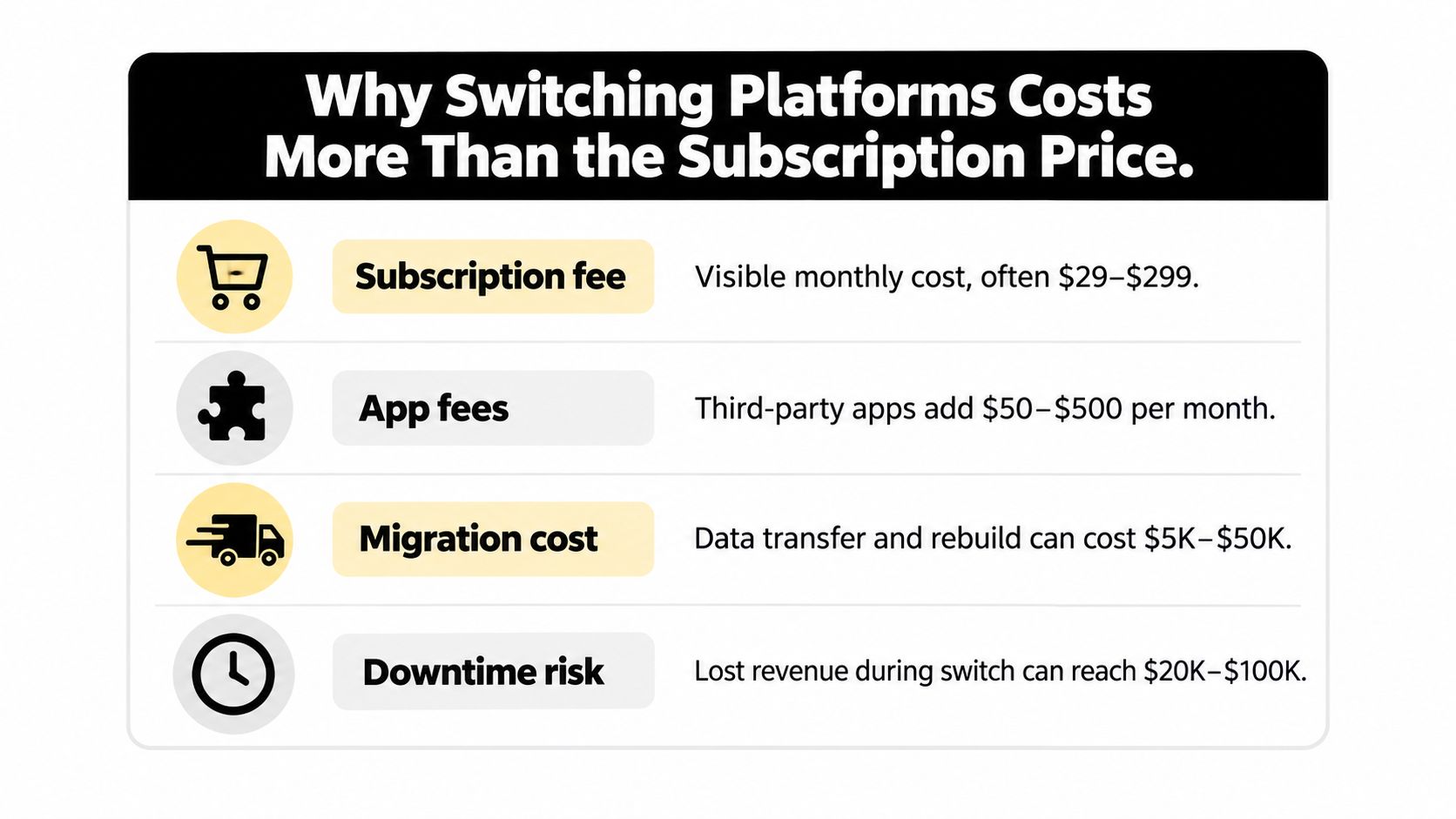
Table of Contents
- Why Switching Platforms Costs More Than the Subscription Price
- The Five Filters That Actually Predict Fit
- Feature Matrix Across the Leading Alternatives
- Five-Year TCO for a $5M DTC Brand
- A Phased Migration Playbook That Protects Revenue
- Matching Platforms to Company Size and Use Case
- Your Decision Framework and Next Steps
Why Switching Platforms Costs More Than the Subscription Price
The first mistake brands make is treating platform choice like a SaaS pricing page exercise. That works for a logo review tool. It fails for commerce, where the bill includes app replacement, integration maintenance, SEO migration risk, and the operational mess that comes from stitching together tools that were never designed to share one record model.
The hidden cost stack
App fees are only the beginning. If your current stack depends on subscriptions, loyalty, reviews, search, feeds, shipping, and analytics apps, the monthly platform line item stops mattering very quickly. The bigger issue is that every plugin or add-on creates another place where data can drift, permissions can break, and upgrades can fail.
Migration cost is the second trap. A move off Shopify isn't just data export and theme rebuild. It's product mapping, redirect planning, checkout validation, QA on customer accounts, and all the edge cases that appear when you discover a field you forgot to migrate.
Downtime risk is the one founders underestimate most. Even a clean cutover can hurt revenue if the new stack underperforms on the pages that matter, product, cart, and checkout. That's why the evaluation has to start with operating surface area, not the sticker price.
Practical rule: if two platforms look close on subscription cost, pick the one that removes the most apps and custom glue.
The right lens is a five-year one. Operational consolidation asks whether one platform can own the order lifecycle or whether you'll keep assembling it from fragments. TCO asks what the platform really costs after hosting, maintenance, payments, and rebuilds. Migration risk asks how much revenue you're exposing during the switch.
Core Web Vitals and AI agent governance matter just as much. If the candidate can't meet the right performance bar on real product and checkout flows, it doesn't matter how good the sales pitch sounds. If it can't control agent permissions, approvals, writes, and audit logs, it's not ready for autonomous commerce.
The Five Filters That Actually Predict Fit
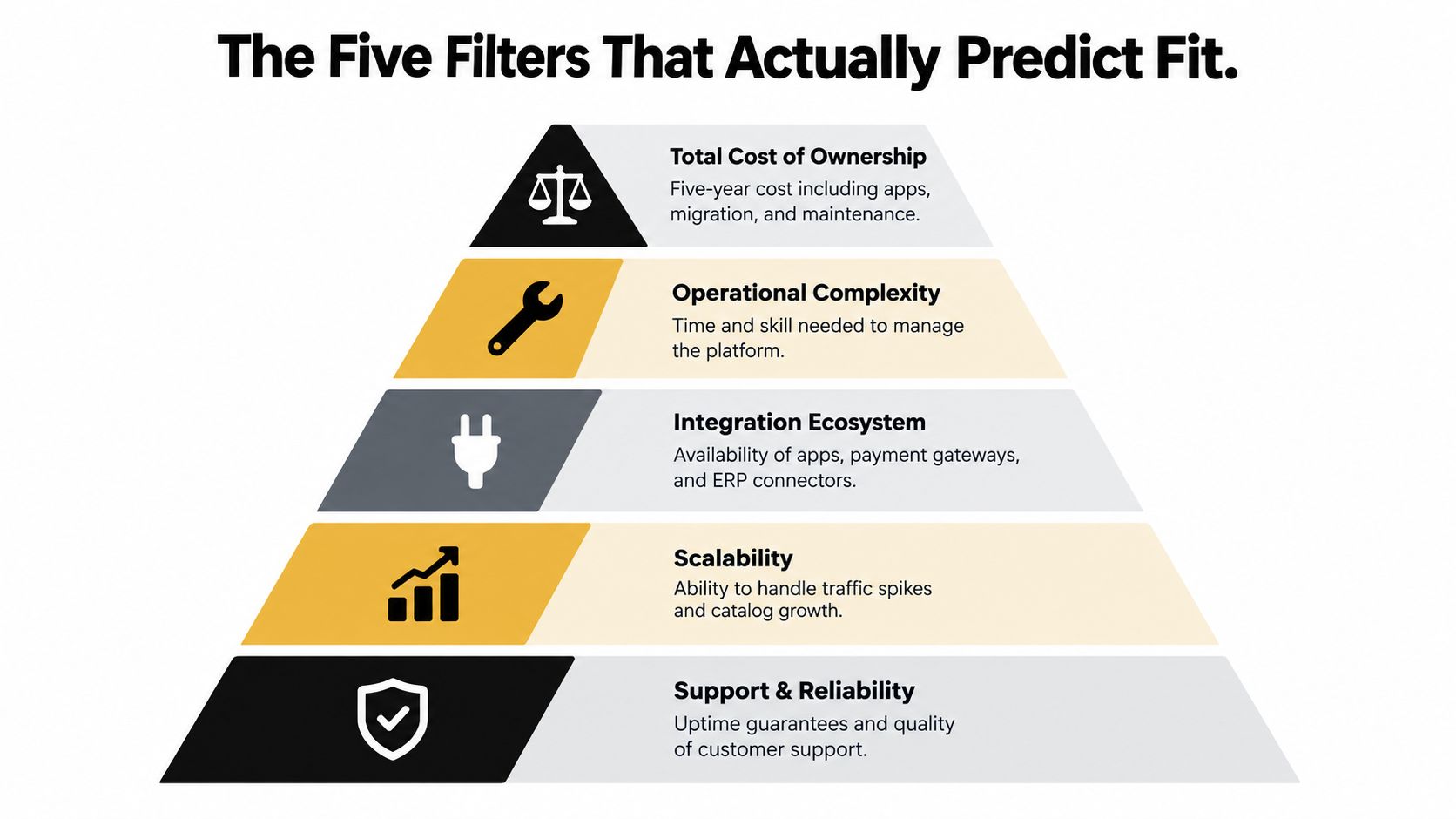
The fastest way to kill a bad shortlist is to use the same filters on every platform. Don't start with themes, app stores, or checkout screenshots. Start with the operating model, then pressure-test the stack against the five things that decide whether a switch pays off.
1. Operational consolidation
Operational consolidation means one order lifecycle, one customer record, one set of rules for discounts, inventory, returns, and messaging. If subscriptions, POS, marketing, and fulfillment live in separate systems, state starts to drift and your team spends time reconciling what happened instead of selling. The elimination rule is simple: if a platform forces you to rebuild the business across too many tools, it is not simpler.
2. Five-year total cost of ownership
TCO is the full cost of ownership across five years, not the monthly subscription alone. It includes hosting, apps, payment margins, developer time, observability, and ongoing upgrade work. A platform fails this filter when the visible fee looks low but the surrounding stack keeps growing.
A low sticker price is not savings if it just moves cost into engineering, operations, and reconciliation.
3. Migration and switching risk
Migration risk is the probability that the move damages SEO, data integrity, or conversion before the new stack stabilizes. That includes redirects, customer history, subscriptions, payment tokens, and checkout behavior. If a platform doesn't support a controlled parallel run and clean verification gates, it shouldn't be near production traffic.
4. Performance under real checkout conditions
Performance means the checkout path, not the homepage, meets the right thresholds under realistic scripts, payment methods, and promotions. The acceptance bar is the same across candidates, LCP at 2.5 seconds or less, INP below 200 milliseconds, and CLS below 0.1 at the 75th percentile, using the criteria published for web benchmarking by Shopify's enterprise team (website benchmarking guidance). If a platform only looks fast in a lab test, that's not enough.
5. AI agent readiness
AI agent readiness is a governance question, not a feature checkbox. The test is whether the platform can handle scoped permissions, approval thresholds, idempotent writes, audit logs, and reversibility when an agent changes a product, campaign, or order. If those controls aren't native or clearly enforceable, the platform isn't safe for consequential automation.
Feature Matrix Across the Leading Alternatives
Here's the blunt version. BigCommerce is the cleanest SaaS-style alternative when you want fewer fees and less app dependence. WooCommerce gives you control, but that control comes with more operational responsibility. Adobe Commerce is the enterprise complexity benchmark. Shopware is a strong mid-market option. PlatformDTC is the consolidation play when you want storefront, checkout, subscriptions, payments, inventory, fulfillment, messaging, and analytics in one system.
| Platform | Consolidation | TCO profile | Migration risk | Checkout performance | Agent governance |
|---|---|---|---|---|---|
| BigCommerce | Strong native consolidation for a hosted platform, with fewer reasons to assemble a huge app stack | Better when you value managed infrastructure and lower surface area, but still depends on implementation discipline | Moderate, because the move is less about infrastructure and more about mapping workflows cleanly | Usually solid if the theme and checkout are kept lean | Limited by default, so you'll need process design for approvals and auditability |
| WooCommerce | Flexible, but fragmented if you rely on many plugins and custom extensions | Can start low, then climb as hosting, security, support, and plugins multiply | Higher, because the current stack often has hidden dependencies | Highly variable across hosting tiers, themes, and plugins | Weak unless you build controls yourself |
| Adobe Commerce | Excellent for complex catalogs, regional operations, and deep customization | High, but can make sense when complexity would explode elsewhere | High, because enterprise migrations usually touch many systems | Good when the implementation is tuned properly | Stronger fit for governance if your team builds it deliberately |
| Shopware | Good balance for teams that need structure without full enterprise sprawl | Mid-range if your use case fits the platform's sweet spot | Moderate | Usually respectable for mid-market builds | Depends on implementation choices |
| PlatformDTC | Very strong, because it consolidates more of the operating stack into one order lifecycle | Designed to reduce duplicate tooling and rework | Lower if you use parallel run and verification gates | Edge-served checkout is built into the model | Strong, because scoped agent credentials and audit trails are core features |
Verdict: if your stack is already held together by half a dozen app vendors, consolidation matters more than another marketplace of add-ons.
BigCommerce wins when you want managed infrastructure, less payment friction, and a cleaner path off Shopify without jumping into enterprise-heavy complexity. WooCommerce wins only if you already have serious WordPress competency and you're willing to own the operational sprawl that comes with it. Adobe Commerce wins when your business has outgrown simple commerce and needs a platform that respects catalogs, regions, and governance. Shopware wins when you want a more disciplined mid-market system without going full enterprise. PlatformDTC wins when the stack itself is the problem.
Five-Year TCO for a $5M DTC Brand
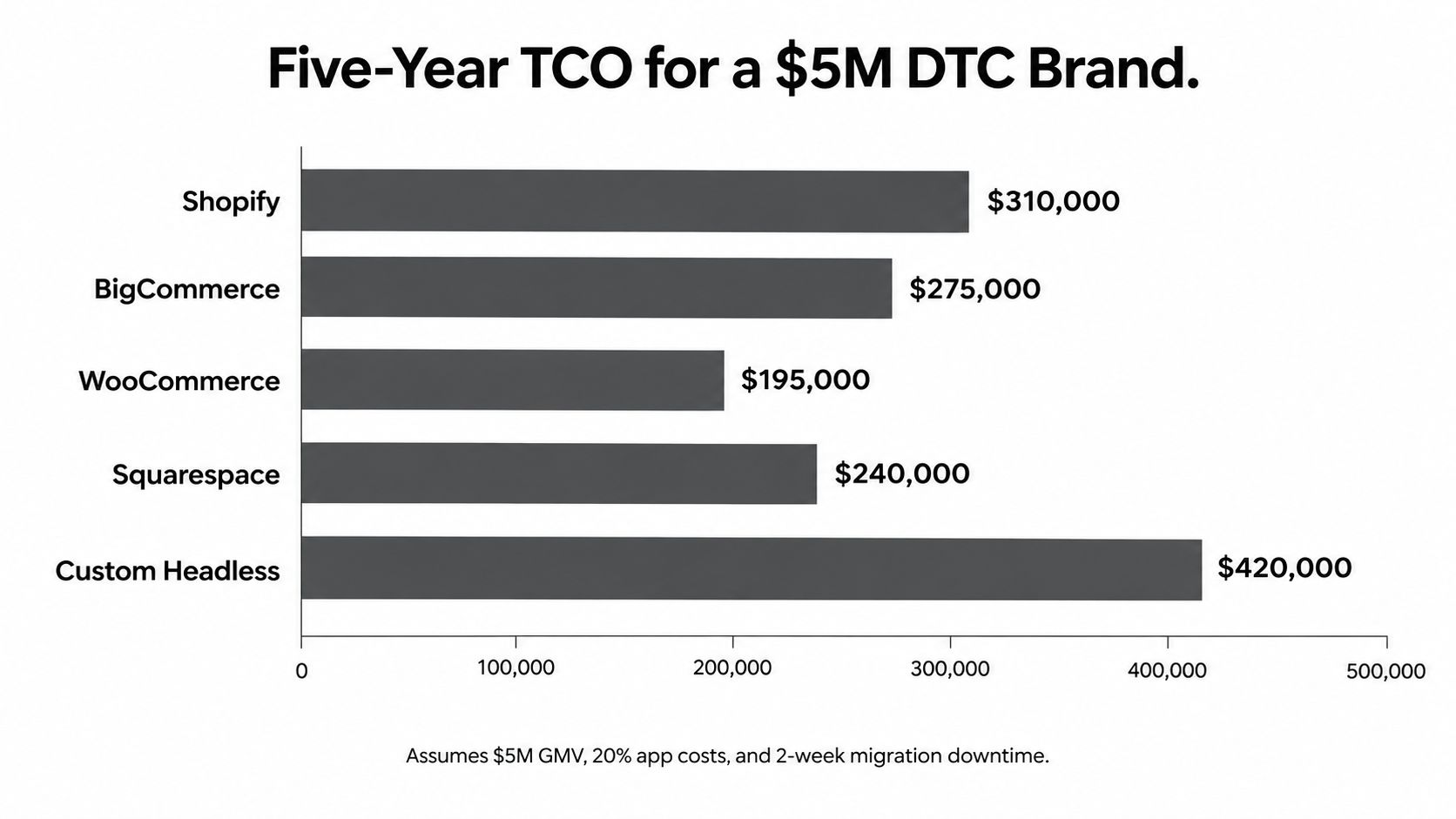
A $5M DTC brand doesn't need a prettier feature chart. It needs a realistic operating model. Once you include app replacement, payment economics, support, maintenance, and migration work, the platform that looks cheapest at signup often becomes the most expensive to own.
If you want a useful framing for this, the fixed-versus-variable cost split from AmbitionCFO on fixed vs variable is a good lens. Commerce platforms are full of costs that move from fixed to variable, or disappear from the invoice only to reappear in payroll and agency fees.
What flips the math
WooCommerce is the classic example. Its open-source core looks inexpensive, but you pay for hosting, plugins, theme work, security, and developer time. That's fine if you want control and can operate it well. It's a bad trade if the business needs reliability without a large technical bench.
BigCommerce usually lands closer to the middle because it reduces the need for separate infrastructure and a pile of supporting apps. Adobe Commerce and custom stacks can look expensive on day one, but they can make sense when the business needs deep control, especially if the alternative is a fragmented system that has to be babysat every week.
The mistake is pretending that list price tells you much about ownership cost. It doesn't. It only tells you what the vendor charges before your team starts building around the gaps.
The two cases that break standard advice
A high-SKU WooCommerce build can be a trap if the team assumes the plugin ecosystem will stay tidy as the catalog grows. The platform is capable, but the maintenance burden can become the real product.
A multi-channel brand on a transactional hosted platform can also lose if the stack can't keep subscriptions, POS, and marketing aligned on the same record model. That's where consolidation becomes financially smarter than “best-in-class” point solutions.
For pricing transparency on a consolidated stack, the PlatformDTC pricing and plans overview is the kind of page you want before modeling your own switch. It matters because the right comparison isn't subscription versus subscription, it's subscription plus operational drag versus a tighter operating system.
A Phased Migration Playbook That Protects Revenue
A replatform is not a config change. It's a revenue event. Treat it that way or you'll pay for it in broken redirects, failed checkouts, and customer service tickets that shouldn't exist.
The migration sequence that actually works
Catalog import comes first. Move products, variants, collections, and inventory before you touch traffic. That lets the team validate structure, naming, and merchandising logic without putting revenue at risk.
Parallel run is the next gate. Run the old and new stacks together so your team can compare order creation, payment capture, analytics, and account behavior in a live environment. If that sounds tedious, good. It's the cheapest way to catch mismatch before customers do.
Traffic split should start small and controlled. Route a limited share of sessions to the new stack, then watch the pages that matter most, product detail, cart, and checkout. If any of those paths degrade, stop. Don't argue with the data.
For practical checkout QA, the walkthrough on how Uxia tests checkout usability is worth reviewing before your team starts final validation. It's a good example of checking the actual purchase flow, not just the homepage polish.
What you verify before cutover
- Redirects: map old URLs to their replacements before production traffic moves.
- Payment tokens: confirm your payment setup won't force customers to re-enter details unnecessarily.
- Analytics: verify that orders, attribution, and campaign tracking fire correctly on the new stack.
- Inventory and fulfillment: compare test orders against warehouse behavior and customer notifications.
- Core Web Vitals: require p75 results that hold on product, cart, and checkout, not just in a synthetic demo.
Non-negotiable: don't cut over until the purchase flow performs under real scripts, real devices, and real checkout conditions.
For implementation detail, the PlatformDTC ecommerce platform migration guide is the right kind of internal reference if you're building a project plan. The point isn't speed, it's control. You want the new system proving itself before it owns the whole revenue stream.
Matching Platforms to Company Size and Use Case
Solo founders don't need enterprise architecture. Large brands don't need a lightweight theme kit pretending to be strategy. Pick based on the shape of your operation, not the fashion of the moment.
Solo founders and very small brands
If you're early and the business is still proving product-market fit, BigCommerce is the safer hosted option if you want to avoid a lot of maintenance without locking yourself into a brittle setup. WooCommerce only makes sense if you already run WordPress and can keep the stack tidy. Shopware and Adobe Commerce are overkill here.
Scaling DTC brands
For brands with real order flow, the main choice is between BigCommerce, WooCommerce, and PlatformDTC. BigCommerce is the clean hosted move when you want fewer moving pieces. WooCommerce is for teams that want control and already have the technical muscle to keep it healthy. PlatformDTC is the sharper pick when consolidation matters more than plugin variety, especially if you want storefront, checkout, subscriptions, payments, inventory, fulfillment, messaging, and analytics in one lifecycle.
Omnichannel retailers and B2B plus DTC
Adobe Commerce and PlatformDTC separate themselves. Adobe Commerce fits if you need deep catalog logic, regional complexity, and a mature enterprise workflow. PlatformDTC fits when the issue isn't only catalog depth, but the need to keep online, B2B, and in-person sales on one record model with governed agent actions. For a brand that wants fewer handoffs between channels, that's a real advantage.
Enterprise teams with regional catalogs
If your business spans countries, stores, and channel-specific logic, Adobe Commerce is still the benchmark among the best shopify alternatives. It's not cheap, and it's not light, but it's built for complexity. If the company's real problem is fragmented data and a sprawl of disconnected commerce tools, PlatformDTC becomes more attractive because it reduces the number of places that can go out of sync.
For a custom build discussion, the PlatformDTC custom ecommerce solution overview is useful context if you're comparing consolidation against a stitched-together stack. The cleanest recommendation is this, if your team keeps paying a tax just to make systems agree with each other, choose the platform that removes the tax.
Your Decision Framework and Next Steps
Use the five filters in order. Start with operational consolidation. If the platform cannot own the order lifecycle cleanly, every other comparison gets distorted. Then judge TCO, migration risk, checkout performance, and AI governance. The ranking changes by business model, the logic does not.
What should disqualify a platform
If it needs a heavy app stack to handle basic commerce, cut it. If it cannot support a controlled migration with parallel run and verification, cut it. If the checkout path cannot hold up in production conditions, cut it. If you cannot explain who approves agent actions, how writes are logged, and how mistakes are reversed, cut it.
For most DTC brands, the shortlist should be two or three names, not six. BigCommerce belongs there when you want hosted simplicity without the worst fee drag. WooCommerce belongs there when WordPress-native control is worth the maintenance burden. Adobe Commerce belongs there when complexity is the business. PlatformDTC belongs there when consolidation and governed AI matter more than plugin abundance.
The strongest test is simple. Pressure-test one real product page, one cart flow, and one write action by an agent, and if you need video for those tests, find video generation platforms to create variants. That is where the honest answers come out. If the system cannot survive that test, it is not the right stack for a brand that plans to scale.
If scoped agent controls and a single order record are your deciding filters, bring your migration and governance requirements to PlatformDTC for a direct comparison.