Subscriptions were offered by 5% of apps worldwide in 2024, and those apps pulled in 48% of all app revenue across the Apple App Store and Google Play, according to Appfigures data reported by TechCrunch. No other app feature carries that much revenue per line of code, and none is easier to run badly.
The reason is structural. When you sell through a store, the store charges the card, retries the decline, decides when access stops and pays you after commission. You don't own the billing rail. You own the decisions around it: what a customer is entitled to in each state, what you're allowed to say to them, and how the money is recognised.
That's where many teams lose subscribers they never had to lose. A single churn percentage combines customers who chose to leave with customers whose card expired on a Tuesday, and the two need opposite responses. Separating them, state by state, is the whole job.
Table of Contents
- What App Store Subscriptions Are and How They Bill
- The Renewal Lifecycle From Active to Expired
- What Apple Takes From Each Subscription Payment
- Voluntary Cancellation Versus Payment Failure Churn
- Retention Moves That Respect the Subscriber
- Metrics That Show Subscription Health
- Reconcile Store Data With Your Customer Record First
What App Store Subscriptions Are and How They Bill
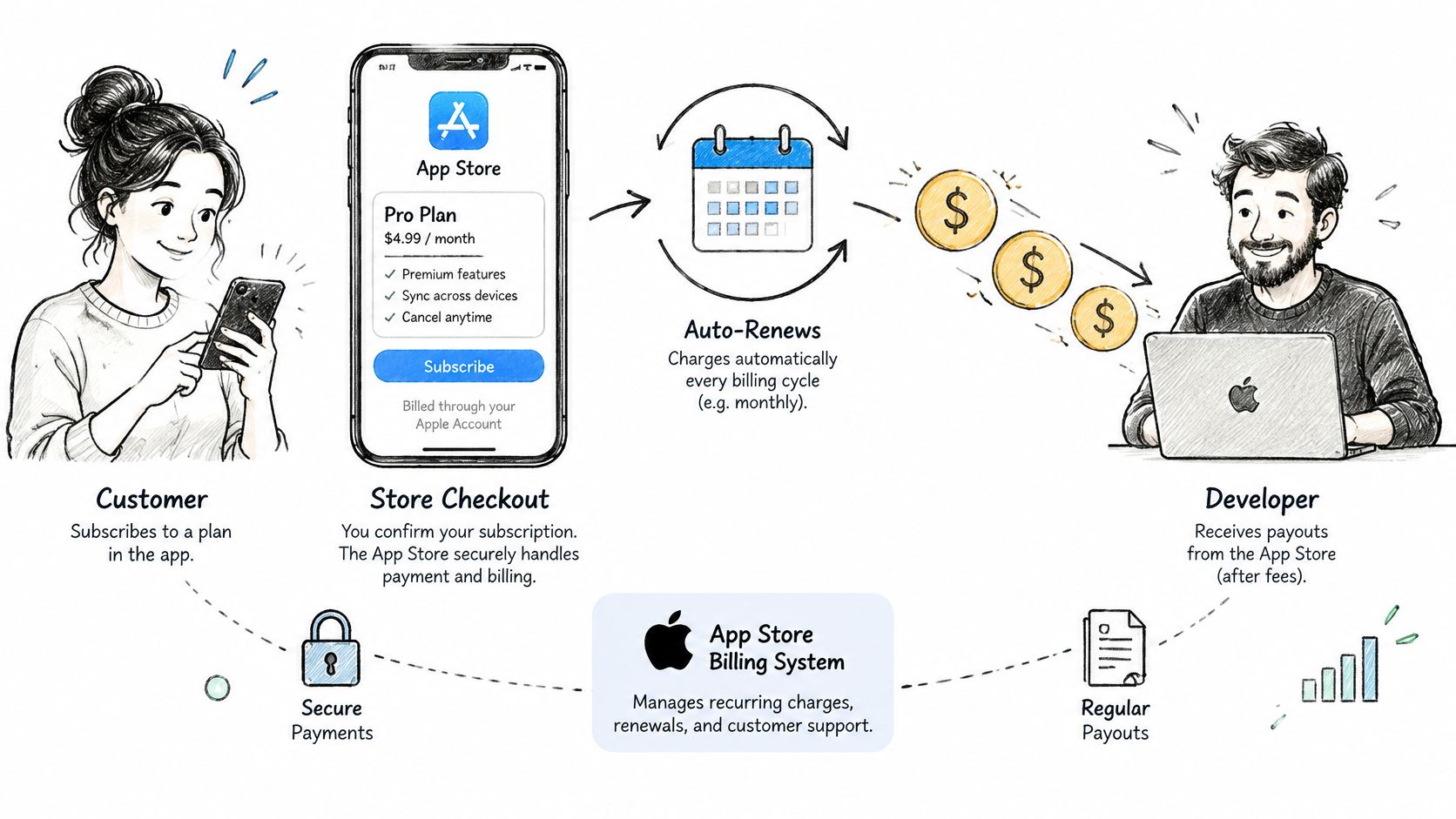
An App Store subscription is a recurring paid plan sold through a store's billing system. The store charges the customer's payment method, renews the plan on schedule when the customer doesn't cancel, and pays the developer after deducting its commission. You choose the price, the duration and the offer. The store owns the transaction, the retry and the refund.
Think about the difference between a gym that bills your card every month at the front desk and a day pass bought once at the door. The day pass ends when you leave. The membership keeps charging until you cancel, and the front desk, not the trainer, decides what happens when the card on file expires. That's the arrangement you sign up for when you sell through Apple or Google.
The category is large. Consumer spending on mobile-app in-app purchases and subscriptions reached $150 billion globally in 2024, a 13% year-over-year increase, according to Sensor Tower.
Here's the shape of that flow, from the customer's first charge to the developer's payout.
The five billing models you'll actually configure
| Billing model | How it bills | Who renews it | Typical use |
|---|---|---|---|
| Auto-renewing monthly | Charged every month until cancelled | Store renews automatically | Content, fitness and productivity apps |
| Auto-renewing annual | Charged once per year until cancelled | Store renews automatically | Discounted plan for committed users |
| Free trial then paid | Free period converts to a paid plan at the end | Store converts unless cancelled | Trial-led onboarding |
| Introductory offer | Discounted first period, then the standard price | Store, at standard price | Acquisition and win-back offers |
| Non-renewing subscription | Pays for fixed-time access and does not renew | Customer must buy again | Seasonal passes and time-limited access |
Read the table as a map of what can go wrong. Every auto-renewing row can produce a failed charge, a grace period and a recovery. The non-renewing row can't, because there's nothing to retry; a lapsed pass is a sales problem, not a billing one. That single difference changes which lifecycle states you have to build for.
Plain rule: choose the billing model before you choose the retention tactics. A monthly plan needs dunning and entitlement logic. A season pass needs a renewal reminder and a reason to buy again.
For a product with a daily habit, such as a practice or drill app, an auto-renewing monthly plan with a short trial matches how people use it and hands the retries to the store. TrueFire's release notes on new features for mobile guitar learning show the pattern in practice: the month gets renewed because lessons, tools and progress tracking are things a player opens most days, not because a contract locked them in.
Seasonal products go the other way. If usage clusters into six weeks a year, a monthly plan mostly manufactures a cancellation queue and a complaints stream. Sell the fixed-term pass or a heavily discounted annual, and keep the monthly option for the customers who use it year-round.
The Renewal Lifecycle From Active to Expired
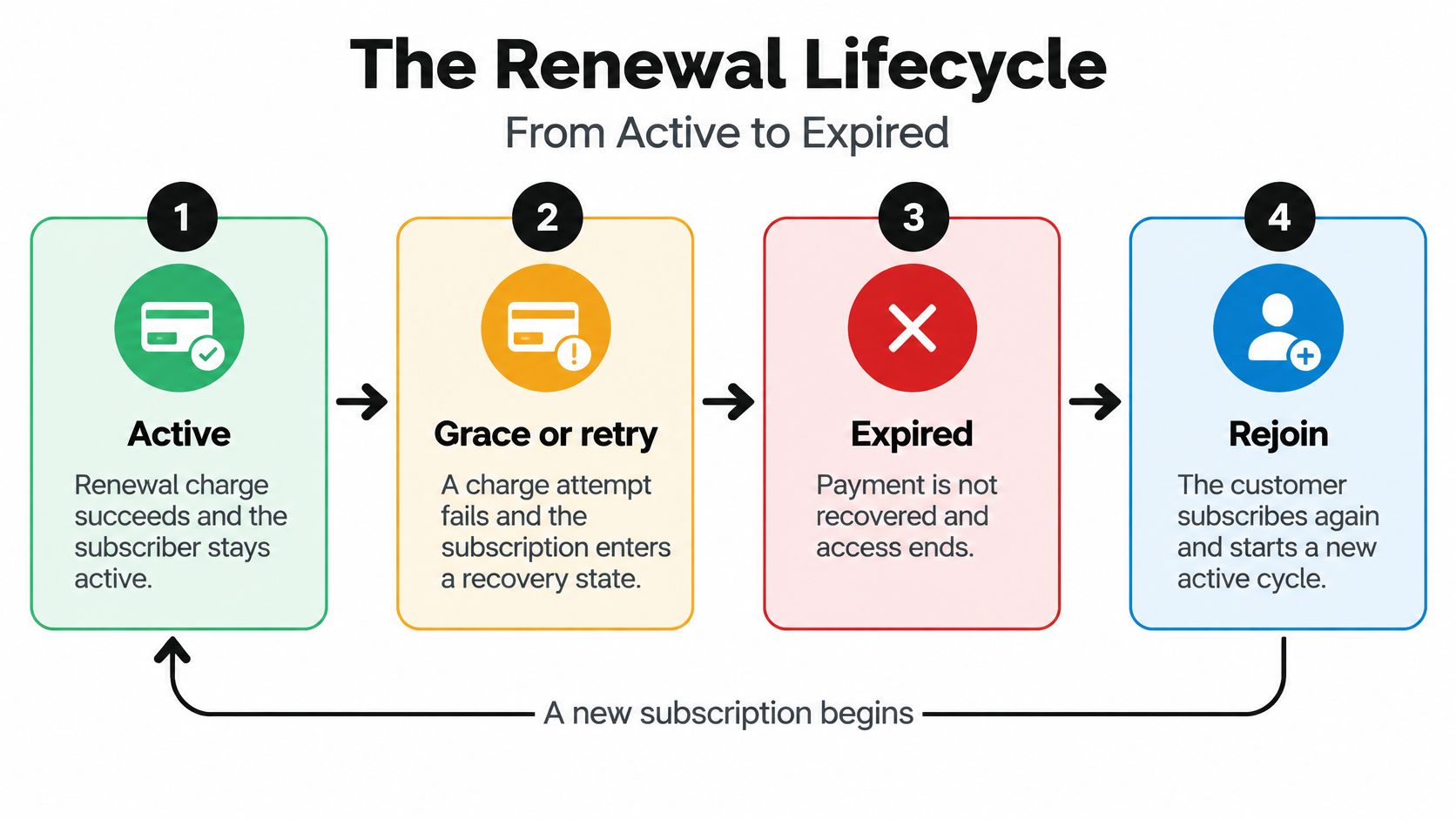
A declined renewal and a cancellation can sit side by side in a revenue report and still mean opposite things. One subscriber chose to leave. The other still wants the product, and the issuer blocked the charge while the store is allowed to try again. The store drives most of those transitions. Your backend stores the state and may grant or remove access only as far as that state permits.
The unpaid path works like a membership card that stays valid while the desk retries the fee, locks the door once retries stop, and requires a new signup only after the membership ends. Subscribers meet the states in this order.
-
Active. The renewal charge succeeds and the subscription stays live. Access stays on, and nothing about the entitlement changes. Record the renewal date and amount on the customer record as well as in the store console. This is the baseline every other state is measured against. You may bill and keep serving. A successful charge is not a save.
-
Grace, also called retry. A charge attempt declines and the store moves the subscription into a grace period. The subscriber keeps access while the store retries payment and prompts a payment-method update. Google Play lets you configure grace periods from 0 to 30 days depending on user and subscription conditions, per the Google Play Billing documentation. This customer has paid before, and the store is still trying. Keep premium access on. You may ask for an updated card. You may not mark the account cancelled, and you may not pull the product while retries are still running.
-
Recovered. The retry succeeds inside the window and the subscription returns to active without the customer doing anything. A recovered payment costs nothing in acquisition, which is the argument for building dunning instead of treating a decline as a lost account. Log it as payment-failure churn avoided, not as a win-back.
-
Account hold. Recovery fails and the subscription moves into hold, where access should generally come off. Suspend the premium features. Keep the purchase history, plan details and customer record intact so a return later takes one tap instead of a fresh onboarding. You may stop paid features. You may not delete the account or force a brand-new signup.
-
Expired. The subscription ends and the customer must resubscribe, which is a new transaction and a new lifecycle. Treat that purchase as acquisition, not recovery, and measure it separately. A voluntary cancellation can end in the same "buy again" outcome, but it never passed through grace or hold. Mixing the two hides whether the leak is billing or the product.
The split between grace and account hold stops two failures that show up in almost every subscription backend. One team leaves access on indefinitely after a payment failure and gives away months of product. Another revokes access the moment a charge declines, while the store is still retrying, and trains a paying customer to believe the app is broken.
Google's documentation also warns that shortening the recovery period may reduce the number of subscriptions recovered. Tune the grace window against recovered revenue and involuntary churn, not against how long you would prefer to wait for the money.
If you want to see the transitions animated before you build them, this walkthrough covers the same flow from charge to rejoin.
PlatformDTC Checkout takes one-time payments and subscriptions, and shoppers manage their own plan afterwards. Merchants can sell subscriptions at checkout, renewals charge automatically, and failed payments are retried automatically. Dunning reads the issuer decline code to separate churn customers chose from churn they did not choose. On a store billing path, the backend still has to consume server notifications, store each state, and grant or revoke access idempotently.
Implementation rule: decide entitlement from the state saved on your server, never from what the app assumes on launch. Duplicate notifications arrive, and processing the same one twice must produce the same result.
What Apple Takes From Each Subscription Payment
Take a plan priced at $10 a month. Under Apple's standard commission the developer keeps roughly $7 before taxes and other costs in the first subscription year, and roughly $8.50 from year two onward, because the rate drops from 30% to 15% at the twelve-month mark. Apple sets out that schedule and the Small Business Program route to 15% from the first payment in its App Store ecosystem report.
| Scenario | Commission rate | Kept from $10 per month | Notes |
|---|---|---|---|
| Year one, standard | 30% | about $7 | Standard rate in the first subscription year |
| Year two onward, standard | 15% | about $8.50 | Rate falls after the first 12 months |
| Small Business Program | 15% | about $8.50 | Eligible developers may qualify from the start |
The same subscriber is worth about 21% more per month in year two than in year one, at an unchanged price. That's not a rounding difference over a base of thousands of subscribers.
Why month thirteen changes the retention math
Many teams report revenue as gross billings and stop there. Gross billings obscure the step-down, so a cohort that remains flat in revenue can be improving in margin as it ages, and a cohort that is growing can be moving toward the 70% payout rate permanently.
Segment cohort reporting by platform, acquisition channel, subscription age and commission regime. A subscriber acquired through an annual plan on a small-business rate is a different economic object from a first-year monthly subscriber at the standard rate, and averaging them tells you nothing you can act on.
Booking rule: store the platform transaction identifier and the full renewal history on the customer record. Refunds, plan upgrades and commission-aware lifetime value all depend on being able to reconstruct which charge produced which entitlement, months later.
Apple also distinguishes digital subscriptions bought through its in-app purchase system from subscriptions started outside the App Store. Checkout architecture therefore affects both margin and eligibility, and regional policy decides which paths are even open to you. Two eligibility questions belong in the product brief, not in the release checklist. Does the app qualify for the 15% rate from the first payment, and is the subscription sold through in-app purchase or started outside the store under the rules that apply in that market? Each answer moves your margin, so the choice has to be made before the build.
Voluntary Cancellation Versus Payment Failure Churn
Churn rate is a blended number, and the blend hides the decision. It treats a subscriber who decided the product was not worth £10 the same as a subscriber whose bank replaced the card and who never opened a cancellation screen. Those are different states. The merchant is allowed to do different things in each one.
Apple reports the states separately. Billing retry can run up to 60 days, after a billing grace period and before involuntary churn when recovery finally fails, as documented in Apple's subscription state analytics reference.
A ward clerk does not use the same form for a patient who asked to leave and a patient whose insurer stopped paying. Subscription billing works the same way. One record is a choice. The other is a failed charge.
| Churn type | Cause | Who acts | Remedy |
|---|---|---|---|
| Voluntary churn | Subscriber cancels because the product no longer meets the need | Product and lifecycle team | Feature fixes, pause or downgrade options, targeted offers |
| Billing grace churn | Renewal declined and access kept while the store retries | Store retries, merchant sends recovery prompts | Recovery messages before the grace period ends |
| Involuntary churn | Billing retries fail over the retry window | Payments and billing team | Localized payment methods, account updater, retry timing |
| Expired after hold | Recovery fails and account hold removes access | Entitlement system and lifecycle team | Keep purchase history and offer a clear resubscribe path |
The remedies barely overlap. Product or pricing dissatisfaction needs retention work: a fix, a cheaper tier, a pause. A declined card needs payment-recovery messaging, local payment methods that work in the customer's market, card account updater support, and retry timing that respects issuer behaviour. A discount campaign against involuntary churn spends margin on people who already wanted to stay.
A four-step diagnostic
- Pull churn by reason, not by total. If analytics cannot break cancellations into customer-initiated and payment-failed, fix that before testing anything.
- Split each reason by lifecycle state. A cancellation recorded in grace is a different event from one recorded while active.
- Compare the two against the billing failure rate for the same period and market, so a spike in one does not hide behind a dip in the other.
- Assign one remedy per segment and give it an owner. Two remedies pointed at one segment means neither gets measured.
PlatformDTC subscriptions include plans, renewals and dunning that read the issuer decline code to separate churn customers chose from churn they did not choose. That split is the line between a retention roadmap and a payments roadmap, and it belongs in place before the second quarter of data arrives. A guide to how to reduce involuntary churn covers the retry-side work in detail.
Store-controlled and merchant-controlled refund paths carry different costs and timelines, which is why teams read the refund terms and conditions before deciding how generous a recovery offer can be.
A high churn rate can overstate product dissatisfaction if billing failures are not isolated first. Find the payment failures, and the retention problem usually shrinks to a size a team can actually work on.
Retention Moves That Respect the Subscriber
A recent US survey of 2,522 adults, including 2,074 current or recent subscribers, found that adults wasted an average of $21 a month, or $252 a year, on subscriptions in 2026, according to CNET's reporting on the survey. That figure is a warning about targets, not just about customers.
Maximising renewal rate is the wrong goal, because some renewals cost more than they earn. An avoidable renewal produces complaints, refund costs, chargebacks and, in a growing number of markets, regulatory attention. The renewals worth chasing are the ones the customer would have chosen if you'd asked them at the right moment.
Five moves that hold up
- Send a pre-renewal notice before the charge. A short message with the amount, the date and a link to manage the plan removes the surprise that drives most complaints.
- Offer a pause or skip instead of a cancellation wall. Someone with three months of unused credit wants relief, not a debate. A pause keeps the record and the relationship; a wall keeps neither.
- Let the subscriber change frequency or downgrade. Monthly to quarterly, or a smaller tier, is a save you can book.
- Disclose the trial-to-paid switch at signup, in the same screen as the trial button, with the price and the date. A trial that converts without clear notice converts once and churns loudly.
- Run a win-back for the forgotten trial. If someone signed up, used nothing and got charged, offer a genuine resolution. It's cheaper than the chargeback.
Our subscribers can skip the next order, swap the product, change the frequency or pause the subscription, and monthly plans can be cancelled at any time with cancellation taking effect at the end of the current billing cycle while access continues until then. Those options exist because a customer who can step down gracefully usually comes back, and a customer who has to fight a cancellation flow usually doesn't.
Trust test: if a retention offer only works because the terms are buried, drop it. Any tactic that depends on the customer not noticing will show up later as refunds, disputes and app review complaints.
The same logic applies outside app stores. A language-learning subscription is a good comparison, because the value shows up in weekly practice rather than in a locked archive, and what makes language subscriptions worth paying for is the same thing that makes any recurring plan defensible: regular use the customer can see. If your product can't show that, a cleverer cancellation flow just delays the honest answer.
Metrics That Show Subscription Health
Gross revenue and download counts are the two numbers teams report first, and both hide subscription health. Revenue works like a fuel gauge that still reads full after someone siphoned the tank: a higher price can cover a smaller paying base for a quarter. Downloads tell you about acquisition and nothing about what happens on day 31.
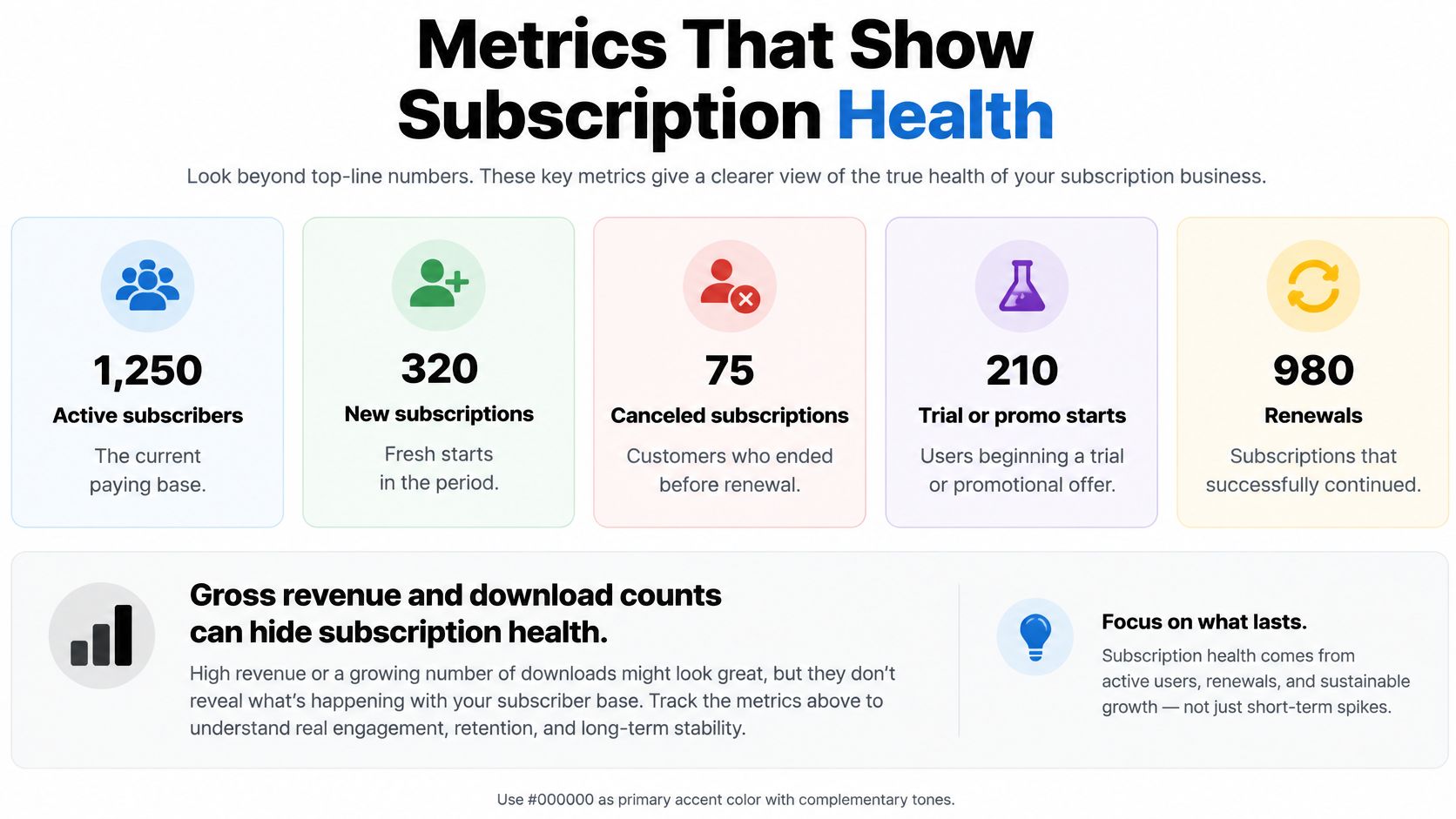
The benchmark that keeps expectations honest: in 2023, 1.7% of subscription-app downloads converted into paying subscribers within the first 30 days, based on RevenueCat's analysis of more than 30,000 subscription apps. Most downloads aren't a near-miss sale. They're a different audience.
The five metrics and how to read them
| Metric | What it tells you | How to read it |
|---|---|---|
| Active subscribers | Size of the paying base at a point in time | Track the trend by country and platform. Rising revenue with a flat or falling active count is a price effect, not health |
| New subscriptions | Acquisition strength | Compare with trial starts and installs for conversion |
| Canceled subscriptions | Voluntary exits in the period | Separate a cancel the customer chose from a renewal the issuer declined, then act only on that state |
| Trial or install-to-paid conversion | How well the offer turns interest into payment | Benchmark against the 1.7% 30-day figure from 2023 |
| Revenue per subscriber | Value after commission and fees | Compare by commission regime and subscription age |
A chosen cancel and a failed payment look the same in a blended churn rate, and they are not the same job. On a voluntary cancel you may offer a step-down while the paid period still runs, then stop selling until access ends. On a decline you retry and recover. You do not treat the customer as gone, and you do not book the renewal until the charge succeeds.
Google Play's own reporting tools provide subscription trends by product and country, which lets you compare subscriber growth across markets and separate acquisition from retention. Its revenue figures represent estimated buyer payments including taxes and other applicable fees, as described in the Play Console subscription reporting documentation. Report your own numbers on the same basis, or you'll spend a meeting reconciling a gap that never existed.
Segment before you decide anything
Every metric above is an average until you split it. Cut each one by platform, country, acquisition channel and subscription age, then look for the segment that moved. A blended conversion rate that drops 0.2 points is noise. A 30-day conversion rate that halves in one country after a pricing change is a decision.
Do the same split on exits. If voluntary cancels jump in one age band, the product stopped earning the next period. If failed renewals jump on one platform while cancels stay flat, the leak is payment, not preference. Pick four metrics, define them the same way every month, and resist adding a fifth until the first four are trusted. A short menu of subscription metrics to track is only useful after those four stay stable.
Reconcile Store Data With Your Customer Record First
The operational question that nobody answers cleanly is ownership. When the store controls billing, retries, access, refunds and cancellation timing, who owns the customer relationship? Legally, the transaction is between the customer and the store. Commercially, the customer is yours, and every message, discount and support reply you send has to respect the boundary.
That boundary is a state map. For each subscription state, write down three things: the action you're permitted to take, the access rule that applies, and how the revenue is treated in your books. Grace and hold are the two states where teams get this wrong, because the action, the access rule and the accounting all point in different directions.
The state map is the decision. Vendor selection, messaging copy and reporting all follow from it, and none of them can fix a state map that was never written.
Five steps to build it
- List every state and name its owner. Active, grace, recovered, hold, expired and refunded, plus any trial states your store exposes. For each one, name the person or system responsible for the next action. If two teams own one state, nobody does.
- Map each state to the action you may take. In grace you can send recovery messages and keep access. In hold you can suspend features but must keep the record. In expired you're selling again, and a discount is legitimate.
- Store the store transaction identifier on the customer record. Without it you can't match a refund, a plan change or a support ticket to the right charge, and commission-aware reporting becomes guesswork.
- Set the refund path for each store. The store controls charges and refunds on its own rails, so your written policy has to describe what happens there and what happens on your own checkout, in plain language, before the first dispute.
- Run one month of reconciliation before scaling. Match store payouts, your order records and your access logs for a full cycle. The discrepancies you find in that month are the ones that would have been invisible at ten times the volume.
PlatformDTC Checkout takes one-time payments and subscriptions and lets shoppers manage their own plan afterwards, and the same catalogue can be sold as a recurring plan with billing, retries and cancellation handling built in. That's one option for brands selling across their own store and the app stores, and it's worth comparing against your state map rather than instead of it. If you're weighing a consolidated approach, this overview of a subscription management platform covers the moving parts.
Start with the map. A brand that knows exactly which state a subscriber is in, what it's allowed to do about it and who owns the next message will run a cleaner subscription business on any platform than one that buys a better tool and keeps guessing.
PlatformDTC runs checkout, subscriptions, payments and analytics on one order record, so a renewal, a failed retry and a cancellation all land against the same customer instead of three disconnected exports. If you're selling subscriptions on your own store and through app stores at the same time, PlatformDTC gives you one place to reconcile the state of every subscriber and the revenue behind them. Bring your state map and see how it lines up.