Forty-two tickets sit in your support queue this morning, and thirty-one of them ask the same question in slightly different words: where is my order. Your head of growth has forwarded a vendor deck about agentic commerce. Your finance lead wants to know what happens the first time the thing buys something it shouldn't.
That's the honest shape of the decision. The interesting question isn't whether an AI agent can answer a shipping question or draft a refund. It can. The question is whether you can prove, afterwards, what it read, what it changed, who approved it, and how you reverse it. Everything below is organised around that test.
Table of Contents
- What an AI Agent Does in an Online Store
- Ecommerce Agent Use Cases and the Approval Each Needs
- Platform Requirements Before an Agent Touches Live Data
- Permissions, Approval Gates and Audit Trails
- How an Agent Completes a Task From Start to Finish
- Who Is Responsible When an Agent Buys the Wrong Item
- Balancing Conversion, Customer Trust and Brand Control
- Decide Which Agent Tasks to Start With
What an AI Agent Does in an Online Store
A shopper in Ohio asks your chat window whether the waxed canvas jacket in medium will reach Toronto before Friday. A scripted chatbot answers with a link to the shipping policy page. An agent checks the medium's stock at the warehouse that serves Canada, reads today's cut-off time, compares express against standard transit for that destination, and replies with a date you can keep plus a link to the size that's in stock.
An AI agent is software that reads your store's records, works toward a goal across several steps, and calls defined tools to act on what it finds. Think of a store manager's assistant holding a keycard. It can walk the stockroom, check a shelf, draft an email, update a listing. It still needs a signature before it spends budget or promises something the business can't deliver.

Authority and records together are what separate that assistant from a chat window, and the money is already moving. Salesforce's 2024 holiday analysis credited shoppers interacting with AI tools and agents with influencing about $229 billion in global online holiday orders, roughly 19% of total online purchases and six percentage points higher than the year before, measured across more than 1.5 billion shoppers in over 89 countries.
Demand and traffic both climbed fast. Adobe Analytics recorded a 693.4% year-over-year rise in visits to U.S. retail sites originating from generative-AI tools during the 2025 holiday season, with November up 769% and December up 673%. On the shopper side, Stord's State of AI in E-Commerce report found that 51% of consumers used generative AI for online shopping in 2025, up from 38% in 2024.
Read those three figures precisely. The Salesforce number covers purchases influenced by an AI interaction, not orders an agent completed on its own. Adobe measures referral traffic, not conversions. Neither proves autonomous checkout has arrived; together they prove that your product data, prices, availability and policy text are already being read by machines that then act on them.
Every store agent you deploy has three parts, and each needs a named owner before launch:
- The data it reads. Catalog and variants, per-market prices, stock, order records, policy fields.
- The tools it calls. Named operations such as create draft refund or update address, each with required inputs and preconditions.
- The rules it follows. Spend ceilings, approval thresholds, what it may say about delivery, and when it must hand off to a person.
Ecommerce Agent Use Cases and the Approval Each Needs
The fastest way to break a store with an agent isn't a weak model. It's giving one agent every permission because a single integration was easier to wire. Sort every task you're considering into one of four approval levels before anyone writes a prompt:
- Read-only. The agent reads records and answers, changing nothing.
- Draft for review. The agent produces work that a person publishes.
- Approval before action. The agent proposes a write and a person confirms it.
- Automatic. The agent completes a narrow, reversible action with no gate.
| Use case | Data the agent reads | Typical action | Approval level |
|---|---|---|---|
| Product discovery and recommendations | Catalog, stock levels, reviews | Suggests products and links to checkout | Read-only |
| Order status and tracking replies | Order record, carrier status | Answers where-is-my-order questions | Automatic for status only |
| Support triage and refund requests | Order, return policy, payment history | Drafts reply and refund recommendation | Approval before refund |
| Product data cleanup | Titles, attributes, images, variants | Fills missing attributes and flags errors | Draft for review |
| Email and SMS campaign drafting | Segments, purchase history, browsing | Writes and schedules campaign | Approval before sending |
| Ad campaign setup | Catalog, budget and cost settings | Creates campaigns within set limits | Approval before spend |
| Pricing and promotion changes | Margin rules, promotion rules | Proposes discounts or price changes | Approval before activation |
| Subscription changes | Subscription status, renewal dates | Pauses, swaps or cancels on request | Approval for billing changes |
| Reorder and inventory alerts | Stock, sales rate, supplier lead time | Drafts purchase order quantities | Draft for review |
Start at the top of that table. Product discovery is safe to switch on this afternoon because it can't move money or mutate a record; the worst outcome is a bad recommendation you can see in the logs. Order status replies are nearly as safe with one condition: automatic for status only, never for the exception. The moment the answer becomes "your parcel is lost," a person owns it.
The middle rows are drafting work, and drafting is where agents earn their keep. Product data cleanup fills missing attributes across a catalog of thousands of SKUs faster than any merchandising team, but a person should review the sweep before it publishes, because a confidently wrong fabric composition is a returns problem and a legal one.
Refunds show how to split a single task across two levels. The agent reads the order, the return policy and the payment history, then drafts a recommendation with the reason code attached. Anything above the threshold you set waits in a queue with an approve or reject button, and the approver's name goes into the record. Below the threshold, it can run alone if the policy fields support it.
Campaign sends, ad spend, price changes and subscription billing all sit at the strictest level for one shared reason: they touch either money or many customers at once. A single mispriced promotion applied to a whole catalog, or a win-back email sent to your entire list twice, costs more than any efficiency the agent adds.
The rule the table implies: any task that writes to money, customer records or outbound messages needs a named approver and a record of who approved it. Tasks that only read never need either.
Platform Requirements Before an Agent Touches Live Data
Bad answers from an agent are almost always bad records underneath. The evidence is blunt. EComAgentBench, a benchmark built on 662 tasks grounded in real Amazon products, required agents to uncover hidden intent, verify candidates and commit to one product within 100 tool calls. Across seven evaluated models, the strongest reached only 57.1% overall accuracy, and accuracy dropped as requirements moved from the visible prompt into hidden or tool-gated sources.
The lesson for a DTC platform is specific: an agent must never infer purchase eligibility, promotion stacking, inventory availability or subscription terms from conversational context. Each of those has to be retrieved from a structured record, with the source field cited and any unresolved constraint surfaced to the shopper.
| Requirement | What the data must show | Failure without it |
|---|---|---|
| Structured catalog | Variants, SKUs and per-market prices | Agent quotes a wrong price or wrong size |
| Single order record | Orders, subscriptions and returns on one record | Agent sees partial history and repeats a refund |
| Policy data as fields | Shipping, return and discount rules as values | Agent invents a policy from old text |
| Typed operations | Named actions with required inputs and preconditions | Free-text writes change the wrong record |
| Timestamped status | Stock and order states with last-updated times | Stale data drives a wrong promise to the customer |
| Human handoff path | Escalation queue with full case history | Customer loops through the bot without reaching a person |
One record model removes most of the guesswork
The expensive failures cluster where systems disagree. Inventory says three units, the storefront says in stock, the discount engine says the code can't stack, and the agent picks one of the three to believe. Consolidating storefront, checkout, subscriptions, payments, inventory and fulfilment onto one record model lets an agent answer three questions from a single source: is this item in stock in this market, can this discount combine with that one, and is this customer already subscribed.
If your stack is a set of apps joined by webhooks, the work is harder but not mysterious. Pick one system as canonical for each entity, and have the agent read only from that one. Our own guide to making your store AI agent ready walks through the record-by-record version of that audit.
Test it with twenty real questions
Before any agent answers a live customer, run this in staging:
- Pull twenty questions your support team answered last week, verbatim.
- Run each one through the agent with production-shaped data.
- Compare every factual claim in the answer against the underlying record.
- Count the answers that were right by luck, meaning the record contradicted them and the agent guessed well.
- Fix the record before you fix the prompt.
That last step is the one teams skip. A prompt tweak hides a data problem for a week and then it returns in a different shape.
Permissions, Approval Gates and Audit Trails
Controls work in layers, and each layer catches a different failure. Scope catches the agent reaching for something it was never meant to touch. Value limits catch runaway spend. Approval gates catch the judgement calls. Audit catches everything after the fact, when a customer disputes an order and you need to reconstruct the afternoon.
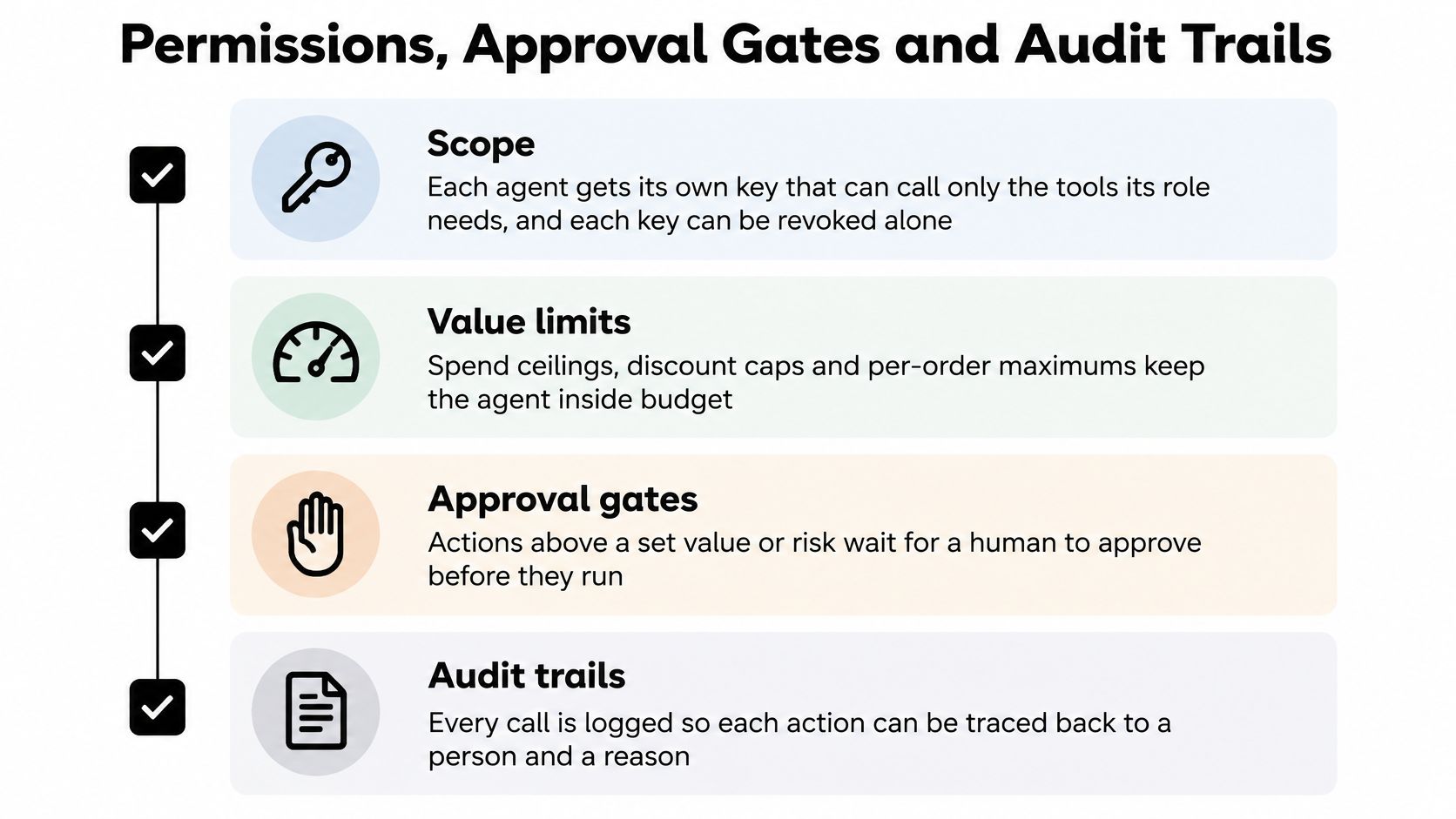
Scope means each agent gets its own key, calling only the tools its role needs, revocable on its own. Your support agent's key should not be able to create a discount. If it can, one convincing email from a stranger becomes a margin problem.
Value limits are numbers you set before the agent runs: a spend ceiling per day, a discount cap per order, a maximum number of outbound messages per hour, a per-order value ceiling for automatic refunds. Write them down where a person can read them, not buried in a config file.
Approval gates hold anything above those limits until a human acts. The queue needs to show the proposed action, the reason the agent gives, the records it used and two buttons. If nobody responds inside the window you set, the action dies rather than proceeding. On our platform the operating rule is simple: the AI agent can do everything the merchant can do in the dashboard, but actions that spend money or message a customer wait for the merchant's approval.
Audit is the layer that saves you in a dispute. Reliability across repeated attempts is the reason it exists. In the τ-bench study of tool-use agents, state-of-the-art function-calling agents including GPT-4o succeeded on fewer than 50% of tasks and reached pass^8 reliability below 25% in retail, where pass^8 measures success across eight repeated trials rather than one attempt. Commerce mutations such as refunds, address changes and subscription cancellations must survive retries, ambiguous instructions and changed backend state, which is why typed operations, idempotency keys, duplicate detection and post-action verification belong in the design rather than the backlog.
What a single audit record must hold
Six fields reconstruct any agent action well enough to defend it to a customer, a processor or a chargeback analyst.
| Field | Example entry | Why it matters |
|---|---|---|
| Agent identity | Support agent, key 3 | Shows which permissions were in force |
| Policy decision | Refund under $50 auto-approved, above $50 queued | Proves the rule applied at the time |
| Timestamp | 2025-03-14T09:21:04.118Z, UTC | Orders events and resolves disputes about sequence |
| Inputs | Order ID, amount, reason code | Shows what the agent was asked to do |
| Result | Refund issued, transaction ID | Confirms the outcome against the payment record |
| Rollback path | Reversal request available for 7 days | Shows whether the action can be undone |
Two edge cases deserve a decision before launch. Where an action can't be undone, such as a shipped replacement or a sent campaign, define the compensation step in advance and record it with the action. And keep one switch that stops every agent write at once, without disabling the read-only agents your customers are using. A governance framework for agent permissions is worth writing down as policy, because the emergency pause gets tested at the worst possible moment.
How an Agent Completes a Task From Start to Finish
Say a shopper emails two hours after checking out. The jacket is a gift and needs a different address. The agent opens the order, sees the label is already printed and the fulfilment record is locked, so it doesn't edit the address. It drafts a carrier intercept request, tells the shopper what happens next, and routes the case to a person with the order and transcript attached. Nothing changed in the order record, and the customer got a real answer.
That's a good outcome produced by knowing which tool not to call. Every safe task follows the same loop.
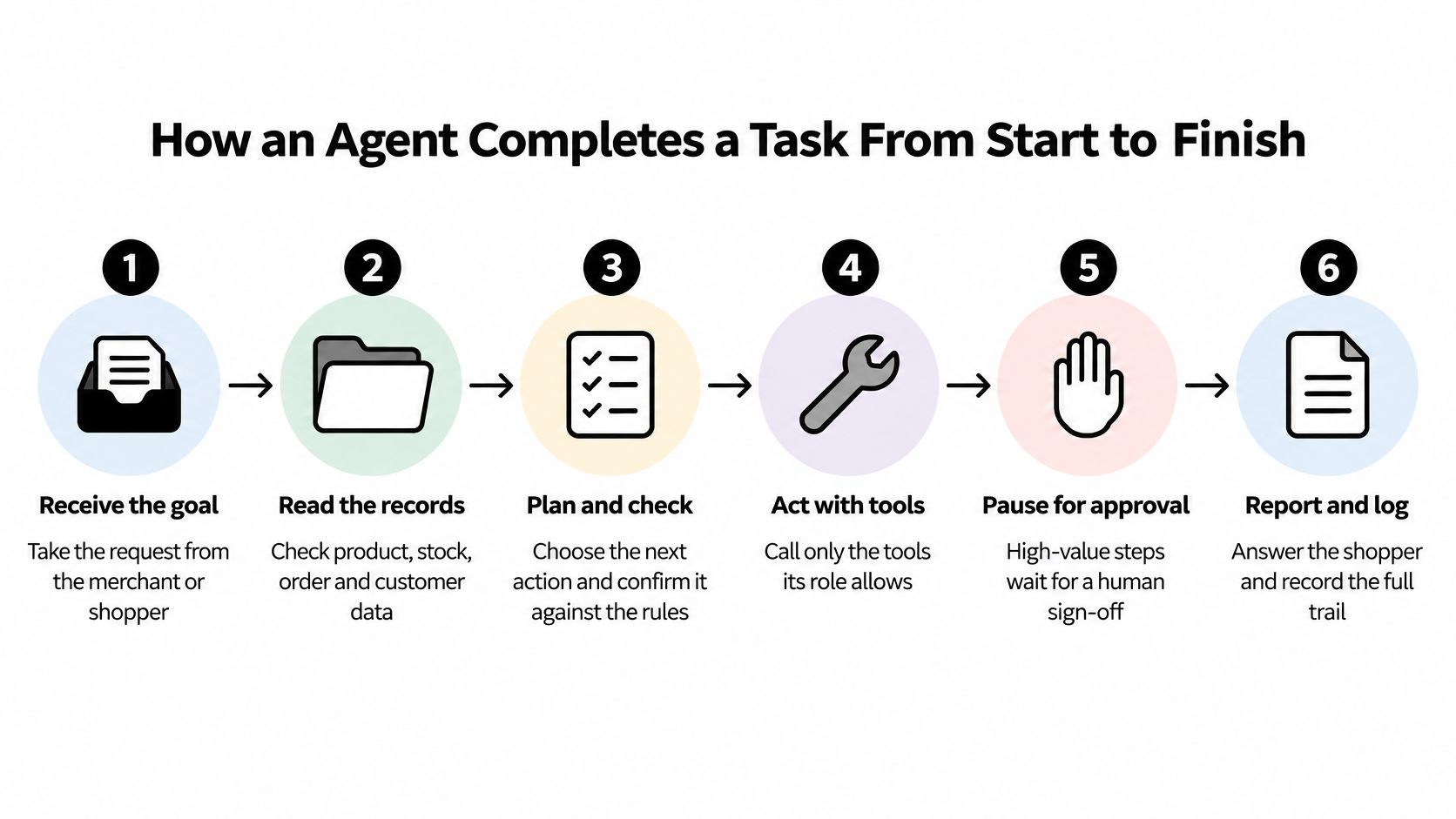
- Receive the goal. From the merchant or the shopper, in their words, captured verbatim.
- Read the records. Product, stock, order and customer, from the canonical source for each.
- Plan and check. Choose the next action and test it against the policy rules before calling anything.
- Call one named tool with typed inputs. For example, create draft refund for order 10482 with an amount and a reason code. Free-text writes are how the wrong record gets changed.
- Check whether approval is required. If it is, the action stops and queues. The agent's job ends there until a person responds.
- Execute with an idempotency key. A retry that carries the same key can't create a second refund.
- Verify the result against the order record. Confirm the mutation landed as intended rather than trusting the tool's response.
- Log the step. Identity, inputs, result and rollback path, so the sequence survives a dispute.
Two edge cases break more launches than anything else. Stale inventory is the first: the agent plans against stock that sold out an hour ago, promises a Tuesday delivery and creates a support ticket that costs more than the sale. Treat any stock figure without a recent timestamp as unknown. The second is a tool call that times out after the action succeeded. Without step seven, the agent retries and the customer gets two refunds; verification against the order record, not the API response, is what stops it. If your teams are wiring these operations by hand, the e-commerce API integration patterns around idempotency and retries are the place to start.
Who Is Responsible When an Agent Buys the Wrong Item
Here's the failure that produces the ugliest ticket. A shopper asks for a replacement pair of running shoes in a 9.5 wide. The agent finds the standard width in the same colourway, decides it's close enough, applies a discount code from the customer's history, and places the order. The shoes arrive, they don't fit, and nobody can say who agreed to the substitution.
With a human checkout you'd lean on evidence. A click on the buy button, a consent screen, a visible review step. Delegated actions can replace all three at once, which means the merchant has to rebuild the evidence trail deliberately rather than inherit it from the checkout page.
The dispute is not theoretical, and the market hasn't settled who owns it. Deloitte's 2025 analysis of agentic AI risk reported that 87% of merchants expected a moderate-to-high increase in AI-enabled attacks over the following 12 months, with 95% planning to make agentic AI a strategic fraud priority. The same paper cites PayPal merchant research in which 46% of large enterprises and 41% of small businesses place responsibility for a disputed agent purchase on the AI platform, while nearly two-thirds of merchants want a standardized liability framework.
Since no framework governs you yet, write your own allocation and put it in your terms:
- Record the intent. Capture the customer's words, their constraints, the variant and the price shown at the moment of action, then freeze that record. It's the closest thing you have to a consent screen.
- Name the approver for every write. Human or rule, by name and threshold.
- Set return and chargeback steps for agent-originated orders. Treat them as a distinct order source so your dispute team can find them in one filter.
- Set a clock on escalations. A human takes over an escalated agent case within a stated number of hours, or the case escalates again.
Autonomous purchasing usually lowers friction and raises post-purchase cost. The gap between those two numbers is your dispute rate, and it's the one agents can move in the wrong direction without anyone noticing for a quarter.
Balancing Conversion, Customer Trust and Brand Control
Trust in a recommendation does not transfer to authorisation of a payment, and the gap is measurable. A 2025 global survey of 5,400 shoppers across nine markets found that 73% used AI during the shopping journey, but only 13% had completed a purchase after an AI referral. Asked what worried them, 32% named payment security, then privacy at 26%, mistakes at 18% and loss of control at 17%.
A shopper will happily let an agent narrow forty jackets to three. Handing it the card is a separate permission, and brands that blur the two lose the second one.
That makes agent readiness a governance question before it's an indexing question. A brand policy for any agent speaking on your behalf has to answer four things in writing: what it may claim about products and delivery times, which promotions it may combine, which customer data it may use, and when it must state uncertainty, disclose a paid placement, or hand off to a person.
Then design the consent step around inspection rather than speed. The shopper sees the exact item, the total with shipping and tax, the delivery date and the return terms before confirming, and can review or revoke what the agent is allowed to do later. A permission screen nobody can find is the same as no permission screen.
Measure past clicks, because clicks are the metric agents inflate most easily. Track assisted conversion, dispute rate, margin impact, opt-out rate and permission revocations. A pricing agent tuned only for the lowest landed price will win visibility in AI recommendations while eroding the margin that pays for the recommendation in the first place.
Decide Which Agent Tasks to Start With
Read the approval column in the use-case table as a switch-on order, not a menu. Enabling everything on day one is how teams end up with an agent issuing refunds and editing prices before anyone has watched it answer a single shipping question correctly.
Phase 1 stays read-only. Product discovery, recommendations and status replies. Phase 2 is draft-for-review only: product data cleanup, campaign copy, reorder quantities. Both phases build the log history you'll need later, and neither can cost you money.
Phase 3 needs a person before any write. Refunds above your threshold, campaign sends, ad spend, promotion activation, subscription billing changes. Phase 4 allows automatic replies for low-risk order status only, and only after several weeks of clean records.
Four checks before you let an agent write
- Send one real request and confirm the queue pauses it with the proposed action visible.
- Open one audit record and confirm identity, policy decision, timestamp, inputs, result and rollback path are all present.
- Retry the same mutation and confirm the idempotency key blocks the duplicate.
- Fire the emergency pause and confirm every agent write stops within minutes while read-only answers continue.
If any check fails, you don't have a phase 3 problem. You have a phase 1 problem that hasn't surfaced yet.
What to measure in month one
Two numbers tell you more than any accuracy score. The share of agent actions a person corrected, and the share of approvals a person rejected. A rejection rate near zero usually means the approver is rubber-stamping; a correction rate that climbs week over week means the records underneath are drifting.
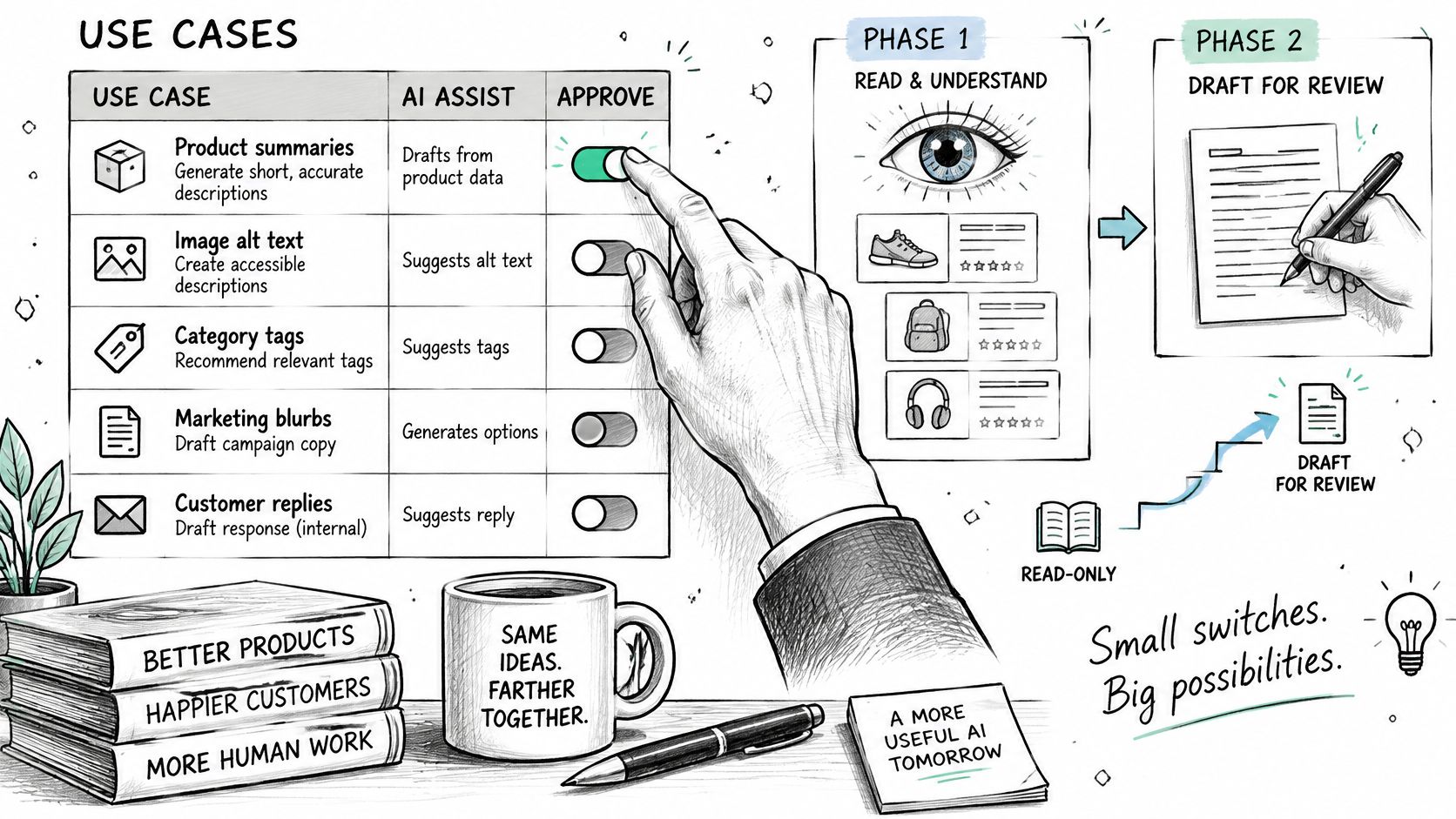
PlatformDTC fits this sequence because agents build storefronts, run campaigns and answer support through scoped keys and an audit log, with per-agent keys that are restricted and revocable one at a time and spending actions waiting for a person, and every action set to Off, Draft or Auto. Start with the highest-volume read-only or draft task you have, watch the logs for a fortnight, and don't open the writing phase until all four checks pass.
PlatformDTC runs storefront, checkout, subscriptions, payments, inventory, fulfilment and messaging on one record model, so an agent reading stock, discounts or subscription status gets a single answer instead of three conflicting ones, and every agent action carries a scoped key, an approval gate on spend and a full audit trail. If you're mapping agent tasks to approvals and would rather not build the permission and logging layer yourself, visit PlatformDTC to see how the governed agent tools work. Start with a read-only agent on your catalog and order data, then widen its permissions as the logs prove clean.