
You might be sitting on a store that still converts, but the stack underneath it is getting noisy. A subscription app wants one customer record, wholesale needs another, and retail POS is already arguing with online inventory. That's usually when teams start looking at shopify alternatives, not because Shopify broke, but because the business model outgrew a single default setup.
The right replacement depends on what you sell and how much control you can support. A DTC brand with subscriptions and a small ops team needs a different answer than a B2B catalog, a retail-heavy brand, or a team that wants to keep engineering effort low. Migration effort matters too, because the wrong move can put revenue at risk while the new stack is still settling.
Table of Contents
- 1. BigCommerce
- 2. Wix eCommerce
- 3. Square Online
- 4. WooCommerce
- 5. PlatformDTC
- 6. Shopware
- 7. Adobe Commerce
- 8. Salesforce Commerce Cloud
- 9. VTEX
- 10. commercetools
- Top 10 Shopify Alternatives: Side-by-Side Feature Comparison
- Choosing Your Platform and Planning the Move
1. BigCommerce
BigCommerce is the most obvious like-for-like option when a team wants hosted SaaS without giving up too much control. Its public scale is real, with annual GMV reported at approximately $31.696 billion in 2025, up from $28.228 billion in 2024, and annual recurring revenue of $359 million in the same report, which helps explain why it keeps showing up in platform shortlists. GMV is not revenue, but it does show that merchants are already using the platform for serious checkout volume, not just side projects. BigCommerce annual report
Where it fits and where it doesn't
BigCommerce works well for brands that want built-in promotions, multi-storefront support, and a checkout flow that can stay on your domain. It also suits teams that are tired of paying for a pile of apps just to cover discount logic, segmentation, and basic marketing feeds. The trade-off is that the platform still rewards clean implementation. If your catalog, tax logic, or integration map is messy, you can still end up needing partner help.
Practical rule: choose BigCommerce when you want Shopify-like operational simplicity, but with less dependence on app sprawl and less tolerance for hidden platform costs.
The migration risk is moderate. You are still moving into a managed SaaS model, so the business gets less operational drag than open source, but you should confirm how your discounts, feeds, and payment setup will behave before you cut over. Start with the actual catalog, not a demo catalog, and verify that your most important promotional paths survive the move. Visit BigCommerce if you want a mature hosted platform with fewer surprises than many mid-market stacks.
2. Wix eCommerce
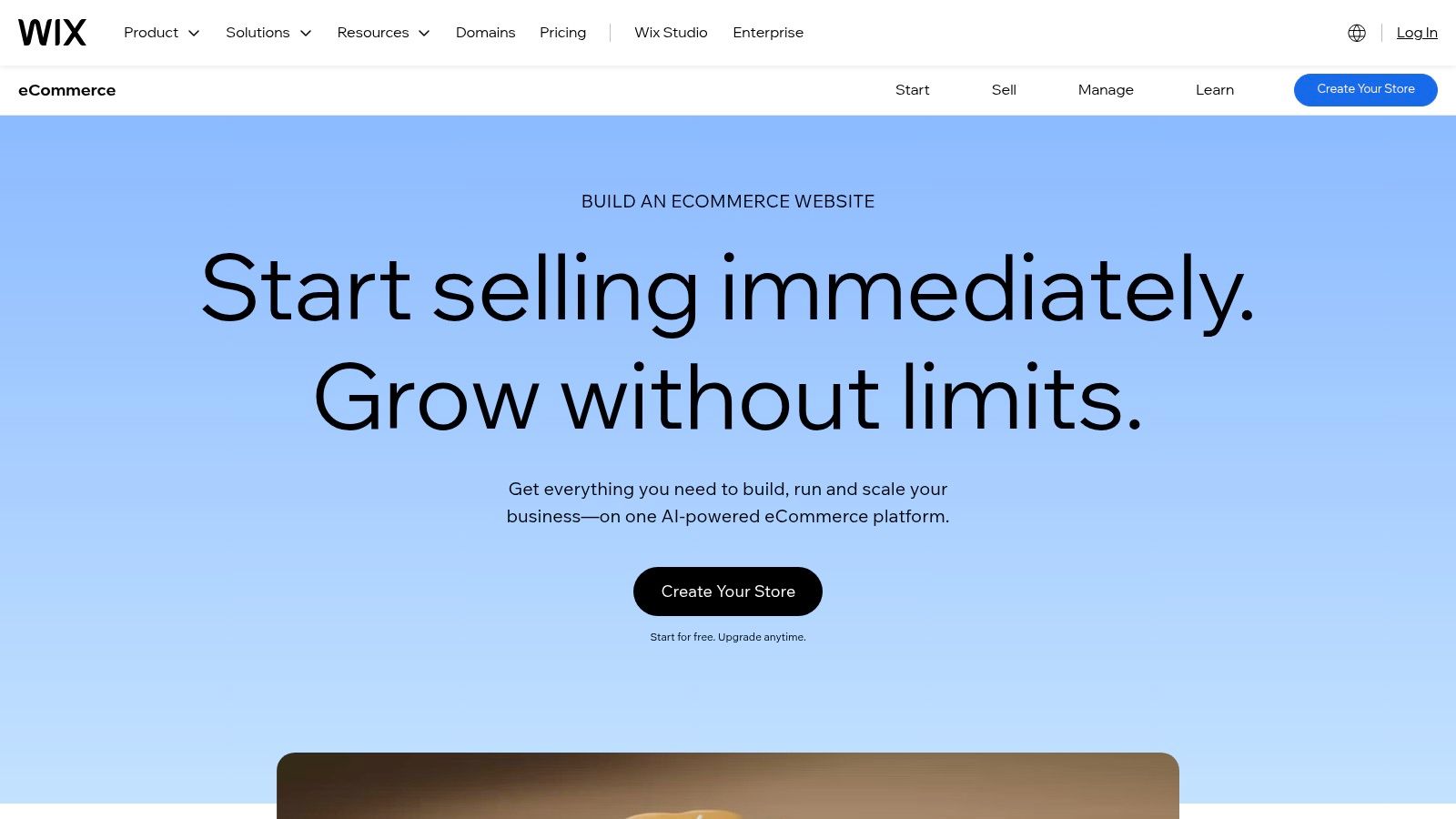
Wix eCommerce is often the fastest way to get a polished storefront live without treating the launch like an engineering project. That makes it a sensible option for smaller DTC lines, pre-launch products, or brands that care more about speed and presentation than deep backend complexity. Wix's own Shopify-alternatives guide positions it as a strong option for businesses that want a full website and store in one place, with the platform's eCommerce plans starting at $29/month when billed annually in the referenced article. Wix Shopify alternatives guide
Best for speed, not complexity
What Wix does well is reduce setup friction. You get a drag-and-drop builder, bundled hosting, and a store layer that's easy to understand without a long technical onboarding. That simplicity matters when the team running the brand is small and nobody wants to manage separate systems for content, store, and support.
It starts to fray when the business becomes operationally dense. If you need highly custom fulfillment rules, unusual catalog structures, or complex warehouse logic, you may feel the limits sooner than you would on a more commerce-first platform. The migration risk is low to moderate, mostly because the setup is straightforward, but the strategic risk comes from outgrowing the platform later.
Launch quickly if you need to validate demand. Replatform later if your merchandising, subscriptions, or B2B logic start demanding more than a site builder should carry.
Visit Wix eCommerce if your priority is a fast launch with bundled tools and predictable setup.
3. Square Online

Square Online fits businesses where the counter and the website need to stay in sync. It works for merchants that want one catalog, one payment flow, and one reconciliation process across in-store and online sales. Square also offers a free plan on the online store product, with processing fees on that tier, so the entry point stays simple for smaller operations. Square Online
Omnichannel first, ecommerce second
Square is strongest when the retail workflow already runs through it. If POS, invoicing, pickup, and payment settlement live in Square, the online store becomes part of the same back office instead of another system to sync by hand. That cuts the risk of staff changing inventory in one place and forgetting the other.
The trade-off is clear. Square Online is not the right fit for brands that need rich promotion rules, complex subscriptions, or advanced multi-location controls. Those businesses usually outgrow it fast. Migration risk stays low when the catalog is simple and Square already handles the storefront. It rises when you are trying to force a deeper DTC operation into a retail-first setup.
If your business is retail-led and online is an extension of the counter, Square's omnichannel overview is a clean, practical fit.
4. WooCommerce
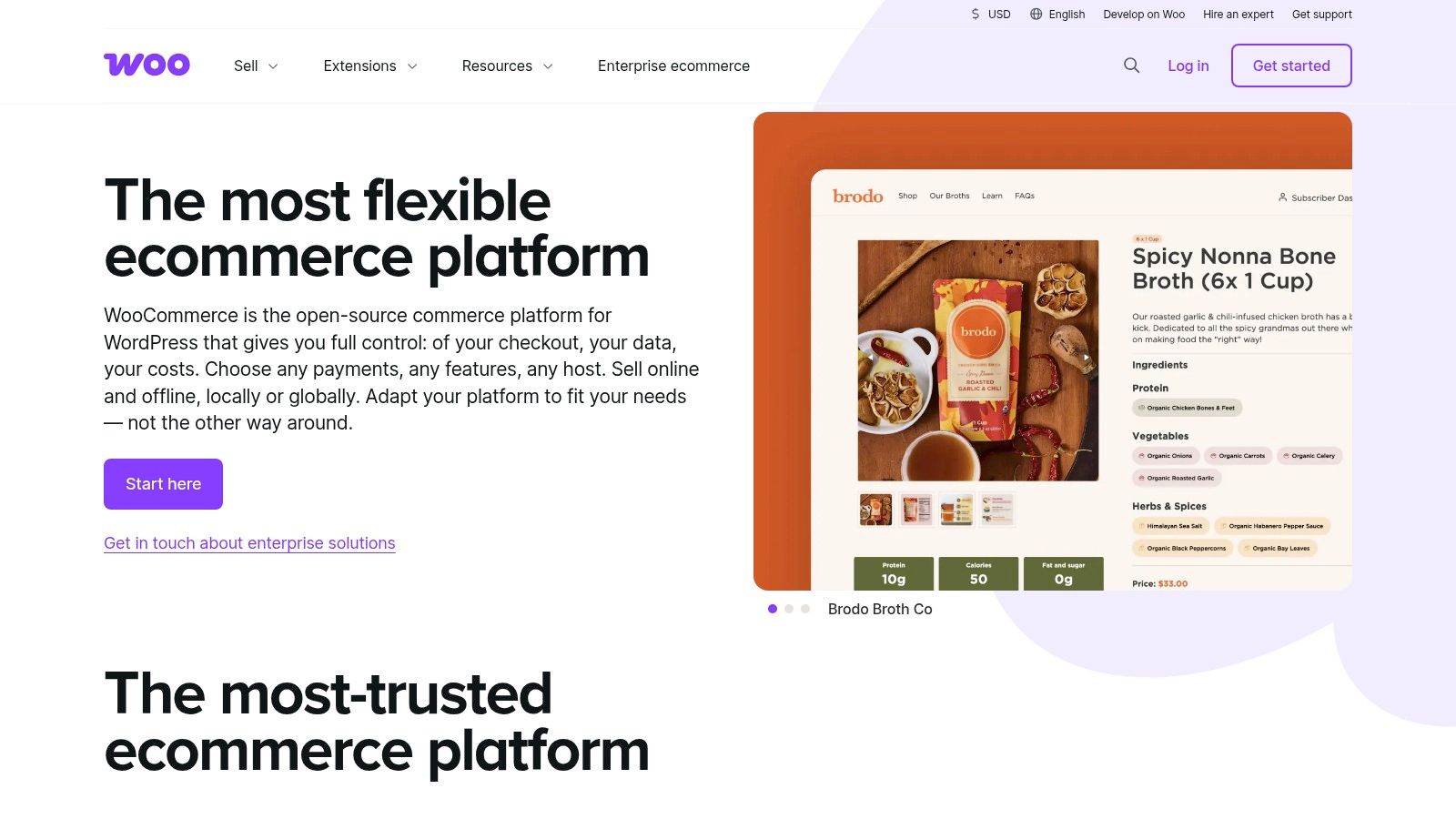
WooCommerce is the serious open-source answer when you want ownership more than convenience. It sits on top of WordPress, which matters because WordPress's share of all websites grew from 21.0% in 2014 to roughly 40%–43% in recent measurements, while WooCommerce powers about 7.9% of all websites and approximately 29.1% of online stores worldwide. It is installed on roughly one-fifth of WordPress websites, which makes it the platform's most-used ecommerce plugin, and that scale comes from the broader WordPress ecosystem rather than a single hosted storefront product. WordPress market share and WooCommerce adoption
Best for control, not convenience
WooCommerce gives you the most freedom in this group for theme control, hosting choice, and plugin strategy. That freedom is why many teams like it, and also why many teams underestimate it. Once you own the stack, you also own performance, security, and upgrades. If the business is growing fast and nobody is ready to take responsibility for that work, the “free” plugin becomes a services bill very quickly.
Operator takeaway: WooCommerce is strongest when your team already lives in WordPress and values ownership over a managed experience.
The migration risk is moderate to high depending on how custom your current Shopify setup is. Simple catalog moves are manageable. Complex app-based workflows, custom discounts, and subscription logic usually take real reconstruction effort. Visit WooCommerce if you want maximum control and can support the operational responsibility that comes with it. For a practical WordPress-based perspective, there's also NotFair's take on WordPress sites, which is worth reading if your content stack already matters as much as your checkout.
5. PlatformDTC
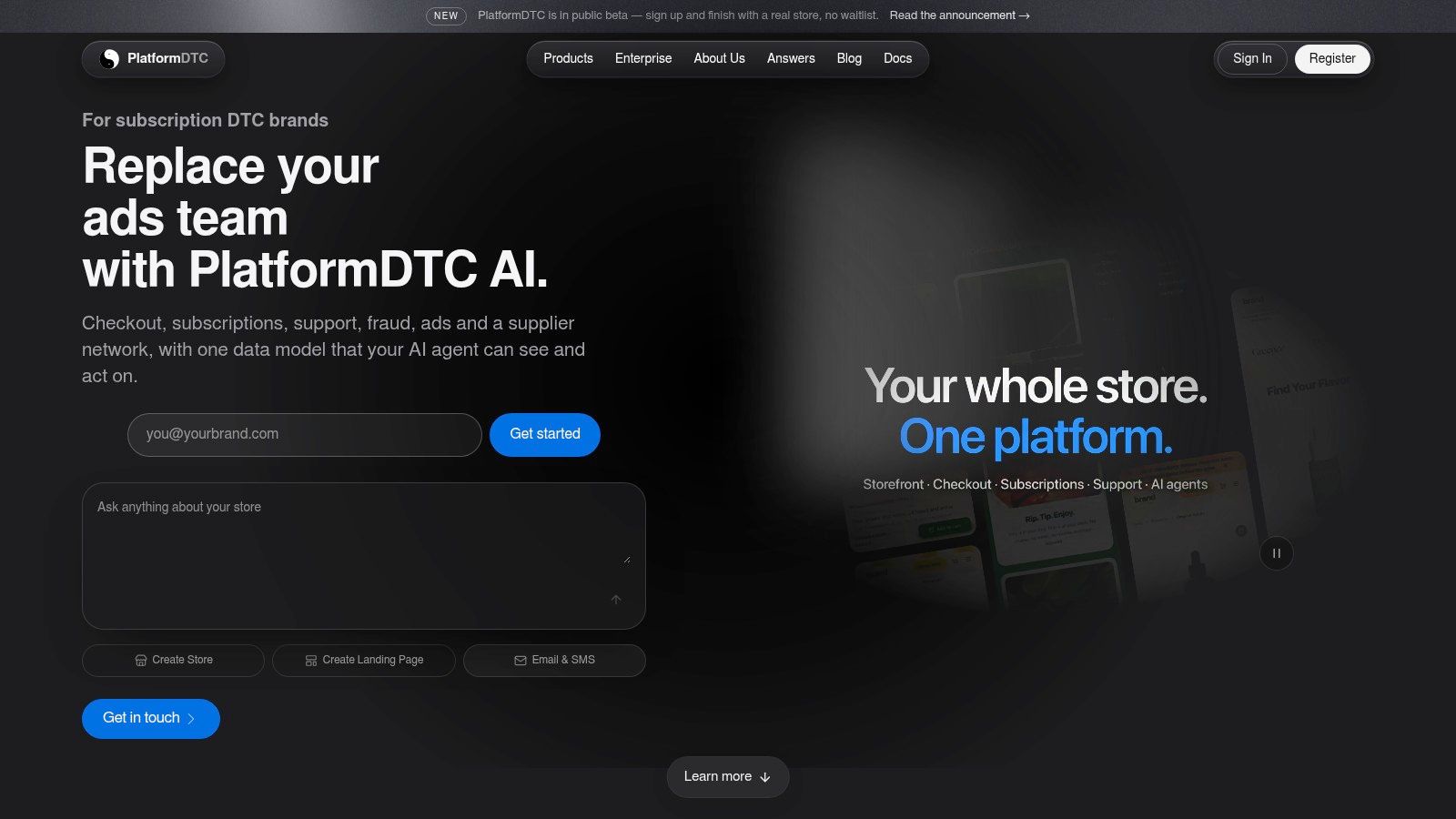
A Shopify replacement has to fit the business model, not just the catalog. PlatformDTC makes sense for subscription-heavy DTC teams that want storefront, billing, inventory, messaging, and reporting in one order-centric system. Renewals, refunds, fulfillment, and one-time purchases stay tied to a single record model, which avoids the usual mismatch between apps. If discounts, inventory, and customer history keep disagreeing, this is the kind of stack that reduces the cleanup.
Built for governed automation
PlatformDTC's main difference is the control layer around automation. It supports scoped agent keys, approval gates on spend, idempotent writes, and a full audit trail for agent actions. That matters if you want AI to handle routine commerce work without creating unauthorized discounts or duplicate updates.
The risk is not theoretical. A 2025 survey reported that 70% of organizations were using agentic AI in some form, while only 21% had complete visibility into agent behavior, permissions, tool usage, and data access. The same research said 65% considered real-time enforcement critical, fewer than half had implemented it, and only 38% monitored agent decisions end to end. Agentic AI security gap research
The best automation setup is the one your finance team can audit after the fact.
PlatformDTC is a strong migration target if you are replacing a Shopify store plus several adjacent apps. It is a poor fit if you want a pure logistics operator, because it is software, not a fulfillment provider. Payment processor availability and jurisdiction limits also need to be checked early, since those constraints shape rollout more than branding does. Visit PlatformDTC if you want a governed DTC stack with subscriptions, checkout, POS, B2B tools, and AI controls in one system. For a closer look at fit and migration scope, visit PlatformDTC's migration overview and see whether a single source of truth matches the way your brand sells.
6. Shopware
Shopware is a good fit for teams that want composable flexibility with a stronger European feel than many US-centric SaaS platforms. It has a SaaS and PaaS delivery model, open-source roots, and a B2B-oriented feature set that makes it practical for brands operating in multiple markets or needing more structure than a lightweight DTC tool can offer. The platform rewards teams that know what they want and can handle a more deliberate implementation.
Better for structured commerce than casual selling
What stands out is the balance between headless readiness and built-in business logic. You get enough native capability to avoid a pile of unnecessary add-ons, but you still have room to shape the stack around how the business sells. That makes Shopware appealing for operators who care about localization, channel complexity, and the ability to grow into B2B without starting over.
The trade-off is discovery and staffing. It is not as ubiquitous in the US talent market as Shopify or WooCommerce, so implementation partners matter more. If your team is small and you do not already have a commerce architect, migration risk moves up quickly.
Choose Shopware when your roadmap includes B2B, localization, or composable storefronts, and you have the team to support that path.
Visit Shopware if you want a platform that can handle more structure without jumping straight to an enterprise mega-suite.
7. Adobe Commerce
Adobe Commerce is what many teams consider when catalog complexity and international expansion start breaking lighter systems. It is enterprise-grade, API-first, and built for brands that need deep B2B support, multi-site governance, and tighter ties to the wider Adobe ecosystem. That makes it a serious answer, but not a casual one.
Powerful, but only if you can staff it
The appeal is obvious. You get a platform that can handle complicated catalog structures, advanced search and merchandising, and a more customized commerce architecture than most hosted systems will tolerate. The downside is equally clear. It takes real development resources to do well, and the total cost of ownership is rarely about the license alone. Hosting, extensions, implementation partners, and governance all matter.
For DTC teams, Adobe Commerce is usually the wrong fit unless the business has already crossed into enterprise complexity. If the brand is still moving fast with a lean team, the platform can slow more than it helps. If the business needs control, deep customization, and a large implementation budget, it becomes much more attractive.
Visit Adobe Commerce if you need enterprise flexibility and can support the operational weight that comes with it.
8. Salesforce Commerce Cloud
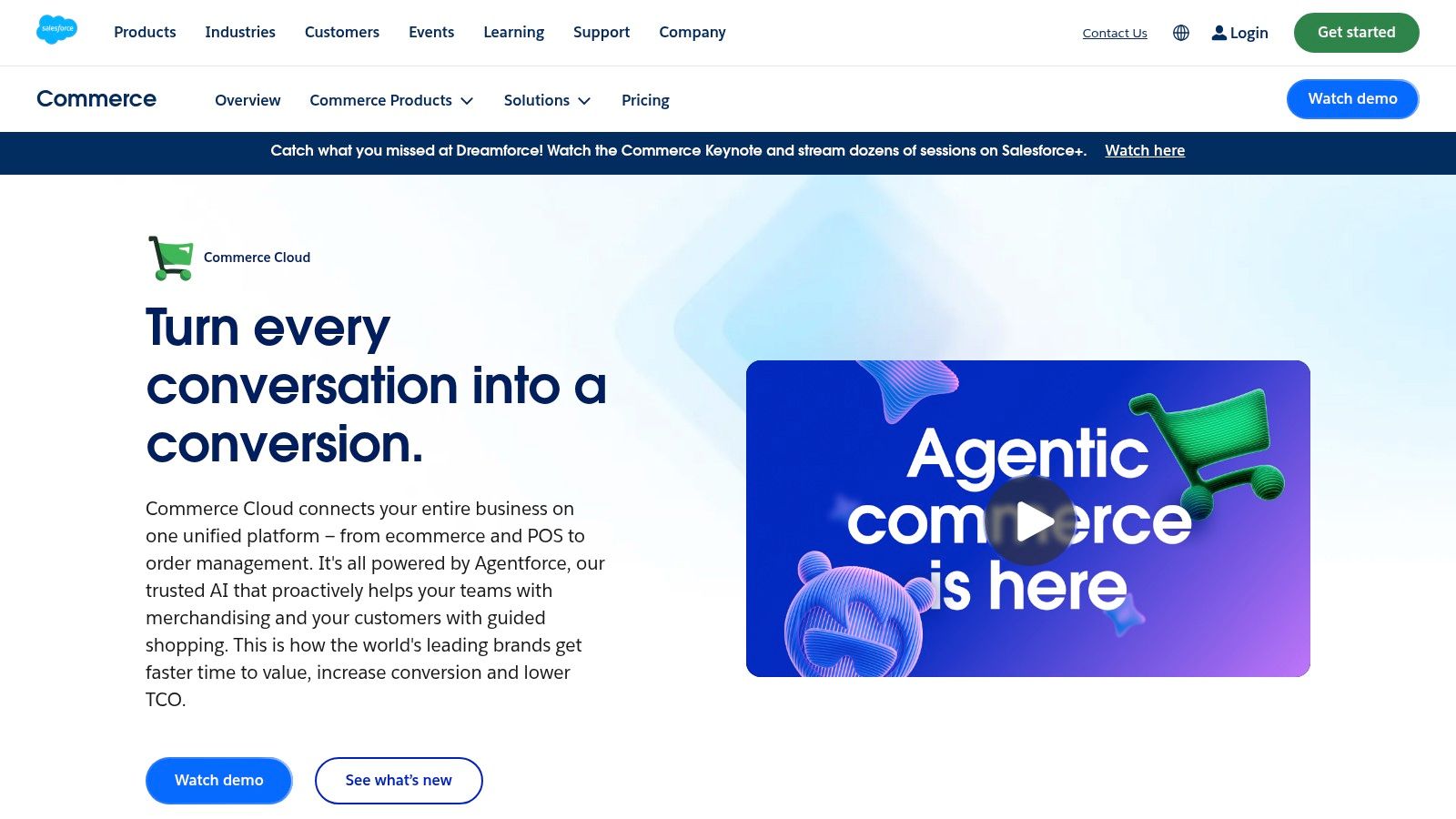
Salesforce Commerce Cloud is the safest choice for teams already standardized on Salesforce for CRM, service, and data. Its real value is not just storefront capability, it is how commerce fits into a broader enterprise operating model. That makes it especially relevant for brands that want tighter personalization, stronger governance, and a more unified data story.
Best when Salesforce is already the center
This is not a platform you pick for a quick migration. Procurement cycles are longer, implementations usually involve certified partners, and pricing is custom. That is a real trade-off, but it is also the reason the platform fits large organizations that want process discipline more than experimentation.
The migration risk is high for smaller brands and manageable for enterprises already living in the Salesforce ecosystem. The operational question is not whether it can run commerce. It can. The question is whether the rest of your stack is already pointed in that direction. If it is, the fit improves quickly.
For a focused comparison point, see PlatformDTC's Shopify Plus alternative guidance, especially if you are evaluating more DTC-oriented control instead of full enterprise CRM alignment.
9. VTEX
VTEX fits businesses that have outgrown a single-channel DTC setup. It supports D2C, B2B, marketplaces, and omnichannel operations in one suite, so it tends to make sense for larger global teams rather than small brand swaps. If you run multiple regions, brands, or selling models, it deserves a close look.
Suited to broad commerce operations
The main benefit is consolidation at scale. Instead of stitching together separate systems for catalog, orders, content, and related commerce tasks, VTEX gives enterprise teams a wider native surface area. That helps when countries or business units need shared governance and fewer handoffs.
The trade-off is complexity. If you are still deciding whether subscriptions, POS, or wholesale belong in the model, VTEX is probably too much platform too early. Migration risk stays high unless your operation already looks like a multi-region commerce business. For teams consolidating wholesale and DTC in one catalog, see PlatformDTC's guide to ecommerce platforms for wholesalers alongside the VTEX evaluation.
Visit VTEX if your reality is enterprise commerce across multiple models, not a single storefront with a few apps.
10. commercetools
commercetools is the strongest headless choice for teams that want to assemble their own commerce architecture instead of accepting a fixed storefront opinion. Its modular model is built for catalog, pricing, promotions, and order handling at enterprise scale, which is why it appeals to teams with strong engineering maturity and a clear composable strategy.
Use it when your front end is a product
This is not a plug-and-play migration. It is a platform for companies that want to own the customer experience and are willing to build around the commerce core. That makes it ideal when the storefront, CMS, OMS, and personalization stack are each strategic decisions, not default features.
The migration risk is high, but the upside is real for large teams. You get flexibility, scale, and a clearer path to best-of-breed architecture, at the cost of more implementation work and more dependence on partners. If your current Shopify setup is already bending under custom requirements, commercetools can be a better long-term base.
For a related operator view, see PlatformDTC's custom ecommerce solution guidance, especially if you are comparing composable control against a more governed DTC operating model.
Top 10 Shopify Alternatives: Side-by-Side Feature Comparison
| Platform | Core features | Unique selling points ✨ | Quality/Performance ★ | Pricing / Value 💰 | Target audience 👥 |
|---|---|---|---|---|---|
| BigCommerce | Multi‑storefront, domain checkout, wallets, advanced promos | ✨ Fewer paid apps; no BC transaction surcharge; ads feed integrations | ★★★★ | 💰 Mid, transparent plans; GMV caps possible | 👥 Growing DTC brands wanting robust built‑ins |
| Wix eCommerce | Drag‑drop editor, AI site builder, payments & subscriptions | ✨ Very fast to launch; many native marketing tools | ★★★☆ | 💰 Low, bundled pricing for small catalogs | 👥 Small DTC, pre‑launch teams, non‑technical founders |
| Square Online (Block) | POS‑linked storefront, free plan, pickup/delivery, cards & wallets | ✨ Seamless POS↔online sync; quick setup from existing Square catalog | ★★★★ | 💰 Low, pay processing on free tier; paid bundles for advanced features | 👥 Omnichannel retailers already on Square |
| WooCommerce (WordPress) | Free core plugin, any gateway, extensible marketplace | ✨ Full ownership of hosting/UX; no platform revenue share | ★★★★ | 💰 Low platform cost; services/hosting vary (variable TCO) | 👥 Content‑first teams and dev‑savvy merchants |
| 🏆 PlatformDTC | Unified storefront, edge checkout, subscriptions, payments, POS, B2B, email/SMS, analytics, governed APIs | ✨ Agent‑safe automation (scoped keys, approvals, idempotent writes); single order lifecycle; published perf & public status | ★★★★★ | 💰 Transparent TCO; plan‑dependent (public beta; direct Stripe/PayPal settlement) | 👥 Subscription‑first DTC $1M–$50M; ops, growth & engineering teams |
| Shopware | SaaS/PaaS cloud, headless APIs, B2B suite, plugin ecosystem | ✨ Strong EU localization & storytelling features; composable options | ★★★★ | 💰 Usage/size‑based; requires discovery | 👥 Mid‑market & enterprise, EU‑focused brands |
| Adobe Commerce (Magento) | Enterprise B2B, multi‑site, AI search/recommendations, extension marketplace | ✨ Tight Adobe Experience Cloud integrations; highly customizable | ★★★★ | 💰 Custom enterprise pricing; TCO varies by hosting/extensions | 👥 Enterprise brands with engineering resources |
| Salesforce Commerce Cloud | Multi‑site commerce, OMS, Data Cloud personalization, partner network | ✨ Deep CRM/data unification and global OMS | ★★★★ | 💰 Custom (often GMV‑linked); longer procurement | 👥 Large enterprises standardizing on Salesforce |
| VTEX | Unified D2C/B2B/marketplace suite, embedded AI, global catalog controls | ✨ Built for multi‑brand, multi‑region operations at scale | ★★★★ | 💰 Enterprise contracts; implementation effort | 👥 Large, global retailers and marketplace operators |
| commercetools | Headless, MACH‑principled APIs (catalog, pricing, orders) | ✨ Maximum composability to assemble best‑of‑breed stacks | ★★★★ | 💰 Custom; TCO depends on chosen services | 👥 Engineering‑led enterprises building composable stacks |
Choosing Your Platform and Planning the Move
Shortlist two or three platforms that match the way you sell. A DTC brand with subscriptions and retail can start with PlatformDTC, BigCommerce, or Square Online depending on how much governance, SaaS simplicity, or POS alignment you need. A content-led or WordPress-heavy brand can make WooCommerce work, while larger enterprise teams should look harder at Adobe Commerce, Salesforce Commerce Cloud, VTEX, or commercetools.
Do not compare subscription prices in isolation. Compare the whole operating model, because the key question is how much work your team is taking on after go-live. That includes hosting, app replacement, engineering time, support load, and the hidden cost of fixing data drift after a rushed move. BigCommerce's published GMV and recurring revenue, WooCommerce's share across WordPress and global stores, and Baymard's checkout findings all point to the same conclusion: platform choice is mostly about fit, not hype. Baymard's benchmark found that 64% of desktop sites and 63% of mobile sites deliver a "mediocre" or worse checkout experience, with only 2% rated "good" in each category, so checkout quality matters as much as storefront design when you replatform. Baymard checkout UX benchmark
Treat migration like a controlled rollout, not a website swap. Confirm payment transfer, URL mapping, and subscription reconciliation with the vendor before you commit. Then run the new stack in parallel until the numbers agree, especially if you sell recurring products, wholesale orders, or anything with multiple fulfillment paths.
My rule for replatforming: if the vendor cannot show you how orders, renewals, refunds, and redirects will survive cutover, the platform is not ready for your business.
The safest move is usually the boring one. Pick the platform that matches your actual operating model, not the one with the loudest feature list. If your stack is already fragmented and you want one system for storefront, subscriptions, payments, POS, B2B, and AI automation with auditability, PlatformDTC is worth a serious look, especially for teams that need control without adding more app drift.
PlatformDTC brings storefront, checkout, subscriptions, payments, inventory, messaging, and analytics into one governed system, which is exactly the kind of consolidation many DTC teams need when Shopify starts feeling stitched together. If you are comparing shopify alternatives for subscriptions, POS, or a cleaner operating model, visit PlatformDTC and see whether a single source of truth fits the way your brand sells.