
You're probably staring at a subscription offer that looked clean in the deck and messy in practice. The price is easy to explain, the renewal logic is not, and the first sign of trouble is usually a failed payment, a confused customer, or a support ticket that never should've existed.
That's the part most founders miss. SaaS subscription models aren't just pricing choices, they're operating systems for how revenue, orders, and customer trust move through the business. When the billing stack sits outside the main order lifecycle, the brand starts losing clarity at renewal, not at acquisition.
Table of Contents
- Why DTC Brands Keep Choosing the Wrong Subscription Model
- What SaaS Subscription Models Actually Measure
- Flat, Usage, Tiered, and Hybrid Subscription Models Compared
- How Hybrid Subscription Models Combine Predictability and Growth
- Subscription Retention as Control and Trust, Not Just Churn Reduction
- How to Choose and Implement the Right SaaS Subscription Model
Why DTC Brands Keep Choosing the Wrong Subscription Model
The wrong model usually gets picked for the right reason. A founder wants the offer to feel simple, so the team picks a flat monthly price and moves fast. The problem shows up later, when the customer learns that the “simple” plan still involves confusing upgrades, payment failures, or a cancellation path that feels like a trap.
I've seen this happen across multiple DTC migrations. The pricing page looked clean, but the renewal flow lived in a separate app, discount rules drifted, and fulfillment records didn't match what billing thought had happened. At that point, support was working from one version of the customer, marketing from another, and finance from a third.
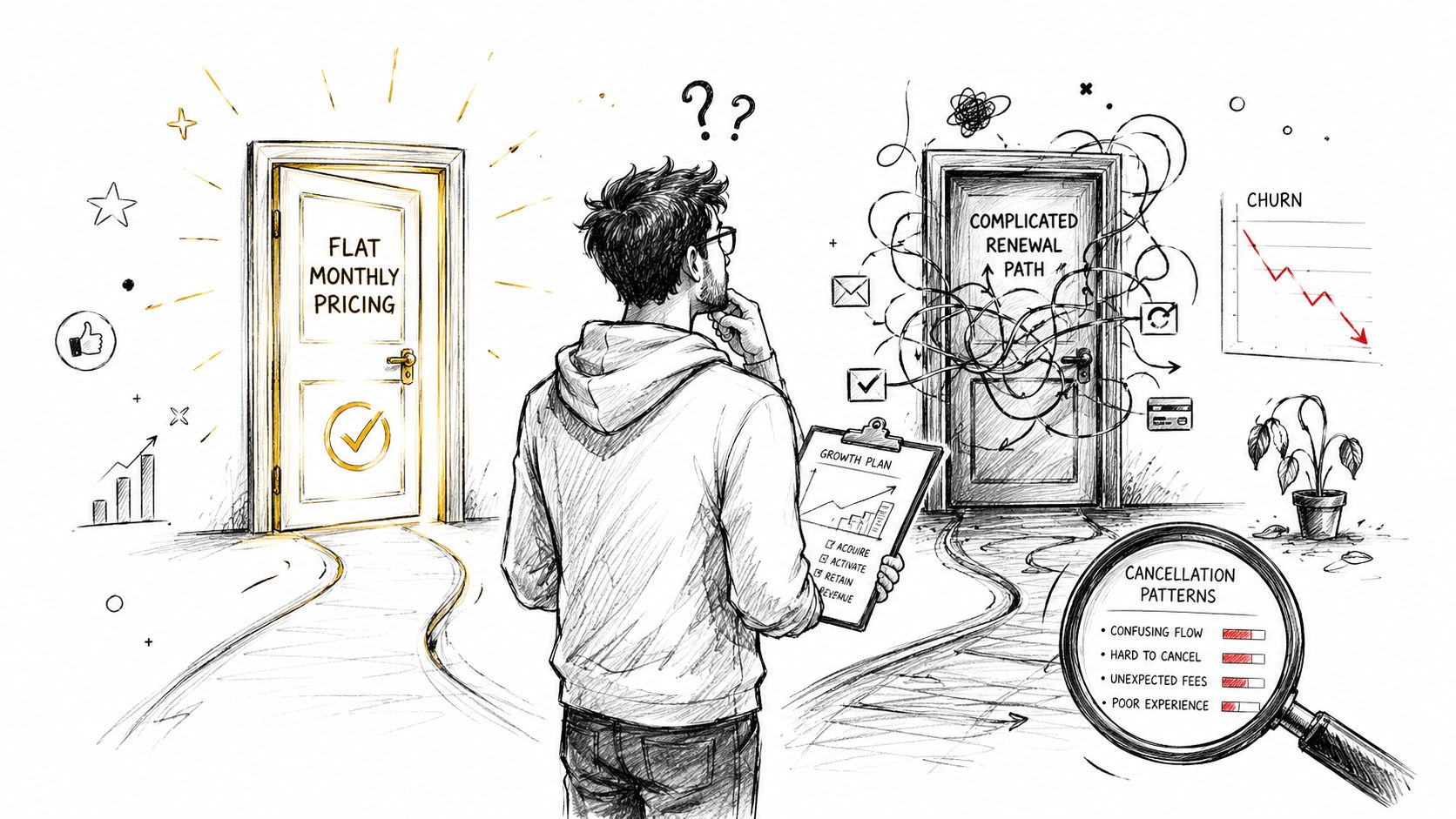
The model is rarely the real problem
A subscription model can only be as good as the data it preserves. In subscription software, recurring revenue depends on ongoing retention, not a one-time sale, and that means the commercial funnel keeps going after checkout. Acquisition, qualification, conversion, billing, renewal, and recovery all sit in the same chain.
Practical rule: if renewal lives in a different system from the original order, expect drift.
That drift creates hidden costs. The team spends more time reconciling records, the customer sees inconsistent charges, and lifecycle campaigns can't tell whether an account is active, paused, at risk, or already lost. A brand can't improve what it can't observe cleanly.
What DTC teams should evaluate instead
The better question is not, “Is this model easy to describe?” It's, “What does this model preserve at renewal?” For a DTC operator, the useful test is whether the system can track cohort retention, renewals, expansion, and involuntary payment failure without splitting the customer into separate records.
A unified lifecycle matters here because every renewal is a new opportunity to keep value alive. That's why PlatformDTC's subscription metrics overview is relevant to operators who need the business view, not just the billing view. If the stack can't connect orders, subscriptions, payments, and fulfillment, the model will look better in a pricing deck than it does in cash collection.
What SaaS Subscription Models Actually Measure
Recurring revenue sounds straightforward until you examine what is retained. A brand can have plenty of active subscribers and still be leaking revenue through downgrades, churn, failed payments, and weak expansion. That's why the core measure isn't the subscriber count; it's the quality of retained revenue.
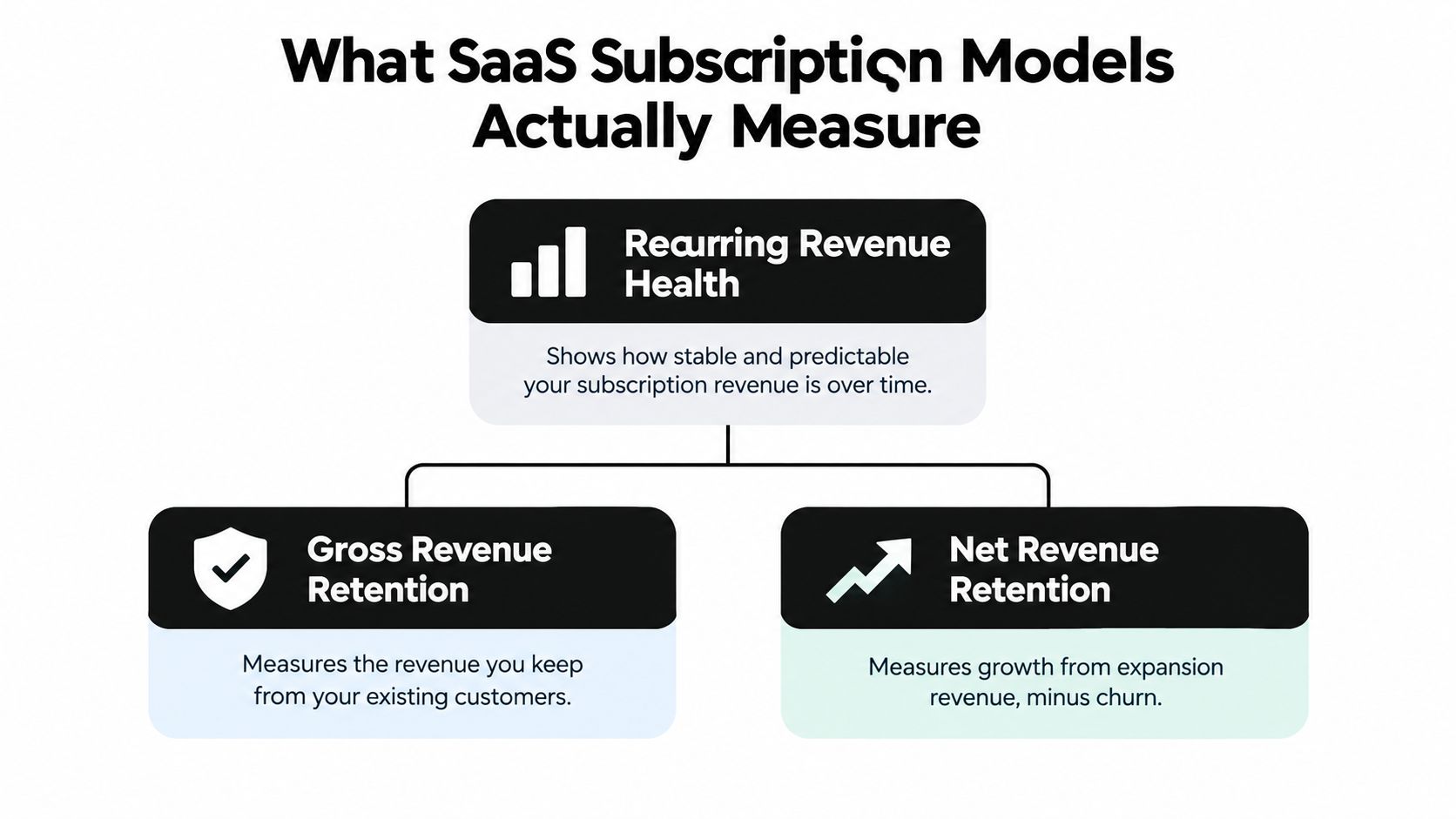
GRR and NRR tell different stories
Gross revenue retention, or GRR, measures the share of starting recurring revenue retained after cancellations, downgrades, and contractions. Net revenue retention, or NRR, adds expansions and upgrades. The distinction matters because a business can hold on to customers poorly and still grow revenue through upsells, or keep customers well and still miss expansion.
The benchmark gap is a warning sign on its own. One dataset based on billing information from more than 2,100 SaaS businesses reported median GRR of 53% for companies below $300,000 in annual recurring revenue over the twelve months ending March 2023, while a survey of more than 800 SaaS founders and executives reported median GRR of 92% for businesses below $1 million in annual recurring revenue. Those numbers don't contradict each other, they show why methodology matters. (subjolt.com guide)
Why a subscriber count hides risk
An active subscriber count only tells you who's still on the list. It doesn't show whether the customer downgraded, paused, failed to pay, or expanded into higher usage. That's why DTC subscription operators should follow the revenue bridge, not the vanity count.
Here's the operational sequence that matters:
- Beginning ARR, what was already contracted.
- Churn and contraction, what disappeared or shrank.
- Expansion, what grew through usage, upgrades, or add-ons.
- Ending ARR, what remains after all movement.
That bridge only works when billing, orders, customer records, and payment recovery are speaking the same language. Subscription systems that sit apart from the main commerce record can't show which revenue came from retention and which came from growth, so the team ends up guessing.
Operational takeaway: measure revenue movement by cohort, not by headcount.
Flat, Usage, Tiered, and Hybrid Subscription Models Compared
The four common models each solve a different problem, and none of them is universally right. Flat pricing buys simplicity. Usage pricing aligns cost with consumption. Tiered pricing helps buyers self-select. Hybrid pricing tries to keep the predictability of a subscription while preserving upside from actual usage.
Here's the catch. The model that converts fastest at launch is not always the one that survives scale. Many brands choose based on the pricing page they admire, then discover later that support load, forecasting, and revenue recognition are the actual constraints.
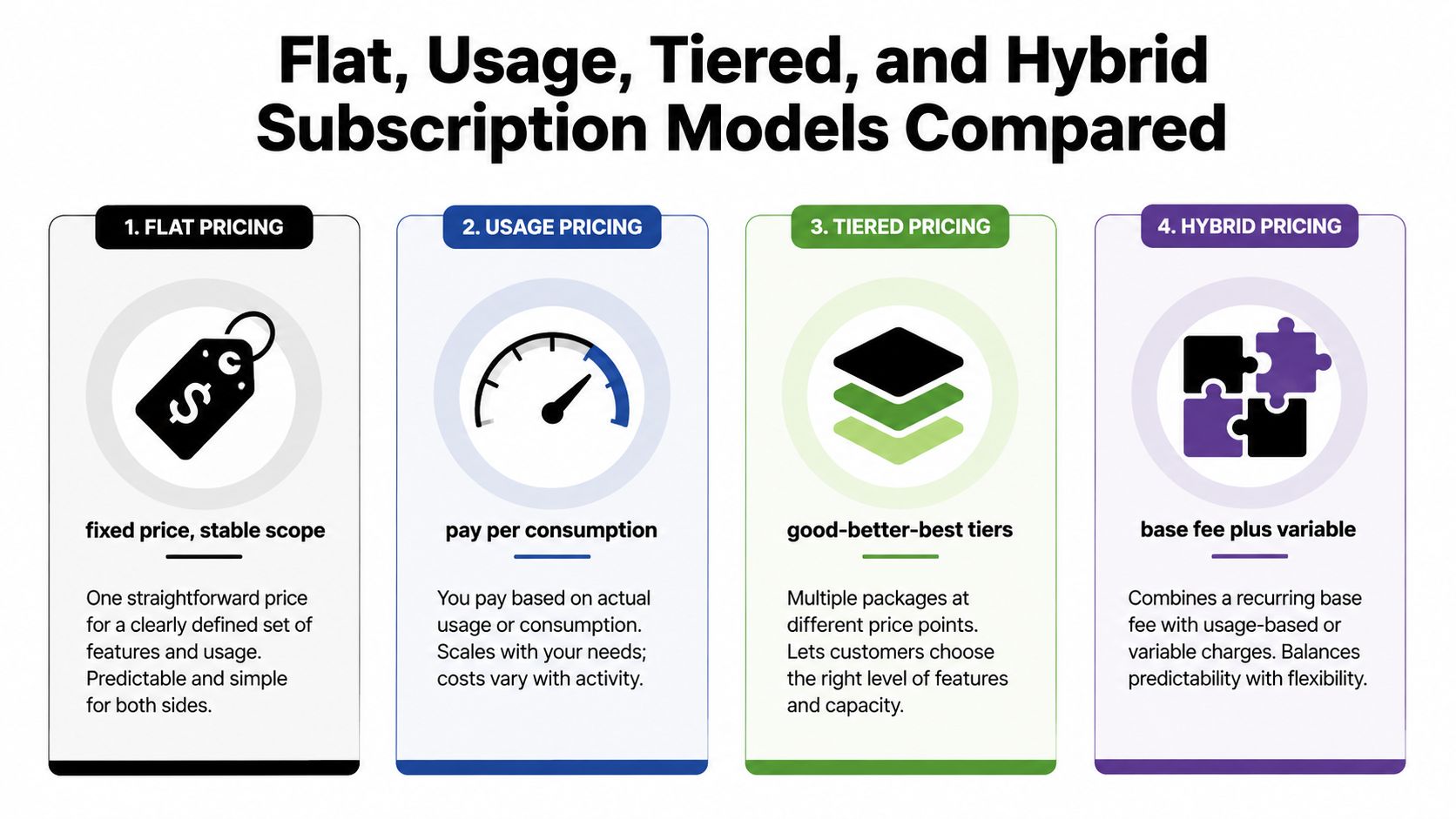
Flat and tiered work when scope is stable
Flat pricing is easiest when value is steady and usage doesn't vary much. The customer knows what they'll pay, the finance team can forecast cleanly, and support doesn't need to explain complex invoices. The weakness is obvious too. Heavy users can become underpriced, and the brand has little room to capture more value without a pricing change.
Tiered pricing gives buyers a visible upgrade path. It works when the product can be packaged into clear limits or feature bundles, and it tends to feel familiar in SaaS because customers can self-select a tier that matches their needs. But tiers still break down when actual usage doesn't fit the box.
Usage and hybrid work when value changes with consumption
Usage pricing becomes attractive when the customer gets more value by consuming more. In Benchmarkit's 2025 data, usage-based pricing produced 108% median NRR versus 95% for seat-based pricing, which suggests that metered expansion can increase existing-customer revenue beyond the original contract value. The same source also reports different outcomes by pricing structure, which is a reminder that the revenue profile depends on the operating model, not just the label. (Benchmarkit pricing data)
Hybrid pricing is where many DTC teams eventually land. You keep a base fee for access or membership, then add a variable component for order volume, active customer count, messaging usage, or another billable event. A useful external reference point is ASC 606 revenue recognition for usage billing, because the accounting treatment matters as much as the customer promise.
The right choice depends on what you're trying to protect.
- Flat pricing protects simplicity.
- Usage pricing protects value alignment.
- Tiered pricing protects self-selection.
- Hybrid pricing protects both predictability and upside, if the governance is tight.
That last clause is where many teams get stuck. A hybrid plan without durable metering, clear proration, and replay-safe billing events becomes a support problem fast.
For a practical ecommerce framing, the internal overview on subscription-based ecommerce is useful because it shows how recurring revenue behaves when it's tied to the broader order lifecycle rather than isolated billing logic.
How Hybrid Subscription Models Combine Predictability and Growth
Hybrid pricing looks simple from the outside, but it only works when the underlying data is disciplined. The base fee gives the brand a floor. The variable component captures growth when a customer uses more, orders more, or expands into a higher-value pattern.
The technical lift is in governance
The billable event has to be defined clearly. Is usage measured at authorization, fulfillment, settlement, or another event? That choice changes refunds, disputes, and revenue treatment. If you get that wrong, the customer sees one story, finance sees another, and the invoice becomes a negotiation instead of a record.
That's why hybrid billing needs a durable usage ledger, late-event handling, replay-safe aggregation, and reconciliation between operational records and invoices. Versioned pricing rules matter too, because a plan can't be auditable if the team keeps changing the logic without a trace.
Customers don't mind variable pricing as much as they mind surprise pricing.
What a good hybrid stack needs
A workable setup usually includes:
- Transparent proration, so mid-cycle changes don't feel arbitrary.
- Usage caps or approvals, so spend doesn't run away.
- Budget visibility, so customers can forecast before they cross thresholds.
- Immutable invoice snapshots, so billing disputes can be checked against the exact rules used at the time.
The operational upside is huge when the system is unified. Renewals, pauses, retries, refunds, and cancellations can live in the same order and payment lifecycle as one-time purchases. That means the team can audit the full story of a customer relationship instead of reconstructing it from app logs.
The same logic is why one integrated commerce system is easier to govern than a stack of subscriptions apps glued together. PlatformDTC's subscriptions engine is relevant here because it keeps renewals inside the same order lifecycle as one-time purchases, which reduces the number of places a pricing rule can drift. That's not a flashy feature, it's the difference between a pricing idea and an operating model.
Subscription Retention as Control and Trust, Not Just Churn Reduction
Most retention playbooks start with discounts and end with frustration. That approach treats churn like a leak to be patched, not a decision to be managed. In subscriptions, that's too narrow, because customers also care about control, predictability, and whether they can leave without a fight.
Recent Mastercard research covering more than 10,000 consumers and over 100 subscription-business executives found that 31% of global consumers frequently cancel and resubscribe, and 74% are more likely to subscribe when cancellation is simple. In the United States, businesses ranked subscription pauses among the most effective retention tactics, 66% of consumers said they would stay for a reduced-price offer, average monthly churn reached 20%, and 54% of businesses said more than 20% of churn was involuntary. (Mastercard research)
Cancellation can improve the business
That research changes how I look at save flows. A clean cancellation path can build trust, improve future reactivation, and reduce support friction even when it increases near-term exits. The point isn't to celebrate churn, it's to stop pretending forced retention is free.
If you want a practical retention framework, the reduce customer churn guide is useful as a baseline. The missing piece for many DTC brands is that churn strategy has to be measured against involuntary failure, not just voluntary cancellation.
Pause, downgrade, and recovery need separate rules
A pause isn't the same as a downgrade, and neither is the same as a failed-payment retry. Those events have different economics, different support costs, and different reactivation odds. If a team uses one blunt intervention for all three, the result is usually more tickets and worse trust.
Practical rule: measure every save attempt against future reactivation, support load, and payment recovery, not just against the immediate saved invoice.
Dark patterns can squeeze a few extra renewals out of weak systems, but they also create anger, chargebacks, and extra support work. A better subscription design gives customers a real exit, a fair pause path, and a clear offer when they're at risk. That approach tends to be harder to build, and better to run.
How to Choose and Implement the Right SaaS Subscription Model
The right model starts with the value metric, not the pricing page. If the product value is steady, a flat or tiered plan may be enough. If the customer's usage or order volume changes the economics, a hybrid model usually needs to sit on top of a cleaner operational core.
The migration itself should be boring in the best way. Import the catalog, run subscription rules in parallel, verify renewals against real orders, and cut over only after the team has checked billing, fulfillment, and customer records against the same source of truth. If that sounds slower than stacking apps together, it is, but it's also how you avoid rebuilding the business in reconciliation mode.
For teams implementing this in practice, the PlatformDTC subscriptions app is one way to manage recurring billing inside a unified commerce record.
A practical checklist
- Map the value metric. Decide what the customer is really paying for, access, usage, membership, or a mix.
- Choose the baseline model. Start with the simplest structure that matches the product.
- Define billable events. Make authorization, fulfillment, or another event explicit.
- Lock pricing rules. Version them so changes can be audited.
- Test renewal states. Check active, paused, failed, canceled, and refunded paths before launch.
- Keep invoice snapshots immutable. If a customer disputes a bill, the record should be easy to verify.
The goal is not to make subscriptions clever. It's to make them governable, predictable, and trustworthy. If your stack can't do that, the pricing model is the least of your problems.
If you're redesigning subscriptions and want the renewal logic, billing, and order record to live in one system, visit PlatformDTC. It's built to handle subscriptions inside a unified commerce stack, so your team can track renewals, recover failed payments, and keep the customer record intact instead of stitching it together after the fact.