Most advice about b2b commerce solutions starts in the wrong place. It talks about prettier portals, faster checkout, or better merchandising, then treats the back office like an implementation detail. In wholesale, that's backwards. Buyers don't just want a storefront, they need a governed buying system that can handle exact account pricing, approvals, invoices, and repeat orders without breaking the order record behind the scenes.
The market pressure is real. B2B e-commerce was estimated at USD 24.08 trillion in 2025 and is projected to reach USD 28.03 trillion in 2026, with growth forecast to USD 105.85 trillion by 2033 at a 20.9% CAGR from 2026 to 2033, according to Grand View Research. That scale changes the question from “Do we need a portal?” to “Can our system safely run wholesale at enterprise volume?”
Table of Contents
- Redefining Self-Service for High-Value B2B Buyers
- Core Capabilities of a Unified Commerce Stack
- Deep Integrations for ERP and Payment Workflows
- Automating the Quote-to-Order Lifecycle
- AI Readiness and Data Governance in Wholesale
- Evaluating Platform Maturity and Migration Risk
- Building a Future-Proof Wholesale Strategy
Redefining Self-Service for High-Value B2B Buyers
B2B self-service fails when teams copy the DTC playbook too exactly. A consumer storefront optimizes for speed and simplicity, but wholesale buying depends on account terms, negotiated pricing, approval paths, and order history that must survive across channels. If the buyer has to call a rep every time pricing or terms change, the portal isn't self-service, it's just another form.
Trust matters more than cosmetic checkout
The buyer profile is changing, but not in the simplistic way many vendors describe. In a 2026 benchmark, 71% of B2B buyers were Millennials or Gen Z, and 39% said they'd place self-service or remote orders above $500,000, while 20% would place $1M+ orders digitally, all in the same report that found 85% of B2B organizations already run a portal. Those figures point to a hard truth, buyers will trust digital ordering at very high values if the system handles governance correctly. platform accounts matter because account-level controls are what make self-service believable in the first place.
A strong wholesale experience doesn't try to remove complexity, it hides complexity from the buyer while preserving it in the rules engine. That means exact customer pricing, visible contract terms, and clean cross-channel order history. If a rep quotes one price and the portal shows another, trust disappears fast.
Practical rule: self-service should reduce human intervention, not remove human oversight where the transaction is sensitive.
That's also why implementation partners matter. When teams need complex Shopify engineering help, the useful work is usually around account logic, not homepage polish.
What buyers actually need to trust
The winning B2B commerce solution is the one that can handle:
- Exact account pricing without leaking discounts across customer groups.
- Approvals and terms that stay attached to the order record.
- Repeat buying without forcing the buyer to rebuild the same cart every time.
- Cross-channel visibility so the same customer can buy online, via rep, or through a portal without fragmentation.
Most portal-first projects overreach here. They add features before they fix governance, then wonder why adoption stalls. Buyers don't reward feature count. They reward reliability, consistency, and the ability to place a large order without creating cleanup work for sales or finance.
Core Capabilities of a Unified Commerce Stack
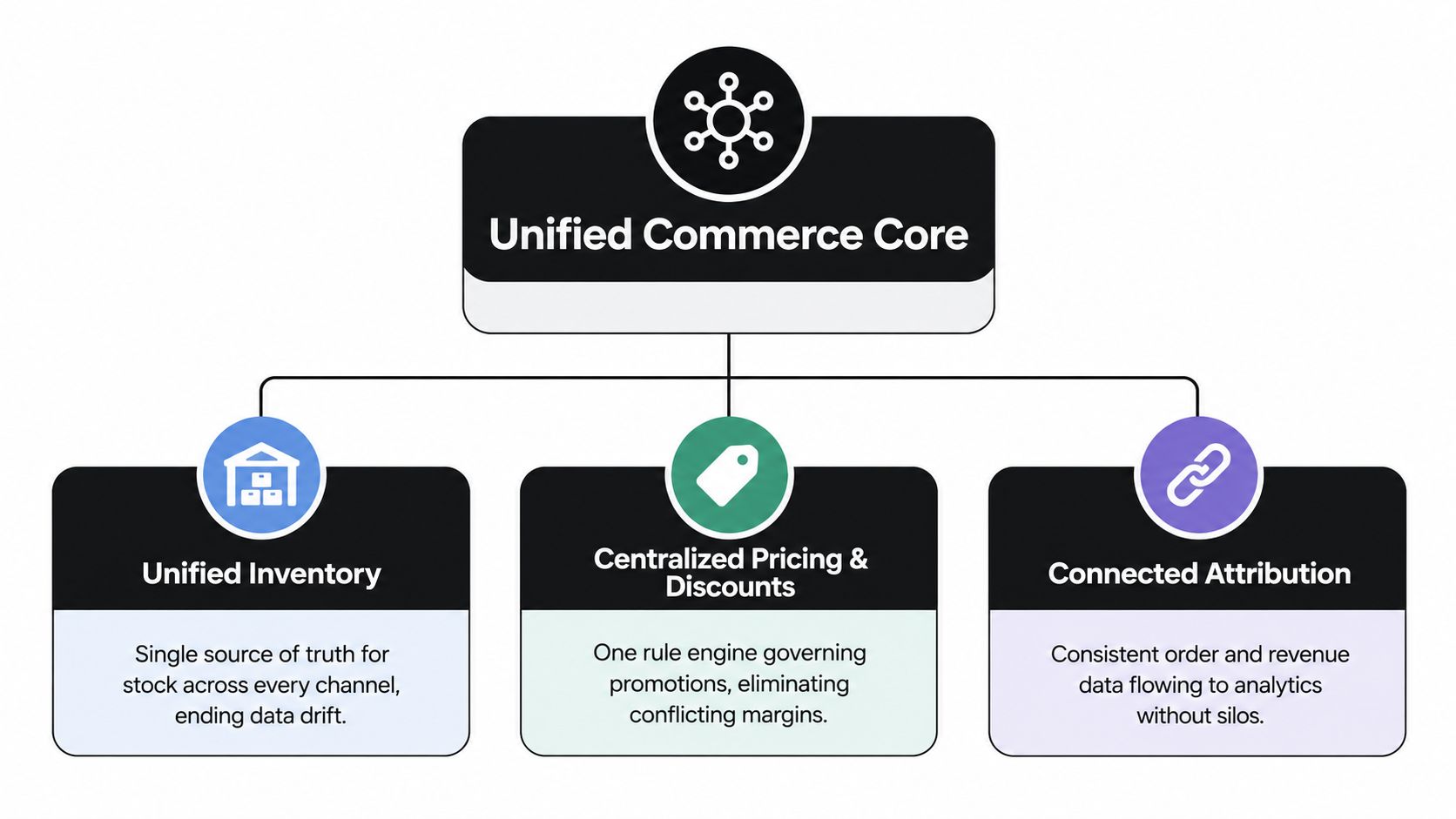
Fragmented app stacks usually break in the same three places, inventory, pricing, and attribution. A B2B site can look polished while the systems underneath disagree about what is in stock, what a customer should pay, and where the order came from. That is not a cosmetic issue. It turns into a revenue, margin, and reporting problem the moment a rep edits an order or a buyer reorders through a different channel.
What buyers need to trust
A unified stack keeps storefront, draft orders, subscriptions, discounts, fulfillment, and analytics on the same order lifecycle. That sounds abstract until a buyer changes quantity, a rep adds invoice terms, and finance needs the same record to reconcile payment later. In a patched stack, each action can live in a different app with different logic, and the record starts to drift.
Clean architecture treats discounts as governed rules, not ad hoc overrides. It also treats draft orders as first-class records, not temporary objects that have to be copied into another system later. That matters because wholesale teams often move between assisted selling and self-service inside the same account.
The order record has to hold up under pressure. If the customer sees one price, the rep sees another, and finance sees a third version, the platform is already doing too much reconciliation by hand.
Operational takeaway: if different teams cannot see the same order state, they are not running one commerce system.
Why integrated capabilities cut engineering waste
Integrated capabilities reduce duplicate logic across the stack. If the checkout, promotions engine, and order record share one model, engineers spend less time reconciling event streams and fixing mismatched rules. If they do not, every new channel adds another integration point and another place for data drift to appear.
PlatformDTC is one example of this model because it combines storefront, checkout, subscriptions, payments, inventory, fulfillment, messaging, analytics, and B2B workflows in a single system. For teams comparing architectures, the important question is not the brand name. It is whether the platform can keep one catalog and one order record consistent across online, B2B, and in-person sales.
Three checks usually expose the weak spots:
- Does the same product and customer data power every channel?
- Can draft orders, invoicing, and wholesale workflows live on the same record as standard orders?
- Does the discount engine enforce one set of rules everywhere?
If the answer is no, the system may still function, but it will not stay simple as the business grows.
Deep Integrations for ERP and Payment Workflows
ERP alignment determines whether a B2B commerce layer stays in step with inventory, pricing, and order state, or drifts apart as the catalog and channel mix grow. Wholesale buyers depend on synchronized company accounts, contract pricing, and bulk ordering. Large catalogs make that harder because every price update and stock change has to hold across channels and regions.
Start with the systems of record
The ERP comes first because it owns the record that finance, operations, and customer service all need to trust. Independent platform evaluations give ERP compatibility 20% and scalability and performance 15% weight, which reflects a simple reality, the commerce layer only works if it matches the source of truth for inventory, pricing, and order state. Native support for SAP, NetSuite, Microsoft Dynamics, and Infor matters because prebuilt connectors lower the risk of brittle point-to-point builds.
Supplier data quality belongs in the same conversation. If your team validates trade partners, supplier tax ID verification API checks can help keep supplier records clean before they reach finance or procurement workflows.
Payment flow should match the order flow
Payment architecture has to match how wholesale orders are placed and settled. Direct settlement, invoicing, and merchant account routing need to fit the buying model, and hosted payment fields help keep sensitive payment handling contained while preserving the checkout flow in the commerce system.
Security and compliance should sit in the vendor shortlist from the start. Mature vendors are commonly benchmarked on SOC 2, ISO 27001, PCI DSS Level 1, and GDPR compliance. Those signals do not prove operational maturity, but they show whether the platform has the controls enterprise buyers expect.
If the ERP and commerce stack disagree on price, the mismatch usually appears after the order has already been accepted.
For teams standardizing in-store and online operations, the same discipline applies to POS integration API work. The stack has to keep customer and order data synchronized no matter where the sale begins. PlatformDTC is one example of a system built around that kind of shared record across storefront, checkout, subscriptions, payments, inventory, fulfillment, messaging, analytics, and B2B workflows.
The practical test is straightforward. Before adding more front-end features, confirm that the platform can maintain auditable pricing rules, synchronized inventory, stable order-state transitions, and clean supplier records. If it cannot, each new channel adds more cleanup work and more manual reconciliation.
Automating the Quote-to-Order Lifecycle
The economics of B2B digital commerce improve when the transaction work gets automated and the order process gets consolidated. That's because wholesale buying often starts with a quote, not a cart. If a rep has to manually rebuild every quote into an order, the system is still doing too much human work to scale cleanly.
Measure the workflow, not just the page
A 2026 industry benchmark reports blended B2B purchase conversion around 1.8 to 2.9%, industrial quote-to-order conversion at 25 to 35%, and 45 to 55% in best-in-class operations. It also reports three-year returns of 211 to 391% and a drop in order-processing cost from roughly $50 to $150 per order to about $25 per order in digitized workflows, according to Shopify Enterprise. Those numbers matter because they shift attention away from homepage conversion and toward the more valuable operational focus point, the quote-to-order handoff.
| B2B Commerce Operational Impact | Improvement Rate |
|---|---|
| Quote-to-order conversion | 25 to 35%, up to 45 to 55% in best-in-class operations |
| Order-processing cost | From roughly $50 to $150 per order down to about $25 per order |
| Three-year returns | 211 to 391% |
Why automation changes the cost structure
The core improvement comes from reducing manual touches. Self-service purchasing removes repetitive back-and-forth, quote automation shortens the time between intent and order, and cleaner routing reduces the chance that an order lands in the wrong queue. That lowers service cost and raises throughput even when top-of-funnel conversion stays modest.
Unified systems make this more useful because renewals and subscriptions can share the same lifecycle as wholesale orders. That means finance, fulfillment, and customer service aren't juggling separate records for recurring revenue and one-time purchase activity. The whole point is to keep the operational model boring, repeatable, and auditable.
Useful metric: measure cost per processed order before you obsess over session-level conversion.
That metric usually reveals more about the health of wholesale operations than website traffic ever will. If the cost to process each order is falling while quote turnaround and manual edits shrink, the commerce system is doing real work. If those costs stay high, the front end might be active, but the backend is still absorbing too much friction.
AI Readiness and Data Governance in Wholesale
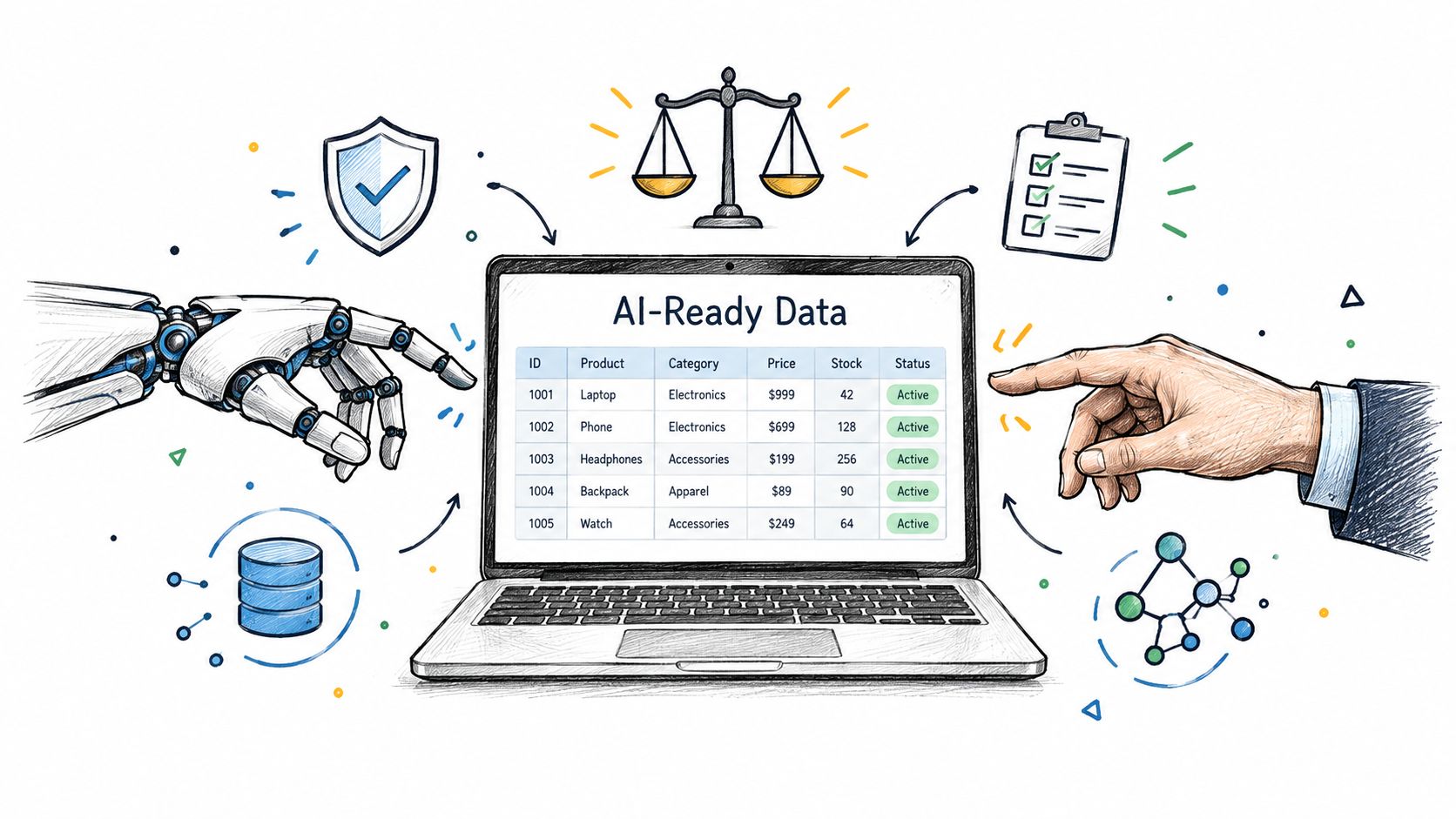
AI in B2B commerce is often sold as a front-end feature. The deeper constraint sits further down. AI only works when product data, pricing rules, permissions, and inventory signals are structured well enough for a system to act on them without creating bad orders or breaking controls.
Governance first, automation second
The weakest part of many stacks is not the AI layer. It is the data model underneath it. Trend coverage points to AI-led supplier research, machine-readable product data, ERP-connected automation, and compliance in the order flow as areas that matter more in 2026. At the same time, Elogic's trend analysis found that 40% of B2B web stores face integration problems with existing systems and 36% lack internal resources.
That mix explains why AI readiness is mainly a governance problem. Scoped keys per agent, approval gates on spend, and idempotent writes are not flashy, but they prevent automated actions from corrupting pricing, inventory, or order state. If a machine does not know what it is allowed to do, or if the same action can be repeated by mistake, the stack is not ready.
Machine-readable operations are the bottleneck
Composable systems are gaining ground for a practical reason. Modular architecture is becoming necessary, not ideological. Buyers and operators need catalogs, pricing, procurement channels, and compliance rules to connect without brittle point-to-point work. That pressure grows when humans and agents act on the same account.
The central question is not whether to adopt AI. It is whether the commerce data model can support it. If product attributes are inconsistent, approvals are unclear, and pricing lives in spreadsheets, automation only speeds up the confusion.
A safe AI-ready stack needs three things: clean product data so machines can interpret attributes without guessing, scoped permissions so agents can only do what they are authorized to do, and auditable actions so every automated change can be reviewed later.
That is the practical standard. Without it, AI adds another layer of risk instead of reducing it.
Evaluating Platform Maturity and Migration Risk
Platform migrations fail most often at cutover, not in the demo. A vendor can look strong on feature breadth and still struggle to move catalogs, preserve order history, or support a parallel run without breaking daily operations.
Compare maturity, not marketing
A mature vendor makes its integration model visible. Clear APIs matter. So do documented migration utilities, support teams that can answer operational questions, a published status page, and support boundaries that are spelled out before implementation starts. Cost structure matters too, especially when app sprawl hides the platform bill.
Parallel operation is the practical test. If the platform can import catalogs, run alongside the existing stack, and let teams verify product data and order routing before cutover, the risk profile improves fast. That kind of run gives wholesale teams time to catch data mismatches before they affect customers.
What to verify before you switch
PlatformDTC migration tools show the sort of utility teams should expect, catalog import, parallel operation, and verification before the final switch.
A serious evaluation should focus on these points:
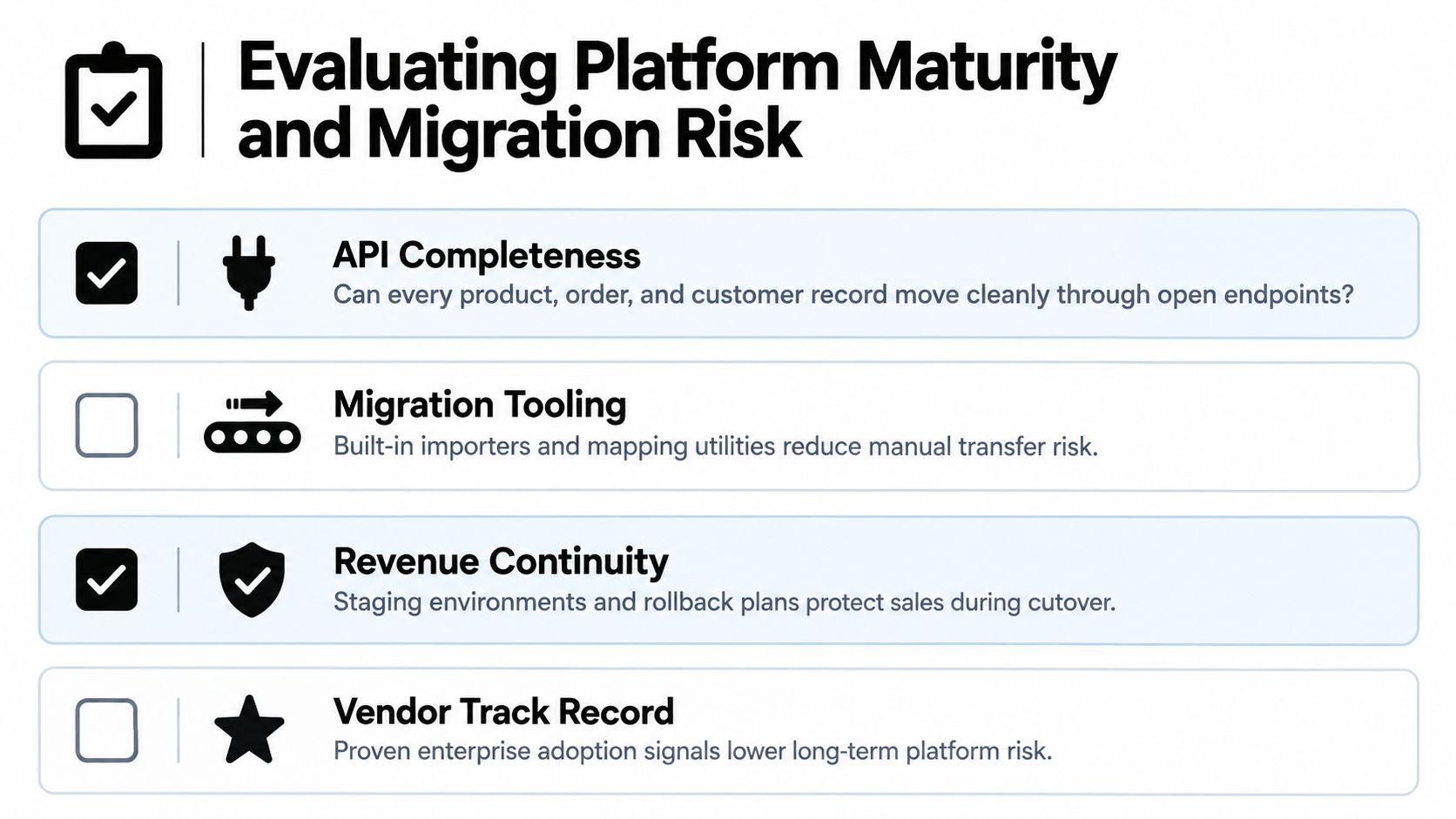
- API completeness so product, order, and customer records move cleanly.
- Migration tooling that reduces manual transfer work.
- Revenue continuity through staging and rollback planning.
- Vendor track record that suggests the platform can handle enterprise use cases.
If the old and new systems cannot run side by side, cutover risk is probably too high.
Total cost of ownership deserves a hard look as well. Subscription fees are only part of the bill. Engineering time, patchwork integrations, and the overhead of keeping a fragmented stack alive often matter more over time. A platform that reduces that burden can be the better choice, even if its sticker price looks higher at the start.
Building a Future-Proof Wholesale Strategy
The B2B market is no longer a side channel. With the market moving from USD 24.08 trillion in 2025 to a projected USD 28.03 trillion in 2026, then toward USD 105.85 trillion by 2033 according to Grand View Research, wholesale is now part of core commerce infrastructure. That scale rewards teams that treat B2B as a governed transaction layer, not a separate front end.
A director I worked with once tried to solve wholesale by adding a portal on top of a legacy stack. The portal looked fine, but order edits kept bouncing between ERP, finance, and customer service. After the migration to a unified order record, the team stopped spending half its week reconciling mismatched data and started focusing on pricing policy, account growth, and automation. That marks the shift from repairing transactions to managing them intentionally.
The next platform should do three things well. It should keep pricing, inventory, and order history unified. It should support edge-served performance and a discount engine that applies the same rules everywhere. It should also leave room for agent-driven operations without giving those agents too much freedom. If you need outside perspective on that move, fractional AI advisory on AI commerce can help teams think through governance before they automate too far.
The long-term test is simple. Can one system handle online, in-person, B2B, and autonomous workflows while preserving a single audit trail? If the answer is yes, you've got a platform that can grow with the business instead of constantly catching up to it.
If you're evaluating b2b commerce solutions and want a clearer view of where unified architecture, governed APIs, and migration planning matter most, visit PlatformDTC and review how its storefront, B2B, payments, and migration tools work together. PlatformDTC is built for teams that need one order record across channels, which makes it a useful benchmark when you're planning your next wholesale platform move.