Roughly 80% of B2B sales now happen through ecommerce channels, so buyers expect professional tools such as draft orders, custom pricing, and invoicing. The right B2B ecommerce solution connects those buying features to accurate pricing, inventory, fulfillment, and customer records.
That distinction matters. A polished storefront can attract a buyer, but it can't rescue an order that shows the wrong contract price, promises unavailable stock, or leaves a procurement team guessing when delivery will arrive. B2B commerce succeeds when the digital experience and the operating system behind it tell the same story.
Table of Contents
- Understanding B2B Ecommerce Solutions
- Core Operational Needs in B2B Commerce
- What B2B Buyers Actually Expect
- Typical B2B Ordering Workflows
- Choosing the Right Platform Features
- Making It Work in Practice
- Common Misconceptions About B2B Platforms
- Misconception one is that a polished storefront is enough
- Misconception two is that self-service replaces sales
- Misconception three is that more apps fix fragmented operations
- Misconception four is that every conversion should be measured the same way
- Misconception five is that channel expansion means creating more separate stores
Understanding B2B Ecommerce Solutions
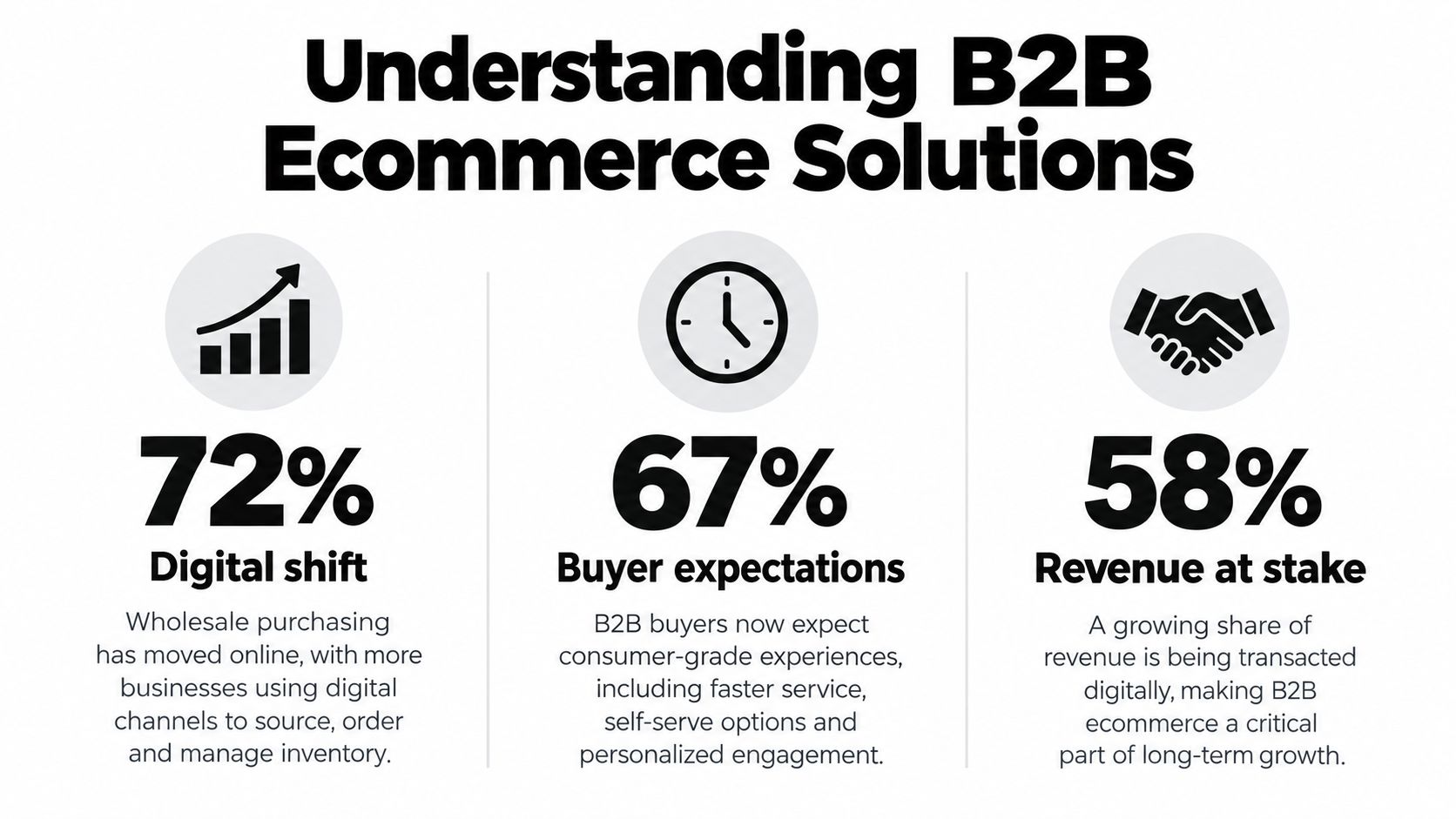
B2B ecommerce has moved beyond the pilot stage. One industry estimate projects the global market to reach about $36 trillion in 2026, up from roughly $32.1 trillion in 2025, while another estimate places 2026 gross merchandise value at $36.86 trillion and forecasts $61.66 trillion by 2031. The methodologies differ, but the direction is consistent: B2B commerce is now one of the largest digital commerce categories in the world. Review the market estimates and methodology.
Digital buying is also becoming the default operating channel in major markets. A 2026 summary reports that about 80% of B2B sales were conducted through ecommerce channels in 2025, while the same research records different historical market totals depending on the measurement method. The practical conclusion doesn't depend on choosing one market-size figure. Buyers already expect suppliers to support online discovery, account access, ordering, payment, and post-purchase service. See the broader B2B ecommerce market context.
The storefront is only one layer
A B2B ecommerce solution typically combines a buyer-facing catalog with account management, customer-specific pricing, ordering, payments, fulfillment, and reporting. The important question isn't whether a platform has each feature somewhere in its product menu. It's whether those features operate on consistent records and rules.
For example, a buyer may browse a public catalog, sign in to see negotiated prices, submit a draft order for approval, pay against invoice terms, and later reorder from the same account. If each stage relies on a different database or integration, the buyer sees conflicting information and the internal team spends time reconciling it.
The B2B commerce solutions guide is useful background for mapping these capabilities before comparing vendors. Treat the exercise as an operating-model decision, not a storefront redesign. The best-looking interface still creates avoidable work if sales, finance, warehouse, and customer service teams can't trust the data behind it.
Practical rule: Evaluate a B2B platform by asking whether it can preserve one accurate commercial truth from quote through payment, shipment, reorder, and support.
Core Operational Needs in B2B Commerce
B2B buyers rarely follow the simple retail pattern of selecting an item, paying immediately, and receiving a standard parcel. They may buy on behalf of a company, use negotiated terms, require approval, purchase in volume, or need a sales representative to adjust the order. B2B ecommerce solutions must support those realities without forcing every transaction into a retail checkout.
Start with the account and catalog model
A serious implementation should let each business account have its own:
- Catalog access: Show the products, pack sizes, and assortments relevant to a customer or buying group.
- Pricing rules: Apply customer-specific, tiered, contract, or volume pricing without relying on manual overrides at checkout.
- Users and permissions: Separate purchasers, approvers, finance users, and account administrators.
- Addresses and tax details: Store ship-to locations, billing information, and purchasing entities accurately.
- Order history: Make previous purchases, invoices, returns, and reorder paths visible to authorized users.
This structure supports repeat purchasing while reducing the chance that a buyer sees a price or product that doesn't apply to the account. It also gives sales teams a reliable place to manage exceptions instead of maintaining private spreadsheets.
Make draft orders and invoicing first-class workflows
Draft orders are valuable when a customer phones a sales representative, requests a quote, or needs a custom assortment. The representative should be able to assemble the order, apply the approved commercial terms, send it for review or payment, and convert it into the same order record used by the online store.
Invoicing needs equal care. A platform should preserve the relationship between the original order, invoice, payment status, shipment, and any credit or adjustment. If finance has to re-enter information into another system, errors become more likely and customer service loses visibility.
Design for repeat work
Wholesale operations often depend on saved carts, quick reorders, minimum quantities, case-pack logic, approval thresholds, and scheduled replenishment. These aren't decorative conveniences. They shorten the path for buyers who already know what they need and help internal teams spend less time rebuilding routine orders.
A B2B feature earns its place when it removes a recurring handoff between the buyer, sales, finance, warehouse, or support team.
What B2B Buyers Actually Expect
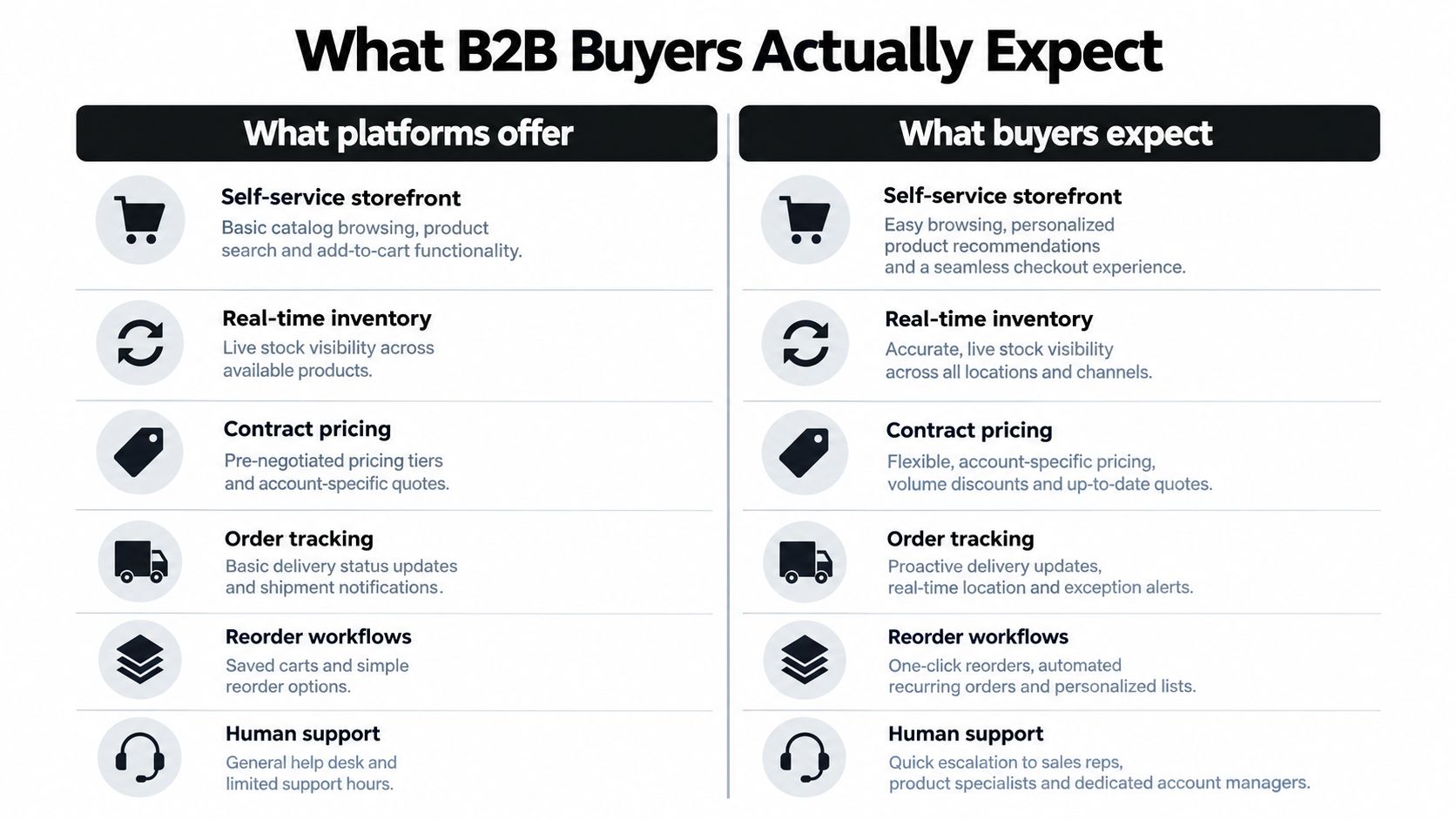
A basic self-service portal answers only one question: can the buyer place an order online? Modern procurement teams ask harder questions. Is the price correct for this account? Is the stock position current? Can the buyer track delivery without calling support? Can the order move through internal approval and still preserve the agreed terms?
Recent buyer research puts precise expectations behind those questions. 64% of buyers expect custom pricing to be reflected online, 46% consider real-time inventory updates essential, and 52% want automated delivery tracking as standard. The same research reports that 81% of buyers face barriers caused by outdated systems and inaccurate data, while more than 60% of B2B teams cite poor data integration and data quality as the main barrier to AI adoption. Explore the research on real-time data and B2B buyer expectations.
Accuracy beats cosmetic polish
A refined interface can make browsing easier, but buyers notice operational errors more sharply than visual imperfections. A catalog that loads quickly still fails if the account sees an obsolete price. A smooth checkout still creates a service ticket if the warehouse can't fulfill the promised quantity.
The platform therefore needs governed synchronization across:
- Pricing: Contract terms, customer groups, quantity breaks, and approved exceptions should resolve consistently wherever the buyer shops.
- Inventory: Available stock should reflect the relevant fulfillment locations and reservations, not merely a periodically refreshed storefront value.
- Fulfillment: Shipment status, partial shipments, backorders, and tracking information should flow back to the account record.
- Support: Service teams need the same order, payment, and delivery context as the buyer.
Support still matters
Self-service doesn't eliminate human assistance. It changes the moment when a representative becomes valuable. A buyer may want to place routine reorders independently but still need help with a disputed invoice, a substitute product, a complex quote, or an urgent shipment.
That makes escalation part of the digital experience. Guidance on how SupportGPT handles B2B care provides a useful reference point for connecting automated assistance with human support instead of treating them as competing channels.
Payment design also deserves operational attention. Account buyers may need card payments, bank-based methods, invoicing, or approved terms, so teams should assess payment gateway capabilities for commerce operations alongside catalog and checkout features. A platform that supports only immediate retail payment may force valuable B2B business back into email and spreadsheets.
Typical B2B Ordering Workflows
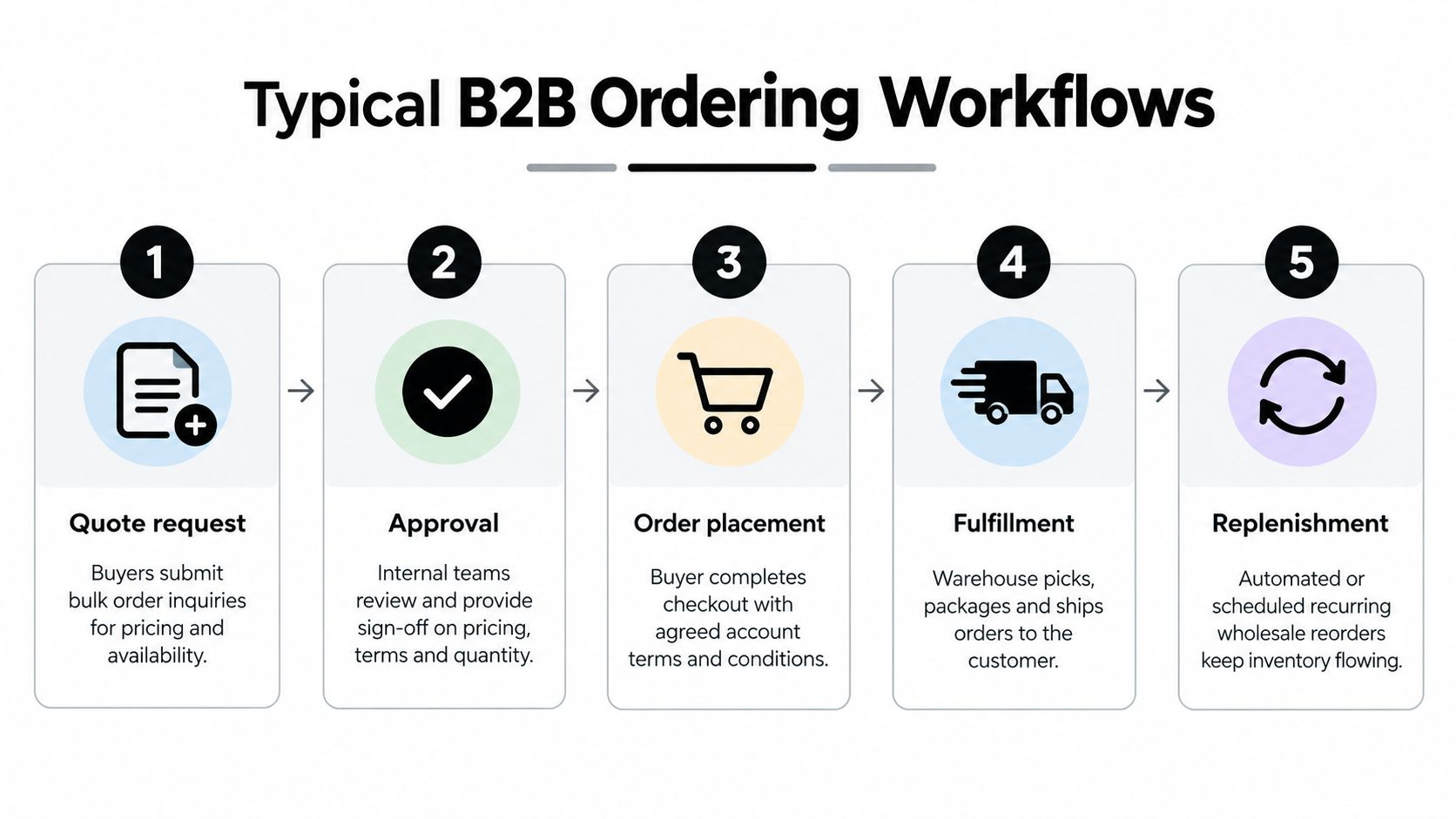
The easiest way to assess a B2B ecommerce solution is to follow an order from the first commercial conversation to the next replenishment. Features that look complete in a product demo often reveal gaps when the workflow crosses sales, finance, warehouse, and customer service.
A quote becomes a controlled order
A customer requests a bulk assortment that isn't available through the standard catalog. A sales representative creates a draft order, selects the account, adds the negotiated products and pricing, and sends the proposal for approval. The buyer reviews the details, and the system preserves the approved commercial terms when the draft becomes an invoice or a paid order.
This flow prevents a common failure: sales agrees to one price while the checkout or finance system applies another. The order record should carry the customer, products, quantities, discounts, shipping details, tax treatment, payment status, and fulfillment instructions together.
Routine replenishment should take less work
For repeat wholesale purchasing, the buyer signs in, opens a previous order, adjusts quantities, and submits a reorder under the account's established pricing and terms. The system checks current availability, routes the order through any required approval, and passes it to fulfillment without asking the buyer to re-enter every line.
If a product is unavailable, the experience should show the exception clearly. It should offer a permitted substitute, a backorder path, or a request for sales assistance rather than accepting an order the warehouse can't ship.
One order model must support many channels
A field representative may create the order by phone. Another customer may use the web storefront, while a third purchases at a counter or through a connected procurement channel. Those transactions can begin differently, but the business still needs one view of customer history, inventory impact, payment state, and fulfillment progress.
Teams evaluating supplier connectivity can use a supplier network overview to think through how external partners and internal channels should interact with the core order lifecycle.
A short visual walkthrough can help stakeholders align on these handoffs:
Choosing the Right Platform Features
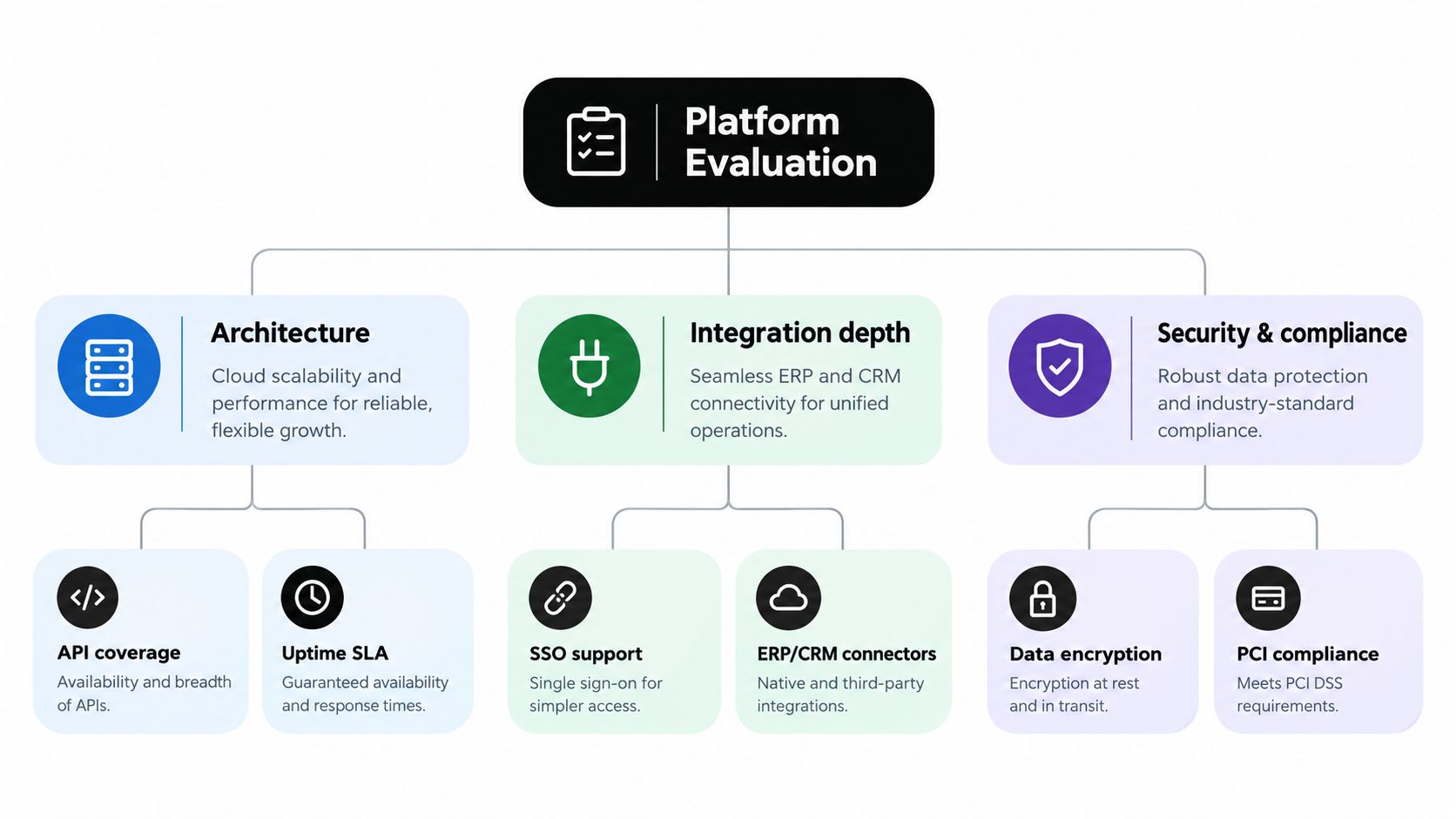
Platform selection should start with operational evidence, not a feature checklist. Draft orders, account pricing, and inventory badges are useful only when the underlying records stay accurate across pricing, stock, fulfillment, and customer accounts. Trace each decision and data change through the full buying lifecycle before comparing interface features.
Test the architecture, not just the interface
Headless commerce separates the buyer-facing experience from the commerce engine through APIs. That structure lets a team change the front end without rewriting catalog, pricing, cart, promotion, or payment logic. It also creates more governance work. Every price lookup, inventory request, checkout action, and promotion call becomes a contract between systems. Review the headless commerce trade-offs and performance guidance.
The practical question is whether those contracts preserve accurate state. A well-designed API-first architecture can support channel-specific experiences and faster iteration. Poorly designed APIs create latency, inconsistent pricing or inventory results, and difficult debugging across ordering workflows. Ask vendors to show how they monitor failed calls, retry incomplete requests, and expose the final state to buyers and operations staff.
Test performance with authenticated buyer journeys, not only anonymous landing pages. The cited guidance says every 100 milliseconds of page-load delay can reduce conversions by up to 3.5%, while average cart abandonment remains above 70%. These figures make edge delivery, cached but governed price payloads, and fewer client-side hops commercial controls rather than cosmetic improvements. The same headless commerce reference explains these performance considerations.
Inspect integration depth and data ownership
Ask vendors to demonstrate what happens when an ERP price changes, a warehouse reserves stock, or a carrier updates delivery information. A diagram of connected boxes is not enough. Request the actual event, API response, retry behavior, audit trail, and customer-facing result.
Give special attention to the systems that determine what a buyer can purchase and what the business can promise:
- Price precedence: Identify which system wins when a contract price, promotional discount, and manual sales adjustment overlap.
- Inventory timing: Check how reservations, cancellations, partial shipments, and multiple locations change available stock.
- Order identity: Confirm that web, sales-assisted, point-of-sale, and replenishment orders remain connected to one customer history.
- Failure handling: Test what the buyer sees when an integration times out or returns incomplete data.
- Auditability: Verify who changed a price, approved an order, edited an address, or released an invoice.
Run these tests with realistic account permissions and current operational data. A platform that shows accurate catalog information in a demonstration may still return stale contract pricing or oversell stock under load.
A managed commerce implementation, such as the approach described in commerce cloud sales managed with MarTech Do, provides a useful comparison when your team needs help connecting platform behavior to broader sales and customer systems. The assessment remains operational: identify the owner of each record, define the source of truth, and document how systems resolve disagreement.
Measure the right conversion event
B2B conversion is easy to misread because a public visitor and an authenticated account buyer have different intent. Published benchmarks place B2B session-to-purchase conversion in a defensible 1.8% to 3.0% range, with a commonly cited cross-industry median of 2.68%. Many B2B sites perform better when they measure downstream actions such as demo requests rather than completed orders. Review the B2B conversion measurement guidance.
Separate the KPI layers:
- Storefront traffic: Measure qualified visits, account identification, product engagement, and assisted conversion.
- Authenticated purchasing: Track account pricing views, reorder usage, cart-to-checkout rate, and approval completion.
- Paid orders: Track checkout-to-paid rate, payment failures, invoice settlement, and fulfillment completion.
This structure helps merchandising, sales, and operations locate the actual bottleneck. A blended conversion rate can make a strong account workflow look weak or conceal a checkout problem behind high-intent repeat buyers. Pair conversion reporting with data-quality checks for price accuracy, stock availability, order status, and fulfillment completion.
Making It Work in Practice
The right implementation starts with operational friction, not a wish list. Gather recent examples of incorrect pricing, unavailable inventory, delayed tracking, manual quote entry, invoice disputes, and duplicate customer records. Rank each issue by how often it occurs and which team has to repair it.
Build a narrow but complete first workflow
Choose one commercially important path and make it reliable from start to finish. For example, begin with an existing account that needs customer-specific pricing, draft orders, invoice payment, warehouse fulfillment, and repeat purchasing. Document every handoff, then test the same order through web, sales-assisted, and support channels where relevant.
Don't launch a broad catalog experience while leaving price and stock synchronization unresolved. A smaller assortment with trustworthy data creates a stronger operational foundation than a larger storefront that generates exceptions for finance and fulfillment.
Use a staged migration
Import the catalog, customers, pricing rules, and open orders with clear ownership for each field. Run the new system alongside the existing process long enough to verify totals, order states, inventory behavior, and customer permissions. Define the cutover criteria before the project begins, including how the team will handle orders created during the transition.
A unified commerce model should support online, wholesale, in-person, and recurring sales without creating separate customer histories. For a concrete example of how B2B buying patterns can be analyzed in practice, see Crescade's B2B ecommerce example analysis.
Govern the operation after launch
Assign owners for pricing, inventory, fulfillment status, integrations, and support escalation. Review failed API calls, manual overrides, and orders that require re-entry. Those exceptions show where the platform or the operating process still needs work.
The useful long-term question isn't whether the launch looked successful. It's whether buyers and employees can complete more orders without questioning which system contains the correct answer.
Common Misconceptions About B2B Platforms
Misconception one is that a polished storefront is enough
A polished storefront improves discovery and usability, but it doesn't solve commercial inconsistency. Buyers will abandon confidence quickly when the displayed price conflicts with a quote, stock appears available but can't be allocated, or delivery status stops after payment.
The stronger approach connects experience design to governed operational data. Product pages, carts, invoices, shipment updates, and support conversations should draw from records that agree with one another. Design still matters, but it should make accurate commerce easier to understand, not disguise unreliable processes.
Misconception two is that self-service replaces sales
B2B buyers want independence for routine work and expert help for exceptions. Removing sales from the digital journey can make complex purchasing harder, especially when an account needs a negotiated assortment, a substitute product, a special delivery arrangement, or approval support.
A capable platform gives sales representatives the same underlying order tools as buyers, with appropriate permissions. The representative can create or edit a draft order, preserve the account's commercial terms, and hand the transaction into payment and fulfillment without starting again in another system.
Misconception three is that more apps fix fragmented operations
Adding an app can solve a well-defined gap. It can't automatically create a reliable order model when catalog, pricing, inventory, payments, fulfillment, and customer service each maintain competing versions of the truth.
Before adding another tool, identify the system that owns the record and the event that updates it. Then confirm that the integration supports retries, reconciliation, permissions, and audit history. If the answer is unclear, the app may reduce visible effort while increasing hidden maintenance.
Misconception four is that every conversion should be measured the same way
Public visitors, logged-in procurement users, sales-assisted buyers, and repeat wholesale accounts don't behave alike. Judging all of them by completed online orders can make a productive account workflow appear unsuccessful or hide friction in a high-intent checkout.
Use separate measures for discovery, account engagement, approval, checkout, payment, and fulfillment. That gives each team a useful signal and prevents marketing from being blamed for a finance or inventory problem.
Misconception five is that channel expansion means creating more separate stores
B2B buyers increasingly combine web, sales calls, in-person purchasing, retail counters, and payment terms. A separate store for each channel may produce short-term speed, but it often creates duplicate catalogs, conflicting prices, and incomplete customer histories.
The more durable model is unified commerce. Different channels can have different experiences and permissions, but they should reconcile to shared catalog, customer, inventory, order, payment, and fulfillment records.
The platform decision isn't really about adding a B2B storefront. It's about deciding whether your business can operate one trustworthy buying system across every channel.
PlatformDTC brings storefront, checkout, subscriptions, payments, inventory, fulfillment, messaging, analytics, and B2B workflows into a unified commerce system with one catalog and order record. If your team is replacing spreadsheets and disconnected channel tools with governed B2B ecommerce workflows, visit PlatformDTC to evaluate the approach.